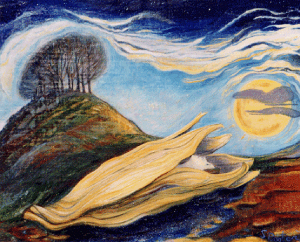
Try and shut your eyes to slits and blink through autumn branches against the light. With patience, a 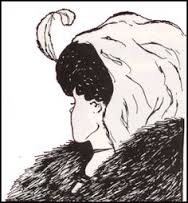 moment arrives when black and white spaces inverse and clusters of stars shine from another dimension. The background has moved to the foreground. A tiny shift in our outlook can result in a new interpretation of what we see, like in the gestalt drawing on the right, which changes the age of the person if you let your eyes wander up and down the image. Visual tricks that open a sudden gap in our seeing reveal how we jump to superficial referencing. Making snap assessments is convenient, safes time, energy, and sometimes lives, but can also trap us in a kind of flatland of rigid divisions.
What do we mean when we say he or she is different – do they look different, act different, think different, or have customs that seem strange to us? Typical brackets are class, gender, cultural background, colour, language, age, ability … and migrants. Defining people by categories clicks in as a default opinion when real or imagined threats require scapegoats. Or resources are scare and solidarity is politically expedient. Suddenly the need to belong and historical prejudices reasserts themselves.
Beneath all habitual categories prowls what is frequently forgotten … the inherent natural tendency of each individual. Consider relatives, neighbours, familiars, friends and foes. The differences that delight or irritate us lie foremost in a person’s unique temperament and inherent tendencies. Background does not explain the mystery of characteristics we are born with, the random mix of evolutionary records in our bodies, a wisdom our minds expand upon through resonance with the collective psyche – a shared matrix of past experience and future potential from which we, ideally, emerge as a self-reflective persona. (The theory of a collective unconscious and similar non-evidenced theories relate to my experience.)
Environmental factors can distort the unfolding of latent knowledge in every living organism. Education has a detrimental effect on children when their intuition is belittled and their minds are flattened with facts before they developed the confidence to question these facts.
 How come I’m invigorated by rushing waters, calmed by a smooth stone, a golden sunset? How do I sense the pulse in a tree, or what life is like for a boar, rat, ox, tiger, rabbit, dragon, snake, horse, sheep, monkey, rooster, dog – unless all nature’s qualities also reside in me?
For example, anyone who sits in a public place and watches people stroll by will notice traces of animal features; can spot a temperament in gestures and movements, observe someone dragging their body behind their head, or push their belly out like a shield. Some people dance along with a fluid gait, while others tiptoe and glance nervously about them.
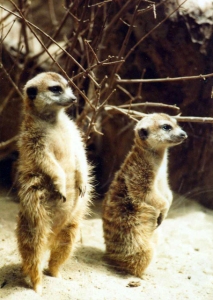 At social gatherings we may come upon clusters of meerkats grooming each other, turtles plodding through the crowd looking for a mate or a fresh salad leaf, peacocks, obsessed with their splendour, blustery cockerels, loving old dogs, sharp-eyed falcons, enchanting robins, and so on. …
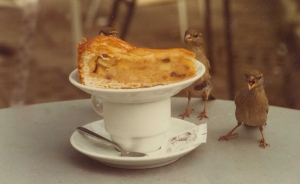
Birds are keen on cake but wary of cats, whereas lions can afford to be relaxed. How amazing then to observe vastly different temperaments complementing each other – like a person 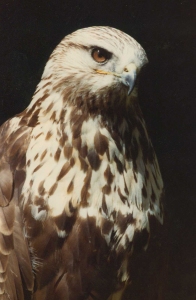 with a butterfly nature tying up with a partner who occasionally roars. Given the rich lore of sensibilities mixing and battling in the human psyche, strangers should be less strange than we make them out to be.
Initial likes and dislikes, even among kin, have nothing to do with background, morals or ethics. Wariness goes along with fascination when it comes to difference. We may not be keen to share a nest, but sharing a street is fun. Nature is a mirror that teaches us how to become human. And animals deserve our special appreciation for reminding us of the innumerable diverse idiosyncrasies in ourselves.
Animals have appeared in wonderful stories around the world, like the Aesop’s Fables or the much older Indian Panchatantra Collection – the chief source of the world’s fable literature.
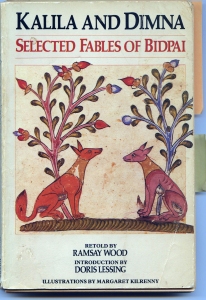 The Persian translation became the Fables of Bidpai. Lovely collections of Kalila and Dimna were published by Ramsey Wood, one with an introduction from Doris Lessing. I got permission from Ramsay Wood to use a short tale from his collection in my novel ‘Course of Mirrors.’
Programmes on ‘Respecting Difference’ have made it into schools and institutions. But can respect be taught in a few hours? More effective are courses that help people to find self-respect through exploring the diverse feelings and judging voices within themselves, the inner conflicts that manifest for us outside.
Acknowledgement, at least, tolerance and patience with our inner crowd eases snap projections and allows us to rediscover ourselves in the eyes and minds of others day by day. The internet expands this mirroring into timeless realms, from where echoes of our own dissonance or resonance return.
In the analogue world people are on the move across the planet – for various reasons – war – drought – famine – persecution – fresh meaning – it is happening, and it will continue. The most productive response to this phenomenon is to embrace its creative potential.
The other day woke up with this thought: Migrants, indeed all citizens sans resources but able and willing to work, could be given the spaces to create new towns, be empowered to build their own houses and develop their own businesses, and conducts, as a way towards gaining self-respect, and in addition contribute to the well being of a community. Maybe this is a naive pipe dream, but worth contemplating nevertheless, since creative opportunities nurture self-respect and move us beyond self-concern.
‘The whole is other than the sum of the parts … it has an independent existence.’ – Kurt Koffka
Related links
More contagious than micro-organisms are fear and hopelessness.
Have you ever gone to your fridge in the middle of the night …
Pattern which connects – Gregory Bateson
Regarding the discovery of what we know, see the visionary work, Involution, by Philippa Rees, a remarkable poetic adventure, with brilliantly researched additional historic commentaries. A book to take on a Desert Island.
 Winding the clock back to before events were recorded in writing and ordered along linear timelines, folks across the globe unified their beliefs through countless symbolic creation myths, none the same, and much more fun than any Big Bang theory, which, in any case, must surely relate to only one among many big & small bangs. Since record-taking, everything supposed to have happened has been arranged around a spine and neatly ordered, chaos tamed into a clearly delineated map of history. It is a beautiful logical structure, mirroring the cosmos, nature, plants, the human body, the brain.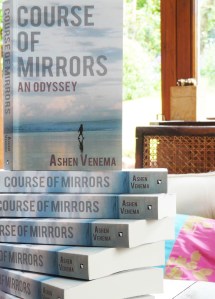

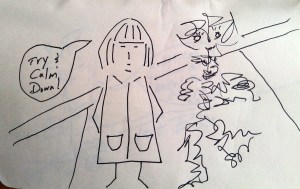 exasperation, when anyone uttering, ‘Calm down,’ deserves a punch.
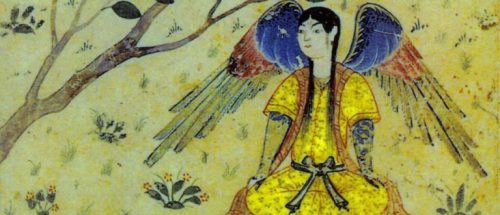 Contemplating buzzwords relating to my soon to be published novel, Course of Mirrors, I thought I make a start with guiding spirits, or angels.
 When I enter the room Dot is absorbed in reading from a folder among stacks of papers stored in drawers under a bed. ‘Hey,’ she looks up, ‘this is fascinating. It’s got your name on it.’
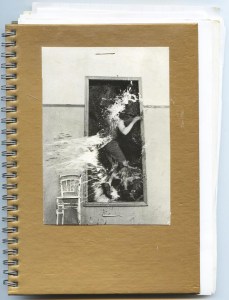 The same year, not wanting to become a writing recluse, I started this blog. Through a poet I met online, Course of Mirrors found a small publisher who loved the story, which perked my confidence. Three years passed without action – a long time when you are not getting any younger. During the long wait, I did however write a time-travelling sequel and started a third book. Not keen to endure more agonising delays, I decided to self-publish.
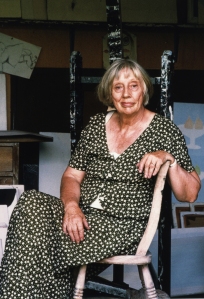 I miss her. She was a deep thinking woman, a painter, psychotherapist and lover of poetry, especially Rumi, whose verses she recited often in her very deep and distinctive voice. She was an inspiration to many. For over ten year, up to 2004, we ran monthly seminars and additional workshops together, on themes like mythology, the power of the imagination, and the significance of dreams. I feel deep gratitude for her supportive friendship and feel strongly that her frequency lives on.
 Records state our ships were launched towards Proxima Centauri – programmed to complete an assignment, after which our android system was to be made redundant. The assignment to find carbon conditions and water to sustain organic life has not been completed. The seeds stored in our vaults remain dry. Are we avoiding redundancy? Our current analysis of the Wikipedia sub-scripts focuses on the vast structure of human language. Here are some pointers: