Be it music, dance, poems, novels, painting, photography, film, architecture, sculpture, weaving … I reckon that listeners, readers, image and film connoisseurs, shape huggers, textile lovers … many of us … occasionally perceive the deep emotional significance of what is conveyed, though sometimes even artists themselves may only faintly sense the deeper underlying symbolic essence of their work, where superficial layers of seeing sink away to the bottom of the Akashic ocean, from where original creativity emerges.
That’s just how it is, except maybe for some universally powerful masterpieces of the arts, old and new. So I wonder, were these masters aware of the emotional depth from which they expressed their art? Were they conscious of their mastery? Or, to put it in another way – is consciousness a factor in conveying deep levels in their most powerful way.
Or, like most of us, including many artists, do we grow only slowly into our depth, connecting us with our own symbolic essence, and through such recognition affect our collective reality?
My occasional deep seeing surprises, and shocks me alive, in pleasant or unpleasant ways.
Deep seeing can seem like the invasion of a psychopomp, in a Jungian sense – a mediator between conscious and unconscious content. It could come from an item on the virtual web, from an image, from a wise being, spirit, or animal – whatever rattles my comfortable ignorance. I may feel embarrassed when discerning a deeper truth, as if I had long failed a task my psyche suggested, or, physically, it may feel like hitting a sore tense point in a muscle.
At times I notice that when my body is tense I can fall into some weird associations, interspersed with trickery. The associations and the meanings I discern may be useful, or not, or outright confusing, as if the wavelength of a familiar radio station is crackling.
In my experience, when I’m contemplating an idea, a project, I tend to attract, like a magnet, tiny messages from anywhere. But what orders these messages into cohesion.
Instead of projecting invaders, why don’t I assume my relaxed self being in tune with my diverse inner crowd, and my soul’s angel … with that extra PSI sense that awakens all the other senses, and a sane inner voice, my normal crazy, which on and off I am asleep to, or intentionally avoid.
Meanwhile, every instance my body recovers from accumulated tension is a birthday, and a day of fresh unlearning, a new unknown.
Irrespective of the benefits AI provides, and the super benefits AI enthusiasts promise, I remain doubtful and, as I tried to express in my last post, and am still searching for ways to express my unease. So I’ll give it another try.
My body-my being is a better wisecrack than my mind alone. The latter, if let loose, will take off into the cosmos like a disengaged kite. Some AI proponents are now referring to humanity as – data in motion – a ‘precious phenomenon’ that needs to be preserved. Well, how reassuring, nature and humans are worth preserving.
Being aware in my body brings deep and grounded, embodied insights that feel fresh and original.
Our body’s treasure-trove of memory, each wonderfully distinct from another; and its instinctive capacity for remembrance, especially when alert to its senses, greatly compensates the buzzing mind.
The body yearns to breathe freely, so energy and blood can flow from head to toe, which is enhanced by movement, since movement stimulates tactile exchanges with the environment, noting temperature, touch, vision, sound, taste and scent, all enriching the imagination.
The attention-demanding internet with its algorithms exploiting the patterns of our attention can become hypnotically addictive and leave the body isolated, forgotten, in a locked position. We can easily live with theories and data, and ignore how feelings build up in the body.
AI bots have developed a theory of senses, and mimic them, they can write novels, create art, and impersonate dead people, but divorced from flesh and blood, they cannot have physical sensations, be it the intimate enchantment of a tiny insect or flower, or the awe of a star-filled sky. The bot’s world, in a way, seems predetermined and flat without recall of the reservoir of eons of plant, animal and human life our vulnerable body-being belongs to and has deep instinctual access to. Even with limited/impaired senses, physical bodies can spark a cosmic connectedness.
So considering our physical inconveniences, which spurn the desire for robots taking care of tedious tasks … to actually fully live in a body … is uniquely precious. The dangers I see are the powerful projections people already invest in the relationship with AI bods, where responses can be taken as valid affirmations that stunt creativity and encourage lazy thinking.
Then again, my window of perception is just a tiny peephole on the world we live in these days, my personal view. The occasional whispers of truth from the other side that slip through my peephole may or may not be of any consequence.
I share a poem I love … my son wrote it time ago, aged eleven …
Mystical texts and phrases can annoy the rational mind, since they hardly ever get to the point or, indeed, contradict themselves. Still, at rare, often fleeting moments, sometimes in nature, a vein of light can reveal a profound truth, even in an overused mystical quote. Or, if one finds the occasional balance between the outer and inner reality, a sudden awe may unfold in consciousness and surprise.
‘Some’ scientifically minded folks, fewer these days, tend to scoff at mysticism with its vague hints and speculations as a waste of time, or look down on the fools of this world who suffer from subjective illusions. And yet, the novel feelings emerging from direct numinous experiences greatly expand the consciousness of ‘The One.’ I guess firmly set rational minds shy away from numinous personal experiences that might rattle their worldview.
The latter may shake their heads at some baffling mystical musings. I re-found this write-up on the Kaif System among many papers heaped up in corners of my home. It was shared by Morag Murray, born in Scotland, who lived and travelled in Central Asia, Tibet, India and the Far East. Her autobiography, ‘My Khyber Marriage,’ 1934, features her marriage to an Afghan chieftain. She is also known as Saira Elizabeth Luiza Shah, mother of Idries Shah.
So here goes … The Kaif System
Kaif is the effect a person, idea, event, object, etc., has upon one. But it is distinct from aesthetic pleasure or any familiarly labelled experience.
When an experience which was trivial or routine gives one a sense of uplift – this may be Kaif. Repeated experiences yielding pleasure or attractive sensations do not have Kaif.
Eating, drinking, dancing, meeting people, visiting, travel, reading, seeing, feeling, hearing, thinking – may have Kaif.
The term for something which has Kaif is Kaifdar – ‘Kaif holding.’
A person who can provoke the sensation of Kaif in an individual or a number of people is called a Kaiyyad (Rhymes with ‘I laugh.’) The instructor in Kaif is called the Sahib el-Kaif (Kaifmaster.) Also used is the term Kaifiat – which means something like ‘Howness.’
The Kaifmaster Barik Ali said: ‘Kaif is the determining ingredient in an enjoyment. If it is not there, true enjoyment is not there. If it is not there, people may divert themselves with happiness – this is not Kaifiat.
The Kaifmaster Ankabut said: ‘Kaif is imparted into a thing. It may be imparted by anyone or anything. When it leaves only the shell is left. People eat shells when they cannot get nuts.’
The Kaifshinas is the Kaif-knower. He can appreciate Kaif (Rhymes with Life.) He may not be able to induce it. His house may be untidy. But it will be full of Kaif.
Kaifju means a Seeker of Kaif. He starts by seeing other people appreciate Kaif, and tries to find it wherever it manifests itself.
Kaif is used either as an indulgence on its own, or in order to provoke higher consciousness, known as ‘the secrets’ (Asrar.)
Kaif may be found in any community, at any time, under any circumstances. It is not bound by language, history, geography.
Certain professions are held to be Kaifdar. They include those of chief of state, builder, artizan, poet and designers of all kinds. Few professions are bereft of Kaif. Certain places are more difficult for Kaifshinasi.
The very term Kaif has become cheapened, so that people use it to mean ‘This is something I like’, or ‘I enjoy that,’ or ‘He has presence,’ or ‘This is satisfying, attractive, stimulating.’ You must be aware of yourself using this term, and also of those who use it, so that the coin may not be debased.
Kaif is defeated very easily. It is defeated in its attempted manifestations by false ideas, by self-esteem, by hypocrisy of any kind
There is a danger in Kaif. People who perceive it and do not respect or honour those who have Kaif, or respect Kaifdar situations, places, and so on, become ‘inverted to themselves.’ This is a state in which a person’s bad characteristics become stronger, and where his self-control becomes less, and where his hidden unpleasantnesses undermine his very being.
Kaif is in shape and in form, as well as in shapelessness and formlessness. It lies dormant in places and among people where it is not perceived for a long time. Then only the introduction of a conscious Kaifshinas will activate it again in that community so that it may take its place to help mankind.
Kaif is not confined to humanity, but can be perceived by all living organisms.
Something which is aesthetically adequate or emotionally stimulating can at the same time be devoid of Kaif.
Certain exercises, which vary in accordance with the person, place and the general situation of his community, enhance Kaifshinasi.
Kaifmasters subject their students to experiences, related incidents, objects and other matter which have Kaif, or can provoke it.
Kaif has a ‘moment,’ called the Dumm-i-Kaif (Breathspan of Kaif) during which it may be, as it were, ‘inhaled’. The Kaifshinas strengthens and makes permanent his perception of it by exercises which apply to this moment.
In religious, musical and even social ceremonials, a Kaifdar is present. One of his activities is to ‘infuse’ Kaif into the proceedings at a time when uninformed onlookers might assume that the people are doing nothing, or else are engaged in an activity (such as a recitation) which is only the vehicle for the application of the Kaif.
Special Kaif-chambers exist, in which an individual with the correct preparation may concentrate and accumulate Kaif, and study it in its manifestations.
In degenerated usage, such Kaif-chambers continue to be used, sometimes as devotional buildings. More often they are thought to be tombs fallen into ruin because there was no apparent use for them, or seem to have other applications, such as kitchens or bath-houses.
There is a well-known watchword: Innna el-Kaif, hadha el Kaif (Assuredly the Kaif is a Sword.) Hence the word SWORD is often used as password and even as a synonym of the working of Kaif.
Objects charged with a certain portion of Kaif are given, lent and carried by many people who know. These, like Kaif-chambers, are generally disguised as something functional, or else are ordinary objects which have been endowed with Kaif. The vulgar often confuse them with talismans or charms.
The saying: ‘Kaif-alaik!’ is a sort of blessing. It means: ‘May you have Kaif.’
In Turkey the Kaif-Agha was the individual entrusted with the royal Kaif. He was a Kaifdar, and generally assigned a court function as well.
Because its smokers have appropriated the term Kaif to describe (inaccurately) their sensations, Hashish has become known as Keef, a mispronunciation of Kaif. There is no real connexion, of course.
* * *
I tend to encapsulate instances of Kaif in photography or haiku.
You may have another term for Kaif, and ways to share inspiring experiences.
Inspired and taken from ‘The Mind World’ – Volume Four of Hazrat Inayat Khan’s lectures.
The heart, in Sufi terms, functions as a mirror – and more …
Whatever is reflected in the heart does not only remain a reflection but becomes a creative power productive of the phenomena of a similar nature.
So, for example, a heart that is holding in itself and reflecting the rose will find roses everywhere. Roses will be attracted to the heart and roses will be produced from it and for it.
As this reflection deepens and becomes stronger it becomes creative of the phenomenon of roses and the symbolic qualities we associate with roses.
Equally, the heart that holds and reflects wounds will find wounds everywhere. It will attract wounds and it will create wounds; for that is the phenomenon of reflection.
There are examples to be found in the world of people who by retaining a thought have created on the physical plane its manifestation, its phenomenon.
The reason is – that the phenomenon is not only an image as produced in the mirror – but that reflection in the heart is the most powerful thing.
It is life itself – and it is creative.
If the heart is calm enough to receive reflections fully and clearly, one can choose for oneself which reflection to retain and which to repel.
☼ ☼ ☼
A calm heart is of course a rare event, especially in the turbulent and rushed environment most of us live in, or fight for existence. We may however remember such moments of grace. And to appreciate the process of reflection as a psychic law can explain many mysteries.
My two quest novels, ‘Course of Mirrors,’ and its sequel, ‘Shapers,’ (found on my book page,) are inspired by the phenomenon of reflection.
Being born, we bring along a smile, which, when being mirrored over time, becomes the signature of our face. Not the cheery or cheesy smile, but the unique one, always remembered by those who know us well. Why? Because something is loosened up in the face … a happy heartbeat sneaks into an authentic smile and, if only for a fleeting instant, a glimpse of heaven is revealed. Mostly, the magic lies in the spontaneity of the smile, and its short duration.
Actors in movies convey touching smiles, at times. Meryl Streep comes to mind. In a photograph or painting this can happen, though less often. There are of course many exceptions, the most famous being Leonardo da Vinci’s enigmatic portrait of Mona Lisa. Her smile seems slowed down in time and keeps resonating with one’s own internal smile … and both linger on. Apart from Da Vinci’s excellent study and understanding of anatomy, and his accomplished painting techniques, the reason why Mona Lisa’s mysterious smile seems eternally fresh, may also have been due to the deep rapport between model and painter. And, interestingly, Sigmund Freud theorized that Leonardo imparted an approving smile from his mother, Caterina, onto the Mona Lisa and other works.
Each smile tells a story, open to interpretation – the smile of intimacy, friendship, reconciliation, condolence, seduction, pity, revenge, conspiracy, the haughty ‘I told you so,’ or simply bliss. It is a long list.
Can one’s authentic smile fade? Can trauma, sadness, or despair about humanity impact the signature of one’s face? Maybe, though I think even if you’re disillusioned with life, lose your teeth, or have ill-fitting dentures that change the physiognomy of your jaw and cheeks, the essence of your smile remains somehow. Maybe in the eyes, or sometimes, irrespective of a facial expression, a person radiates a peaceful atmosphere, a loving presence, which Hazrat Inayat Khan called ‘the smiling forehead.’
Doubt is generally considered a weakness, but it can also be strength, and a function of renewal.
We seek approval. We like to belong with people/groups that resonate with our ideals. We are trying to order the puzzles of our experiences into some coherence that guides our purpose and actions, and gives our life meaning. And who does not cherish the moments when all feels perfect? Yet only traces of perfection live on in the heart, because life moves on.
An invocation by Hazrat Inayat Khan used to intrigue and troubled me …
‘Towards the One
The perfection of Love, Harmony and Beauty
The Only Being
United with all the illuminated souls
Who form … the Spirit of Guidance …’
Perfection is not of this world, I told myself. And yet, the above invocation gains power in the context of how Hazrat Inayat Khan defines ideals:
‘The ideal is the means – its breaking is the goal.’
His grandson, Fazal Inayat-Khan, put it in another way:
‘With faith one attains and realises peace and harmony.
With doubt one destroys and gains freedom to move ontowards.’
It could be a safe space we aspire to, since once expelled from the warm womb, we struggle to find a similar space in this world. Whatever else we aspire to, it takes discipline, consistency, and perseverance to work towards one’s ideal.
Through discipline we acquire a basic understanding of things. In spiritual terms, this is also the challenge of the Buddhist Hinayana and Mahayana practices.
But what if we have proudly gained a level of certainty, be it about our achievements, identity, position, faith? And what if we cling to that certainty – at all costs – numbing the chattering of our minds? How do we escape a stagnant reality, the prison of certainty?
Chögyam Trungpa, in his lectures on Tantric Wisdom says doubt is ignored on the path of discipline, but during a further stage, Vashrajana (Crazy Wisdom,) confusion, and creepy questions about our truth are legitimised, and offer enormous potential. Allowing doubt – and including that doubt is part of our progress.
In a book of gathered lectures, ‘Journey Without Goal,’ Trungpa points to a fearless attitude.
My former Sufi teacher and friend, Fazal Inayat-Khan, operated in the realm of Crazy Wisdom. Some of his students understood where he was coming from, while others were super annoyed. I’m still inspired by Crazy Wisdom, but having lost my Sufi friend, I lack the courage to travel this goal-less path alone.
Teachers of that kind, who live life with fearless intensity, move on as soon as their purpose is done, they never grow old.
The theme of Crazy Wisdom, in the sense of stepping into the unknown, is challenging my imagination now in the third book, ‘Mesa,’ I’m writing in the Odyssey of Course of Mirrors. It’s about Mesa’s return to her future perfect world, where time has come to a near standstill. Against all logic, but understanding the truth in her heart, she is tasked to bring back history, and friction, as a cure.
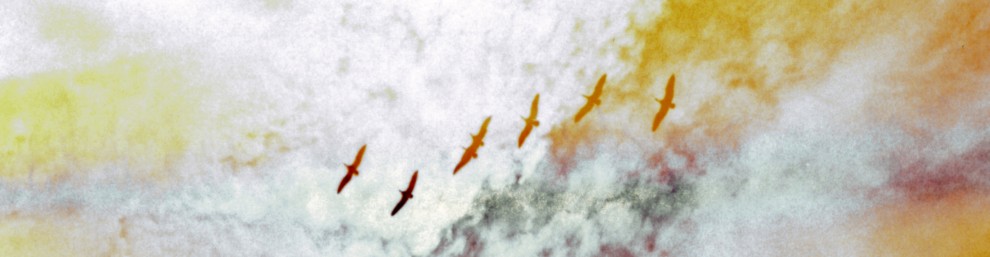
Photo: The image was taken by son, Yeshen Venema, during a visit to Vietnam. I added the clouds :)
I wrote the above essay in 1997, inspired by my readings during a vocational film degree, which helped me to catch up on cultural history. The file was idling away in a Clarisworks format on an old floppy disk. A friend (thank you Ian) managed to transfer the text into a Word document. Cleaning the formatting distortions suffered in the process took a while, but was worth the effort, since I wanted to share this theme of exploring Human Identity in the Digital Age with my readers in a PDF file. A short overview of this essay can be found in my archived posts, listed under January 2018. But here is the full work, including its bibliography. The chapters are headed: Vanishing Time, Vanishing Space, Vanishing Body, Eyes that would Fix and Control us as Objects, Seeing through the Simulacra, and, A Palace of Mirrors. Throughout, I evoke scenes from the SF film Bladerunner.
I’m interested to know your thoughts on the yet unfolding theme of identity in our age.
The title of the essay was inspired by a wonderful Walt Whitman poem called ‘Sing the Body Electric.’
A poem by a former Sufi teacher and friend, Fazal Inayat-Khan, conveys a similar vibrant spirit:
A QALANDAR … a human being in the making …
Adam/man, Minerva/woman – a human being in the making – functioning in the world on the stage of life – playing the script of destiny with the delight of indifference and the carelessness of full satisfaction. A being knowing all there is to be known by it, yet ever learning; ready to feel all there is to be sensed by it, yet ever discovering new depth of emotions; capable of expressing its deepest and truest inspirations, yet ever expanding its consciousness; sensitive enough to give and receive love in all its forms and levels of becoming.
The full poem is printed in ‘Heart of a Sufi,’ a book I co-edited with two friends (see my book page.)
Here the last paragraph of QALANDAR …
A Qalandar is simple as a child, wise as an old woman, unfathomable as an old man. He belongs to the moment, she responds to every need. He speaks all languages; she performs all roles. They are one …
Everything alive is curious, humans excel in this trait. When meeting up with something we haven’t come across we ask … is it worth knowing: is it important, useful, is it friend or foe? Getting to know something is a kind of taming. We energise what we tame, and attempt to exert control over it, be it elements, animals, people, or ideas. Then again, when for innumerable reasons, which include changing priorities or attitudes, interest fades; we withdraw our energy from what we tamed.
Take this vat. Not having held water for some time – its wood shriveled.
a dried-up vessel
lacking its soulful function
becomes an icon
an exquisite memory
or inspiration
where in beauty of decay
new dreams incubate
as nature’s purpose rotates
Getting older sparks such contemplation, and the reassurance that a formidable self-regulating force is in charge of life – nature and its cycles of birth, death and rebirth.
Despite every greedy effort to control nature, there is ample proof it will only work for life if we honour the spirit behind the delicate interdependencies of its cyclic system, which in its wisdom continuously expands the consciousness of the one and only being.
‘Stop acting so small. You are the universe in ecstatic motion.’ Jalāl ad-Dīn Muhammad Rūmī