 Always keen to bridge and connect seemingly unrelated intellectual territories, I tend to dip into essays of poet-philosophers and cultural theorists stacked near my bed.
Paul Virilio’s ‘Open Sky’ is a recent addition, translated by Julie Rose in 1997. Not an easy read, but the analysis of the social destruction wrought by modern technologies of communication and surveillance drew me in. The last chapter, Escape Velocity, relates a striking experience by Buzz Aldrin during the Apollo 11 mission. I share it here, within a short excerpt from the chapter, curious to discover what my readers make of it:
… Inflated to fill the dimensions of the world’s space, the time of the present world flashes us a glimpse on our screens of another regime of temporality … Outrageously puffed up by all the commotion of our communication technology, the perpetual present suddenly serves to illuminate duration. Reproducing the alternation between night and the solar day that once organised our ephemerides, the endless day of the reception of events produces an instantaneous lighting of reality that leaves the customary importance of the successive nature of facts in the shade; factual sequences little by little lose their mnemonic value …
… In his memoirs of the first moon landing, Buzz Aldrin in his own way confirms this disqualification of sunlight. Listen to what he has to say from the surface of the night star:
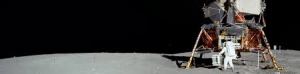 ‘The light is also weird. Since there’s no atmosphere, the phenomenon of refraction disappears, so much so that you go directly from total shadow into sunlight, without any transition. When I hold my hand out to stick it in the light, you’d think I was crossing the barrier to another dimension.’
It is as though, for the astronaut, shadow and light were two new dimensions, inasmuch as any kind of transition no longer exists for him. The loss of the phenomena of atmospheric refraction produces a different perception of reality …
Virilio draws a comparison to a similar loss for earthlings … the different degree of illumination which, before the invention of electricity, still marked the hours of the day or the days of the year has become of diminished importance. Under the indirect light from screens and other control centres of the transmission of events, the time of chronological succession evaporates, paving the way for the instantaneous exposure time as harsh as that floodlighting of which Aldrin tells us:
‘On the moon, the sun shines on us like a gigantic spotlight.’
All three astronauts of the Apollo 11 mission had problems after their return to earth. Spatial and temporal disorientation are not easily reconciled with one’s reality identification. Virilio writes … as for Aldrin, after two nervous breakdowns, several detoxification treatments for alcohol abuse and a divorce, he was to wind up in a psychiatric ward.
Struck by Aldrin’s experience, I thought about the increased screen time, especially now so many of us engage in since the corona virus changed our rhythm of interaction with nature, local environments, family, friends, and the wider world.
I first pondered the cultural implications of the digital advent during a mid-1990s film degree as a mature student. For those interested – my post from 2018 gives a flavour of my dissertation – click here for ‘Body Electric- – it’s worth a visit.
John Wheeler came up with the idea of the universe as self-observing system (being.) Light travels at 186 000 miles per second. When we look into deep space we are seeing galaxies over ten billion years old. In that sense everything we see is in a past, which our observing consciousness creates. So I ask myself what realities do we envision during this surreal corona time, individually and collectively?
Is Paul Virilio’s bleak vision justified? Is the hyper centre of present time becoming the sole reference axis of worldwide activity? Is the individual of the scientific age, with diminished positional reference, losing the capacity to experience him/herself at the centre of energy?
Click here for an article from the Frieze magazine.
And if you’re brave, read this fascinating & sobering interview of Paul Virilio by Caroline Dumoucel.
Or – can we create enough pockets of stillness to counter the acceleration of the fall upwards, of progress propaganda, and instead re-connect to body, earth and roots?
P. S. All links in the post open a new window.
 … that’s me, a dreamer. Dreams re-appear, like a déjà vu. A trick of light will superimpose an image on a scene gleaned in passing. Or a sound, a name, a number, a movement, colour or scent may link up to a dream’s mood. Similarly, memories of seemingly unrelated events from years ago can pop up while doing mundane tasks. This reminiscing improves for me as I grow wiser (older,) a subtle re-organising of events.
 With little chance of publication, giving this sequel once more editing time seems irrational; then again, I’m the weirdest person I know. The irrational has always impelled me forward from deep states of being, in search of wholeness. Like some writers, I juggle for rhythm and balance with a multitude inside, until a character, a theme, or a poem persists and generates engagement.
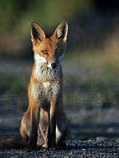 a tall fox appears
 even hunt their kind
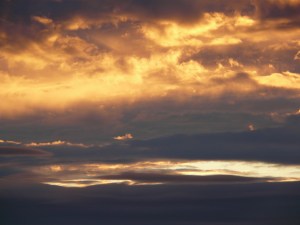 How to reconcile moments of pure beauty and light our restless world offers, with the heavy darkness of human ignorance? How is it the guiding spirit that is shining through everything so often escapes the unseeing eye? Is it our wounded hearts, or our anxious busy thoughts that prevent spontaneous being? Many of us like twilight, the dawn, the dusk, mist, where darkness and light do not negate but enhance each other. They mingle. As friends do, or lovers. Twilight is poetry in motion.
 like tiny cherubs
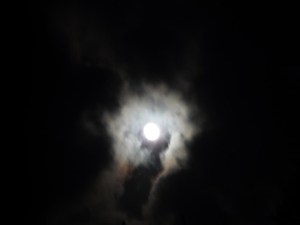 When there is no other near to share such paradoxical quickening with, I may call on those who enriched my life but are no longer present. I adore the moon, the ancient chunk of earth, reflecting and making tolerable the blinding beams of the sun, granting us poetry and symbolic language.
 We must see things fresh, not through tired ideas our establishments bank on, that destroy nature’s homeostasis and spill imbalances into cultures too poor to afford resistance. I say – let our children and young people decide what’s worth living for?
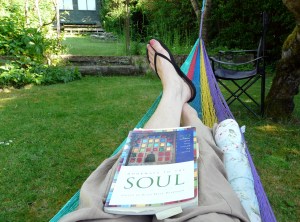
 Sun, finally, bliss. I sit in the garden, reading, among Robin friends flitting through the apple blossoms. After two hours in the heat my body needs shade. I resolve to clear some cobwebbed drawers in the shed.
 some two pfennig coins had acquired high iconic value. Up to 1968 German pennies were of copper, from there on steel was added, which made the coins magnetic.
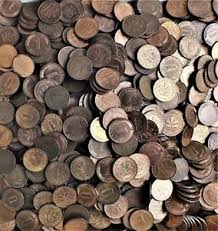 With hundreds of pennies, the odds seemed promising, at least compared to the lottery ticket I buy once a week.
 How do I cope? I don’t watch TV, haven’t done so for years. I prefer to read coherent articles and watch movies on BFI. And I’m lucky to have a garden, with nature to touch and absorb. The lilac tree waves, the laurel hedge sparkles; Robins build their nests, tulips nod in the breeze. Oh, and to end my ramblings, I just picked some delicate violets and forget-me-nots from my garden. They both have five leaves.
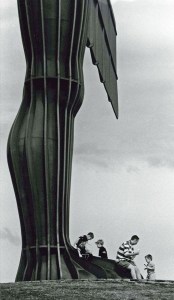
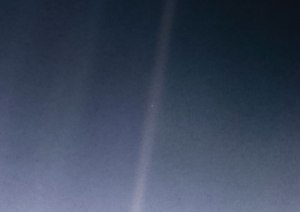 And then consider Carl Sagan’s tender reflections on the pale blue dot, the Mote of Dust, as in a sunbeam, the home we all have in common, a selfie, seen from afar. “Where everyone’s love, everyone you know, everyone you ever heard of, every human being who ever was, lived out their lives.”
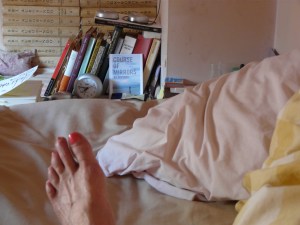 A few days ago, waking at dawn, I had retained a dream vision:
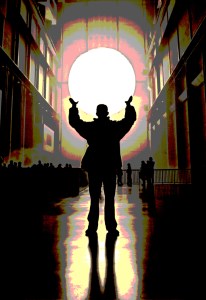 Maybe the dimension of Tate Modern’s Turbine Hall could suffice, but only a Turner price gets you there. In case you don’t know, the Turbine Hall is the place that allowed visitors to touch the sun, like my son did during an Olafur Eliasson’s weather project exhibition a few years ago.
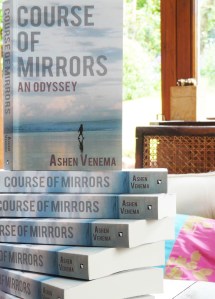 Normally, a writer’s work is condensed and hidden between the neat covers of a book, or captured on e-book screens, one click by one click. The concept of spreading the pages out in real space fascinates me, and ideas keep tumbling in. Like making the text respond to the concentration of the reader, or the lack, in which case sentences would ripple, as if floating on water.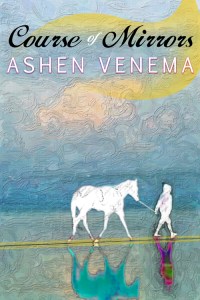
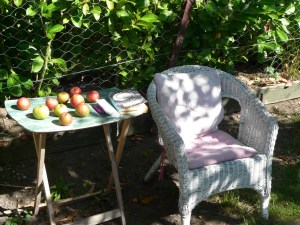 Embodying the perfect autumn warmth, a divine stillness, devoid of mental chatter, other than a faint hum of the river of cars flowing along the town’s bypass, and the gentlest sound of a disintegrating wood chime in my cherry tree, whatever else happens in the world is another dream.
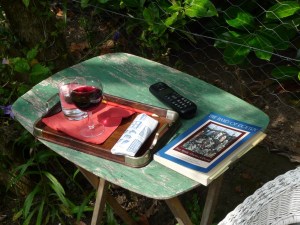 This time of year I like reading in the garden. Last week I forgot to take a book inside – ‘The Hand of Poetry,’ collected poems from Sanai, Attar, Rumi, Saadi and Hafiz, translated by Coleman/Barks, with introductions taken from talks by Inayat Khan. During a short but heavy shower that night, the book greedily feasted on rain. I found it blown up, like a balloon, to double its size.
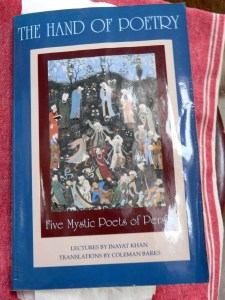 and three times over. On the third day I hung the book by its spine on the washing line. Once dry, I managed to press the volume with a heavy vintage iron into reasonable shape again. The ordeal required my undivided attention. The re-read pages during those hours lodged themselves with refreshed presence in my heart.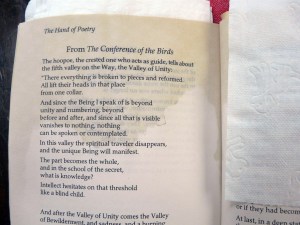
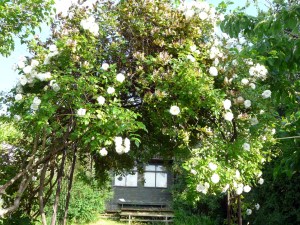 Meanwhile I enjoy some treasures close by …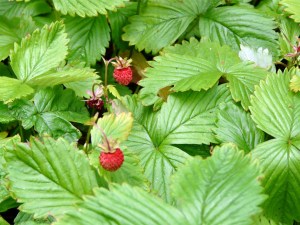
 let sleep do its work


 Course of Mirrors