 Hurrah, today is poetry day in the UK.Where would our world be without poets?
I sometimes forget I’m a poet.
Waving hello to all poets the world over I’ll share here a poem I wrote years back for an artist friend and her family.
… notes on a messy old woman …
in her art the charcoal mining hills
are shadow lands holding gold
and white mountains of china clay
spark New Jerusalem in her heart
she draws Cornish Cliffs rising black
from pale sands – jutting like mythic
creatures into a calm cobalt sea 
beneath an impassive slate sky
she delights in the yellow of lemon
green of pear – shape of aubergine
textures of sunflower – curly kale
and the pink gleam on the skin
of fish – best caught on the day
each thing away from its home
…solitary objects …
alone in space – the pot – pan
cup – knife and fork she paints
like icons on white and says
… they speak for themselves …
when spring brings pungent earth 
she plants narcissus and hyacinth –
geranium and rose – tomatoes – mint
clematis – azalea and rose again
she bends low to weed her garden
but not to wash the kitchen floor
nor does she mind a grimy table
sink – bowl – glass or plate 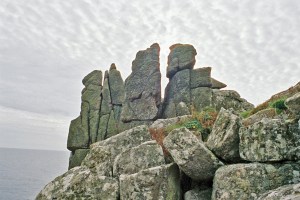
yet her home is bright with friends
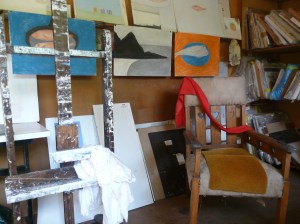
walls are hung with paintings
shelves groan under books
colourful rugs blot out the dust
her stomach has hardened to bugs 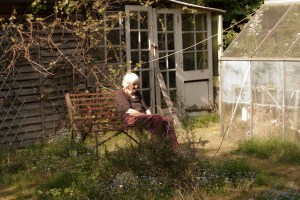
and if a thing cracks or falls apart
one of her five children will come
to fix the chair – shelf – clock – tap
the leaking roof or creaking door
… her strategy works …
all objects she observes revert
to the empty spaces between them
Ashen, 2004
You may wonder what has been happening since my last post, to which many of you kindly responded in relation to my dream and my desolate, confused state, which was heartening.
The post coincided with my publisher coming clean after I had faithfully waited three years for the production work on Course of Mirrors to begin. Still, I’m thankful – at least the path is clear. I decided not to approach any of the giants. I’m taking control. Having had lots of time to compare self-publishing set-ups, I’ve chosen one that’s most respected in the trade and also stores and distributes books.
I believe strongly in Course of Mirrors – the book will be launched in spring 2017. I’ll keep my online friends updated. Once my first novel is on the road, I may crowdfund for the sequel … and a collection of my poetry.
‘Faith is the evidence of things not seen.’ – W Hutchinson Murray
Sorry, the layout of this page turned messy :)
 16/17th September 2016 was a strange night of wild dreams – one of a big old mansion of which I occupy a part (I actually live in a semi,) while the other part is lived in by an aging famous actor, Jeremy Irons. In the dream he collects antique furniture, art objects and frames. Some large pieces, including a massive empty frame, he fixes onto a wall in the courtyard. We mainly meet in the wide inner hall of the mansion. He seems a little absentminded but quite amicable and kind. He likes that I talk to him.
 Records state our ships were launched towards Proxima Centauri – programmed to complete an assignment, after which our android system was to be made redundant. The assignment to find carbon conditions and water to sustain organic life has not been completed. The seeds stored in our vaults remain dry. Are we avoiding redundancy? Our current analysis of the Wikipedia sub-scripts focuses on the vast structure of human language. Here are some pointers:
 few years ago during a
 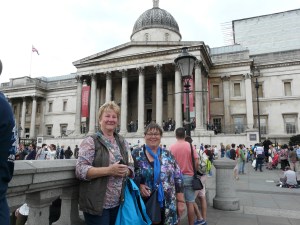 From there we wove our way through St James Park and ended up at Buckingham Palace.
 life, shine through our energy field, temperament, movement, voice, characteristics and life-interest. The qualities my friends nourished in me as a child, I still value today, the unconditional kind heart of Gaby, and Lieselotte’s ability to assess situations quickly and get things done. I saw that they also nourish these qualities in each other. Sadly they had to return home and miss my party last weekend.
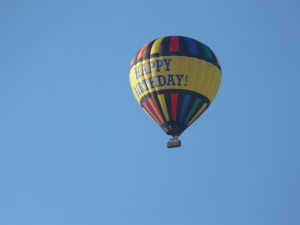 The Party… lovely sunshine, guest coming and going. An unknown sponsor even ordered a birthday balloon to sail above my garden :) My good-weather-wish came true. Some of us kept a circle outside until midnight among sparkling lights. The occasional apple dropped.
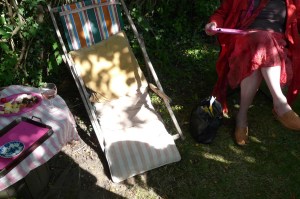 than my own. Glasses clinked. There was silliness, acknowledgements, revelations.
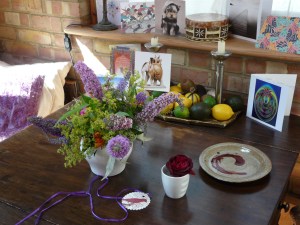 From The Prophet …
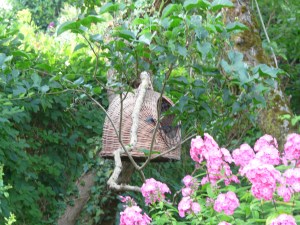 Last week, drama revisited. One of the fledglings fell from its nest. The parents called the alarm, showing me where to find the escapee, huddled in a corner, its beak demanding food. It was not quite ready to fly. I couldn’t find the nest, so I put the little one in an old cat :) basket, which I fixed on a safe branch cats couldn’t reach. I made the basket homely, with leaves, arty pieces of dry roots – a cushion even. All was well. The parents came and fed their lost baby, which made me happy.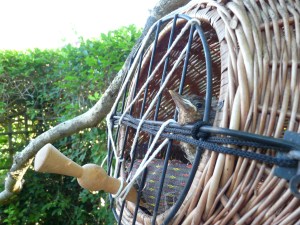
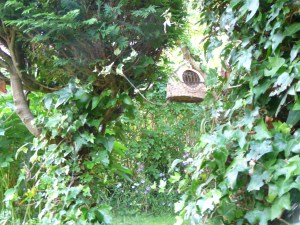 The luxury nest is now empty, and apart from a soft breeze ruffling flowers and leaves, the garden is strangely quiet today.
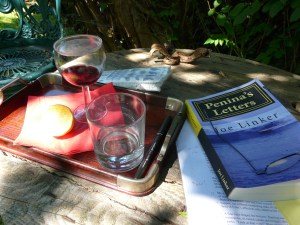 Time permitting, I do the occasional review on books. A blogger’s friend novel, Joe Linker’s ‘Penina’s Letters,’ struck a chord. So I share my review here.
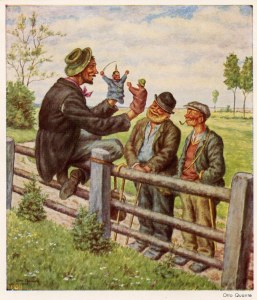 Long-festering issues are popping up in ugly shapes on our flat screens.
 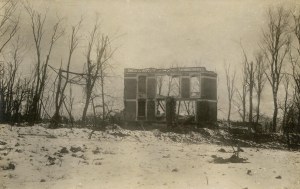 People fleeing from war-zones, natural disasters and nil prospects, attracted to the seemingly coherent structures of democracies, want to re-build their existence, are mostly educated, keen to work, and are longing to regain their self-esteem. Why not focus on the opportunities in this situation? Ask how the migration phenomenon can benefit societies? And how Britain can creatively support Europe in a process that simply cannot be stopped?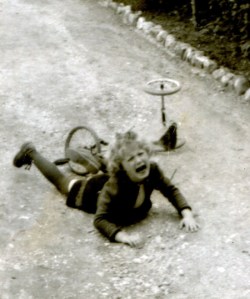
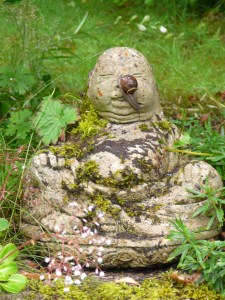
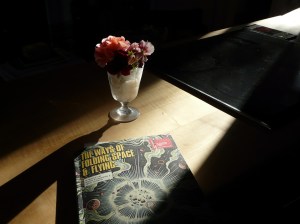 Here I find peace and time to crawl once more out of a family pattern, the kind of constellation one is born into, gets sucked into, and tries one’s best to loosen in order to gain more freedom and clarity.


