
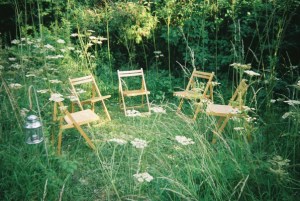
 Democracy starts inside us. One way to explore our inner crowd is through allowing the different aspects of our personality to have a voice, including ones we dislike or suppress, like parts burdened with shame, self-loathing and self-hate. Together with their inner persecutors and defenders, they tend to pop up involuntarily with strong emotional force during stress, or an experience that all too often had its first traumatic installment way back in childhood.
During a 1980s training with the Psychosynthesis Institute in London, we gave names to what we called our sub-personalities. The concept encapsulated what I had sensed for a long while, that I host various distinct entities inside me that can spring to live with their unique voices, interests, sensitivities and defenses in response to circumstances.
Take a dwelling that houses a family of all ages. From day to day there are debates, intimidation, fights, making up, tenderness, fun, humour, but always reoccurring conflicts, like an angered sibling can easily spark a massive row. Then ask who is in charge? A family with conflicting needs lives inside each of us.
As baby, toddler, teen, young adult and so on, we succeed or fail in overcoming obstructions. We learn, or unlearn. Ideally we mature and the understanding of ourselves deepens. Some memories we cherish, others we bury. Yet each time a traumatic condensed experience re-occurs, dormant anxieties may explode and cause us to overreact to situations out of all proportions.
The needy child seeking attention is easily recognised. Where early hope for safety and acknowledgement was frustrated, the inner child in the adult draws on an arsenal of acquired strategies, be it nagging, crying, pleading, pleasing, withdrawal, or, equally, rage. Stonewalling and sarcasm can serve as defense. The little person in us may have been confused by contradictory demands, manipulated by a toxic parent or severely damaged through abuse, yet still struggles for acceptance and love.
Another well-worn sub-personality opts for control, a no nonsense character, who detests, let’s say, hesitation and vulnerability. So when a firm response to a present situation is required, this despot may simply order the child to pipe down and shut up. End of story. You get the drift.
Internal conflicts can be harsh. Without awareness of the warring cast in us, we tend to blame others for our upsets. Alternatively we punish ourselves. Identifying and befriending judgmental players is vital before we can reach the vulnerable and fearful part that has become numb and possibly unconscious, or discover the creative dreamer that was ridiculed. Or, indeed, lift a dis-empowered warrior, who must learn to say ‘No!’
Without a mentor, this awareness journey is a daunting task.
 Unable to afford Jungian analysis, my spiritual search became an escape from what I saw as our revengeful, destructive and corrupt world.
Meeting a remarkable, brilliantly creative Sufi teacher, who embraced psychology as a basis for the spiritual quest, was my turning point in the mid 1970s. Grounding and digging started with a workshop called ‘Earthing.’
I had had a wild life up to then, a path I don’t regret. My empathy and patient listening lacked skill, but attracted interesting and eccentric people into my life. However, I needed to accept my limits, and better understand myself, others, and the absurd world we are born into, with the inherited traumas from our parents’ and generation before them.

World objects from my sand tray
A welcome to my inner journey was imaginative play, giving voice to the different parts of myself through monologues, imagery, objects, drama, art, sculpting, painting and writing, etc., all effective in daring to acknowledge conflicting needs. Due to choices enforced by my early environment, I host a philosopher and poet at odds with each other, as well as a cynic and a romantic. Their conflicts are as creative as they are intimidating.
In the digital realm people have come to make up aliases based on their ambivalent shadow aspects, like appearing in different disguises on Twitter, sometimes for the sole fun of contradicting each other. As a writer one might contemplate publishing trash genre that sells well, under pseudonyms, though it seems crass, like a soloist hijacking the performance of a symphony.
Stepping aside from internal conflict, invites my unbiased mediator. My quick route to self-remembrance is saying ‘hello’ to my body, whose every cell holds a record of old wounds. The body (the earth by implication) has endured horrendous exploitation, and to call it into awareness, with all its scars, is a huge challenge for some people.
‘You do not have to be good.
You do not have to walk on your knees
For a hundred miles through the desert, repenting.
You only have to let the soft animal of your body
love what it loves … ‘ from Wild Geese by Marie Oliver
In the present global turmoil, my inner child craves empathy and compassion to endure the pain of the world, including pain I feel observing how some public figures ignorantly out-ward their inner stress through creating enemies – divide and conquer – a steely defense, and a betrayal of the heart. Then again, truth to the face rarely convinces, it lacks depth, and blunts out the whispers from the dark.
Many brilliant books facilitate psychological understanding, but when it comes to moving through a dark tunnel (also called the Night Sea Journey) it is best to seek a skilled companion as guide. In my therapy practice I came upon heart-breaking stories of abuse, especially sexual abuse. The last few decades have shown the full horror of such deeply intrusive and traumatising incidents, and how widespread they are, across all social settings.
‘You’re not alone’ … is the message by Tim Ferris, in a recent very moving and powerful podcast he conducted with Debbie Millman.
PRESS HERE for his Healing Journey after Childhood Abuse (including an extensive resource list)
He ends with a beautiful re-framing of suffering … The obstacles are the path.
This attitude brings meaning to our mysterious existence, to our individual and collective journeys. Obstacles force us to question rules, habits and behaviour. Suffering through adversity, hardship, ignorance, injustice and violence teaches us empathy for each other, and expands consciousness towards our interdependence and essential wholeness.
I could add a list of books here, but if the above concepts speak to you, click on the Tim Ferris link, even if you choose not to listen to his podcast, scroll down his page and find a list of books and resources.
To end this post, despite all grounding over the years, I’m still at heart a space cadet, exploring time travelling in ‘Shapers,’ the sequel to my first novel, ‘Course of Mirrors.’
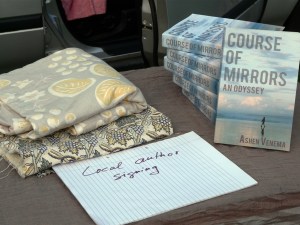 The weather was a little unpredictable, but, just in case, I made small preparation. A night without rain settled it. I got up at 6 am this morning. As a last thought I took a few copies of my novel, ‘Course of Mirrors,’ along. I sold seven copies, at half price. My entry catch phrase was, ‘Do you read?’ The lovely exchanges and the personal signing of copies gave me much pleasure.
 The car boot sale happened on the premises of an agricultural museum, adding charm. A fabulous steam train travelled up and down behind my stall. When there were children on it I waved, and they waved enthusiastically back.
 … that’s me, a dreamer. Dreams re-appear, like a déjà vu. A trick of light will superimpose an image on a scene gleaned in passing. Or a sound, a name, a number, a movement, colour or scent may link up to a dream’s mood. Similarly, memories of seemingly unrelated events from years ago can pop up while doing mundane tasks. This reminiscing improves for me as I grow wiser (older,) a subtle re-organising of events.
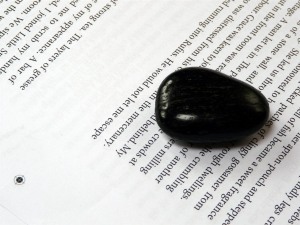 With little chance of publication, giving this sequel once more editing time seems irrational; then again, I’m the weirdest person I know. The irrational has always impelled me forward from deep states of being, in search of wholeness. Like some writers, I juggle for rhythm and balance with a multitude inside, until a character, a theme, or a poem persists and generates engagement.
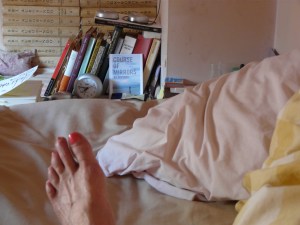 A few days ago, waking at dawn, I had retained a dream vision:
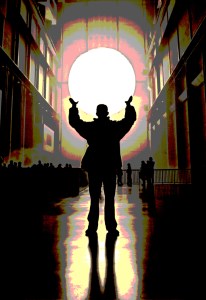 Maybe the dimension of Tate Modern’s Turbine Hall could suffice, but only a Turner price gets you there. In case you don’t know, the Turbine Hall is the place that allowed visitors to touch the sun, like my son did during an Olafur Eliasson’s weather project exhibition a few years ago.
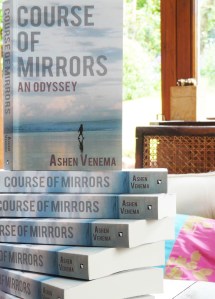 Normally, a writer’s work is condensed and hidden between the neat covers of a book, or captured on e-book screens, one click by one click. The concept of spreading the pages out in real space fascinates me, and ideas keep tumbling in. Like making the text respond to the concentration of the reader, or the lack, in which case sentences would ripple, as if floating on water.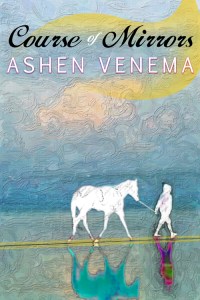
 When not actually engaged with it every single day, at least contemplating the in-depth editing of ‘Shapers,’ is my daily routine.
 The wind blustered cold though, and I was grateful for the hat I brought along, and the tissues to dry my runny nose and watering eyes.
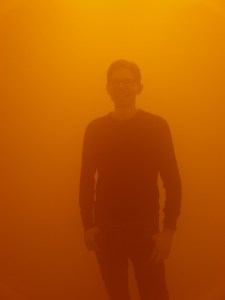 The 39 meters long fog tunnel took me by surprise. I hardly saw anything beyond a meter around me. Space became mysterious and unfathomable deep. I had a sense of being totally lost while also feeling held, though assured in the knowledge that my son was near, and that I could call him and reach out for his hand.
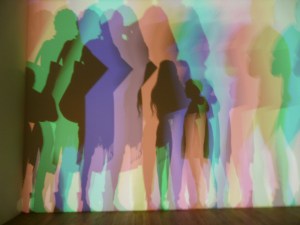 In one room, a kind of Plato’s cave, our back-lit bodies made colourful shadows ahead that shrunk or grew in size as we stepped forward or backwards, or overlapped and multiplied as we moved sideways. The magic was achieved through a row of primal coloured light beams projected onto the wall we visitors faced. Thing is, we are more intrigued, animated and comforted by reflections than the light itself.
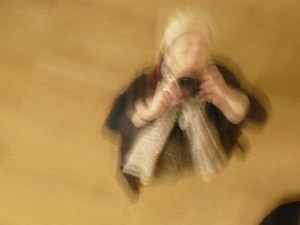 Here is a ceiling looking back at me. When ceilings fill the frame of our perception, the only landmark we catch is our own image.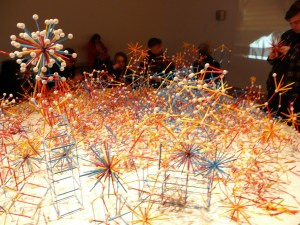
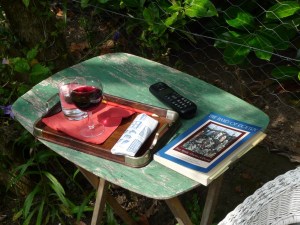 This time of year I like reading in the garden. Last week I forgot to take a book inside – ‘The Hand of Poetry,’ collected poems from Sanai, Attar, Rumi, Saadi and Hafiz, translated by Coleman/Barks, with introductions taken from talks by Inayat Khan. During a short but heavy shower that night, the book greedily feasted on rain. I found it blown up, like a balloon, to double its size.
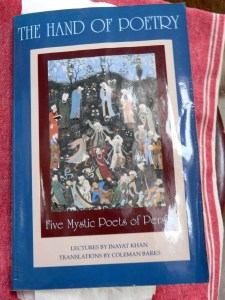 and three times over. On the third day I hung the book by its spine on the washing line. Once dry, I managed to press the volume with a heavy vintage iron into reasonable shape again. The ordeal required my undivided attention. The re-read pages during those hours lodged themselves with refreshed presence in my heart.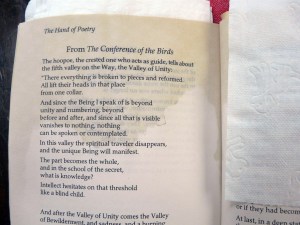
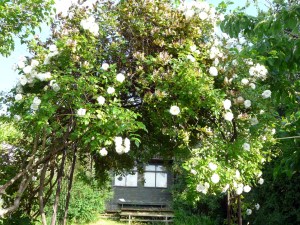 Meanwhile I enjoy some treasures close by …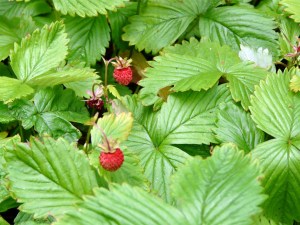
 Writers and readers have their unique (often indirect) discernment of text and image; a fluid perception spots moods in the sky, or envisages what’might be happening behind doors.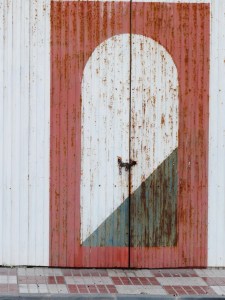
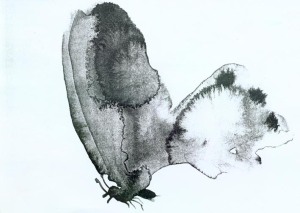
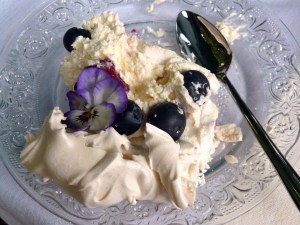 Our senses, physical and otherwise, make us feel alive, grant pleasure, and no doubt increase our hunger for taste, touch, smell, sight and sound, and more senses besides.
  … the small, round boiled new potatoes were the sweet, starchy berries of the earth. Their light brown skins stretched enticingly over the creamy white fruit within. The asparagus, almost luminescent green, redolent of a waving forest of green marine plants viewed through the warm clear waters of a tropical island bay, fresh and tender in the soft embrace of the mouth and chewy enough for the teeth to relish their work of liberating the cacophony of nourishing juices over the vibrant, aroused tongue.
 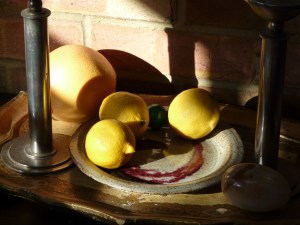 The salmon, its raw fishiness tamed by gentle heat in the company of thin slices of lime, into a piquancy which thrashed around the palette like wild seas. And, the final trigger to culinary orgasm, a tangy, herby sauce, which pulled the palette this way and that, like stretching a rubber band, taking it for moments into the realms of sublimity.
 During gatherings of friends, we love sharing stories as well as food delicacies … the displays and the bouquet of flavours wafting on the air on such occasions may well attract hungry ancestors, grateful for such feasts.
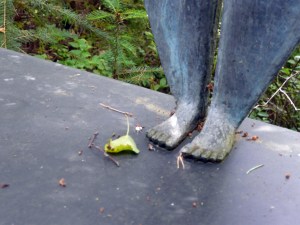 In my last post I touched upon the half-imagined essence shining through a work in progress – via incubation, the search for one’s language (in whatever form,) through the heart. This kind of search is bound to involve deep personal experiences, be it related to an outer or inner place, as the myth of one’s existential journey, which, when authentically communicated and shared tends to assume universal significance.
 Talking in the dark, their hands occasionally touching, Louise and Addie come to value their fragile pact. Even Addie’s abandoned visiting grandson is wooed by the loving regard between his grandmother and her new friend, and their tolerance and tender concern for him, which is, the way I read it, the initiation of a small boy into the wisdom of respect. While the petty gossip of townsfolk adds to the fun of their social transgression and strengthen the closeness they’re forging, the jealous objections of Louis’s daughter and Addie’s son are truly hurtful, and in the end decisive.
 As painters or sculptors do, I frequently step back from my writing projects, searching for the core, a half imagined essence to shine through and re-animate the creative flow. Skills alone don’t do it, techniques alone don’t do it, nor style. As long as the essence of what I try to express floats in the unconscious, my efforts will baffle and tease me.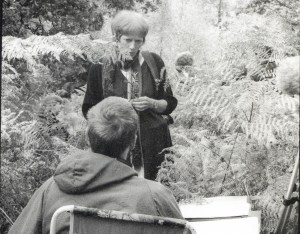


 Course of Mirrors