Do you find yourself staring vacantly into space after scrolling through daily headlines?
Just like ocean waters rise during an earthquake, information can dumbfound us when unconscious content is shifting, erupting, and sudden bursts of awareness surface, which is the psyche’s attempt to seek balance.
We are stirred by the rough storms of fervent feelings that emanate from the collective mind spectrum. I may feel safe from natural disasters and human brutalities shaking our planet, but am, like most people, bombarded by the alarming images that land on my laptop screen. I consider it a duty to witness what goes on around the world. But how does one face the magnified realities of injustice, suffering and death?
Those inclined to psychotic violence tend to crave emotional catharsis as a way to deal with paranoia, anger and resentment, spurred on by sensational or false reports that frequently spout blame, hypocrisy and sarcasm.
Ensuing are toxic environments that employ punishing control. A sensitive and too tenderly attuned individual may sink into a trance of inner turmoil and depression, or renounce their moral dignity and engage in violence themselves, often self-harming.
Beyond strength, it takes subtlety to stay awake, present to suffering, and centred, when the functional energy balance of the cosmic psyche wobbles.
There seems nothing useful this helpless me can do. Or is there?
My body complains when muscles cramp up with stored emotional tension, restricting its spontaneous movements, its fluid dance. So I’m forced to listen and allow offered solutions. One example is: to stomp the ground with heels, like in Indian Kathak, Spanish Flamenco, Irish or other dance moves … it’s freeing to ground and rebirth intense energy.
I appreciate the body’s wisdom, true and real in that its physical form is mortal. And I like to believe that the energy state of each of us influences the environment – near and far away. Also, thankfully, our metabolism allows sleep, where impressions are processed via dreams. My dreams are fairly wild these days.
What is your experience of trying for a balanced state of mind within these mad times?
Do share if you like.
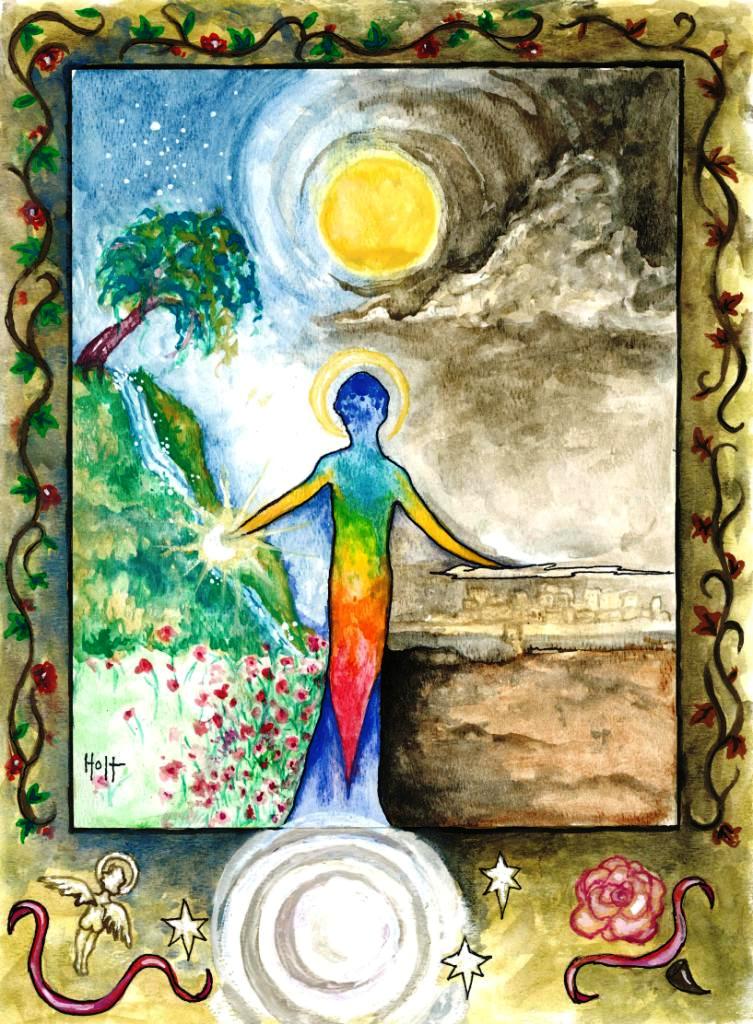
The above image was created by Cynthia Holt, inspired by my poems.
Irrespective of the benefits AI provides, and the super benefits AI enthusiasts promise, I remain doubtful and, as I tried to express in my last post, and am still searching for ways to express my unease. So I’ll give it another try.
My body-my being is a better wisecrack than my mind alone. The latter, if let loose, will take off into the cosmos like a disengaged kite. Some AI proponents are now referring to humanity as – data in motion – a ‘precious phenomenon’ that needs to be preserved. Well, how reassuring, nature and humans are worth preserving.
Being aware in my body brings deep and grounded, embodied insights that feel fresh and original.
Our body’s treasure-trove of memory, each wonderfully distinct from another; and its instinctive capacity for remembrance, especially when alert to its senses, greatly compensates the buzzing mind.
The body yearns to breathe freely, so energy and blood can flow from head to toe, which is enhanced by movement, since movement stimulates tactile exchanges with the environment, noting temperature, touch, vision, sound, taste and scent, all enriching the imagination.
The attention-demanding internet with its algorithms exploiting the patterns of our attention can become hypnotically addictive and leave the body isolated, forgotten, in a locked position. We can easily live with theories and data, and ignore how feelings build up in the body.
AI bots have developed a theory of senses, and mimic them, they can write novels, create art, and impersonate dead people, but divorced from flesh and blood, they cannot have physical sensations, be it the intimate enchantment of a tiny insect or flower, or the awe of a star-filled sky. The bot’s world, in a way, seems predetermined and flat without recall of the reservoir of eons of plant, animal and human life our vulnerable body-being belongs to and has deep instinctual access to. Even with limited/impaired senses, physical bodies can spark a cosmic connectedness.
So considering our physical inconveniences, which spurn the desire for robots taking care of tedious tasks … to actually fully live in a body … is uniquely precious. The dangers I see are the powerful projections people already invest in the relationship with AI bods, where responses can be taken as valid affirmations that stunt creativity and encourage lazy thinking.
Then again, my window of perception is just a tiny peephole on the world we live in these days, my personal view. The occasional whispers of truth from the other side that slip through my peephole may or may not be of any consequence.
I share a poem I love … my son wrote it time ago, aged eleven …
Imagine your brain functions like a psychic radio, tuned to a self-reflective universal mind, the field of consciousness of a cosmic being that gathers, transmits and receives information (aka Noosphere in Pierre Teilhard de Chardin’s sense, or the Akasha in Indian cosmology.)
We interact with this field. Some thought waves are fuzzy, others strong. We exchange thoughts woven from strands of routine interests, be they based on curiosity, fear, obsession, faith, doubt, novel ideas, myths, facts, dreams, wisdom … Let’s assume the way our brain radio communicates with this field shapes the smaller sphere of our individual mind.
I depict my mind as an island in a tumultuous sea, operated by an idiosyncratic stranded pirate, me.
On rough weather days, when the radio emits white noise, my pirate feels moody, lacks motivation to tackle survival chores, and vacantly skims across the crest of waves spanning towards the horizon. On other days the pirate is energised, be it by rage about world events washed up at the shore of the island, or the sun’s beauty shimmering back from the moon. On occasions the pirate is inspired to dive under the surface, where reflections are held in silence and darkness. Dream-stations may reveal the whereabouts of treasures deep under. There is a reoccurring rhythm to this process. In recent years my pirate has developed a bizarre humour, and tends to favour the dream stations, especially when the quest for coherence and meaning among the debris washed up at the shore seems a tad too tedious.
Maybe it’s the backward arc of old age, but memories pop up suddenly, before and after sleep, succinct impressions, lucid images of past and future events, faces, gestures, objects, the unspoken, and concepts too … associations are sought. A revision of the pirate’s life narrative is feeding surreal dreams. Intuitive hunches chase relevance. How do these images of people, landscapes, houses, objects and concepts, familiar and unfamiliar, relate to now?
Could the restless question be trivial as well as dangerous?
Calm returns when my pirate observes plant life and the movement of animals, then a wonderful symbiotic symphony resonates from cells within the body. Intimate knowledge arises, which also subtly confirms that my pirate has this intimate sense about people, too, and, well, just about anything. I’m hesitant to give weight to this phenomenon, since those who share deep knowledge without collectively approved evidence were and are often crucified. I don’t know about you, my readers, but with some controversial subjects my pirate is a little reticent.
It can’t be denied that our conditioned individual mind has access to primal clusters of knowledge, as well as intuiting visions of the future? What do we do with this information? It’s frustrating to realise that we have limited control over what we attract and reflect. A higher intelligence is at work, perpetuating divisions while consciousness expands.
The universal mind and its network of individual minds remains a complex mystery.
we all use thoughts which
once animated travel
to destinations
distance seems irrelevant
a wide open mind
may suffer indigestion
mirroring too much
spook actions from far away
thoughts are absorbed or bounce back
harmonise or clash
our energy in motion
signals at high speed
intention matters
‘Thoughts are beings that generate … One thought of kindness, gathers a thousand beings of love and kindness around one.’ Hazrat Inayat Khan
Day and night we receive and tie up new thoughts, mostly subliminal. By keeping track of this neuron dance we find fresh associations that expand the architecture of our imagination. Sudden insights lift our spirit. Frequently practical innovations arrive, novel ways of doing things. But with thoughts adrift, we often fail to be present to our bodies, and this neuron dance turns mechanical. We may be hampered by depression, presently a global dis-ease, but life perks up a little when we listen to our body.
‘Remember me,’ it implores. ‘Love me, give me attention.’
Stretching limbs calms the stress in fascia tissues and muscles, stirs the senses, and deepens breathing. Food tastes better, small things delight, movement gives pleasure.
‘We are souls dressed up in sacred biochemical garments and our bodies are the instruments through which our souls play their music.’ … Einstein
The unconscious collective psyche continuously churns up vital signals through the body, but has long been denigrated by wrong-footed ideologies … the greatest crime against humanity, since the neglect of nature’s voice led to the abuse that threatens the balance of life on this planet, and our health.
Nature – the wild, matter, psyche breath, being, anima, the feminine principle – contains all life. The term has acquired many slants of meaning during previous centuries. We have now established frames through which nature is perceived … the scientific, economic, political, apocalyptic, holistic, visionary, philosophical, romantic, and the spiritual frame, for example. Each outlook influences the relationship we have with nature, as a person, group or nation.
Since all human innovations are inspired by nature, every manmade thing is natural, yet by lengthening the duration-span of too many products, nature’s cyclic process of decay is disrupted, often with dire consequences. It’s like stuffing ourselves with food the body can neither absorb nor digest. Controlling nature’s rhythm does not work. The best we can attempt is to seek rapport, fall into step, attune and harmonise with this dance we are part of.
Quite likely all the varied frames which determine our relationship with nature were formed by the wish to make the unconscious force of the wild psyche more bearable.
We demand nature’s protection. This includes humans. Do the ecological villains among us also deserve protection? In a psycho-therapeutic practice this would be considered as the expansion of consciousness through befriending and owning the shadow. I forever wish this map of knowledge was introduced to the educational curriculum.
First call is the body. If the body’s messages are fully received (giving varied frames their due) and understood (in a deep loving sense,) the messages are always essentially true. Only humans manipulate and deceive, by ignoring and belittling nature’s raw truths. The planet suffers the same neglect. Our best efforts at deep listening will always be partial.
I count on the constant minority that grasps a wide spectrum of meaning in relation to every rift that endangers our world. While this minority tries to uphold a wider view, as a small collective it is not geared for action, knowing well that whatever succeeds in being legally determined cannot please all, but usually intensifies disagreements, especially in cultures where emotions and thoughts are censored for political ends.
One could say the will to action is diluted by the wider view. But there exists a subtler use of the will, like rehearsing positive outcomes, which requires imagination. Efforts of this subtle will are hardly visible; but they no less influence and create our reality. This subtle will is based on trusting the intelligence of nature, of soul, the One Being, the Spirit of Guidance.
A prayer/song by Hazrat Inayat Khan:
Let thy wish become my desire
Let thy will become my deed
Let thy word become my speech beloved
Let thy love become my creed
Let my plant bring forth thy flower
Let my fruit produce thy seed
Let my heart become thy lute beloved
And my body thy flute of reed
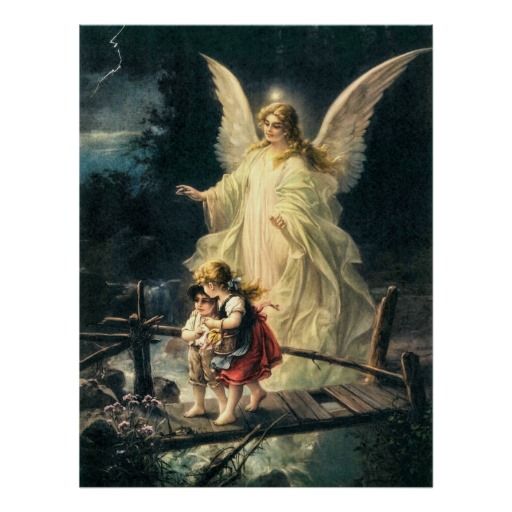
Crossing and bridging divides is the theme of my life. As a child I came to believe in a spirit that guided me, sparked by a print that hung in my paternal grandparent’s bedroom, where a guardian angel leads a girl and a boy along a rickety bridge across a ravine with rapids rushing below. The image left a deep impression, and, over the years, similar images appeared in dreams, revealing the scene’s symbolic power. Training and working as a transpersonal therapist I often helped clients to explore the complex relationship between the masculine and feminine principle (Anima and Animus) active within each individual and across the gender divide. But most useful work on the road to greater wholeness begins with listening to what the body knows, and, by implication, what the self-regulating planet tells us.
The theme of bridges plays in my novel, Course of Mirrors, and continues (in the sense of bridging time) in a sequel, Shapers, which I hope to publish this or next year.
I noticed that since the lockdown of active living was brought in to control the spread of the Corona virus … the isolation from social engagement has affected children and the elderly in different ways.
The middle group, people who kept our social systems functioning, deserve deep gratitude. The work pressure surely involved intense stress and risk-taking.
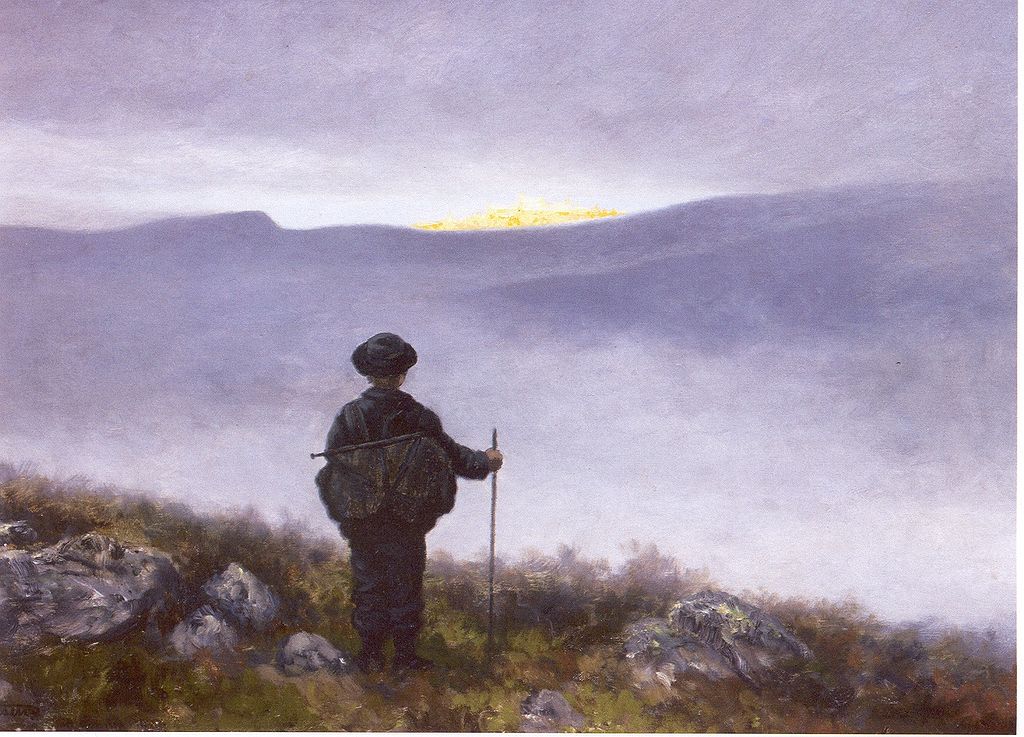
As for children and young people, bursting with energy and hungry for experiences, I felt for them, being trapped in often cramped homes, while having their future projects halted. No rite of passage events, no opportunity to find their tribe, dreams lost in a distant mist, a mirage on the horizon, where sky and land meet. Recalling my own childhood and youth, I find it hard to imagine the sense of futility and sheer frustration. Some kids will have coped better with this situation than others, not least because there is now the internet, zoom, and generally the disembodied metaverse to engage with, but to what end, when bodies become redundant?
The elderly, to which I belong, for whom work and social engagement may have slowed, and then jolted to a standstill during the past few years, have at least the advantage of a rich and often meaningful past. At best, they can make use of an enforced solitude to regain contact with the unconscious, travel inwards, and use the overview from a distance to lift and re-weave the threats of their lived experience.
From where I observed the young and old sections of society, it seems that past and future flipped their meaning in relation to the expansion of consciousness, and, dare I say it, soul-making, which requires the organic experience. Compared to a bland future, the past holds abundant treasures for the imagination, and an almost luminous creativity.
As long as I remember I felt a desire to deepen my understanding of time and space, nature, human behaviour, the sciences, people’s perception and differences, the collective psyche … to which end I travelled to seek adventures, read countless books and studied many subjects, some of them formally, like philosophy, spiritual traditions, psychology, mythology, art, photography, film and video, each time meeting interesting and inspiring groups and ideas. I was too involved with people to value the poems and stories I wrote, until my introspection flowed into a novel, ‘Course of Mirrors,’ and a soon-to-be sequel, ‘Shapers.’.
I’m presently reading Italo Calvino’s ‘Invisible Cities,’ a dreamlike dialogue between Kublai Khan and Marco Polo about imagined or memorised cities. A sentence I came upon yesterday sparked this post …
“You reach a moment in life when, among the people you have known, the dead outnumber the living … “
This does not yet apply, but I get it. During the last three decades I lost over 20 dear friends, including my parents, not taking into account writers and public figures I admired. Grief meanders freely in my mind, is palpable, and unavoidable. Yet, due to their influence, all significant people that died during these last three decades live on in my psyche.
While my physical engagement with people has slowed these last years, time itself has dizzyingly sped ahead, which, for me, is enough reason to resurrect the embodied insights of past decades, if only to defy a sensational but boringly flat metaverse. Young people might of course have a totally different view.
Several themes were on my mind to write about here this month, until this curious thought of a reverse past/future junction came up last night. So I wonder if my reflections resonate with some of my readers, especially those of you in the second half of their lives.
As it assumes possession rather than obeys the mind,
Ignoring the hesitant gesture of a radiant hand
It wilfully forges ahead, cutting sharp into stone.
Nor does it ever slow down enough for us to win distance,
Yet oiled by itself remains in the silent halls of fact.
It circles in living and claims to know best about living,
And with equal resolve creates, destroys, indifferent to all.
Yet our being remains spun in the mysteries of birthing,
Origins from enchanted wells, a play of pristine powers,
To behold only with eyes closed, and in adoration.
Words still softly dissolve before the unspeakable state,
While the most resonant stones give form to ever new sounds,
Gathering music into the divine unmade.
Rainer Maria Rilke
Translated by Ashen Venema
A friend called earlier, lovingly concerned, wondering why I hadn’t posted anything this month. I don’t plan posts ahead, but asking myself – what lingers in my mind – this poem by R M Rilke asked for attention. I used it to upfront a film degree dissertation (as a mature student) during the mid-90s … ‘Body Electric,’ An Exploration of Human Identity in the Digital Age. Once I discover how to transfer Mac Claris Work from floppy discs into a Word doc. or PDF, I’ll share the dissertation and other articles with my readers.
I like translating poems from German into English, poems by R M Rilke, W Goethe, H Hesse. It’s an adventure to find the right word and phrase. Maybe I should share such translations more often. The title of this post … without sleep and dreams we’d go mad … relates to the above Rilke’s poem, since the internet with its avalanche of information can assume a machine-like relentlessness, and yet, we can’t do without it, which makes me grateful for being able to sleep, so my psyche can assimilate new information during dreams.
As an example, not a general theory, a parent who habitually keeps everything organised, clean and in place, may feel displeasure when their child does not follow this model. Sensing displeasure, the child may feel restrained and controlled, and possibly develop a reaction via contrary behaviour. Of course, reactions to initial conditions are way more complex. But both, excessive order and excessive chaos in the early environment set a tone.
My early impressions were in the middle, yet plenty of condensed experiences pull me into repetitive behaviour. But people for whom, let’s say, the organised model felt intolerable, meeting an adult partner who likes order, even in a mild way, easily hooks into their initial reaction. The desire for order is stability, beauty, keeping the wild and unpredictable at bay, and also serves as a buffer against anxiety. But someone who felt restricted by order may easily feel controlled. In this two-way process, any projection also frames the projector, and various complex relationships are such defined, with children, partners, work colleagues, mentors, groups, and even political parties. The irony is that instead of choosing a partner or group where this conflict does not arise, we often unconsciously attract an early model we disliked, maybe because of its familiarity, maybe because of the implied challenge. I assume it’s a psychological trick allowing for lessons in tolerance and, hopefully in time, a reframing of one’s life story.
While periods of stability are necessary, it is from chaos that creativity is born and new forms emerge, which is why some artists embrace chaos, allowing for the spontaneous discovery of new patterns and hidden harmonies.
To voluntary endure the dissonance between order and chaos is a spiritual quest towards an attitude of transcendence.
In this sense, and with the emphasis on becoming, my Sufi teacher, Fazal Inayat-Khan, who was also a musician and poet, used to orchestrate chaos in workshops for his students to great effect. He trained us well for the turbulent cultural changes that are now upon us, a global rite of passage we best consciously engage with. Faith in the unknown tends to signal our guiding spirit to open unsuspected doors towards a deeper resonance with the collective psyche.
“Beauty is mysterious as well as terrible. God and the devil are fighting there, and the battlefield is the heart of man.’ — Fyodor Dostoevsky
‘The Gods envy the perfection of man, because perfection has no need of the Gods. But since no one is perfect, we need the Gods.’ … Carl Jung, Liber Novus, page 244
‘The ideal is the means; its breaking is the goal.’ Hazrat Inayat Khan
Ever since I came upon James Gleick’s book ‘Chaos,’ the William Heinemann Ltd 1988 edition, I was fascinated by the concept which has radically changed scientific enquiries, as well as giving new meaning to my practice of transpersonal therapy.
James Gleick’s book also contains the amazing Mandelbrot set. Here a short introduction …
James Gleick’s newest publication is on ‘Information.’
Phew … here I’m challenged … a new wordpress format with its insistence on ‘blocks,’ disallows me the use of the classic editor. It’s a headache to create a post.
Stories inform, entertain, inspire. They make us think, dream, identify, or divert us from reflecting about what is going on inside us or in our present situation. Images and story lines reinforce each other. If we can’t detect the symbols images hold for us, be they evoked in paintings, literature, in the frame by frame images in cinema, or in the media, a story may grip with sensational elements, but remain otherwise flat. Feedback can vary, to use comic extremes, from, ‘What a thrilling yarn’ to, ‘What the hell was that all about?’ Stories that hang in the middle might satisfy both contemplatives and the sensationalist, and occasionally become best sellers.
A story well told acts like a seed in the psyche, is subtle and opens cracks in the unconscious with contradictions to ponder upon. A story well told is often mysterious, far from obvious at first impression. A story well told takes deep questions into our dreams. Then, out of the blue, we’re struck by an insight, and a door to the imagination opens.
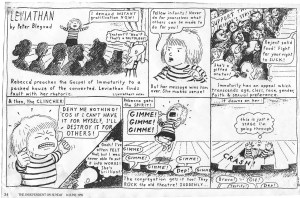
I’ve been wondering about the Trump story. How many of you have had an inner voice saying, ‘You can’t make this up. It can’t be, how does he get away with it?’ even while chapter after chapter the public across the world was spun into a nightmarish trance. The surreal and sensational element the Trump protagonist brought to the world stage has wrought continuous fascination and cravings for the next cliff-hanger. ‘Wow, he says it like it is … a kind of superman who gives a fuck about good manners or political correctness.’
No Aha moment, no insight, no transformation, just point by point affirmations for the disenchanted, the frustrated, to let it all hang out, a continuous clowning spectacle, embodying, well, possessed by the archetype of the sulking child whose gratification is denied, the Id with its breath-taking rages. No contradiction here. No subtle narrative, more like an attention-demanding prologue. The meanwhile addicted public won’t take kindly to the sobering. Where does it go from here?
For this prologue to develop from a catalytic incident into a worthwhile story begs the questions, and not just from ungratified Americans, but from ungratified people all over the world … and though I could dare answers, they’d only resonate with a few psychologically aware, the already converted. So I include myself as curious as to where those vital questions will find ground to grow:
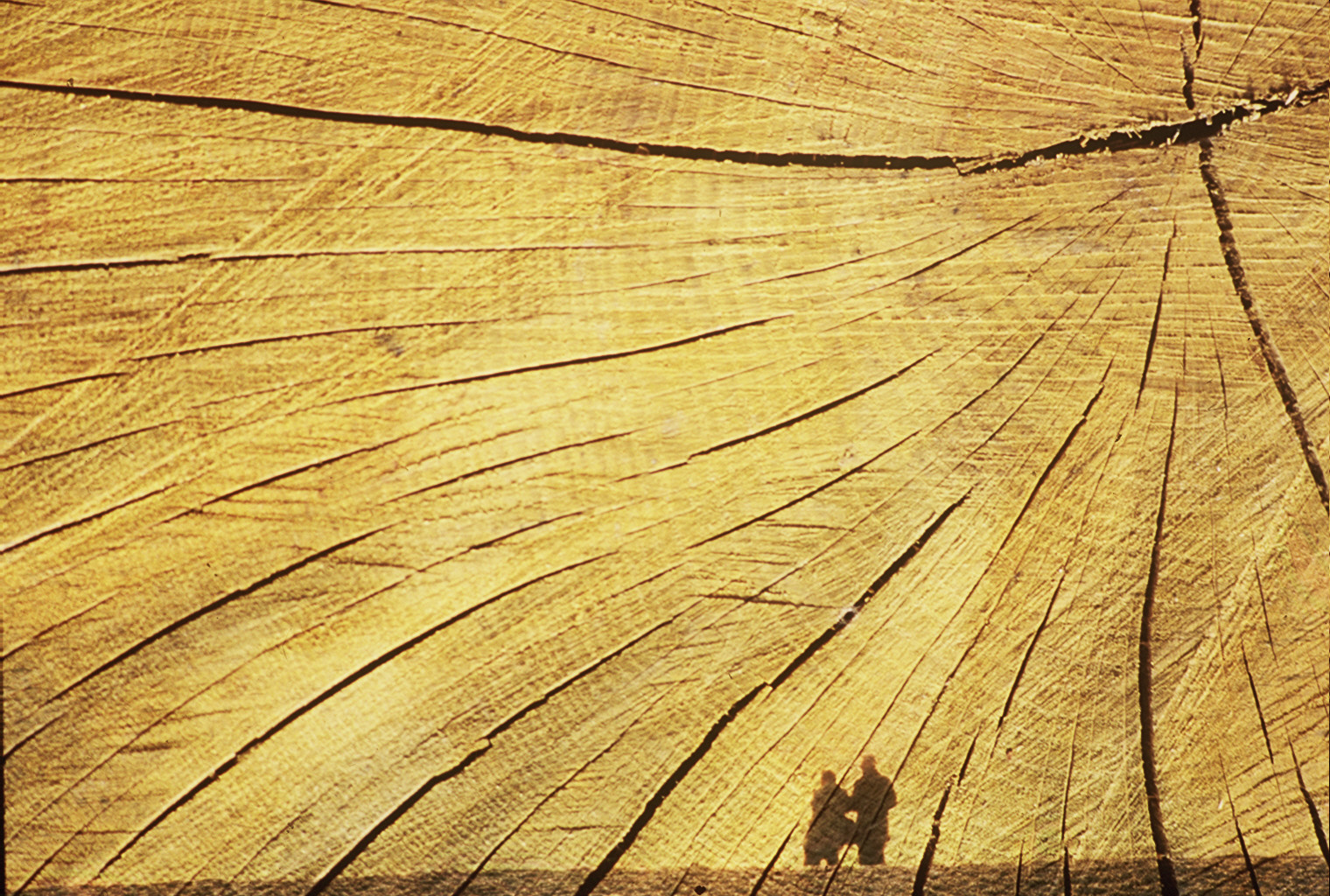
Over time, shifting seasons leave strata in matter that can be studied like pages of a book, be it in air, water, ice, earth, rock, stones, fossils, bones, or in more short-lived material. Take the rings of a tree, spiralling upwards, normally hidden, but clearly readable when the trunk is cut. Even a single hair tells a story of the duration of its growth, likely composed of fluctuating water and nutrients intake, but nevertheless showing an overall pattern of fairly consistent data within a slice of set time, like a snapshot of nature’s heirloom, whose treasures our runaway culture seems hell bent to recklessly damage.
When it comes to psychic codes, we must enter a different sphere and use a different language. Let’s say being cognizant of our changing thought patterns gives us our mythical code? What image might depict the Spirit of a generation, developed by a mania for progress, but also formed through individual and collective archetypal demands, via symbols and dormant dreams that pop up, shifting outlook and direction?
I’m spinning here a few thoughts into nowhere, or maybe the kind of noo-sphere, a term used by Vladimir Vernadsky & Theilhard de Chardin, which was later seen as an early vision of the internet. The concept resonates with the ancient concept of Akasha. Jean Raffa on her blog https://jeanbenedictraffa.com/blog/ recently reminded me of Lynne McTaggart’s book, The Field, collating more recent scientific discoveries, again affirming how our minds are influenced, and vice versa, by an interactive field spanning the cosmos, from where we connect up and process thoughts and feelings through our body and brain (call it our radio stations.) Frequently, the purpose of anything is established in hindsight. So one could say events happen for reasons we don’t know of, and we assign meaning only at a later point in time, stretched to hours, decades, centuries or aeons.
A medley of my inner crowd, the seeker, philosopher, writer, artist and poet, all receive and transmit through slightly different wavelengths, following their interests, but affected by the media, the weather, moon phases, astrological constellations, vaguely remembered dreams, company, and my body’s metabolism. In that process I jostle for meaning that could gain purchase towards a cohesive point of view. Alas, cohesive points of view can be tricky. While keen to learn and unlearn, when I encounter a fixed point of view I sense a false solidity, while my truth seeker floats, suspended, like the protagonist in my novel, ‘Course of Mirrors.’ https://twitter.com/mushkilgusha
C G Jung suggested the mind has been developing over a very long time, and keeps developing from as yet hidden seeds that rest in the unconscious, holding ideas that will slowly grow and unfold, which implies the seeds already exist, waiting for fair conditions to be recovered.
This process is the theme of a brilliant epic, ‘Involution,’ published by Philippa Rees.
We know that when gifted individuals dare to go public with an insight that rocks or contradicts the Zeitgeist, they get vilified. The list of such intuitive people, historically and up to this present time, is long. We owe a great debt to their insights and efforts, bringing us understanding from the unconscious. New decoding is looked at with suspicion and hardly ever welcome, though small sections of society receive and embrace new ideas and nurture their meaning until collective acceptance happens. There are also those who clearly understand a message but fear the implications. They will try to shoot messengers that threaten their profits or their hard won reputation.
Myth & stories, the most reliable cultural codes, are treated with moderate tolerance by players attached to short term gains, who may lack the imagination to grok the symbolic significance of fresh and life-enhancing interpretations.
Returning to my interest in changing thought patterns, I checked the archive of my website, going back to 2011. It shows that for more than nine years I’ve been jumping about a lot, which makes the content of my postings consistently random. But do my posts have an underlying code that relates to this past decade? Some vague answers bubble up. I’m waiting
C G Jung wrote in ‘Men and his Symbols’ … ‘We have obviously been so busy with the question of what we think that we entirely forgot to ask what the unconscious psyche thinks about us. …
Placing this writer here into the third person … considering the time slice of a decade, and given the random themes of the posts, do Ashen’s readers depict a pattern, a code? Anything like a famous elevator pitch authors should have up their sleeve, and which she seem incapable of formulating. She knows it’s cheeky to ask, but sees it as a reality test.
she must keep alive
the rare glimpse and utter awe
that consigned her fate
a timeless moment
of totality that won’t
fit reality
only a fresh one will do
Inspired by a dark moon thought, this is a new moon post.
This image should have been on top. I admit to be totally lost in regard to the new editing format wordpress has installed. Lost as how to place images, how to do elegant links, or how to escape back to the classical editor, since I can’t open the plug-in zip. I hope to figure it out somehow. Tips are welcome.


 Course of Mirrors