 When not actually engaged with it every single day, at least contemplating the in-depth editing of ‘Shapers,’ is my daily routine.
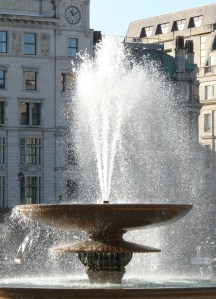
This week had a highlight, since I was treated to a day in London by my son. As luck would offer, it was a day with glorious December sunshine, giving sparkle to the fountains in Trafalgar Square.  The wind blustered cold though, and I was grateful for the hat I brought along, and the tissues to dry my runny nose and watering eyes.
First call was the famous and wonderful Watkins Bookshop in Cecil Court, where I sold a few old books, including copies of my novel, ‘Course of Mirrors,’ and a few remaining hardback copies of ‘Heart of a Sufi,’ an extraordinary rare book, believe me.
Later we took a boat trip from the Embankment to the Tate Modern Olafur Eliasson exhibition, which turned out to be a deeply touching and immersive experience. The Danish-Icelandic artist Olaf Eliasson challenges habitual modes of perception. His passion for nature, space, light, renewable energy, reflective metals and geometry has drawn together a devoted team of collaborators. The art projects stimulate poignant debates about our environment and our communities through visual and sensual installations, sculptures, photographs and paintings.
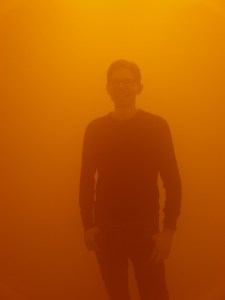 The 39 meters long fog tunnel took me by surprise. I hardly saw anything beyond a meter around me. Space became mysterious and unfathomable deep. I had a sense of being totally lost while also feeling held, though assured in the knowledge that my son was near, and that I could call him and reach out for his hand.
I also reached into the patch of tender rain suffused with spectral

this image is by Yeshen Venema
hues, like just discernible water dust or the finest hair floating down and caressing my skin with moisture.
Moisture – how often do we think of this gentle yet indispensable harbinger of all organic life?
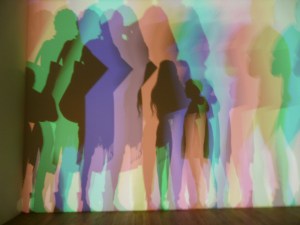 In one room, a kind of Plato’s cave, our back-lit bodies made colourful shadows ahead that shrunk or grew in size as we stepped forward or backwards, or overlapped and multiplied as we moved sideways. The magic was achieved through a row of primal coloured light beams projected onto the wall we visitors faced. Thing is, we are more intrigued, animated and comforted by reflections than the light itself.
It’s why I love the moon, which is going to be full tomorrow.
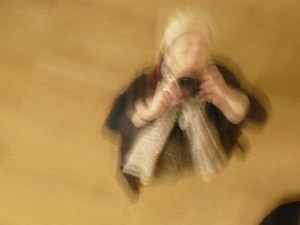 Here is a ceiling looking back at me. When ceilings fill the frame of our perception, the only landmark we catch is our own image.
Apart from suffering back pain while trying to catch one’s own image, there’s a possible message … let’s not box ourselves into the realities of narrow visions.
And there was so much more to take in and think about in the expanded studio, showing the wider scope of Eliasson’s activities, projects like Little Sun, Green Light and Ice Watch.
On a big round table small and big kids can have fun building architectural structures.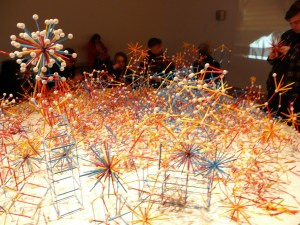
Oh, and we enjoyed a delicious lunch at the Tate Modern, while overlooking St Paul’s Cathedral across the Thames in crisp winter light.
It was a very special day in the company of my very special son. In a world that seems distressingly askew these days, it’s heartening to know there is a new generation of sane and life-embracing young people.
Check out some videos about Olafur Eliasson.
 We mostly think through conventional forms and givens, for practical reasons, while another way of thinking embraces invisible and unknown dynamics via intuition – like the seeming particle/wave paradox in quantum mechanics, where a local particle also exists as a non-local wave. The two perceptions can potentially mingle creatively, but, notably in times of social uncertainty, they clash, and fewer people maintain the ability to tolerate
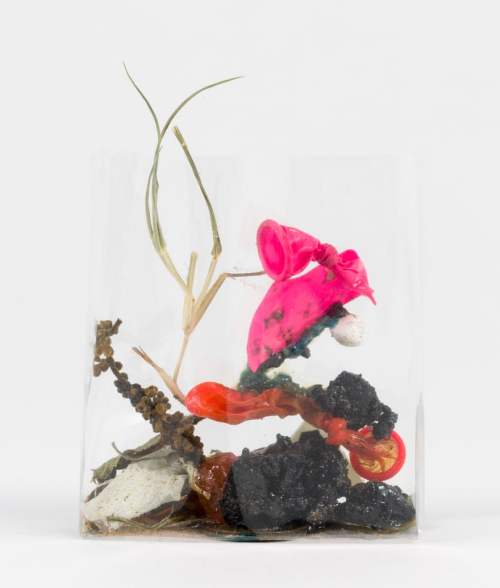 The eye-catching miniatures created by Yuji Agematsu pulled me back to my student phase in Munich during the 1970ies, when a group of friends looked out for small items like roots, twigs, leaves, seeds, grasses, feathers, stones, shells, dried or fresh flowers, the occasional bottle top or bits of shiny sweet wrappers, and sampled such bits into cellophane bags. We then handed these tiny poetry worlds to pedestrians or people sitting outside cafes in the then student district of Munich, Schwabing. It gave us thrill when recipients expressed a shock of surprise.
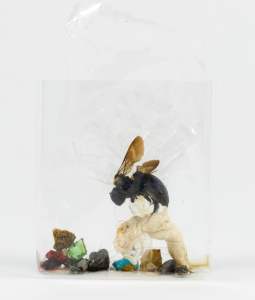 In this
 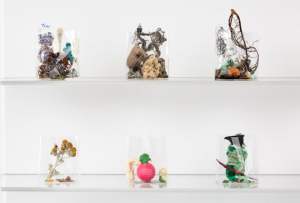 Yuji’s search for trash treasures developed into a language that emotionally embraces urban archaeology. He attracts bits of litter we may regard with a smirk, mostly ignore or simply not notice. While his miniature installations are scaled down to finger size sculptures, the mind-expanding and transformative effect equals grand scale installations. My experience, apart from the cognitive surprise, was being left with a bodily sensation, a deep feeling connection with these miniatures.
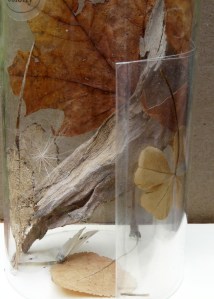 I have miniature installation in my home, on windowsills … unable to resist picking up feathers, seeds, leaves, driftwood, pebbles and so on, which often hold the story of an eternal moment in time.
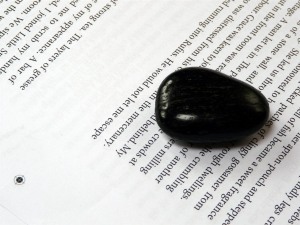 A small black stone, for example, features prominently as a protagonist in my novel,
  In my last post I touched upon the half-imagined essence shining through a work in progress – via incubation, the search for one’s language (in whatever form,) through the heart. This kind of search is bound to involve deep personal experiences, be it related to an outer or inner place, as the myth of one’s existential journey, which, when authentically communicated and shared tends to assume universal significance.
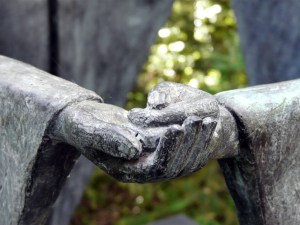 Talking in the dark, their hands occasionally touching, Louise and Addie come to value their fragile pact. Even Addie’s abandoned visiting grandson is wooed by the loving regard between his grandmother and her new friend, and their tolerance and tender concern for him, which is, the way I read it, the initiation of a small boy into the wisdom of respect. While the petty gossip of townsfolk adds to the fun of their social transgression and strengthen the closeness they’re forging, the jealous objections of Louis’s daughter and Addie’s son are truly hurtful, and in the end decisive.
 As painters or sculptors do, I frequently step back from my writing projects, searching for the core, a half imagined essence to shine through and re-animate the creative flow. Skills alone don’t do it, techniques alone don’t do it, nor style. As long as the essence of what I try to express floats in the unconscious, my efforts will baffle and tease me.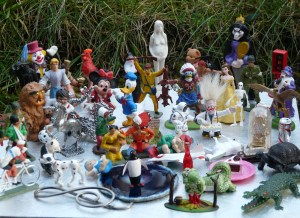
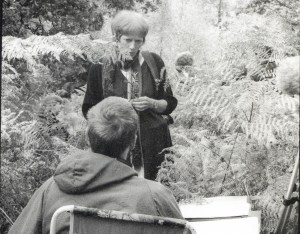
 Truly witnessing the tragedies on our planet is not the same as passive looking, witnessing expands and transforms consciousness. As an individual I feel helpless, unable to solve the overwhelming problems, but by witnessing and accepting the sad truth of what is happening, and by grieving the losses, I, each of us, in a small way, can contribute towards a necessary and crucial paradigm shift.
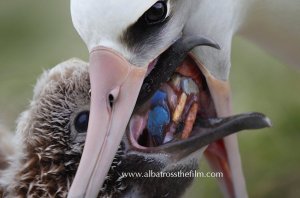 Some scenes near the end of the film bring home powerful metaphors – like what it takes to fly. Fledglings, to lighten their weight, must empty their stomachs of everything fed to them by their parents (in this instant plastic.) Mothers, forgive yourselves. We can hardly avoid dumping stuff on your offspring, be it psychic or material. Many fledglings don’t manage, but if lucky, and if the right wind comes along, their wings will carry them across the sea towards their adult adventure.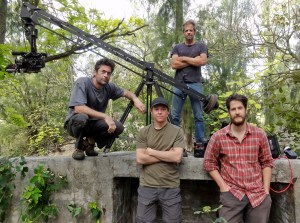
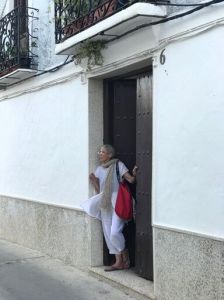
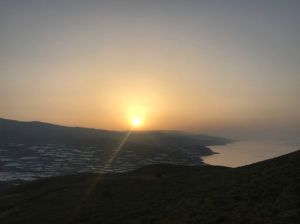
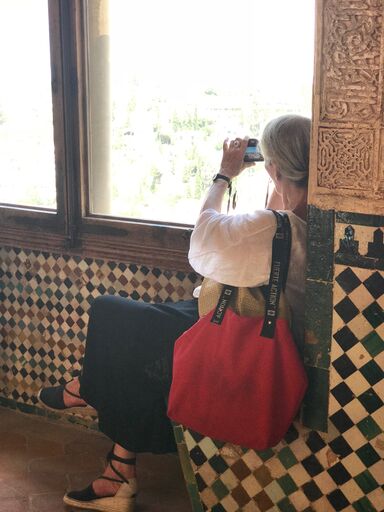 Me … less than a month ago at the Alhambra. I wonder how many people over the centuries sat on this ledge to gaze out over the Albayzin. Adding to my last post, and my images … ‘sunny places,’ these are images taken by my son on his IPhone …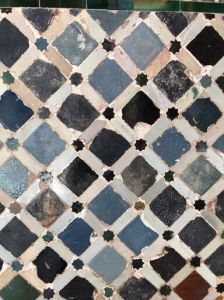

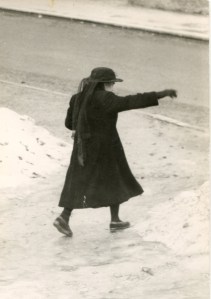 Marie was one-of-a-kind, a unicum, einzigartig. Considered a fool, she was waddling through the streets of my childhood village in search of rejected items.
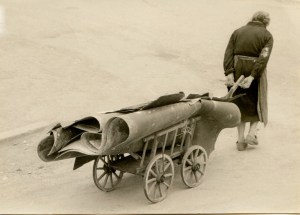 Marie found good – even in the flawed. She says:
 chased by hungry spirits hovering over their houses. They resent and envy my freedom. I scare them, because I remind them of the ravages of time. I’m beholden to no one, which is why they spread lies about me. I’ve sharp ears.
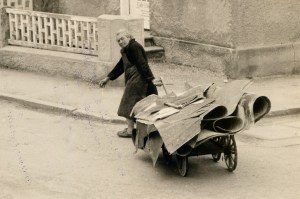 There you have it. Ask me anything and you get truth, since I’ve got nothing to lose. The absurdity of human behaviour makes rejection bearable. I learned to live with it. Consequently, my brain cells can’t help being impressed by discarded objects. It’s compulsive. When you get there one day, remember me, the woman in the street, shouting, ‘We ripe, we rot, it’s all the same. Do as you like.’
 Having succumbed to waves of nostalgia, I’m unsure what will emerge next, which is fine for now. My father’s death at 99, while sad, is also a relief. During the last two years I’ve been on tender hooks, waiting for the telephone call, and the prospect of sorting and processing a left-behind-part of my life. As anticipated, the reality of it was exhausting. There’s no financial reward, since what’s left of my father’s estate will just about cover the bills. His furniture was too damaged to be accepted at auctions, and anything else of value he had given away to people whose support he appreciated. He resented me for not living up to his ideas, and I resented him for his total lack of support. He had fun, spending a fortune on years of luxury cruises around the world with his second partner. While often justified, resentment is entirely useless. I tried my best, so I’ll drop my misgivings and wish my dad’s soul a good journey onwards. It frees up my life.
 It’s ironic, because my Dad had artistic leanings resembled my own. We only occasionally clicked, for a short while, especially when he needed me, after which he retreated into his controlling paranoid mode. He may have been jealous of the self determining freedom available to my generation. I should add that his psyche was injured by the last horrific war.