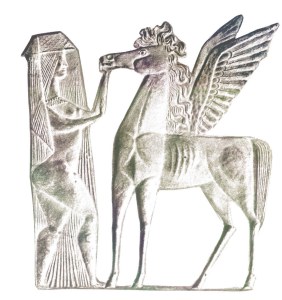
A tile made for me by E. Cordier for photos in his studio.
In a previous post I mentioned my erratic filing, which, when working on a writing project, results in phases of strolling through my inner jungle in search of a spot marked for attention, often years back, or wandering through a library in a kind of trance, ignoring categories, with only a vague sense of purpose. On route, I explore seemingly unrelated and often incongruous themes, before a match creates coherence in a new context.
While searching for an invisible gestalt, I tend to reread authors that inspired me. Last week it was Six Memos for the next Millennium, by Italo Calvino (translated by Patrick Creagh.) Like him, I’m all for the shared magical. His Memos are lectures he prepared during 1984 for presentation at Harvard University. It was the year when computers moved into our lives. Maybe he was concerned about Orwell’s dystopian Newspeak being just around the corner. In any case, it made Calvino reflect on a set of literary values. His sudden death meant he never presented these lectures, and only five Memos made it later into print: Lightness – Quickness – Exactitude – Visibility and Multiplicity … keywords, expanding on ways we perceive.
Though it’s a small volume, the material is too rich and diverse for my humble post. Still, I want to share a few quotes and reflections from re-reading the chapter on visibility. Calvino wrote …
… For successful imagery, writers must do two things: convert the visuals of the mind into words, and at the same time make sure that the words are so well-crafted that when read, the reader can instantly visualise every setting, every character, every chosen detail as if they were looking at it directly, and not at a page. It’s a deliberate process, this transmogrifying from image to text and back to image ….
He describes the progression … something that is painstaking but not necessarily painful, from the moment you grasp the significance of a single image and then associate it with other images, forming a field of analogies, symmetries and confrontations, and then organising this material, which is no longer purely visual but also conceptual, to try and give order and sense to the development of a story. Here the writing, the textual product, becomes increasingly important. From the moment you start putting black onto white what really matters is the written word, first as a search for an equivalent of the visual image, then as a coherent expansion of the initial stylistic direction, so that eventually it is the image that is being pulled along by the text, and not the other way around …
My poems, and certainly my first novel, started with a spark, a solitary image, like a cypher compelling me to uncover its meaning. An unfolding message can be drowned or crowned. Writing (like any creation energised by passion and craft) occasionally achieves such a finely tuned nuance that an invisible quality resonates deeply through the visible.
During my recent reading of Calvino’s chapter on visibility I recalled my entry into black and white photographic processing, which, before digital technology, happened in the darkroom … to start with, in complete darkness, with the celluloid film being developed in a chemical bath, regularly shaken, like the preparation of a homeopathic tincture, then rinsed and fixed in another bath, rinsed again and dried. Creating prints is the next stage, for which red light is allowed. The negative is placed into the enlarger, from where it is projected through a lens with a sharp beam of measured light onto a light-sensitised sheet beneath. Correct duration of the beam results in a positive print that, at best, develops very slowly in a tray of chemical developer.
Watching the print of a well exposed negative emerge under the red light has always given me enormous pleasure. Like a dream emerging from the unconscious and becoming visible.
The image first appears as a sketch, until grey and dark tones assume saturation, ideally without losing highlights. Once perfection is achieved, the print is shortly rinsed and transported into the fixation bath for a while. Only then is it safe to introduce daylight, for further rinsing and drying of the print on a hot press.
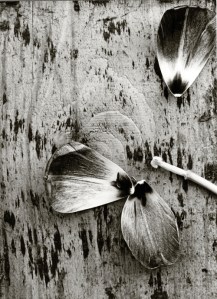 No doubt the experience of a slowly developing image in the darkroom influenced my writing. A sketch to start with, suggesting a mood, a lightness of touch, and, with some stroke of luck, an emerging symbolic element, which black & white photography is particularly well suited for. In short, a feast for the imagination, inviting associations for … poems, stories, and even cosmologies.
Are you a visual writer – in Calvino’s sense? Do you bring vision into focus with your eyes shut? Do you use images to think, and words to imagine what never existed?
Back in 2012 I posted a very short review of Italo Calvino’s Six Memos on Goodreads
related post – imagination …
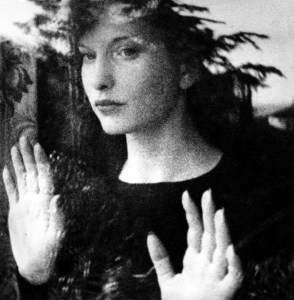 For the artist Maya Deren (1917-1951,) who created some highly influential films in her short life, scientific findings were but the raw materials of creative action: ‘The first step of creative action is the violation of the natural integrity of an original context.’ She saw the function of art and its validation in the creation of mythical realities. Her symbolic images of personal significance also chime universally.
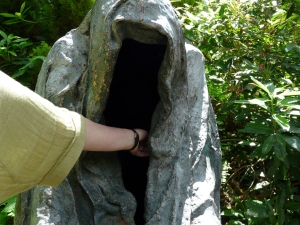 Simulated reality blinds with the Gestalt of our collective mind, where every viewpoint exists at the same time. It lacks context and shadow definition, over-exposes our field of consciousness. For Baudrillard, the schizophrenic subject can no longer produce the limits of its own being, or produce itself as a mirror. It becomes a screen, a switching center for all networks of influence. The electric sphere of the internet simulates our nervous system and turns it inside out. There remains the reality of our psychological experiences, where shadows have to be reckoned with.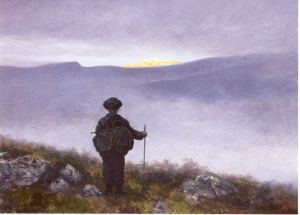
 Birth and death remain the ultimate spinners of life. In the parlance of the mystic, the moment of exaltation is in the immanent glimpse of the curl of the beloved. Can the beloved be the beloved if she is fully known? And what do we know of the various dimensions where she resides?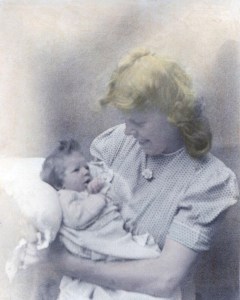
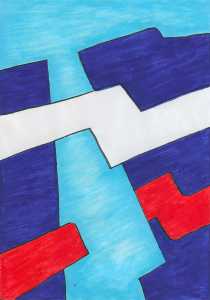
 Equally, the simple words of some prayers and mantras transmit the power of their initially intended blessing. Then again, if a quality is not already dormant in me, I may sense the love tincture, but the symbolic aspect drowns in crackling noises when I can’t fine-tune the relevant radio wave. This is why, when we return at different times during our lives to creative works that intrigued us, we may find the essence of a message and grok how it relates to us with sudden intuitive comprehension.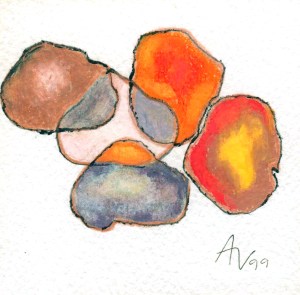
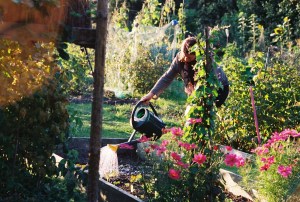 In this warm and wet autumn
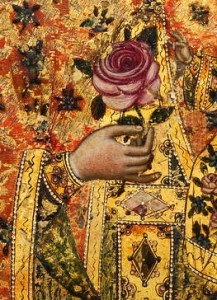 The genus Rosa, according to fossil evidence, is 35 million years old and begun to be cultivated circa 5000 years ago. Due to its tessellated structure, dome-like shape and its delightful perfume, the rose has become a symbol of the heart, of wholeness, love, beauty and perfection the world over, frequently with mystical connotation, and often highly stylised, as in Islamic art.
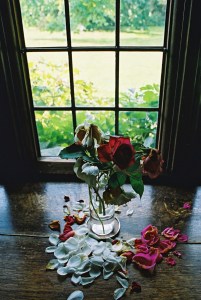 While fear of loss and abandonment engenders life, it also draws us towards the mystery of infinite consciousness, the one being with countless names. Various practices, derived from spiritual traditions, can calm a turbulent mind enough for a glimpse of harmony beyond divisions. For a while, at least, we sense the larger presence, the effortless zone, the flow – and given patience, come to realise that consciousness is what we are.
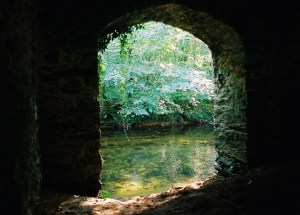 Once a novel is released into the public domain it belongs to readers who, when snatching the story from a stream running by, engage with it from their own perspective.
 If you’re a member of Goodreads, please consider entering the
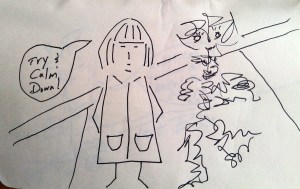 exasperation, when anyone uttering, ‘Calm down,’ deserves a punch.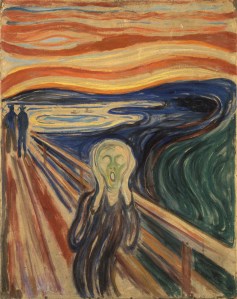
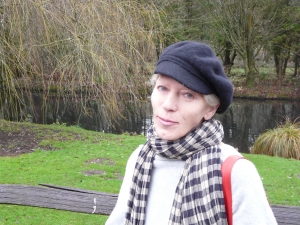 This photo was recently taken by my son on a non-make-up day, after a delicious meal with one two glasses of wine. I softened the stark reality of my age with a slight photo shop treatment. It’s the best smile I can manage in this time of confusing tragic/comic politics, for which there is no solution but to pray that the majority of people, the psyche of the world, will be able to face and endure the shadow revelations of our age, and the usual opportunists of fear – without falling into despair …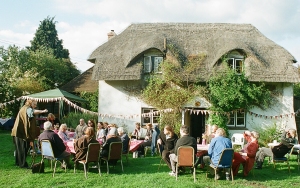
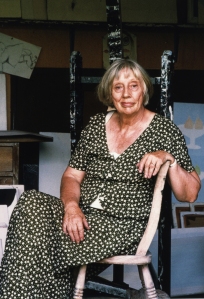 I miss her. She was a deep thinking woman, a painter, psychotherapist and lover of poetry, especially Rumi, whose verses she recited often in her very deep and distinctive voice. She was an inspiration to many. For over ten year, up to 2004, we ran monthly seminars and additional workshops together, on themes like mythology, the power of the imagination, and the significance of dreams. I feel deep gratitude for her supportive friendship and feel strongly that her frequency lives on.


