 Sun, finally, bliss. I sit in the garden, reading, among Robin friends flitting through the apple blossoms. After two hours in the heat my body needs shade. I resolve to clear some cobwebbed drawers in the shed.
The moment I lift a weighty plastic bag, I know it contains German pfennige (pennies,) about 2 kg in weight, at least. These one & two penny coins were meant to buy my wedding shoes. It escapes me how I came to start this collection. In any case, the coins were never used, though the wedding took place, and the marriage lasted for a good while. Two eccentrics … but that’s another story.
For the rest of the day I fell into a kind of Scrooge Duck hallucination, since, as I learned from Google, 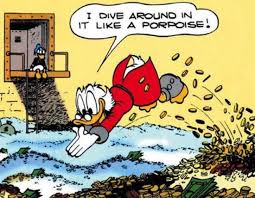 some two pfennig coins had acquired high iconic value. Up to 1968 German pennies were of copper, from there on steel was added, which made the coins magnetic.
So, equipped with a small magnet from the door of my fridge, a magnifying glass, various breakfast bowls, a glass of water, and another glass of wine, I returned to my sun spot and commenced with methodical sorting, looking for two ghosts – a 1967 coin marked G (printed in Karlsruhe) that had already steel in it, and a 1969 late limited edition of still pure copper, marked J (printed in Hamburg.)
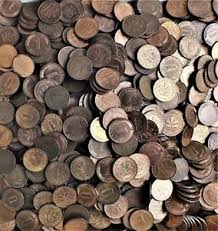 With hundreds of pennies, the odds seemed promising, at least compared to the lottery ticket I buy once a week.
I felt a rush of energy I hadn’t felt for some time. Purpose with a promise is a high energy state, I thought, giggling to myself, a habit of late, due to the surreal atmosphere since the corona virus lock down. What if? What if I find a penny worth £3000 to £5000 to collectors? I could afford to market my book, regain confidence to publish the sequel, have some work done around here, fix the shed roof, asks a painter in, buy a number of books, and leave a chunk aside for emergencies.
Well, I was as meticulous as can be, but by the time dusk chill set in, I hadn’t discovered even one ghosts. Some coins might fetch a few £s from collectors, given more research. Thing is, I’d make a good buyer for a business, having excellent taste and a knack for bargains, but selling is not my forte.
Nor am I a talented collector; otherwise, for instance, I wouldn’t have burned negatives and photographs of praiseworthy experiential novelty, including images of celebrities taken during the 1960s/1970s. Vain laurels, I thought then, devaluing my achievements. Nor would I have gifted away hundreds of vinyl records of that period, and precious books, all in a minimalist attempt to travel light into a new adventure. Profit, for better or worse, has always been secondary. And that’s another story …
The only things I collect, or maybe they collect me, are small stones. The irony of choosing to treasure such solid items is not lost on me. It’s to counter-balance my high energy states. These states, which I love, though they also exhaust, generated many satisfying projects, often in relation to groups. I gradually learned to balance the energies between my extrovert and introvert, between intense emotional and cognitive investment and periods of drifting and dreaming – incubating a new beginning – waiting for another decisive moment of clarity. How this energy seesaw was impressed in me directly after my birth is another story …
Instances of high energy in the last decade were more solitary, though I had great supporters, the co-editing Heart of a Sufi, which came out in 2011, and the writing and editing my novels, Course of Mirrors, and its sequel, Shapers. The former came out in 2017. Since then stressful events dented my spirits, a lunatic Brexit, my father’s erratic care needs, which wrecked my income, his death in 2018, and the global lock down to halt a virus, but spreading hopelessness like a trance. Procrastination became keyword for just about everything.
Somehow my short-lived penny passion brought back a taste of excitement, which beautifully sums up the essence of my first novel – finally an elevator pitch – that amazing feeling of getting on the road and the road pulling you along like a magnet to a half-imagined mysterious goal.
It’s sobering that the magic carpet of journeying has been grounded worldwide. And with the present road blocks, investing energy into a journey seems pointless, unless it’s an inner journey. Here I’m fortunate to hold rich life experiences. Being reminded what a strong purpose feels like, will, I hope, motivate me to value my writing again.
Sadness pops up when I think of teens, the young, whose natural impulse is to be active and connect physically with their peer groups, and whose desire for journeying is now frustrated – in stark contrast to the inspiring decades of my youth during the 60s/70s. Old or young, we’re all missing spontaneity, direct contact, stimulating discussions, hugs. One can never have enough hugs. Too many people struggle at present in isolation, or, indeed, in strained togetherness.
 How do I cope? I don’t watch TV, haven’t done so for years. I prefer to read coherent articles and watch movies on BFI. And I’m lucky to have a garden, with nature to touch and absorb. The lilac tree waves, the laurel hedge sparkles; Robins build their nests, tulips nod in the breeze. Oh, and to end my ramblings, I just picked some delicate violets and forget-me-nots from my garden. They both have five leaves.
It’s time for me to read my odyssey once more, to attract the wind of light required for refining the sequel. You, too, might enjoy the read, for a taste of
… that amazing feeling of getting on the road and the road pulling you along like a magnet to a half-imagined mysterious goal.
Links regarding Course of Mirrors appear on my book page
 a tall fox appears
 even hunt their kind
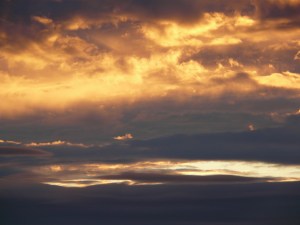 How to reconcile moments of pure beauty and light our restless world offers, with the heavy darkness of human ignorance? How is it the guiding spirit that is shining through everything so often escapes the unseeing eye? Is it our wounded hearts, or our anxious busy thoughts that prevent spontaneous being? Many of us like twilight, the dawn, the dusk, mist, where darkness and light do not negate but enhance each other. They mingle. As friends do, or lovers. Twilight is poetry in motion.
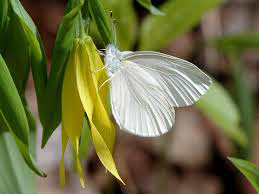 like tiny cherubs
 When there is no other near to share such paradoxical quickening with, I may call on those who enriched my life but are no longer present. I adore the moon, the ancient chunk of earth, reflecting and making tolerable the blinding beams of the sun, granting us poetry and symbolic language.
 We must see things fresh, not through tired ideas our establishments bank on, that destroy nature’s homeostasis and spill imbalances into cultures too poor to afford resistance. I say – let our children and young people decide what’s worth living for?
 Once upon a time Khidr, the Teacher of Moses, called upon mankind with a warning. At a certain date, he said, all the water in the world which had not been specially hoarded would disappear. It would then be renewed, with different water, which would drive men mad.
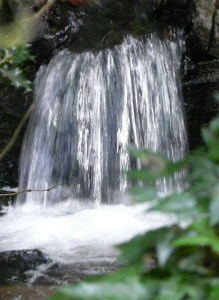 When he saw, from his security, the waterfalls again beginning to flow, this man descended among the other sons of men. He found that they were thinking and talking in an entirely different way from before; yet they had no memory of what had happened, nor of having been warned. When he tried to talk to them, he realized that they thought that he was mad, and they showed hostility or compassion, not understanding.
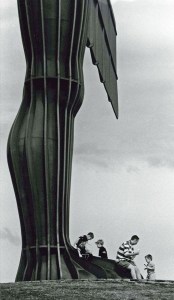
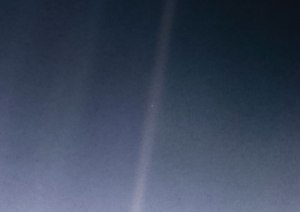 And then consider Carl Sagan’s tender reflections on the pale blue dot, the Mote of Dust, as in a sunbeam, the home we all have in common, a selfie, seen from afar. “Where everyone’s love, everyone you know, everyone you ever heard of, every human being who ever was, lived out their lives.”
 The thought brought on a Haiku last week …
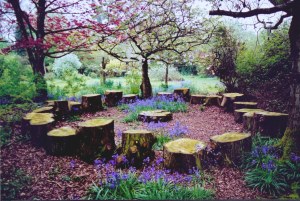 singing a phrase for an hour, or longer, with short intervals when the organ’s tune breaks into musical improvisations, only to return to the melody and phrase. In the end the sound slows and fades, leaving the echo of your voice as an indispensable part of all voices.
 To remain grounded and prevent the fate of Icarus, I tolerate the company of my little devils.
 A few days ago, waking at dawn, I had retained a dream vision:
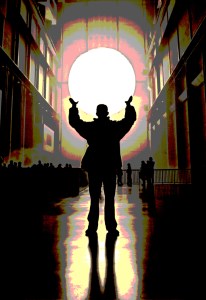 Maybe the dimension of Tate Modern’s Turbine Hall could suffice, but only a Turner price gets you there. In case you don’t know, the Turbine Hall is the place that allowed visitors to touch the sun, like my son did during an Olafur Eliasson’s weather project exhibition a few years ago.
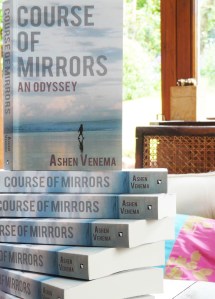 Normally, a writer’s work is condensed and hidden between the neat covers of a book, or captured on e-book screens, one click by one click. The concept of spreading the pages out in real space fascinates me, and ideas keep tumbling in. Like making the text respond to the concentration of the reader, or the lack, in which case sentences would ripple, as if floating on water.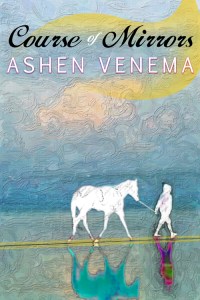
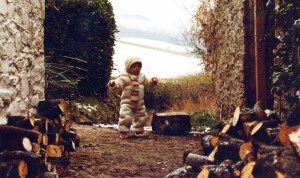 The midwife rushed after us, having overheard we wanted a home birth, but were told she had retired and the new midwife would not arrive in time. ‘Not true,’ she said, which settled it. In my wisdom I had brought my husband along. Sister Heney was delighted to attend a rare home birth for her last delivery. All went well. My epiphany snow baby, she later said. It didn’t take a helicopter landing on the opposite field to transport us to a hospital, only a police land rover to bring this dear midwife up through ice-covered lanes and snowfall to the cottage in the Quantock Hills where snow baby was duly born. We lived in this Somerset hamlet for five blissful years, with the kindest neighbours one could wish for.
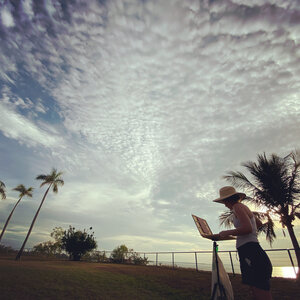 My son recently had another birthday. He allowed me to share a blog-post. In it he relates his holiday in Darwin, Australia, where his wife’s family lives.
 We take traders for granted. We hardly talk about the people who are often highly skilled and confident in their particular field. The term traders doesn’t sum it up but must do, since ‘crafts’ has come to define rare and often vanishing artisan work.
 I’m talking about hands-on work … work with the elements and under innumerable atmospheric conditions. These people deserve praise and should be given medals. Our lives would be severely disrupted without their expertise, and, frankly, societies would come to a standstill.


 Course of Mirrors