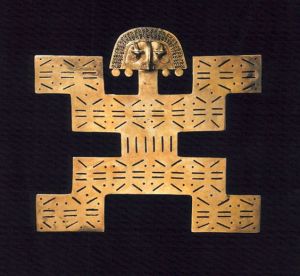
Tolima Pectoral 1000AD
In my last post, Teddy mentioned my fascination with AI. This interest became obsessive while doing a sabbatical film degree that ended in 1997 – my lucky chance to catch up on cultural history and post-modern theories. I plan to re-type my dissertation, which includes pages of tedious notes and a bibliography. But presently, like so many papers I wrote at the time, the master piece rests in an old Mac disc in a format I can’t translate to Word.
Artificial intelligence is unstoppable. I’m curious as to your take on the subject, so I’m sharing a few quotes from my exploration of human identity in the digital age.
I pinched the title for my dissertation ‘Body Electric,’ from Walt Whitman’s poem ‘I sing the body electric.’ He celebrates the body – of man, of woman, of child, bodies of flesh, sinew and blood. Do follow the above link, the invigorating poem stands in ironic juxtaposition to the theme of AI. Could a mechanical electric body ever convey the curious, breathing, laughing flesh that Whitman hearts because it pleases the soul? How would its divine nimbus compare to a form governed by mechanical algorithms? For Whitman the human body is sacred. Its magnetism comes through eyes, from the soul, a term shelved by neuroscience. Call it what you will, soul or consciousness; its light will forever seek vessels and new direction.
Fronting ‘Body Electric’ is my translation of R M Rilke’s Sonnets to Orpheus X, which, even at his time, bemoans machines that ignore the hesitant gesture of a radiant hand. Here only one a few lines:
Yet our being remains spun in mysteries of birthing
Origins from enchanted wells, a play of pristine powers
To behold only with eyes closed and in adoration.
The text develops as an intuitive assembly and starts with a quote by Michael Foucault:
‘Man is only a recent invention, a figure not yet two centuries old, a new wrinkle in our knowledge; he will disappear again as soon as that knowledge has discovered a new form.’
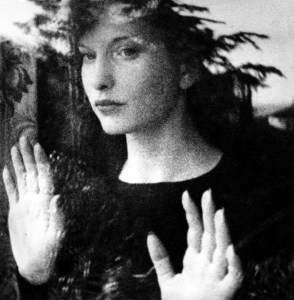 For the artist Maya Deren (1917-1951,) who created some highly influential films in her short life, scientific findings were but the raw materials of creative action: ‘The first step of creative action is the violation of the natural integrity of an original context.’ She saw the function of art and its validation in the creation of mythical realities. Her symbolic images of personal significance also chime universally.
Here is a link to her film ‘At Land.’
In dreams, time vanishes. This applies equally when dream worlds are shared, with the additional ecstasy of an interactive virtual reality:
‘… we would enter the world of fluids … Over with the solid, over with the continuous and the calm; some dance quality would invade everything and Cartesian philosophers would go through a trance, floating on history like chops on gravy.’ – Henry Michaux
But what about the vanishing space? In the public realm of instant ‘in’form’ation’ nothing keeps its form long enough to take root. Spaces to hide or resist the other fade as human nature is flood-lit. Jean Baudrillard foresaw a silence of the masses as ironic and antagonistic coping mechanism:
‘… hyper conformist simulation of the very mechanism of the system, which is another form of refusal by over acceptance …’ Jean Baudrillard
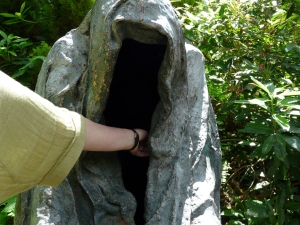 Simulated reality blinds with the Gestalt of our collective mind, where every viewpoint exists at the same time. It lacks context and shadow definition, over-exposes our field of consciousness. For Baudrillard, the schizophrenic subject can no longer produce the limits of its own being, or produce itself as a mirror. It becomes a screen, a switching center for all networks of influence. The electric sphere of the internet simulates our nervous system and turns it inside out. There remains the reality of our psychological experiences, where shadows have to be reckoned with.
Donna Haraway, a biologist and professor of the History of Consciousness, sees pleasure in the confusion of boundaries. She once said, ‘I would rather be a cyborg than a goddess.’ This intrigues. The inspiring, if manic torrent of concepts pouring into Haraway’s lectures requires extreme co-presence from her students. I resonate with her thought that contradiction is the criterion of the real, which is a theme in my planned third book (following Course of Mirrors and Shapers.) I like it that Haraway’s favourite story teller is Ursula Le Guin :)
CYBORG – a human, enhanced with integral technology. Visit this link for a taster – a TED talk by Kevin Warwick, a Professor of Cybernetics.
When it becomes possible to clone super humans one has to ask, why the need for babies, why the need for women, and what’s the point of males. Can myth be banished, and what if the human being – that pack of neurons – is squeezed into microchips like genies into bottles, how will future societies hang together?
An emerging idea proposes that to maintain homeostasis requires a new religion, DATAISM. Check this link to an extract from Homo Deus: A Brief History of Tomorrow, by Yuval Noah Harari on WIRED …
Would shadow entities of the collective psyche slip through data and act out hidden agendas? Kevin Kelly wrote: ‘… as we unleash living forces into our created machines, we lose control of them. They acquire wildness and some the surprises that the wild entails. This then is the dilemma all gods must accept: That they can no longer be completely sovereign over their finest creations.’
Besides the above quotes, my dissertation includes thoughts from Marshall McLuhan, Paul Virilio, Roger Callois, Walter Benjamin, Gregory Bateson, Don Cupitt, Francis Crick, D Dennett, Goethe, Anthony Stevens, John Searle, David Chalmers, Horst Hendriks-Jansen, Sherry Turkle, Danah Zohar and many more – all of them google worthy.
As a golden thread through my dissertation I use scenes from the film Bladerunner, where replicants are indistinguishable from humans and develop emotional responses. If we give them a past, Tyrell says, we create a cushion for their emotions and can control them. A fail-safe device makes sure of that. Familiar? It turns out that ‘mother’ the equivalent of history, is a trigger word for lack. One replicant blasts his tester to smithereens and seeks revenge on his maker. The film leaves one with the uncomfortable sense that we are all replicants, with memories implanted by history. There is no escape from the burden of existential insecurity.
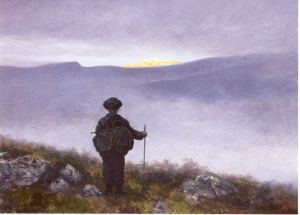
Theodor Kittelsen 1857 – 1914
Relationships and the context of place are vital to experience a sense of identity, like an energy field that grows in relation to the reality we create for ourselves. In other words, we are artists of our continuous self-invention, and we must choose our horizons.
Reverend Don Cupitt wrote the self is an animal with cultural inscriptions on the surface. Not that he is wrong, but when he assumes the soul has died, he must refer to his personal version of soul and its loss of meaning.
The Soul, the light of the universe, eternal life and consciousness, is essentially independent of matter and mind. Once embodied, we tend to forget the light’s source and feel trapped and homesick. Whether there is a purpose to the cyclic embodiment of consciousness may be a useless question, since purpose can only emerge through living and through the myths we create. Bless our imagination. Presently AI is the most generously funded myth, forging ahead, regardless of the dire state of humanity and our planet as a whole.
 Birth and death remain the ultimate spinners of life. In the parlance of the mystic, the moment of exaltation is in the immanent glimpse of the curl of the beloved. Can the beloved be the beloved if she is fully known? And what do we know of the various dimensions where she resides?
Don’t miss this worthwhile article by John Gray in the New Statesman (Oct 2016) on the upgrade from Homo sapiens into Homo deus. The page may take a while to load.
All links open a new page. They are part of post and totally worthwhile.
 Having succumbed to waves of nostalgia, I’m unsure what will emerge next, which is fine for now. My father’s death at 99, while sad, is also a relief. During the last two years I’ve been on tender hooks, waiting for the telephone call, and the prospect of sorting and processing a left-behind-part of my life. As anticipated, the reality of it was exhausting. There’s no financial reward, since what’s left of my father’s estate will just about cover the bills. His furniture was too damaged to be accepted at auctions, and anything else of value he had given away to people whose support he appreciated. He resented me for not living up to his ideas, and I resented him for his total lack of support. He had fun, spending a fortune on years of luxury cruises around the world with his second partner. While often justified, resentment is entirely useless. I tried my best, so I’ll drop my misgivings and wish my dad’s soul a good journey onwards. It frees up my life.
 It’s ironic, because my Dad had artistic leanings resembled my own. We only occasionally clicked, for a short while, especially when he needed me, after which he retreated into his controlling paranoid mode. He may have been jealous of the self determining freedom available to my generation. I should add that his psyche was injured by the last horrific war.
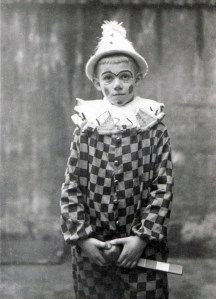
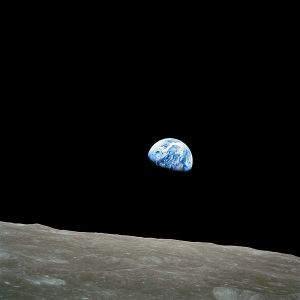
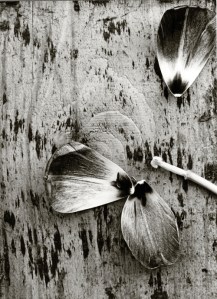 No doubt the experience of a slowly developing image in the darkroom influenced my writing. A sketch to start with, suggesting a mood, a lightness of touch, and, with some stroke of luck, an emerging symbolic element, which black & white photography is particularly well suited for. In short, a feast for the imagination, inviting associations for … poems, stories, and even cosmologies.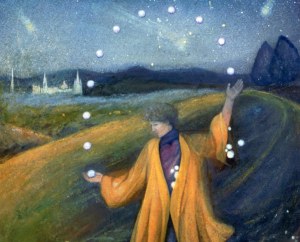
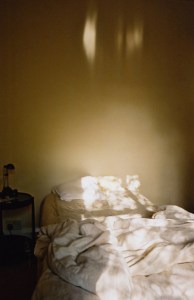 My dream vanished. It’s going to be one of those weird days, I reckon, soon confirmed by a fleeting glance while passing a mirror. My morning ritual includes stretching muscles while coffee filters into the cup. I breakfast before the screen, skim through emails and various online papers, shake head at captions ranging from atrocious, futile to hilarious, the latter due to brexasparation. The scene beyond the window calms – wispy clouds, birds flitting from hedge to tree to hedge, familiar cats slouching across frosted grass, the ginger, the black & white bushy monster, the nimble black tom with white paws and white-tipped tail, much like an exclamation mark.
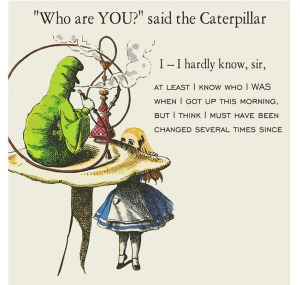 I deeply appreciate the dreams that provide an afterglow to the relationships in my life, be it the ones marked by kindness and love or the ones distorted by projections and a narrow reading of intentions. The insights that dreams bring help me to renew my sense self, no matter how delusional, it’s what I need to function in this world.
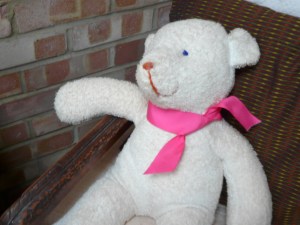 She brought me down from the attic this morning and gave me a good bashing and brushing at the back door, where the wind scattered my accumulated dust. She had no idea why she suddenly wanted me, the transitional object, around. But I know.
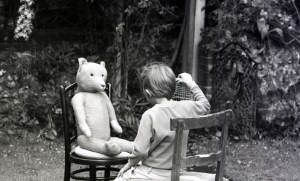 For now I’m redeemed. Everyone knows that teddies are brilliant listeners. I nod and never talk back, avoiding all misunderstandings.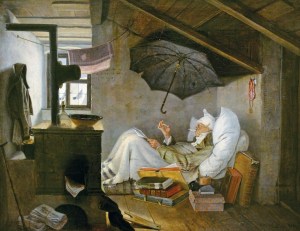
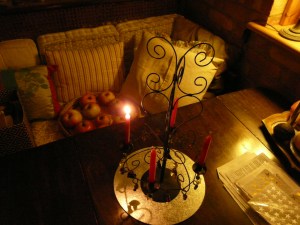 My home was hexed lately, so it feels peaceful to light a first advent candle. I’m still exhausted after spending weeks without heating, editing while wrapped up in several layers of outlandish costumes and with revolving hot water bottles on my lap. Blissfully warm again, a relentlessly dripping kitchen tap drove me nuts. Unable to focus on editing, I diverted myself with sorting client notes for confidential shredding. Tap fixed, my printer stopped working, just when I intended to make my batch of Christmas cards. It’s become a time-consuming job to get things mended. Chuck it, is the general advice.
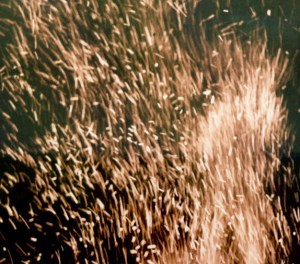 Instead, I laid strips of cord and cloth soaked in hemp oil into a star formation, building a grid of tinder and dry branches on top. On this base I arranged layer upon layer of books and stacked them like bricks to form a conical heap that grew shoulder-high. I had brought a box of candle-ends and a flask of strong spirit in case extra fuel was needed.


 Course of Mirrors