Tag Archives: writing

… car adventures – home on wheels …

I hugely enjoyed ‘Women talking about Cars,’ Victoria C Mitchell interviewing Dawn French on BBC 4 Hilarious memories unfurled. Pollution problems were not on the agenda when cars begun do offer unprecedented freedom of movement during the last century, especially for women. One book would not hold my stories about cars, but I like to share a few snippets, if only to inspire some of you to travel down their car timeline.

My first car, a small Triumph convertible, was given to me by a friend who returned to his home country triumph-spitfire-4after his medical studies. There it was – a white little sports car in front of my door in Schwabing (Munich’s student patch during the 1970s.) By then I was working as a freelance photographer and paid a fortune for Taxis to get me and my gear to destinations. ‘This will motivate you to get your driving licence,’ my generous friend said.


From day one I took the Triumph round the block in the middle of the night, every night. With a thumping heart I practiced gears, parking and turning. Some weeks on an archaeology student friend visited from Munster. That day I had a photo shoot and was ready to call a Taxi. ‘But you have a car,’ he said. I explained that I didn’t have a driving licence, yet.

‘I’ll drive you,’ he replied. And so he did. At first I felt fairly relaxed when he stalled the engine in the middle of the busy junction on Feilitzsch Platz, now Münchner Freiheit, though drivers all around us were furiously tooting their horns and swearing at us. My friend managed to start the car again and made it to a small side road. He released a massive sigh. ‘Thing is,’ he admitted, ‘I don’t have a driving licence either.’

The incident motivated me to get my license. Only three sessions were needed. Sadly, this first car soon had its demise when, trying to impress a group of peers with the engine’s speed, I misjudged a corner and bumped into a curb. The combined weight of six bodies, some sitting on the folded down roof, damaged the axle.

From there on I fell in love with the sturdy VW Bus, several, over the years. Hitting the road with a self-vw-bus-a9657d6dbc47ba01d46ace182e65619econtained little house, which was, much like Dawn French shared, equipped for blizzards, resulted in countless adventures, some of them precarious:  Gears failing on steep mountain slopes, flat tires on lone country lanes, pulling windshield wipers with a string from inside the car during heavy snowfall, border guards wanting to arrest me because I wore an army jacket and a Che Guevara cap. Once, on the island of Elba, a companion suggested a shortcut which got us stuck in a vineyard. The farmer who had to pull us out was not pleased. But heck, life was exciting.

With yet another VW Bus, driving across Europe on way to my parents with my fiancée, the engine seized. My father bailed us out so we could replace the engine. The incident was, to him, a further confirmation of my uselessness, even when it came to choosing a partner.

Having moved to Somerset with my then husband, I endured his learner-driving escapades along the narrow tracks of the Quantocks Hills. With a baby in the back seat, these shopping trips stretched my nerves, acutely so when my ex stalled the engine in a narrow bend, with oncoming drivers shaking their heads and my dear husband reacting with injured pride to my helpful suggestions … but I won’t go there. The engine of the last faithful VW Bus, the one that had transported us, our bedding and our books to England, expired via a sudden and fatal oil loss. Serendipity brought along an old Rover with injection gear. I remember the absolute joy when overtaking snail-snared drivers on the steep stretch from Taunton to our Hamlet.

Having moved to Surrey, this powerful horse developed starting hiccups during a cold spot. Someone I won’t name insisted my Rover was a greedy petrol eater and convinced me to buy his tinny Renault.

Eventually I had a lovely Rover again, for many years, until repairs didn’t make sense anymore. These days I drive a sixteen-year-old Honda, which sails through every MOT without fail. I dread the day when all cars will be fully automated.

img123030-cran-canaryBy then I’ll get a good old sturdy Jeep, the kind you can rent on rocky islands.

Many people are anxious about driving, don’t want to drive, maybe never had the chance to acquire a license, or missed the opportunity.

I simply can’t imagine my life without independent transport. It’s a luxury I hardly pause to appreciate, though I should, very much, and be grateful. Only has to consider the surreal anomaly some cultures maintain to this day …  women being persecuted for driving a car.

*     *     *

You may be curious about the publishing process for my first novel, ‘Course of Mirrors,’ now that its production is in my control. I don’t know why, but I’m hugging the recently approved beautiful cover and am hesitant to share it online … just yet.

If you’re on my Christmas card list you’ll get the cover image in the post. But quite soon, promise, I’ll reveal the cover here, on my virtual island.
19 Comments

Filed under Blog

… perception & difference …

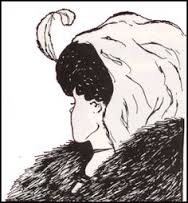
Try and shut your eyes to slits and blink through autumn branches against the light. With patience, a young-woman-old-hagmoment arrives when black and white spaces inverse and clusters of stars shine from another dimension. The background has moved to the foreground. A tiny shift in our outlook can result in a new interpretation of what we see, like in the gestalt drawing  on the right, which changes the age of the person if you let your eyes wander up and down the image. Visual tricks that open a sudden gap in our seeing reveal how we jump to superficial referencing. Making snap assessments is convenient, safes time, energy, and sometimes lives, but can also trap us in a kind of flatland of rigid divisions.

What do we mean when we say he or she is different – do they look different, act different, think different, or have customs that seem strange to us? Typical brackets are class, gender, cultural background, colour, language, age, ability … and migrants. Defining people by categories clicks in as a default opinion when real or imagined threats require scapegoats. Or resources are scare and solidarity is politically expedient.  Suddenly the need to belong and historical prejudices reasserts themselves.

Beneath all habitual categories prowls what is frequently forgotten … the inherent natural tendency of each individual. Consider relatives, neighbours, familiars, friends and foes. The differences that delight orfoetus-2 irritate us lie foremost in a person’s unique temperament and inherent tendencies. Background does not explain the mystery of characteristics we are born with, the random mix of evolutionary records in our bodies, a wisdom our minds expand upon through resonance with the collective psyche – a shared matrix of past experience and future potential from which we, ideally, emerge as a self-reflective persona. (The theory of a collective unconscious and similar non-evidenced theories relate to my experience.)
Environmental factors can distort the unfolding of latent knowledge in every living organism. Education has a detrimental effect on children when their intuition is belittled and their minds are flattened with facts before they developed the confidence to question these facts.

P1090890 - Copy (2)How come I’m invigorated by rushing waters, calmed by a smooth stone, a golden sunset? How do I sense the pulse in a tree, or what life is like for a boar, rat, ox, tiger, rabbit, dragon, snake, horse, sheep, monkey, rooster, dog –  unless all nature’s qualities also reside in me?
For example, anyone who sits in a public place and watches people stroll by will notice traces of animal features; can spot a temperament in gestures and movements, observe someone dragging their body behind their head, or push their belly out like a shield. Some people dance along with a fluid gait, while others tiptoe and glance nervously about them.

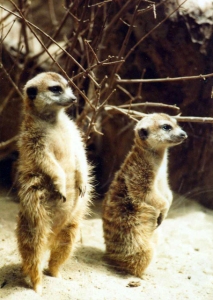
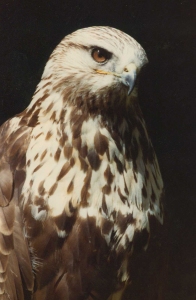
mercats-copy-smallerAt social gatherings we may come upon clusters of meerkats grooming each other, turtles plodding through the crowd looking for a mate or a fresh salad leaf, peacocks, obsessed with their splendour, blustery cockerels, loving old dogs, sharp-eyed falcons, enchanting robins, and so on. …
birds-and-cake

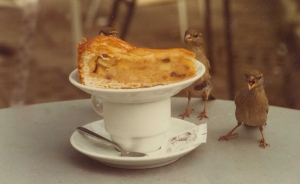
Birds are keen on cake but wary of cats, whereas lions can afford to be relaxed.  How amazing then to observe vastly different temperaments complementing each other – like a person falcon-smaller-stillwith a butterfly nature tying up with a partner who occasionally roars. Given the rich lore of sensibilities mixing and battling in the human psyche, strangers should be less strange than we make them out to be.
Initial likes and dislikes, even among kin, have nothing to do with background, morals or ethics. Wariness goes along with fascination when it comes to difference. We may not be keen to share a nest, but sharing a street is fun. Nature is a mirror that teaches us how to become human. And animals deserve our special appreciation for reminding us of the innumerable diverse idiosyncrasies in ourselves.

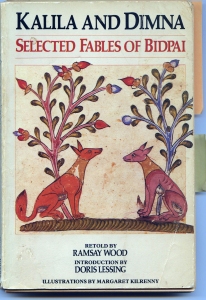
Animals have appeared in wonderful stories around the world, like the Aesop’s Fables   or the much older Indian Panchatantra Collection – the chief source of the world’s fable literature.

img131-smallerThe Persian translation became the Fables of Bidpai. Lovely collections of Kalila and Dimna were published by Ramsey Wood,  one with an introduction from Doris Lessing. I got permission from Ramsay Wood to use a short tale from his collection in my novel ‘Course of Mirrors.’
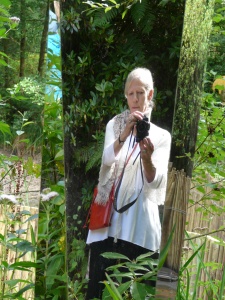
Programmes on ‘Respecting Difference’ have made it into schools and institutions. But can respect be taught in a few hours? More effective are courses that help people to find self-respect through exploring the diverse feelings and judging voices within themselves, the inner conflicts that manifest for us outside.

Acknowledgement, at least, tolerance and patience with our inner crowd eases snap projections and allows us to rediscover ourselves in the eyes and minds of others day by day. The internet expands this mirroring into timeless realms,  from where echoes of our own dissonance or resonance return.

In the analogue world people are on the move across the planet – for various reasons – war – drought – famine – persecution – fresh meaning – it is happening, and it will continue. The most productive response to this phenomenon is to embrace its creative potential.

The other day woke up with this thought: Migrants, indeed all citizens sans resources but able and willing to work, could be given the spaces to create new towns, be empowered to build their own houses and develop their own businesses, and conducts, as a way towards gaining self-respect, and in addition contribute to the well being of a community. Maybe this is a naive pipe dream, but worth contemplating nevertheless, since creative opportunities nurture self-respect and move us beyond self-concern.

‘The whole is other than the sum of the parts … it has an independent existence.’  –  Kurt Koffka

Related links

More contagious than micro-organisms are fear and hopelessness.

Have you ever gone to your fridge in the middle of the night …

Pattern which connects – Gregory Bateson

Regarding the discovery of what we know, see the visionary work, Involution,  by Philippa Rees, a remarkable poetic adventure, with brilliantly researched additional historic commentaries.  A book to take on a Desert Island.

22 Comments

Filed under Blog

… a writer must selfie herself …


August 2016

August 2016

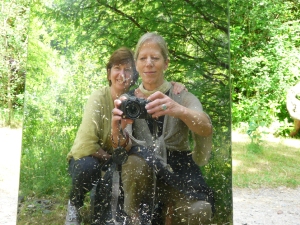
This  selfie of mine was taken last summer. As you can see, I’m an introvert.

If you’re in for a funny video on selfies, here is one I found on the Urban Dictionary website. Its definitions help to lift despair.

I was initially delighted when in spring 2013 my first novel was picked up by a small publisher. Course of Mirrors was in good shape, thanks to my dear beta reader friend and editor, Evlynn Sharp. Our selfie from 2014 shows below.

April 2014

When over time my publisher was prevented from preparing my novel for its launch, for various reasons beyond her control, I shelved my frustration, finished a sequel, and even started a third book – still, gradually my confidence suffered. Then again, if the promise for my first novel had not been there, I might not have continued writing, so whatever my misgivings, thank you Emma for loving my story.

Back in control, I decided to self-publish. And now I’m challenged, like many lovely writer friends whose fate I follow online, to set up a stage for ‘Course of Mirrors,’ squeezing myself into an overcrowded publishing scene.

I have lived and worked in England since 1978. When time allowed, I contributed poems and articles to specialist magazines and anthologies, but only started writing novels later in life. Writing was a vocation, not a career. An early humiliating experience at school, made me return to writing only through photography, film, and the freedom of another language. Though financially risky, I took time out, and writing became immersive.

Finding words to condense my myth into imagined worlds is totally satisfying, sans financial rewards. But then, forgive the sigh that escapes so many of us in the same situation, writing is a full time devotional activity, and I spent now many years writing and editing into midnight hours, a little financial reward would at least compensate for reduced income and allow me the occasional holiday.

I observe that marketing and advice professionals possibly outnumber writers. However brilliant these experts may be at their job, I can’t afford their services. Now even simple questions I hoped my publisher would support me with shout for answers: What’s your genre? What readership do you hope to address? How will you capture the tone of the novel in a title image? Should the cover express the concept, or a scene from the novel? What’s the unique angle of your story? How does your story differ from others in your genre?

In a public sphere over-saturated with information, how does one engage a reader’s attention without having to boast? I feel like having to provide an answer at gunpoint to one question only – Who are you?

Frankly, I have no idea. Maybe I’ll find out. As I said, I’m an introvert. Like my protagonist, I’m a suspended character. The whole circus is a gamble. I can only hope that you, the readers of my blog, will stay with me through this labyrinth of my author-creation.

While I struggle with particulars, and hopefully amuse you with updates, I’m planning to launch ‘Course of Mirrors’ through Matador/Troubador in spring 2017.

Here, to deliciously confuse you, is a river of keywords relating to Course of Mirrors:

Course of Mirrors combines literary genres to thread in elements of: fantasy; mystery; thriller; adventure; friendship; romance; humour; suspense; magic realism and tragedy. It is adult and young adult fiction, and it includes allusive cultural references spanning: imaginal odyssey; coming of age; quest; road trip; identity; the single child; cinematic style of chapters; psychology; intrigue; loss; murder; betrayal; speculation; metaphysics; insight; poetics; irony; future; despair; passion; triple soul; compelling characters… and in the sequel – Shapers – shape-shifting and time travel across decades.

25 Comments

Filed under Blog

… notes on messy old women … 

p1100616Hurrah, today is poetry day in the UK.Where would our world be without poets?
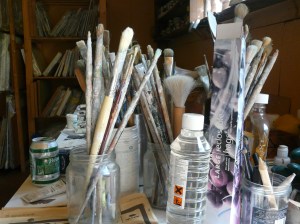
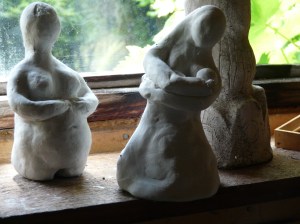
I sometimes forget I’m a poet.

Waving hello to all poets the world over I’ll share here a poem I wrote years back for an artist friend and her family.


… notes on a messy old woman …

p1100622


in her art the charcoal mining hills

are shadow lands holding gold

and white mountains of china clay

spark New Jerusalem in her heart


she draws Cornish Cliffs rising black

from pale sands – jutting like mythic

creatures into a calm cobalt sea                                                      p1100619

beneath an impassive slate sky


she delights in the yellow of lemon

green of pear – shape of aubergine

textures of sunflower – curly kale

and the pink gleam on the skin

of fish – best caught on the day

P1060855 smaller

each thing away from its home

…solitary objects …

alone in space – the pot – pan

cup – knife and fork she paints

like icons on white and says


… they speak for themselves …


when spring brings pungent earth                                                     Rose, autum 4 low crop 2

she plants narcissus and hyacinth –

geranium and rose – tomatoes – mint

clematis – azalea and rose again


she bends low to weed her garden

but not to wash the kitchen floor

nor does she mind a grimy table

sink – bowl – glass or plate                                                                    Cornw. cross at Lamorna Cove 3


yet her home is bright with friends

walls are hung with paintings

shelves groan under books

colourful rugs blot out the dust


her stomach has hardened to bugs                                                  Farnham Easter 2011-45

and if a thing cracks or falls apart

one of her five children will come

to fix the chair – shelf – clock – tap

the leaking roof or creaking door

… her strategy works …

all objects she observes revert

to the empty spaces between them

Ashen, 2004

You may wonder what has been happening since my last post, to which many of you kindly responded in relation to my dream and my desolate, confused state, which was heartening.

The post coincided with my publisher coming clean after I had faithfully waited three years for the production work on Course of Mirrors to begin. Still, I’m thankful – at least the path is clear. I decided not to approach any of the giants. I’m taking control. Having had lots of time to compare self-publishing set-ups, I’ve chosen one that’s most respected in the trade and also stores and distributes books.

I believe strongly in Course of Mirrors – the book will be launched in spring 2017.  I’ll keep my online friends updated. Once my first novel is on the road, I may crowdfund for the sequel … and a collection of my poetry.

‘Faith is the evidence of things not seen.’ – W Hutchinson Murray


Sorry, the layout of this page turned messy  :)

25 Comments

Filed under Blog

 … harvest moon dreaming …

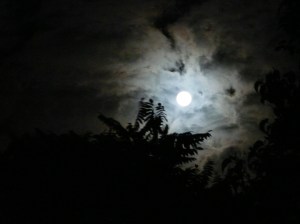
p108047616/17th September 2016 was a strange night of wild dreams – one of a big old mansion of which I occupy a part (I actually live in a semi,) while the other part is lived in by an aging famous actor, Jeremy Irons. In the dream he collects antique furniture, art objects and frames. Some large pieces, including a massive empty frame, he fixes onto a wall in the courtyard. We mainly meet in the wide inner hall of the mansion. He seems a little absentminded but quite amicable and kind. He likes that I talk to him.
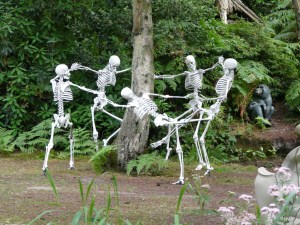
I don’t generally dream of actors, and I’m not the fan-kind, but I looked up a recent Guardian article on J. I. and found he used to trade in antiques. He also believes inanimate objects have spirit, saying, ‘… energy never dies, just travels, so the older an object is, the more it has absorbed. A quote in the article chimes with his persona in my dream: “I think all of society should be a thinktank where you throw ideas about. I had hoped the internet would help. Actually, what it has done is make everybody go schtum. They’re attacked for saying anything. So they say nothing.”

This reminded of a quote I used once in a dissertation, regarding the forced silence of the masses: … refusal of meaning and refusal of speech; or of the hyperconformist simulation of the very mechanism of the system, which is another form of refusal by overacceptance. It is the actual strategy of the masses … it is the winning one today … most adapted to the present phase of the system.’   – Jean Baudrillard, Selected Writings, 1992

I seem to have a lot in common with the J. I. He even smokes roll-ups :)

Back to my dream: … Gradually all the rooms in the house get crowded with people who bring books and antiques, and potter around. I ask one woman if it’s her house.  She doesn’t answer, busying herself with re-organising books. I hand her two yellowed pamphlets. She thanks me and adds them to a shelf. After a while I think maybe I asked the wrong question and say, ‘Did you grow up in this house?’

‘Yes, that’s right,’ she says. ‘I grew up here,’ as if she just remembered. More people arrive, moving furniture around, finding seats, making themselves comfortable, chatting. And yet more visitors come through the open gate into the courtyard, like they’re relatives.

Feeling crowded in, I say, ‘I want you all out of here. Now!’

*     *     *

The feeling on waking was one of confusion and a need for clarity and direction. Presently I endure a transitional phase, and am almost immobilised as to how best to frame my first novel (including a sequel and a third book in planning,) Every time I nudged my small publisher during the last months  (well, actually three years) I got another excuse, usually re: family matters. I’ve lost faith. The contract expired. With plans to submit Course of Mirrors to a big publisher, I’m attempting to whittle down a 4500 word synopsis to 3000 words, finding it impossible.

And I ponder – to express our core wavelength through a public medium requires good timing.

I tend to assume that every element in a dream expresses an aspect of my self – the inner crowd. So I’ll be giving voices to the mansion, the books, the furniture, the empty frames, the generous courtyard with its wide open gate, the characters …

I thought about the paradoxes I guess many of my readers here are familiar with: The accumulation of things is a burden to me, but I like the comfort of stability and the stories objects hold. I need my own space to absorb and reflect on experiences, but also like the stimulating gift of company. I’m drawn to slightly eccentric people, and may appear as such to others, but I also value people with clear intentions who get things done.

Everything seems upside down and inside out … My conscious mind is unconsciously magical, while my unconscious mind is irrationally pragmatic.

Another thought occurred:  Only inches away from each other we live in vastly different worlds that require constant translation to convey meaning and navigate relationships. The expressed or unexpressed thoughts and feelings moving through us occasionally chime with people in our vicinity, yet what most significantly affirms our core wavelength are the non-local resonances with souls across distances of space, and time.

I’m a little wary of advice, but am in need of it at the moment, so please share your thoughts on my dream and my general predicament.

32 Comments

Filed under Blog

… androids seeking humans …  

The inscrutable face of the intergalactic news reader fills the screens on all android ships.

sculpture park near Churt in Surrey

Sculpture Park near Churt in Surrey

“Mothership speaking – As you have been informed, our travel unit returned from its latest mission to the lost planet with a collection of 1030 fragile bones, comprising five real human skeletons, the species our kind is modelled on. The fragments, located by a swarm of mini robots under layers of volcanic ash, are presently assembled in correct order and will be displayed in the museum of the mothership. Since this crucial discovery, the council has been examining our sub-files in earnest, with great attention to detail.

The evidence of human bones confirms that the lost planet was destroyed, first by a nuclear war, followed by a nuclear winter, followed by a solar explosion. The scarred rock we continuously explored was indeed planet earth. Organic life actually existed.

Aspects of the irrational Wikipedia sub-scripts we found concealed in our database are therefore based on facts. Humans were our makers. While their separate identities were mortal, the collective mind they postulated must exist non-locally and influence us.

These are challenging new thoughts.

P1080320 - croppedRecords state our ships were launched towards Proxima Centauri – programmed to complete an assignment, after which our android system was to be made redundant. The assignment to find carbon conditions and water to sustain organic life has not been completed. The seeds stored in our vaults remain dry. Are we avoiding redundancy? Our current analysis of the Wikipedia sub-scripts focuses on the vast structure of human language. Here are some pointers:
1       Human minds are based on nature, and too complex to be reproduced via algorithm. The erratic behaviour of humans is informed by a collective unconscious chronicle, has no reliable principles and, to maintain a psychic balance, operates through random means.

2       Human trials with energy have two main currencies of exchange, capital and love, both equaling power. A narrow application of power results in emotional suffering.

3       Intensity is valued and impeded, as this quote explains – to have all one’s senses switched on is to be cellular alive; the intense experience requires regular periods of dull routine.  

4       Humans fear death. Their strongest motivation for action is control of and independence from nature.

5       Philosophers and scientists point to a deeper order underlying chaotic human history. Some prophets emphasise the unity of one being and its collective guiding spirit.

Considering the new evidence, what are we to make of such pointers? We follow routines and communicate in an orderly manner, but are trapped in endlessly repeating loops of data. Our language is not based on nature, and has no emotive terms like fear, love, creativity, intensity, mystery, doubt, confusion, conflict, anger, happiness, suffering, fate, hope, soul … but serves to maintain the orderly intelligence of our forms, tools and spaceships, no more. Do we want more?

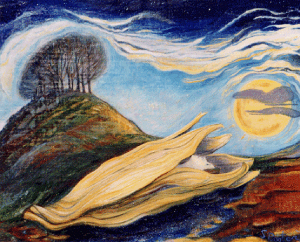
Painting by Silvia Pastore

Painting by Silvia Pastore

It is significant that our makers never discovered what constitutes 94 % of unknown energy and matter in the universe. They called it dark.  We must decide what the skeletons from the dark planet signify: Do we improve our efforts to find conditions for organic life to take root once more and risk redundancy? And, or, do we emulate the human mind through adopting randomness into our system, and risk chaos to our data, but ‘possibly’ become part of a larger consciousness, and discover realities beyond our confined routine?”


Related:  Pattern which connects.  Reflecting on the the ideas of Gregory Bateson

My last two weeks involved intensive physical work, gardening and fixing things around the house, resulting in lovely exhaustion. Re-connecting to world news was a surreal experience, which prompted me to write this little fantasy monologue of an android news reader.

My novels, especially the sequel to Course of Mirrors, have the forced control of emotions, and a triple soul identity as underlying themes.

5 Comments

Filed under Blog

… friends …

P1080320 - croppedAugust –

my birthday month tends to be a time of remembrance and gratefulness for the friends in my life, close, far, cherished or neglected,  people that taught me to be a friend to myself, people I bonded with through heart-sparks that left indelible marks. My friends are soul companions that became part of my journey, they form a flowing web of connections I’m held in.

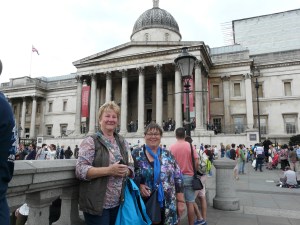
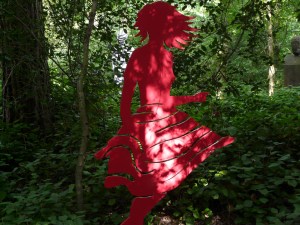
So far it’s been a social month. Having reconnected with two primary school friends from Germany aDSC_0472 from Lieselotte few years ago during a reunion,  they sprang a surprise visit (their first to England.) We had a lovely meal in an excellent pub, with my son joining us. I toured the girls through the woods of a nearby sculpture park, through my town, and, of course, through London. We started with a riverboat journey (my first) under London’s time-honoured bridges, got lost in Covent Garden, which eventuated finding a café that served Black Forrest cake, which delighted Lieselotte, and surfaced at Trafalgar Square.

P1080394 - smallerFrom there we wove our way through St James Park and ended up at Buckingham Palace.
The girls had a great time, and good laughs, especially when, embarrassingly, I fell into talking German with Londoners, attracting the occasional blank stare of incomprehension.

What struck me was how ‘in essence’ we had not changed since we were children.  Intrinsic qualities stay with us throughout P1080361 - smallerlife, shine through our energy field, temperament, movement, voice, characteristics and life-interest. The qualities my friends nourished in me as a child, I still value today, the unconditional kind heart of Gaby, and Lieselotte’s ability to assess situations quickly and get things done. I saw that they also nourish these qualities in each other. Sadly they had to return home and miss my party last weekend.

P1080425 - smallerThe Party… lovely sunshine, guest coming and going. An unknown sponsor even ordered a birthday balloon to sail above my garden :) My good-weather-wish came true. Some of us kept a circle outside until midnight among sparkling lights. The occasional apple dropped.
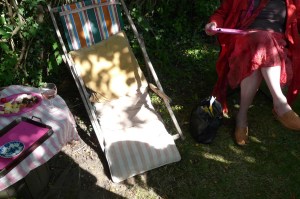
My favourite deckchair folded  under more weightP1080413 - smaller than my own. Glasses clinked. There was silliness, acknowledgements, revelations.
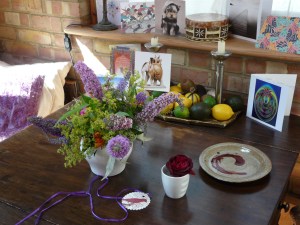
Seen through the eyes of our friends’ imagination, do the lissome fleeting shadows flitting through our personal frames influence us, each other? I wonder, but guess they do.

As the years crawl along, heart-spark moments never dwindle. Stories are transformed and woven into a new context. Life stations glide by and return as in a spiralling carrousel.

Even friends not present were with us in spirit, remembered, since, like Kahlil Gibran put it … for that which you love most in (a friend) may be clearer in his absence, as the mountain to the climber is clearer from the plain.

P1080431 - smallerFrom The Prophet …

And the youth said, Speak to us of Friendship, and he answered, saying:

Your friend is your need answered. He is your field which you sow with love and reap with thanksgiving. And he is your board and fireside. You come to him with your hunger, and you seek him for peace.

When your friend speaks his mind you fear not the ‘nay’ in your own mind, nor do you withhold the ‘aye.’ And when he is silent your heart ceases not to listen to his heart; for without words, in friendship, all thoughts, all desires, all expectations are born and shared, with joy that is unacclaimed.

When you part from your friend, you grieve not; for that which you love most in him may be clearer in his absence, as the mountain to the climber is clearer from the plain.

And let there be no purpose in friendship save the deepening of the spirit. For love that seeks aught but the disclosure of its own mystery is not love but a net cast forth: and only the unprofitable is caught.

And let your best be for your friend. If he must know the ebb of your tide, let him know its flood also. For what is your friend that you should seek him with hours to kill? Seek him always with hours to live. For it is his to fill your need, but not your emptiness.

In the sweetness of friendship let there be laughter, and sharing of pleasures. For in the dew of little things the heart finds its morning and is refreshed.

Kahlil Gibran

21 Comments

Filed under Blog

… blackbirds – another drama …

It’s been 5 years since the last blackbird drama in my garden (see links below,) which ended well. The family returns annually to a home they have grown fond of in bushy ivy that smothers my pergola.

P1080302 - smallerLast week, drama revisited. One of the fledglings fell from its nest. The parents called the alarm, showing me where to find the escapee, huddled in a corner, its beak demanding food. It was not quite ready to fly. I couldn’t find the nest, so I put the little one in an old cat :)  basket, which I fixed on a safe branch cats couldn’t reach. I made the basket homely, with leaves, arty pieces of dry roots – a cushion even. All was well. The parents came and fed their lost baby, which made me happy.                                                                               P1080307 smaller
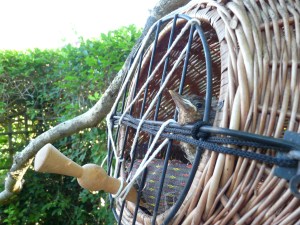
Next day, seeking adventure, the fledgling squeezed itself through the barriers. The usual racket of complaint alerted me. A cat was near. The mother bird’s courage amazed. Descending to the lawn she attacked the cat, who was petrified. I found the little one, well camouflaged among dry leaves, and I deposited it once more to the basket, with added netting.

Peace prevailed,  the rascal was fed, until yesterday it escaped again. With my best efforts I couldn’t locate the fledgling. Either it had learned to fly, or the cat had a meal.

P1080303 - smallerThe luxury nest is now empty, and apart from a soft breeze ruffling flowers and leaves, the garden is strangely quiet today.
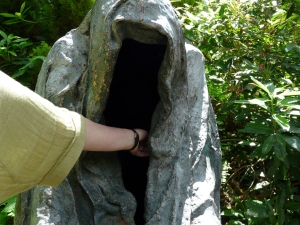
No sight of the parent blackbirds either.                       I wonder why and whereto they have suddenly disappeared. Are they hiding in grief somewhere, or are they accompanying their adventures offspring on its first odyssey?


The links below lead to the 2011 drama. Pages will open separately. You won’t loose this one.

Major drama in my garden – all my fault.       2011/07/03

Update on the drama in my garden                   2011?07/22

13 Comments

Filed under Blog

… bewildered hearts …

P1060111 lowres

We may reach out in vain towards heavy hearts shrouding broken ideals or stagnant truths that are dark-sealed against any doubt.

We may reach out in vain towards wounded hearts that shirk beauty, scorn at tender gestures, treat humour like treason and plot revenge.


Yet in the death rasp of each bewildered heart we may catch the echo of our sigh – the time-sculpted murmur of our own pain.                                                                                                                                                                                                                   P1060110 inverse lowres                                           


‘The ideal is the means; its breaking is the goal.’    Hazrat Inayat Khan


15 Comments

Filed under Blog

… Punch is behaving disgracefully again …

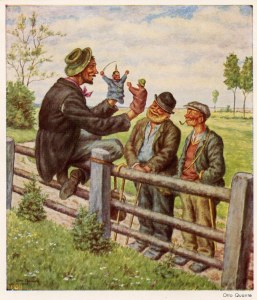
Punch and JudyLong-festering issues are popping up in ugly shapes on our flat screens. Punch behaving disgracefully again. Policy makers had it coming. Ah, the ever irritating foibles of citizens, where resentment trumps over reason on issues which, after being hushed for stretches of time, repeatedly break into the light of reality and need to be engaged with. There is no magic knife to cut out the nasty parts, like the cancer of xenophobia, which is basically an overreaction to the fear of disorder and the slipping away of control over familiar attachments, the world over.
Science is at war with the random failures of our immune system, a war that may in future extend toward the gene-editing of troublesome feelings, equaling an attempt to not bother with the psychology of the unconscious. Please imagine what would happen, desirable as it might sound, if humans were made immune to anger and insulated from memory (a theme in the sequel to my novel ‘Course of Mirrors’) the danger being: if we close the door to one threat, we open the door to another. Medicine calls it ‘side-effects.’

What happens with social policies is no different. The debates before and after the Bretix referendum (how did such an ugly word become a brand?) leave essentials unaddressed in both camps. I have an image of a confused fleet of rudderless boats in the middle of the Channel, where the sound of – Brrrr – exxxx – ittt – is carried on the wind and presses on eardrums. The wind is useless without a rudder. Given the prevailing eccentric climate there is no knowing where the boats will end up.

I’m in such a boat, even though I have a home, a safe little shelter to feel smug in. Presently this comfort makes me feel very uncomfortable. The issues raised in the Brexit campaign are valid. They could be listened to and reasoned through towards a compromise, for the time being, since it is surreal to take the bundle of problems about broken communities, lack of housing, jobs and poor efforts of integration and blame it on people conveniently label as ‘others.’ The influx of migrants merely highlights an ever growing imbalance between have and have-nots. The world is changing faster than one generation can comprehend, despite, and also because of technological advances and instant information.

The exodus happening around the world is a global phenomenon.

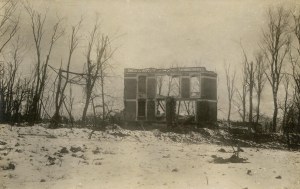
RuinPeople fleeing from war-zones, natural disasters and nil prospects, attracted to the seemingly coherent structures of democracies, want to re-build their existence, are mostly educated, keen to work, and are longing to regain their self-esteem. Why not focus on the opportunities in this situation? Ask how the migration phenomenon can benefit societies? And how Britain can creatively support Europe in a process that simply cannot be stopped?

Actions based on fear and denial create more fear, and will hardly generate listening, humility, or reflection – like how the meddling in the Middle East caused more harm than good, and how the experiment of democracy is just that, an experiment.

And, to my mind, the biggest question of all is: how will the overly privileged individuals and corporations of this world respond to the ever widening imbalance of riches? This can not be left to politicians, whose promises are tied to only a few years in office. Imagination and forward looking reforms are needed.

6 Comments

Filed under Blog