
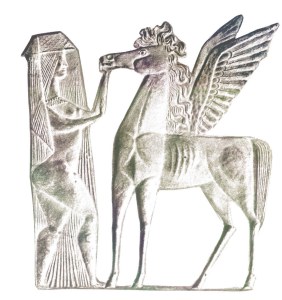
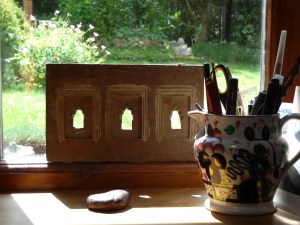
A tile made for me by E. Cordier for photos in his studio.
In a previous post I mentioned my erratic filing, which, when working on a writing project, results in phases of strolling through my inner jungle in search of a spot marked for attention, often years back, or wandering through a library in a kind of trance, ignoring categories, with only a vague sense of purpose. On route, I explore seemingly unrelated and often incongruous themes, before a match creates coherence in a new context.
While searching for an invisible gestalt, I tend to reread authors that inspired me. Last week it was Six Memos for the next Millennium, by Italo Calvino (translated by Patrick Creagh.) Like him, I’m all for the shared magical. His Memos are lectures he prepared during 1984 for presentation at Harvard University. It was the year when computers moved into our lives. Maybe he was concerned about Orwell’s dystopian Newspeak being just around the corner. In any case, it made Calvino reflect on a set of literary values. His sudden death meant he never presented these lectures, and only five Memos made it later into print: Lightness – Quickness – Exactitude – Visibility and Multiplicity … keywords, expanding on ways we perceive.
Though it’s a small volume, the material is too rich and diverse for my humble post. Still, I want to share a few quotes and reflections from re-reading the chapter on visibility. Calvino wrote …
… For successful imagery, writers must do two things: convert the visuals of the mind into words, and at the same time make sure that the words are so well-crafted that when read, the reader can instantly visualise every setting, every character, every chosen detail as if they were looking at it directly, and not at a page. It’s a deliberate process, this transmogrifying from image to text and back to image ….
He describes the progression … something that is painstaking but not necessarily painful, from the moment you grasp the significance of a single image and then associate it with other images, forming a field of analogies, symmetries and confrontations, and then organising this material, which is no longer purely visual but also conceptual, to try and give order and sense to the development of a story. Here the writing, the textual product, becomes increasingly important. From the moment you start putting black onto white what really matters is the written word, first as a search for an equivalent of the visual image, then as a coherent expansion of the initial stylistic direction, so that eventually it is the image that is being pulled along by the text, and not the other way around …
My poems, and certainly my first novel, started with a spark, a solitary image, like a cypher compelling me to uncover its meaning. An unfolding message can be drowned or crowned. Writing (like any creation energised by passion and craft) occasionally achieves such a finely tuned nuance that an invisible quality resonates deeply through the visible.
During my recent reading of Calvino’s chapter on visibility I recalled my entry into black and white photographic processing, which, before digital technology, happened in the darkroom … to start with, in complete darkness, with the celluloid film being developed in a chemical bath, regularly shaken, like the preparation of a homeopathic tincture, then rinsed and fixed in another bath, rinsed again and dried. Creating prints is the next stage, for which red light is allowed. The negative is placed into the enlarger, from where it is projected through a lens with a sharp beam of measured light onto a light-sensitised sheet beneath. Correct duration of the beam results in a positive print that, at best, develops very slowly in a tray of chemical developer.
Watching the print of a well exposed negative emerge under the red light has always given me enormous pleasure. Like a dream emerging from the unconscious and becoming visible.
The image first appears as a sketch, until grey and dark tones assume saturation, ideally without losing highlights. Once perfection is achieved, the print is shortly rinsed and transported into the fixation bath for a while. Only then is it safe to introduce daylight, for further rinsing and drying of the print on a hot press.
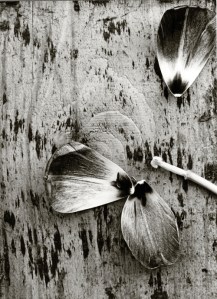 No doubt the experience of a slowly developing image in the darkroom influenced my writing. A sketch to start with, suggesting a mood, a lightness of touch, and, with some stroke of luck, an emerging symbolic element, which black & white photography is particularly well suited for. In short, a feast for the imagination, inviting associations for … poems, stories, and even cosmologies.
Are you a visual writer – in Calvino’s sense? Do you bring vision into focus with your eyes shut? Do you use images to think, and words to imagine what never existed?
Back in 2012 I posted a very short review of Italo Calvino’s Six Memos on Goodreads
related post – imagination …
 She brought me down from the attic this morning and gave me a good bashing and brushing at the back door, where the wind scattered my accumulated dust. She had no idea why she suddenly wanted me, the transitional object, around. But I know.
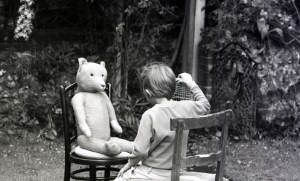 For now I’m redeemed. Everyone knows that teddies are brilliant listeners. I nod and never talk back, avoiding all misunderstandings.
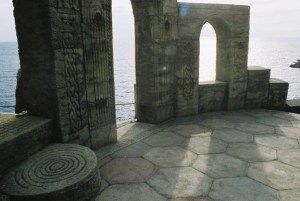 The scene takes place on a sunlit peninsula, set in a glittering sea. I play with white cubes, each feather light. The childlike part of me experiments with the beauty of forms and the building of imaginative structures that mirror colours of the sky and surrounding landscapes. Others join in, and not just friends, strangers too. We have fun, laugh and toss cubes to each other. We are building a temple to celebrate play.
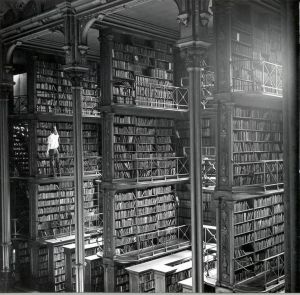 After all, there are walls and walls.
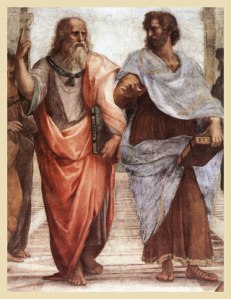 virtues of Plato’s top-down and Aristotle’s bottom-up metaphysical arguments. I explored question such as – do the aggressors in my dream represent the judgmental part of me that inhibits the creative impulse of the child that shrinks when it feel unwelcome? … Yes.
 Plenty of subjects nudged me towards a blog post during these last weeks. No gust struck a chime – the sure sign I was avoiding something. I stepped back – into gardening, watching birds, boring paperwork, reading, and posting two reviews of thought-provoking novels on Goodreads:
  Yesterday I met with friends I had not seen for a while. We shared stories upon stories. With each of us being the lonely manifested part of our soul crowd, we fine-tuned into the universal themes of combined interests. It’s tricky to express what happens when we allow our associated crowds to wake and remind us of their presences within us. I tried to enlarge on the theme of soul families in a recent post –
 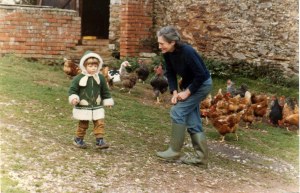 Our selfless neighbours left an indelible impression on my son. They made him a valued and loved part of a small community. Our farmer friend, Hope, was hungry for knowledge, though never realised her dream of travelling as a journalist. She had however the most vivid visions of Tibet; a place neither of us had visited but felt strong emotional connection with. Not the first time, I had a shock of appreciation for the unremembered sparking instant rapport slipping through time.
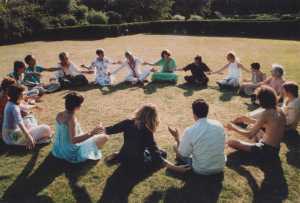 I was thirty then, had travelled much and been involved with innumerable internationally composed groupings, circles upon circles – this was to continue for decades to come. Among the groups were people who felt strangely familiar, like Hope. We would guard out solitude, cry together, or laugh hilariously about silly things. Equally there were those wary of me, often for reasons unknown to themselves, which made me wary of them. You may know this treading-on-eggshells feeling.
 A week ago I used the Goodreads giveaway programme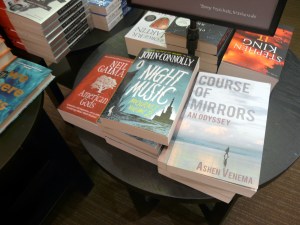
 Once a novel is released into the public domain it belongs to readers who, when snatching the story from a stream running by, engage with it from their own perspective.
 If you’re a member of Goodreads, please consider entering the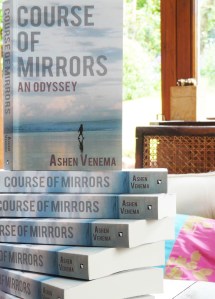


 Course of Mirrors