Tag Archives: Fazal Inayat-Khan

… to live in an angry world …

Anger is a natural human emotion. When its agressive energy accumulates as tension in the body, depending on one’s basic temperament, it can well up like a river bursting its banks and trigger a surge of destruction, or, if held inward, often can develop into depression, self-harm or illness.

We may not think of ourselves as prone to anger, but think again … loss, resentment, frustration, rigid bureaucracy, fear mongering, feeling powerless, being lied to, neglected, humiliated, threatened, manipulated, or simply witnessing daily insane politics, injustice and cruelty … tell me in all honesty you don’t regularly feel angry.

My former Sufi teacher/friend, ‘Fazal Inayat-Khan,’ embraced contradiction as a function or reality. He had a vastly dynamic, psychological and deeply intuitive way of interpreting his grandfather’s Sufi message of ‘love, harmony and beauty,’ upsetting the traditional understanding of his elders, not in essence, but in the way harmony may be restored. For example, he instigated workshops on the theme of spiritual war-games, like ‘Struggle and Conflict.’

Imagine young people could engage in this ingenious way of recycling redundant matter using the trapped energy of their unresolved feelings …

Sadly, there is a lack of opportunity, especially for young people, to safely release strong feelings, physically or symbolically. As regards the latter approach, artists and creative people have an advantage by employing their imagination to adjust the imbalance of inner turmoil, to help ease the anger out there.  

A related post … https://courseofmirrors.com/2018/08/16/re-framing-the-seven-deadly-sins/

During tumultuous events

dark fears flood our nights

while days pass obscured  by lies

truth an ancient myth

players who crave attention

are easily bored

and at times relish mayhem

to release their frustration

 meanwhile

a young bee enchants

with fitful choreography

and a spring breeze cheers    

How do you, my readers, release your angry feelings?

2 Comments

Filed under Blog

… allowing doubt …

Doubt is generally considered a weakness, but it can also be strength, and a function of renewal.

We seek approval. We like to belong with people/groups that resonate with our ideals. We are trying to order the puzzles of our experiences into some coherence that guides our purpose and actions, and gives our life meaning. And who does not cherish the moments when all feels perfect? Yet only traces of perfection live on in the heart, because life moves on.

An invocation by Hazrat Inayat Khan used to intrigue and troubled me …

‘Towards the One

The perfection of Love, Harmony and Beauty

The Only Being

United with all the illuminated souls

Who form … the Spirit of Guidance …’

Perfection is not of this world, I told myself. And yet, the above invocation gains power in the context of how Hazrat Inayat Khan defines ideals:

‘The ideal is the means – its breaking is the goal.’

His grandson, Fazal Inayat-Khan, put it in another way:

‘With faith one attains and realises peace and harmony.

With doubt one destroys and gains freedom to move ontowards.’

It could be a safe space we aspire to, since once expelled from the warm womb, we struggle to find a similar space in this world. Whatever else we aspire to, it takes discipline, consistency, and perseverance to work towards one’s ideal.

Through discipline we acquire a basic understanding of things. In spiritual terms, this is also the challenge of the Buddhist Hinayana and Mahayana practices.

But what if we have proudly gained a level of certainty, be it about our achievements, identity, position, faith?  And what if we cling to that certainty – at all costs – numbing the chattering of our minds? How do we escape a stagnant reality, the prison of certainty?

Chögyam Trungpa, in his lectures on Tantric Wisdom says doubt is ignored on the path of discipline, but during a further stage, Vashrajana (Crazy Wisdom,) confusion, and creepy questions about our truth are legitimised, and offer enormous potential. Allowing doubt – and including that doubt is part of our progress.

In a book of gathered lectures, ‘Journey Without Goal,’ Trungpa points to a fearless attitude.

My former Sufi teacher and friend, Fazal Inayat-Khan, operated in the realm of Crazy Wisdom. Some of his students understood where he was coming from, while others were super annoyed. I’m still inspired by Crazy Wisdom, but having lost my Sufi friend, I lack the courage to travel this goal-less path alone.

Teachers of that kind, who live life with fearless intensity, move on as soon as their purpose is done, they never grow old.

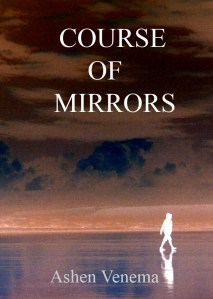
The theme of Crazy Wisdom, in the sense of stepping into the unknown, is challenging my imagination now in the third book, ‘Mesa,’ I’m writing in the Odyssey of Course of Mirrors. It’s about Mesa’s return to her future perfect world, where time has come to a near standstill. Against all logic, but understanding the truth in her heart, she is tasked to bring back history, and friction, as a cure.

Photo: The image was taken by son, Yeshen Venema, during a visit to Vietnam. I added the clouds 🙂

4 Comments

Filed under Blog

… dear old, dear new, how do we marry you …

I watched some of the pageant ceremonies, processions of dignitaries, colourful guards and regiments under hundreds of flags, and I watched the new King’s formal appointments in the wake of his mother’s death. I watched in wonder at the order and precision with which the various events were executed, with drums and trumpets, every footstep synchronized, left, right, left, right … all in the presence of thousands of people lining the streets, or witnessed through the BBC coverage by innumerable viewers around the world. The deep gratitude people express for Queen Elizabeth the second is not surprising considering the innumerable people and organisations she engaged with and visibly supported from her anointed position, but as the display continues, day by day, the commemorations edge on the surreal.
 
Any momentous public outpouring of grief tends to compound our experiences of personal bereavements, and, of course, reminds us of our mortality. This event, however, is about more than the loss of a beloved Queen who used her privilege and symbolic power through seven decades to serve as best as she could. Her loss rocks the solid traditional constitution she represented. While the centuries’ old tradition of this monarchy sits uncomfortable within modern society, it is nostalgically clung to and treasured.
 
The queues of people eager to pay tribute to the Queen’s lying in state in Westminster Hall have been, and continue to be many miles long, presently with a wait of 24 hour during a chilly night. All recorded: https://www.bbc.co.uk/news/live/uk-629217 And there’s a queue tracker on You Tube https://www.youtube.com/watch?v=cJxDwDzAwEs
 
Within the crazy weaving of my mind I was searching for a thread to make sense of the unfolding pattern of unavoidable changes that loom to endanger the old order, which always calls for transitional objects that sooth the loss and helps to honour both the familiar old and the unknown new potential of the future. What can serve here as a transitional object, something to hug for comfort, equivalent to a Linus blanket?
 
I was reminded of a theme my former Sufi friend and teacher, Fazal Inayat- Khan, often explored. In the prologue to a book, Old Thinking, New Thinking, containing a handful of his lectures he reluctantly agreed to have published during the 1970’s, long out of print, Fazal gave credit to both, the old ways (formal and reliable) and the new ways that seek essence.
 
                         ‘Old thinking is a claim and new thinking is an aim.’
 
Could there be an equal validation of form and essence for the UK monarchy?
 
When my mind floats in a vague space, I tend to express my ambivalent thoughts through Haiku:
 
a pendulum swings
left right ahead back
circling by the gravity
of hidden forces
 
dryness is conservative
until it overheats
moisture conducts the traffic
of novel ideas
until rain floods the bedrock
 
Kings or Queens were historically regarded as divinities. The afterglow of such divine aura still glimmers around the mantle of monarchies in our world, and a yearning for the divine remains, with the need for an ideal, something whole to give meaning to our lives. But can a monarchy still serve as such an ideal?
 
Ultimately, the Kingdom to come is of course the Kingdom within, where archetypal qualities can spark a force that steers and rules our destiny.
 
As familiar faces of relatives and friends leave an imprint in our psyche, so do faces of people in public life. The media showers us with faces of celebrities, providing icons and avatars that embody qualities we aspire to, or despise.

Dissidents against England’s monarchy highlight the extravagant financial privileges of royalty, and the historic trail of devastating exploitation during its colonial past. Apologies and reparations must surely be ongoing. And then there is the Commonwealth, which some proclaim to be a post-colonial club: https://www.bbc.co.uk/news/uk-43715079

I’m a dreamer, without allegiance to a crown or state. I’m wary of crowds and any hive mind, totally unsuited to get embroiled in arguments about the monarchy. My gripes are with the unpleasant character assassinations of individuals, found on popular internet platforms.

Character assassination resembles kleptomania, an irresistible urge to steal someone’s glamour.

What further is there to be said right now? Do my readers here envisage a Kingdom within?

8 Comments

Filed under Blog

My promised essay ‘The Body Electric’

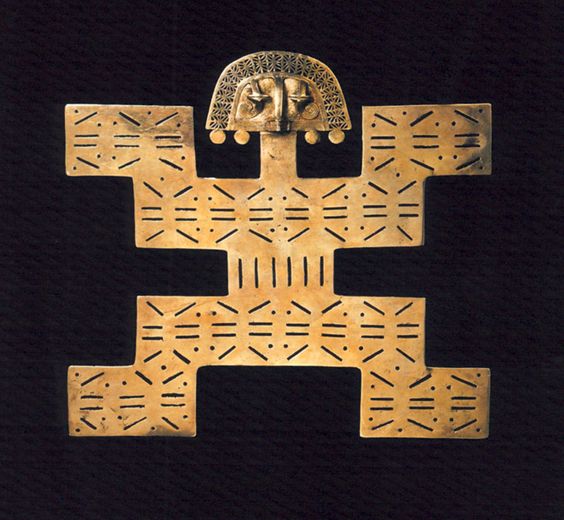
Tomila, Museo del Oro, Santafe de Bogota

I wrote the above essay in 1997, inspired by my readings during a vocational film degree, which helped me to catch up on cultural history. The file was idling away in a Clarisworks format on an old floppy disk. A friend (thank you Ian) managed to transfer the text into a Word document. Cleaning the formatting distortions suffered in the process took a while, but was worth the effort, since I wanted to share this theme of exploring Human Identity in the Digital Age with my readers in a PDF file.  A short overview of this essay can be found in my archived posts, listed under January 2018. But here is the full work, including its bibliography. The chapters are headed: Vanishing Time, Vanishing Space, Vanishing Body, Eyes that would Fix and Control us as Objects, Seeing through the Simulacra, and, A Palace of Mirrors. Throughout, I evoke scenes from the SF film Bladerunner.

I’m interested to know your thoughts on the yet unfolding theme of identity in our age.

The title of the essay was inspired by a wonderful Walt Whitman poem called ‘Sing the Body Electric.’ 

A poem by a former Sufi teacher and friend, Fazal Inayat-Khan, conveys a similar vibrant spirit:

A QALANDAR … a human being in the making …

Adam/man, Minerva/woman – a human being in the making – functioning in the world on the stage of life – playing the script of destiny with the delight of indifference and the carelessness of full satisfaction. A being knowing all there is to be known by it, yet ever learning; ready to feel all there is to be sensed by it, yet ever discovering new depth of emotions; capable of expressing its deepest and truest inspirations, yet ever expanding its consciousness; sensitive enough to give and receive love in all its forms and levels of becoming.

The full poem is printed in ‘Heart of a Sufi,’ a book I co-edited with two friends (see my book page.)

Here the last paragraph of QALANDAR …

A Qalandar is simple as a child, wise as an old woman, unfathomable as an old man. He belongs to the moment, she responds to every need. He speaks all languages; she performs all roles. They are one …

                                                                              Fazal Inayat-Khan, 18th of June 1972

7 Comments

Filed under Blog

… musings on order and chaos …

As an example, not a general theory, a parent who habitually keeps everything organised, clean and in place, may feel displeasure when their child does not follow this model. Sensing displeasure, the child may feel restrained and controlled, and possibly develop a reaction via contrary behaviour. Of course, reactions to initial conditions are way more complex. But both, excessive order and excessive chaos in the early environment set a tone.

My early impressions were in the middle, yet plenty of condensed experiences pull me into repetitive behaviour. But people for whom, let’s say, the organised model felt intolerable, meeting an adult partner who likes order, even in a mild way, easily hooks into their initial reaction. The desire for order is stability, beauty, keeping the wild and unpredictable at bay, and also serves as a buffer against anxiety. But someone who felt restricted by order may easily feel controlled. In this two-way process, any projection also frames the projector, and various complex relationships are such defined, with children, partners, work colleagues, mentors, groups, and even political parties. The irony is that instead of choosing a partner or group where this conflict does not arise, we often unconsciously attract an early model we disliked, maybe because of its familiarity, maybe because of the implied challenge. I assume it’s a psychological trick allowing for lessons in tolerance and, hopefully in time, a reframing of one’s life story.

While periods of stability are necessary, it is from chaos that creativity is born and new forms emerge, which is why some artists embrace chaos, allowing for the spontaneous discovery of new patterns and hidden harmonies.

To voluntary endure the dissonance between order and chaos is a spiritual quest towards an attitude of transcendence.

In this sense, and with the emphasis on becoming, my Sufi teacher, Fazal Inayat-Khan, who was also a musician and poet, used to orchestrate chaos in workshops for his students to great effect. He trained us well for the turbulent cultural changes that are now upon us, a global rite of passage we best consciously engage with. Faith in the unknown tends to signal our guiding spirit to open unsuspected doors towards a deeper resonance with the collective psyche.

“Beauty is mysterious as well as terrible. God and the devil are fighting there, and the battlefield is the heart of man.’ — Fyodor Dostoevsky

‘The Gods envy the perfection of man, because perfection has no need of the Gods. But since no one is perfect, we need the Gods.’ … Carl Jung, Liber Novus, page 244

‘The ideal is the means; its breaking is the goal.’ Hazrat Inayat Khan

Ever since I came upon James Gleick’s book ‘Chaos,’ the William Heinemann Ltd 1988 edition, I was fascinated by the concept which has radically changed scientific enquiries, as well as giving new meaning to my practice of transpersonal therapy.

James Gleick’s book also contains the amazing Mandelbrot set. Here a short introduction …

https://www.youtube.com/watch?v=3orIIcKD8p4

James Gleick’s newest publication is on ‘Information.’

Phew … here I’m challenged … a new wordpress format with its insistence on ‘blocks,’ disallows me the use of the classic editor. It’s a headache to create a post.

12 Comments

Filed under Blog

… using – or being used by algorithms …

The morose question of whether to be or not to be has moved on to whether to appear or not to appear. Appearances can deceive according to context. Or as my spiritual friend, Fazal Inayat Khan used to say, ‘Form is a relic of eternal potential.’ Things that have lost their former function have joined the archive of icons, metaphors.

Could the function of our individuality become no more than a statistical entity during our lifetime?

Today’s institutions and corporations share knowledge, advice, wisdom, stipulate laws, or instill fear via alerts. Ultimately, they accumulate information but are not necessarily held accountable for how this information is used. Priests used to claim this power in the name of God, as well as sorcerers and witches, who made it their business to converse with spirits. Many people project power onto an all-knowing agency, though today’s most consequential agency has moved on into the next clan of power holders – those who collect and control data … our data, our location, movements, activities, political leaning, looks, habits, likes and dislikes.

Our existence is being whittled down into digits that tumble about in a sea of algorithms, and wherever they perk up in statistics they could fix our fate, since temporal data can be adjusted to any setting a bureaucracy chooses as being predictive. This, mainly unchecked, development is running into problems, with the recent U.K exam result fiasco only being the latest example. Bless our young people for revolting.

Power of information equals control, for your own good, maybe, depending, of course, on who is in charge. Distorting and withholding knowledge, be it intentionally, through ignorance or through expediency, endangers democracy when used unchallenged as manipulation tools by governments. At worst, it enables profit seekers to accelerate the exploitation of earth’s resources, maintaining poverty around the globe.

Those involved in research, students, scientist, and writes, know the challenges of filing and stacking information. My own filing mirrors the ad hoc workings of my brain. To find stuff again is a matter of focus, luck and intuition. While occasionally frustrating, I trust my larger self and the collective unconscious. It is my oracular method, circumventing any too strict measurements promoted as our new saviour, algorithms. I value rationality, just not when it discounts spontaneous human creativity, heart felt compassion, and the inspiring moods of nature.

Belonging has never been easier – not belonging has never been more difficult. How does one evade the pressure of countless unfair impositions our systems prescribe via algorithms? In Walt Whitman style one could say … every ‘digit’ belonging to me as good belongs to you …  But wait, there is vast space in the One, space between atoms, between digits, between the many of us, where one can belong and be eccentric and separate at the same time.

Where do algorithms lead? How do they influence our values? Yuval Noah Harari in his book Homo Deus, describes ‘dataism’ as a new religion, a potential digital dictatorship that could shape our reality. Who would aspire to such a stagnant future?

I was fascinated and encouraged by a recent discussion between Yuval Noah Harari and Taiwan’s digital minister, Audrey Tang. (click here for the YouTube video coming up on a separate page)

They discuss code, including, at the start, the issue of non-polarized gender, going on to the negatives and positives of human hacking and the democratic fairness that can potentially happen when transparent data sharing and plural viewpoints are allowed.

Audrey Tang says,

‘Technology should be utilised to promote freedom, democracy & human rights.’

In Taiwan, this hugely influential young trans woman is making this happen.

16 Comments

Filed under Blog

… there is a place …

Imagine a circle of people, 20 to 40, adding their voices to the drone and tune of a reed organ, repeatedly singing a phrase for an hour, or longer, with short intervals when the organ’s tune breaks into musical improvisations, only to return to the melody and phrase. In the end the sound slows and fades, leaving the echo of your voice as an indispensable part of all voices.

Then imagine a deep silence.

One of many musical tunings my spiritual Sufi friend created went with these words:

There is a place of beauty –

There is a place of peace –

There is a place of harmony –

In me

Before you grunt at the sheer illusion of such place, consider the evocation of beauty, peace and harmony as an ideal, a means –  not a goal – a means towards the hub of the mill, where the grain is ground to flour in a process of transformation.

Musical tunings are regular events among Sufi friends. Their rhythmic repeating, with or without words, produces a trance-like state in participants – not aiming at escape, but at a homecoming. Fazal Inayat-Khan’s teachings broke rules, exceeded conventions. While honouring the value of traditional methods, he introduced  contemporary phrases, like the one above, and responded to his audience with spirited musical improvisations.

The purpose of such events is remembrance of the Self, or the One. In traditional Zikr it would be Allah, God, though in strict Islamic circles music is not allowed.

I occasionally play and sing the above tune on my reed organ, especially when distressing incidents happen around the world and I have a need to tune mind and body. The place of beauty, peace and harmony only exists in the imagination, as a timeless inner realm, a state where duality co-exists, a state of unknowing, where the spirit of eternal potential lingers.

For me these group events were profoundly renewing. The body, my temporary home, became a tuning fork brought into resonance with the ground and the marrow of my bones. Suffused with consciousness, any mind-chatter merged with the yearning sounds, and my atoms realigned in new constellations.

A darker cover for my novel I wish I had used.

Intention does not bring us to this uncharted and unmeasured inner place. And even glimpsing a truth flashing from there may shock the angels in us. Catching such truth can happen equally through other means … nature, art, dance, literature, drugs, breath work, praying, guided imagery, computer programming, psalm singing, sport, silence, fasting, dreams, etc., but resonance is needed, and a deep desire for truth must lurk in the heart.

While practices towards this ungraspable inner realm may have repetitive elements, the place is never repeated but ever fresh. It is where the breath of life pulses, just not at our timescale.

Returning from the inner realm to the contemporary flow of time, we get on with life. Yet such deep memories remains and will respond to a sincere recall, where we detect once more how matter is revealed in its essence and shine. For the psyche this is gold. This inner place shows that while we embody birth and death, light and darkness, good and bad, past and future, in true essence we are pure consciousness.

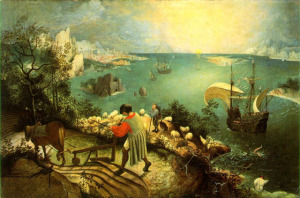
To remain grounded and prevent the fate of Icarus, I tolerate the company of my little devils.

My angels like it so, agreeing that while the obscure company I keep makes living complex, painful, a challenge, it also makes existence more interesting for that, and aids the psyche’s expansion of consciousness.

10 Comments

Filed under Blog

… embracing the messy soul …

I hesitated posting this, since a deep sadness resurfaced and took hold of me while pondering Soul and Spirit. What’s the point, why exist, to what end? I asked this as a child, having been shown horrendous images in the wake of the Second World War, meant as shock treatment in my German primary school during the 1950’s. A poem I wrote about this experience I still don’t feel confident to share. I turned iconoclast, explored philosophies, religions, myths, literature, searched for exceptional minds, and resisted prescribed beliefs in favour of direct experience.

In my twenties I turned to images and their symbolic power, until a numinous event in Israel reunited me with language, literature, poetry, and science. I studied too many subjects to bore you with, at my own expense, none for economic advantage. I did meet exceptional people, including mystics, yet my question, like a spell, kept birthing more questions.

Disheartened, yet fascinated by our manic mechanistic Zeitgeist, I adopted a transpersonal view, letting things unfold until decisions fell into place. With each intuitive choice, energy for action met me half way and helped me succeed with many projects. This included workshops on dreams and myth, and the wonderful Parent Link programme I helped get on the road, all about reflective listening and the language we use. Unfortunately this parent and school-supported project received no support from the Government. Still, at times I felt I was making beneficial contributions to society.  Of late, no new question has arrived to kick off a renaissance in my poetic imagination, or shed light on the collective mood of futility, which seems to confirm the scientific view that reality is determined by numbers.

Battered, but not beaten, I honour my core resolves: that everything physical is en-souled and resonates with everything else in the universe. And that consciousness, with the potential for symbolic awareness in humans, creates innumerable realities we co-create in ever new forms.
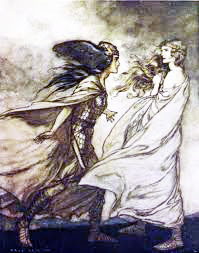
Arthur Rackman – Twilight

Soul and Spirit have become terms relegated to poetry. Some traditions hold them to be interchangeable and interdependent, akin to the Eastern concept of Yin and Yang. In this sense the feminine and masculine principles (mentioned below) reside in women and men alike, that is, their receptive and active and qualities work in each of us. Certain myths simplified and distorted this truth, which now asserts itself with fresh understandings regarding the psychological identification with gender.

“When I say the feminine, I don’t mean gender. I mean the feminine principle that is living—or suppressed—in both men and women.”  Marion Woodman

Observing the political debates around the globe, I notice a similar narrow power dictum in entrenched wars for control, which conjure up the quarrel of parents that drive children to hide in the broom cupboard.

I understand SOUL (Psyche) as pure consciousness, self-sufficient. Yet once identified with impressions of the physical world –  soul becomes the vessel. We talk of soul shining through eyes, through nature, or as immanent presence pervading matter. Consider body, mother, growth, loss, suffering, receptivity, attachment, memory, meaning, imagination, mystery, intuition, aesthetics, melancholy, yearning, endurance, constrictions, chaos, bliss … One may associate Soul with Eros, energy, the cosmos, planets, moon, beauty, stars, history, identity, myths, time, space, past, darkness, the unconscious, unpredictability, and the female principle (Anima) inviting spirit for input and direction.

SPIRIT, to me, is like a wind of light carrying seeds of information to recipient vessels, conscious or unconscious, singular or universal. Humans interpret this information, wisely or not. We talk of actions as spirited, fiery, determined, energetic, contradictory, passionate, always moving and changing. We talk of people driven by principles, for good or bad, or, frankly, being possessed. Spirit aligns with order and ideals, again, for good or bad. Add the relentless drive for perfection which aims, in some traditions, for transcendence, seeking the divine not in the messy psyche, but only in abstract spheres beyond matter. We associate Spirit with logos, will, action, speed, the sun, innovation, reason, light, the male principle (Animus,) and future visions … welcomed by the soul.
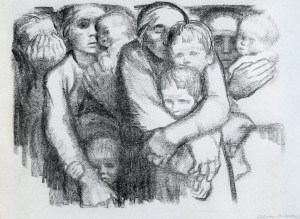
Mothers – Käthe Kollwitz

Torn between spiritual heights and visions, and the dark depth of the collective psyche, my initial therapy training with Roberto Assagioli’s Psychosynthesis impressed me with an undeniable necessity: The higher we rise the deeper we’re called to descend into the murky shadow of ourselves and our collective inheritance. Gripped then, once again, by the deep sadness I felt as a child in the face of human suffering, I cried for days. The work began, with my own unconscious, with individuals and groups. But nearly 35 years on, I feel yet again despair that the knowledge gained about the psyche is not wider applied. The abuse of people, especially women and children, and the planet itself, continues in the name of the power principle and progress, as does the resistance to acknowledge and heal personal and collective grief. It’s so much more convenient to blame an enemy.

I had the privilege to meet a remarkable Sufi teacher, Fazal Inayat-Khan, and the community of his students during the mid 1970’s. As the grandson of the saintly Hazrat Inayat Khan, Fazal developed his grandfather’s message in passionate, spontaneous and radical modern ways. One of his sayings: ‘Answers are dead, questions are alive,’ gave perspective to my existential query. For him, fragile egos behind the mask of their persona needed strengthening before the Self could become conscious. He orchestrated intense workshops during which the shadow aspects of our personalities were exposed. Each event was followed by a tender and humorous process of debriefing. He taught me to forgive myself, to be kind to myself. He died much too young in 1990. The copyright to hundreds of Fazal’s pioneering talks is held by the present Sufi Way, so his deep mystical insights must wait for another day. While I was co-editing Heart of a Sufi, reminiscences gathered from his students, we were limited to a few quotes and one inspired poem, Qalandar, which I hope to share some time.

Explanations aim to reassure, but knowing the limits of reason, I search for metaphors, symbols, poetry in words and images to make my fleeting insights graspable, as lonely as they stand, and as totally irrelevant as they may be to others. Still, it’s a lovely surprise when readers explore the archives here, or read my quest novel, ‘Course of Mirrors,’ which defies genres.

Turbulent times call for intuitive introspection, though sifting through the avalanche of information available is probably the great task we must master in this present decade. When lame slogans and bitter opinions are shouted with animosity across the media, our conscience is severely tested.

What we call good and bad coexists in the psyche. If you’ve read Ursula Le Guin’s Wizard of Earthsea Saga, you may recall the poignant moment when the protagonist realises that he and his shadow opponent share a secret name. For that instant their identities merge as one.

Among great thinkers of recent decades who influenced my thoughts, I often return to Stanislav Grof, Gregory Bateson, C. G. Jung, and the people who honoured and expanded Jung’s brilliant insights, among them Esther Harding, Marie-Louise v. Franz, Marion Woodman, James Hillman, Anthony Stevens and many others who further explored the Psyche in relation to the inner work of individuation, that is – learning to hold the tension of opposites towards realising the balance of a universal underlying wholeness. Archetypal forces inspire, overpower, or dull us to sleepwalk into tragedies. We, with our humble egos can take on our small responsibility; each individual serves as a bridge, and an interface.

‘Matrignosis’ is a rich site by Jean Raffa, who explores Jung’s ideas with helpful guidance.

Related: Cartography of the Psyche, with a link to Stanislav Grof’s talk on the psychology of the future.

And my cheeky post about the ego – give the poor ego a break.

To conclude, a rare excerpt of thoughts on metaphysics from Hazrat Inayat Khan, shared with his students between 1915- 1920:
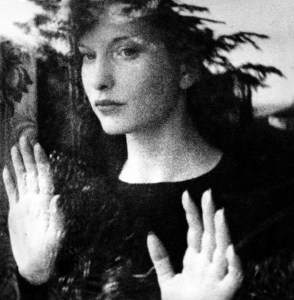
Maya Deren – Meshes of the Afternoon

The Experience of the Soul through the Spirit …

The soul has two different sides and two different experiences. One side is the experience with the mind and the body, the other side is the experience of the spirit. The former is called the outer experience, the latter the inner experience. The nature of the soul is like glass, transparent, and when one side of the glass is covered it becomes a mirror. So the soul becomes a mirror in which the outer experiences are reflected when the other side is covered. That is why, however greatly blessed a person may be with the outer knowledge, he is not necessarily gifted with the inner knowledge. Therefore, in order to attain to the inner knowledge the Sufi covers the other side of the soul, that its mirror part may face the spirit instead of the outer world. As soon as is able to accomplish this he receives inspirations and revelations.

There are people who are by nature intuitive, or who are called psychic or clairvoyant by nature. It is accounted for by the other side of their soul naturally facing the spirit within. One may call them extraordinary, or exceptional, but not mystical, for the mystic does not desire that position. He, by concentration and meditation, gains such mastery that he can cover the soul from without to take the reflection within, and that he can cover the soul from within when he requires the reflection from the outer world to its full extent. Balance is desirable, and mastery is the goal to be attained.

27 Comments

Filed under Blog

… dazzling journalism through this dark moon phase …

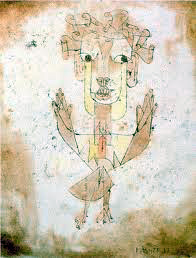
Angelus Novus, Klee

We’ve been living through metaphorical dark moon years, with debris stirred up from deep, and yet, when brave souls explore the confusion in such times, sharp beams break through cracks in the mud.

Wars fought over territories and resources have become wars over ideologies and identity. The internet intensifies clashing ideas, and where free speech is allowed, arguments find air. Whose side to take, where to place oneself –  left, right, center, past, present, future? Peace- loving citizens are challenged. Does one go numb, angry, self-righteous, or suffer confusion? Are they defensive reactions to the cacophony of voices struggling for attention? Some shout, some play clever games, some share information, true or false, and others offer sharp insights, be it through anguish, sincerity, passion or irony.

Marina Hyde from the Guardian does the latter, with anguish, sincerity, passion and, most of all, irony. Conflict inspires the search for her truth. Like a martial artist, she uses words that dance without hesitation, in swift, spirited and glittering moves. The new moon a few days ago brought a dazzling peace of her journalism, a laser glance at recent politics. Marina’s dark irony brightened my confused and deflated mood – because she speaks to the truth.

Marina Hyde – her bit on Dominic Cummings

… using words my mother would never have …

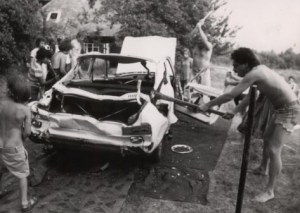
cathartic therapy, Sufi style

It’s of course useless, and mostly counterproductive, to blame or dispense anger about ideologies on particular people or nations.

Far better to release the rage by smashing up old cars, as my former Sufi teacher, Fazal Inayat-Khan, encouraged us to do. But who has such novel opportunity? For now, we’re in this storm blowing from paradise together.

Nationalism is the pathology of modern developmental history as inevitable as neurosis in the individual.   – Tom Nairn, The Break-Up of Britain

Relevant, my post on nationalism from April 2012 … here is everywhere

4 Comments

Filed under Blog

… old thinking, new thinking …

We mostly think through conventional forms and givens, for practical reasons, while another way of thinking embraces invisible and unknown dynamics via intuition – like the seeming particle/wave paradox in quantum mechanics, where a local particle also exists as a non-local wave. The two perceptions can potentially mingle creatively, but, notably in times of social uncertainty, they clash, and fewer people maintain the ability to tolerate negative capability.

The way autocratic opinions over divisive issues are sensationalised by some tabloids, sends my thoughts flitting through the mutable and nuanced zones of shadow lands. I write the glut of absurdities off my chest, only to delete the drafts, not having the talent or guts for the iconoclastic fun Marina Hyde pours into her articles for the Guardian.

The tit for tat race of opposing interest groups that blame, attack and counter attack each other eludes any balanced comprehension of events. Opportunists, generously funded, like to whip up the chaos for their own benefit. Fertile ground for tyrants. This will go on until the churning oceans calm and offer deeper reflections.

My early education was unremarkable, but I fondly recall a few teachers who made space for ambivalence, encouraging us to question everything and value respectful, if inconclusive, debates. Glib opinions and self-righteousness were mocked and laughed at.

In the early seventies, doing a short apprenticeship with a small Dutch advertising firm in London, we had weekly meetings, where ideas, no matter how crazy, were explored. Every person working in the building was asked to the table, including caterers and cleaners. This inspirational seedbed sparked successful projects and maintained a motivated team.

Decades later, during a part time stretch at Social Services, policy makers introduced a new computer programme for tick-box client assessments, a software developed without involving the people who were meant to use it – us. Sparing you the specifics of this nonsensical scheme, the nightmare in its wake resulted in multiple nervous breakdowns by employees. Since I had a private psychotherapy practice I escaped the hell and resigned.

A relentless trend towards greater efficiency continued despite loud social backlash. Over and over I listened to the stories of my stressed clients suffering from the overbearing changes in public institutions and private companies. The forced procedures insulted the intelligence of workers, who felt the stupidity and pain of it all in their guts, as did I. The harmful effect on mental health, family life, education, small traders and community venues … is ongoing.

Recently I re-read a 1970s lecture by my Sufi teacher, Fazal Inayat Khan – Old Thinking, New Thinking – also used as title of a small collection of his controversial talks, published in 1979 by Harper & Row. Some of Fazal’s students insisted on this publication. He reluctantly agreed. I’ll share here a few notions that struck me form the lecture, Old Thinking, New Thinking:

The end of real is false, while the greatest false is real.

The real is about form, the false (non-evidenced) is about essence. Fazal addressed two qualitative different ways of thinking, both beneficial if used in the right time and context. Those supporting form and tradition set out to protect stability, whereas those who seek essence knock over the stable towards the freedom of the unknown. Imaginative people, including scientists and artists, tend to overshoot crumbling realities.

The sad logic of power driven politicians is to manipulate social anxieties by promising simple fixes to allay feelings of uncertainty. In such times people tends to grope towards old thinking, to what can be predicted and depended upon, thus moving away from the immeasurable independence of anything beyond facts.

Old thinking relies on valid knowledge; however, to apply this knowledge intelligently requires new thinking, so essence can find expression once more.

Old thinking will bring achievement, notwithstanding that without new thinking it will have achieved nothing. Traditions wedded to established forms exemplify old thinking. Yet for a tradition to remain sincere and dynamic new thinking is required.

In other words, only what changes stays functional. Much as we dislike it, life could not continue if it were not for the transient growth and death phases of nature. The same applies to cycles that call for the expansion of consciousness.

How is one to value both form and essence in complex times and stay sane? No way around it, we must suffer the anguish of holding the tension between static knowledge and intuition in our hearts. Not easy. Perhaps because I experienced the 1960s new thinking surge, any leaps of goodwill from young people still brings tears to my eyes. I’m interested in everything. I’m interested in bridging divides. I even occasionally delight being in the spirit zone, with the effortless flow of things. (A Zen concept)

Deep, maybe very deep down, every one of us knows the bliss of being in the zone.

Old thinking is a sorting process – new thinking is a melting process

Old thinking is a claim – new thinking is an aim …               Fazal Inayat Khan

20 Comments

Filed under Blog