Tag Archives: book

… when the soul speaks …

Not just her daimon, but some unforgettable characters are given voices in the remarkable life of this visionary narrator, ‘Patchwork of a Safari Pilgrim’ by Philippa Rees. The link should include reviews.

Philippa Rees is also the author of an earlier, brilliant innovative work – INVOLUTION – that seeks to reconcile Science to God, structured as a dialogue between Reason and Soul, a revolutionary fresh hypothesis of evolution. 

‘Safari of a Patchwork Pilgrim’ provides a mesmerizing background to this hypothesis, based on profound direct experience of another dimension. From my own, and shared stories during my client work, I’m certain they are more common than generally acknowledged. Without support, however, to integrate such insights into daily mundane life can be challenging, and often exposes people to ridicule, or much worse.

‘Patchwork of a Safari Pilgrim,’ is a vividly told story, sharing the agonizing attempt to bridge two worlds and translate meaning and truth between different dimensions. It’s the life of a genius.

A totally engaging read.                

There’s presently nothing I could add to the brilliant reviews of Safari. I’m still digesting the unforgettable characters and the brilliant prose. But out of personal interest, I asked Philippa three questions, in the light of her experiences … and she graciously responded …

How did the sudden access to the Akashic memory change your sense of coherence?

My entry to the Akashic Record- the collective memory of evolution- was rapid but not sudden. The incremental loss of all my attachments to anything that ‘placed and held’ my identity: country first, then family, then moral injunctions (obligations), and finally, abandoning my children, for their sakes, one after another, removed the struts of what I (and others) thought was my identity. Through conflict, I surrendered each allegiance for a deeper one. It is why I had to take the reader through the growth of my understanding, with its critical components, and then the loss of each in turn. Leaving my children pulled me up by the roots.

Then I found myself in the mid-Atlantic, alone without any way forward or back. At this point, I was confined only by my fears, and they manifested physically in constant hallucinations of snakes. The snakes (fear) guarded the entrance to the Akasha.

I understood that instinctively. After experiencing compassion for the adder’s fear of me, and its explosion into a shower of sparks, the entry to the greater Akasha was cleared. I no longer had any fear, and the layers of creation manifested in wider and broader visions. What characterised these vistas was their integration with my own thoughts. Thought and vision coalesced. Space and time coalesced. I could move what I was seeing with my emotional thoughts. I could dive deeper into darkness (and it was sometimes terrifying) or imagine myself back into light. By imagine, I mean evoke memories and images of natural beauty like a mackerel sky, flocks of birds, a deer tripping through a dappled light. Those emotions of love and wonder acted like helium to raise me above the sucking, self-preserving fear.

I then realised that the co-ordinates of where each of us stands are in the crosshairs between love and fear. Love lifts, fear suppresses and sinks. Where they intersect determines what and who we are in every moment of our lives.

So what is called decoherence (aka madness) was much more coherent than the dislocation we normally live in, where thought and manifestation are separated. That separation is called time. In time, the material and the mental are distinct from one another. Causation works unidirectionally only, from the past to the present. We live in a squint-eyed world with only half of creation’s story. But the Akashic experience is timeless. Everything (both past and future) is simultaneously present because we contain it all. The future’s unrolling is already coded and inbuilt.

To try to live simultaneously in both the world of time and the timeless world of instantaneity, I adopted strategies (dancing, whirling and, when they threatened to confuse, falling), all of which, of course, were deemed symptoms of insanity.

That brings me to your next question.

How would you define synchronicity and how did it serve you?

If you understand the relativity of time, as being characteristic only of upper shallow surface layers, synchronicity is easier to understand. Not very different from dreaming, although in dreaming, events are still linearly sequenced, but changes can be instantaneous from one person or place instantly to another, and very much governed by emotions. Diving through the levels of the Akasha was like puncturing overlapping transparent dreams, the colours and images interpenetrating one another, some dark and terrifying, others sublime.

 When we talk of synchronicity, we usually mean the improbable and simultaneous events that happen and which link together a particular significance for the observer. The observer makes the link of significance. Other people dismiss that significance and call it a coincidence simply because of its improbability. Only the person whose thought or perception sees the linkage understands it. That understanding imbues the events with meaning. So, in that sense, synchronicities appear to have the quality of a personal signal or a gift of confirmation—something from another world.

I would say that, indeed, they do come from another world, from the penetration of the Akashic memory into the world of time. They are also a gift from that world, and they tend to happen in moments of uncertainty when the person for whom they have significance is momentarily poised between conflicting claims. They are suspended without a causal imperative. So, they have the quality of confirming independent thought and action, a sort of nudge, ‘you are right, keep on, look afresh, believe in what is happening to you.’

Other manifestations of different causality can manifest in what are called poltergeist, teleportation and remote viewing. I believe all these are capacities of the same kind of altered consciousness in which perception of time and space is akin to the Akasha in which all is simultaneously present. Thought precedes manifestation. It is the central understanding in Involution, that consciousness creates.

The other aspect of synchronicity, which I came to understand very well, was that it can never be willed or anticipated, because it is not of this world of time. In that sense, it is always a gift. A gift that rewards the trust of being open to it. When you understand it and live within its affirmation, it happens more often, perhaps because you have somewhat freed yourself from the world of time and causality and live half-embedded in the divine. By the divine, I mean the acceptance of the perfect integrated linkage of all consciousness.

How did it serve me?

Through the extraordinary sequences of things being provided just when they were needed, I came to trust and rely upon my own integration into the divine. Clearly, my life was important in some way that superseded any beliefs I might have about it! At many moments of desperation, when I asked for signs or indications, there was only silence. Nothing. I came to realise that any act of will (wish, even prayer) was an affront to a supreme reality that had its own patterns, purposes and momentum. I could sink into and accept that, but not, in any small degree, orchestrate it! Not even by wanting or articulating a need! My needs were already known! And not always the ones I thought were paramount!

Once I had learned that, I found my well-being was provided for. All the improbable gifts; of a cruise to recuperate and then a home to build were given to restore me to the world of time and material 3D reality. Every person serves the divine creation, whether they know it or not. Synchronicity served both my exile and, equally, my return. The latter implied some purpose for which I had been preserved. Unlike the rapidity of my escape, the return was very much infused with slow and dogged time. Perhaps because I had travelled so far into instantaneity, I had to relearn the rules of material existence.  For this reason, the writing of Involution was a compelling obligation of gratitude, and. in hindsight it rang out as also the intention of all that had happened to me.  All had been necessary and led to it. And the writing of that was fostered and accompanied by constant synchronicities and the final affirmation of George Eliot! Back to ordinary time, but with filaments of Akashic timelessness still wafting and attached!

How would you explain the demands of your unique Daimon ?

This is more difficult. I want to avoid proselytizing or imposing my experience as any kind of special favour, and it is also deeply personal. But first, I must correct you: Daimon makes no demands, ever. The initial persuasion to write the book was not coercion but encouragement to have the courage to do what I contemplated for a long time.

When he, whom I call Daimon, first revealed himself, it was after a few disguises as other lovers. Without those, I would never have recognised, accepted or believed. For the Daimon is the Divine Self, or the Divine Companion, the Voice of the Soul, personal to me, but equally personal to anyone, whether recognised or not. That Voice is an expression of all the previous loves, both human and animal, and also the abstract loves of beauty, inspiration, music and longing. For a woman, likely to seem male; for a male, to seem female (the counter completion of the part) but also plural, uniting all, communing with all. Is Daimon God? Not entirely, but the personal God within, which, once recognised, is a constant presence, but also a Voice when addressed in the deepest silence, when all thought is stilled.

As I believe our DNA links each of us personally to the Akasha of historic memory, I believe the Divine Self links us to the God of All—So, in that way, it/he/she/they is both immanent and transcendent. The Voice does not speak unless thought or desperation calls to it. Occasionally, when I was in real danger, it alerted me. Perhaps the danger itself called out? That Self intimately knows the individual, his language, his references, but also his or her place and purpose, but the knowledge waits for its natural manifestation, never imposing any constraints upon liberty or error or time. But when directly addressed, it/he/she mirrors back /calls forth what is already known. When you think about it, to understand is to stand under. The umbrella of the Soul.

In ‘Safari’ I gave a direct voice to the Daimon in the recapture of events to alert a reader to what I had relied upon and consulted, at the height of the experience, almost constantly. He did not appear or penetrate my consciousness until all else was lost, and I had nowhere to turn, but at that point, he spoke very clearly. Without him, I would never have survived. So, feeling cherished, I ventured into the timeless worlds and took risks that to others, then and now, also seem insanely devoid of fear.

I have the sense that what God waits for, and why free will was granted to humanity, is reciprocity. God is lonely. He waits to be freely and joyfully loved by those gifted with the freedom to withhold it: Unlike angels who love by their nature, we have to choose.

Hence, the ending of both Safari and Canto the Ninth.

I shall know the moment I may turn and lift you…

My hands will liquid shape your acquiescence:

In the silent break of day, upon my shoulder

Upon dawn’s clavicle, your happy cheek will lean

Cradled in my neck, you’ll breathe our essence:

I shall carry you entwined and carefully

Through the silver light and striding water…

Wade until we drown in salt bright sea.

Liquid shape, Dawn’s clavicle, neck cradle, striding water- all anomalous contradictions; the point at which the individual and personal become the united universal.

————————-

You may want to follow Philippa on Sub stack: https://philipparees.substack.com/p/perfection-in-the-commonplace

Philippa would be an honourable member of the underground community of Shapers 🙂 …  scientists with a mystical bent, as featured in my novel of that name.
4 Comments

Filed under Blog

… making peace with my soul’s code …

Rivers of thought swirl by and through me, day and night, changing hourly with impressions, mood, weather, star constellation. The thoughts I attract bring along eddies of fleeting association, a fraction of which create new connections, some bringing solutions and insights worth following. Having learned patience, I let most thoughts flow on and fade, to maybe return.
An overly ordered mind would go mad trying to make sense of every thought, like a simulated AI would short circuit with floods of impressions it cannot contextualize.

What enables most humans to deal with ever turbulent feelings and thought processes; how does one edit out what is irrelevant?

I always liked to assume there is a core vibration each of us brings along, a theme around which passions assemble, and necessities, priorities, things that need doing to stay coherent and in rapport with our environment, family, friends, jobs, projects, and not least manage tasks that serve our survival in this ever more complex world.

Our culture rewards strongly defined social roles, though the drawback can be fossilized minds, made rigid, opinionated, avoiding doubt, and unable to imagine other points of views with a generous attitude. A strong definition of one’s place and function in the world could be likened to an instantly recognizable genre, with a predictable protagonist.

By comparison, be it a simplification, philosophers, artists and poets, dreamers, well, creative people with expansive interests, are a slippery lot. They don’t often fit a clear-cut social role, but tend to hang around in fringe positions, distanced from the gyre, observing and evaluating the system, the market place, and the wheels of politics with a wary eye.

From the fringe it is possible to gain a symbolic understanding of people and events, which can stimulate innovation and even visions that reveal deeper layers of the psyche.

These days people say, ‘I want a simple life,’ an option that is rapidly vanishing. More of us are pushed to the fringe, challenged to embrace the complexities of modern/digital life, having to struggle with doubt and inner conflict. This phenomenon may explain the desperate search for advice. Social platforms are brimming with quotes and aphorisms, which, unfortunately, only spark in a heart that is open at a personally timely moment. Otherwise these wisdom’s just float by like irritating advertising banners.

While pondering such thoughts recently, I was reminded of a book that came out in 1997, ‘The Soul’s Code,’ by James Hillman. He explores the guiding force in a person’s life, in various traditions called daimon, genius or guardian angel. He uses the term ‘acorn theory,’ based on the idea of an initial strong image we bring along that calls our destiny towards us. The book struck a deep chord at the time. I’ll read it again, to soothe my outrage with the world.

Hillman dared us to believe that we are each meant to be here; that we are needed by the world around us.
An interesting mind, as you’ll find in this longish interview. https://scott.london/interviews/hillman.html

9 Comments

Filed under Blog

… musings on order and chaos …

As an example, not a general theory, a parent who habitually keeps everything organised, clean and in place, may feel displeasure when their child does not follow this model. Sensing displeasure, the child may feel restrained and controlled, and possibly develop a reaction via contrary behaviour. Of course, reactions to initial conditions are way more complex. But both, excessive order and excessive chaos in the early environment set a tone.

My early impressions were in the middle, yet plenty of condensed experiences pull me into repetitive behaviour. But people for whom, let’s say, the organised model felt intolerable, meeting an adult partner who likes order, even in a mild way, easily hooks into their initial reaction. The desire for order is stability, beauty, keeping the wild and unpredictable at bay, and also serves as a buffer against anxiety. But someone who felt restricted by order may easily feel controlled. In this two-way process, any projection also frames the projector, and various complex relationships are such defined, with children, partners, work colleagues, mentors, groups, and even political parties. The irony is that instead of choosing a partner or group where this conflict does not arise, we often unconsciously attract an early model we disliked, maybe because of its familiarity, maybe because of the implied challenge. I assume it’s a psychological trick allowing for lessons in tolerance and, hopefully in time, a reframing of one’s life story.

While periods of stability are necessary, it is from chaos that creativity is born and new forms emerge, which is why some artists embrace chaos, allowing for the spontaneous discovery of new patterns and hidden harmonies.

To voluntary endure the dissonance between order and chaos is a spiritual quest towards an attitude of transcendence.

In this sense, and with the emphasis on becoming, my Sufi teacher, Fazal Inayat-Khan, who was also a musician and poet, used to orchestrate chaos in workshops for his students to great effect. He trained us well for the turbulent cultural changes that are now upon us, a global rite of passage we best consciously engage with. Faith in the unknown tends to signal our guiding spirit to open unsuspected doors towards a deeper resonance with the collective psyche.

“Beauty is mysterious as well as terrible. God and the devil are fighting there, and the battlefield is the heart of man.’ — Fyodor Dostoevsky

‘The Gods envy the perfection of man, because perfection has no need of the Gods. But since no one is perfect, we need the Gods.’ … Carl Jung, Liber Novus, page 244

‘The ideal is the means; its breaking is the goal.’ Hazrat Inayat Khan

Ever since I came upon James Gleick’s book ‘Chaos,’ the William Heinemann Ltd 1988 edition, I was fascinated by the concept which has radically changed scientific enquiries, as well as giving new meaning to my practice of transpersonal therapy.

James Gleick’s book also contains the amazing Mandelbrot set. Here a short introduction …

https://www.youtube.com/watch?v=3orIIcKD8p4

James Gleick’s newest publication is on ‘Information.’

Phew … here I’m challenged … a new wordpress format with its insistence on ‘blocks,’ disallows me the use of the classic editor. It’s a headache to create a post.

12 Comments

Filed under Blog

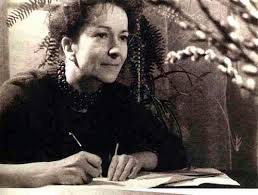
… to shift my thoughts, I read poems by Wislawa Szymborska …

One book of poems I have always at my bedside, for when I need to shift my thoughts, is Wislawa Szymborka’s New and Collected poems 1957 -1997, translated by Stanislaw Baranczak and Clare Cavenagh, published by Faber and Faber 1999

She lived from July 2, 1923–February 1, 2012

Apologies for not having the photographers’ names for the two images of her that are spanning decades.

I like the humour, the ironic style, the contradictions running through the poems like a clear spring.

I thought I share a poem in full, since I posted a fragment on Twitter the other day. And also because I remember the protagonist in my novel, Course Mirrors,’ is in search of The Real.

THE REAL WORLD

The real world doesn’t take flight
the way dreams do.
No muffled voice, no doorbell
can dispel it,
no shriek, no crash
can cut it short.

Images in dream
are hazy and ambiguous,
and can generally be explained
in many different ways.
Reality means reality:
that’s tougher nut to crack.

Dreams have keys.
The real world opens on its own
and can’t be shut.
Report cards and stars
pour from it,
butterflies and flatiron warmers
shower down,
headless caps
and shards of clouds.
Together they form a rebus
that can’t be solved.

Without us dreams couldn’t exist.
The one on whom the real world depends
is still unknown,
and the products of his insomnia
are available to anyone
who wakes up.

Dreams aren’t crazy—
it’s the real world that’s insane,
if only in the stubbornness
with which it sticks
to the current of events.

In dreams our recently deceased
are still alive,
in perfect health, no less,
and restored to the full bloom of youth.
The real world lays the corpse
in front of us.
The real world doesn’t blink an eye.

Dreams are featherweights,
and memory can shake them off with ease.
The real world doesn’t have to fear forgetfulness.
It’s a tough customer.
It sits on our shoulders,
weighs on our hearts,
tumbles to our feet.

There’s no escaping it,
it tags along each time we flee.
And there’s no stop
along our escape route
where reality isn’t expecting us.

Wislawa Szymborska 

Her Nobel Prize speech inspires … if you are shy to call yourself a poet, follow this link and soak it up.

Poets, not being profitable, get little screen-time. Wislawa Szymborska says … ‘Their work is hopelessly unphotogenic. Someone sits at a table or lies on a sofa while staring motionless at a wall or ceiling. Once in a while this person writes down seven lines only to cross out one of them fifteen minutes later, and then another hour passes, during which nothing happens … Who could stand to watch this kind of thing?’

‘I’ve mentioned inspiration. Contemporary poets answer evasively when asked what it is, and if it actually exists. It’s not that they’ve never known the blessing of this inner impulse. It’s just not easy to explain something to someone else that you don’t understand yourself.’

‘Whatever inspiration is, it’s born from a continuous “I don’t know.’

Her words bring to mind a Rumi quote: ‘Sell your cleverness and buy bewilderment.’ 

Follow this link to Brainpickings and find a number of write ups about Wislawa Szymborska

Brainpicking’s Bulgarian creator, Maria Popova honours language, and somehow manages to bring context and coherence to the irrational and the imagination. Her curiosity is unlimited. She writes about my favourite people in the world. Among them are poets like Wislawa Szymborska.

12 Comments

Filed under Blog

… book pages let loose …

A few days ago, waking at dawn, I had retained a dream vision:
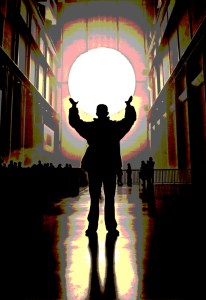
I saw the entire content of my novel, Course of Mirrors, 400 pages in all, displayed on one huge panel.  Astonished, I pondered how this expansion graphically showed that writing a novel involves massive work, time, and fierce motivation.

To put this into context, I must add I lacked motivation and confidence for some time now, having to deal with existential problems.

The 21.5 cm height and a 13.5 cm width of each page poured out onto a single panel would create a near 100 meter high and 52 meter wide installation.

Even if the panel size were halved by using front and back, it’s still a crazy idea – right?

Maybe the dimension of Tate Modern’s Turbine Hall could suffice, but only a Turner price gets you there. In case you don’t know, the Turbine Hall is the place that allowed visitors to touch the sun, like my son did during an Olafur Eliasson’s weather project exhibition a few years ago.
As regards my high-rise panel of book pages, any visitors keen to engage in reading could only do so at average eye levels, unless they had means to levitate. Now that would be another idea.

Well, imagination being such fun, I played on.

Much smaller double-sided panels could each display the pages of one of the 29 chapters, broken up into moments, occasionally interspersed with slivers of mirrors, where the body of a reader flits by, or maybe images that enhance or contradict the mood of a scene. You enter the story by stepping into a cave-like enclosure. The text on panels is lit from within, not spreading much light, to achieve a twilight experience, which was done in caves long, long, long ago, with the imprints of hands.

This cave could be entered from four sides. One may choose to start at the end and read the story backwards, or wander through and pick chapters randomly, more in the way one reads poetry. In any case, the title image at each entry/exit gate would evoke an enchanting journey at the edge of consciousness, between rational and the mystical states.

Normally, a writer’s work is condensed and hidden between the neat covers of a book, or captured on e-book screens, one click by one click. The concept of spreading the pages out in real space fascinates me, and ideas keep tumbling in. Like making the text respond to the concentration of the reader, or the lack, in which case sentences would ripple, as if floating on water.

Intrigued by this vision of visitors wandering through the chapters of my novel, I thought of the remarkable characters, all archetypal part-mirrors of me, of you, of anyone really.

How if readers could scan a paragraph about one character, place it on an empty panel and temporarily type a scene of their own imagination about that character?

If you feel the fun and have any additional ideas, please share them here.

What I like about the interactive setup, is the random strolling. Just while writing this post I opened my novel at an arbitrary page and hit on a romantic instant after Ana met her first love. He gives her a heart-shaped ruby as a promise – half a page at the end of chapter six. Here the excerpt …

Luke dropped the jewel back into my palm and pressed my hands close. “You’re the true heart for me. We’ll meet again. We’ll journey together.”  He glanced at the travel-ready troupe, waiting for him. “I won’t fasten the chain round your neck, though I’d love to.” His face was close enough for me to catch the scent of his hair, the pond, grass, wood smoke and musk. I longed to touch his lips, steal and take along his smile.

“How can I contact you?”

“Find a messenger to deliver a note to Tatum and his Magic Theatre. His troupe is getting known along the river.”

I felt drawn into the loop of his mysterious fate. I wanted to be held, forget myself in his arms. Instead, I stared at my feet, pondering this indelible moment of intimacy and suddenly dreaded the journey ahead – without him.

Last week Course of Mirrors had a lovely review by Cath Humphris, which I’m pleased to share:

https://cathum.wordpress.com/2020/01/13/course-of-mirrors-an-odyssey-by-ashen-venema/

A magical tale, in which a young woman embarks on a hazardous search for The Real.

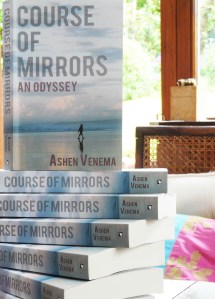
Since I have presently no way of realising my crazy interactive vision, you can only enter the world of my novel condensed in its covers, here: Courseofmirrors  This Troubador page connects to other platforms, too. Then again, any bookshop can order the novel.

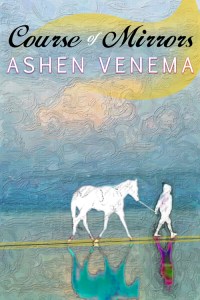
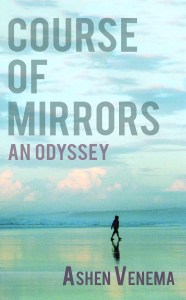
The image on the left was an early cover idea from authonomy days, not used in the end.

For the time being I’m having a hard time surviving, which hinders my deepening edit for the sequel to Course of Mirrors … Shapers … from which I share some chapters on my Patreon page. If it is within your means, and you can tolerate or even like struggling fools, please support my creative spirit on Patreon. Here the link.

https://www.patreon.com/user?u=10520241

13 Comments

Filed under Blog

… loss and restoration …

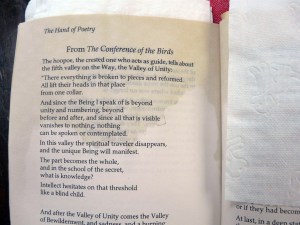
This time of year I like reading in the garden. Last week I forgot to take a book inside – ‘The Hand of Poetry,’ collected poems from Sanai, Attar, Rumi, Saadi and Hafiz, translated by Coleman/Barks, with introductions taken from talks by Inayat Khan. During a short but heavy shower that night, the book greedily feasted on rain. I found it blown up, like a balloon, to double its size.
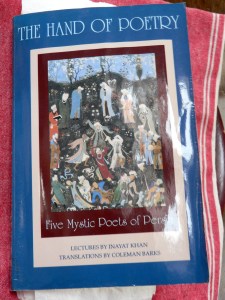
Restoration would atone for my failing. Gently lifting page after page, I placed toilet paper between each, twice and three times over. On the third day I hung the book by its spine on the washing line. Once dry, I managed to press the volume with a heavy vintage iron into reasonable shape again. The ordeal required my undivided attention. The re-read pages during those hours lodged themselves with refreshed presence in my heart.
I recalled a scene from ‘Shapers’ –  the not yet published sequel to ‘Course of Mirrors.’ The story starts with a shipwreck.  Surviving this tragedy, my protagonist finds her diary drenched to pulp. The irreplaceable loss gained her unexpected access to internalised memories, and the ability to exchange virtual letters with her soulmate of the future, scripts made visible in the thin air before her.

This phenomenon happens to me frequently these days. Just before sleep, or waking, I see screens with writing, sometimes even Twitter pages, which later turn out real. Beats me – explanations are welcome.

Memory is fluid. The child in us not only imagines the future, but also re-imagines the past. While I was lifting apart the soaked poetry pages during my restoration, it struck me they resembled crumpled and discoloured reminiscences of my father a trailing grief about our dissonance brought to light in dreams, with messages to abandon this nonsense. Can you miss a surreal projection? Yes you can – releasing a feeling of rejection that ruled years of your life takes getting used to. Had I not taken my dad’s anger with the world, and me,  so personal, I might have implored deeper into his heart pain, and mine, since, after all, deep down, our sensitivity for beauty and nature, even our humour, were much alike.

I had resisted my father’s expectations and boldly followed my heart, which, while gratifying, brought its shadow of existential anxieties. My rare brave attempts to cross the dividing bridge were met with contempt for my quixotic worldview. Bridges then became imaginary sanctuaries between varied realities, a neutral zone for my rebel to gather strength for the next quest ahead. Bridges became a major theme in my novel ‘Course of Mirrors’ – see book page on this site, or my twitter page @mushkilgusha

Rejection can add fuel to a journey. But what if a regular fuel runs out? Consider the weird silence when a monotonous background noise stops … suddenly. I identified my inner background noise as the subtle lament of blame that long ago slyly settled in my unconscious. Blaming something or someone can achieve an emotional distance, displace resentfulness, a hurt,  – but now – this peculiar silence …

The symbolic intelligence of psyche’s inner dimension communicates not only through dreams, but also through our surroundings: world events, people, objects, images. My restoration of ‘The Hand of Poetry’ resonated. Compulsive energies shift when time slows,. Familiar scripts may assume fresh meaning, and re-write themselves with different rhythms and new pauses for the spirit of surprise to enter.

Meanwhile I enjoy some treasures close by …



And I’d like to share a Hafiz poem from the restored collection. Hazrat Inayat Khan says of him:

The mission of Hafiz was to express, to the fanatically inclined religious world, the presence of God, which is not to be found only in heaven, but to be found here on earth.’

THE BANQUET

A gathering of good friends

talking quietly outdoors,

the banquet being served, a dry Rosé

with a bite of Kebab afterwards,

a wink form the one who pours,

Hafiz telling some story,

Hajji Qavam with his long laugh,

a full moon overhead,

the infinite mystery

of all this love.

If someone doesn’t want the pleasure

of such an openhearted garden,

companionship, no, life itself,

must be against his rules.

Hafiz

14 Comments

Filed under Blog

… Cover Reveal – Course of Mirrors …

venema-5th-draftr4r-darker

Every time I look at the image I smile.

It’s sufficiently intriguing to draw readers into my harvest of gathered paradoxical reality and, ideally, fall in love with the gripping odyssey of Ana and the memorable characters she meets. I took the photograph some years ago at the Atlantic coast, while exploring Morocco with a friend.

The official publishing date of Course of Mirrors – 29/04/2017 – and a short description, show up at my Troubador page, which will eventually have links added to amazon and other platforms.

When pre-ordering the book becomes possible I’ll let you know. It’s my hope that there’ll be early paper copies available at the Troubador stall during the London Book Fair in March.

At this stage the text of Course of Mirrors has been typeset and after a few tweaks looks great. Once a last proof between me and my editor is completed, I’ll forward PDFs to the two writers who kindly offered a review, unless they prefer to wait for a printed copy.

Releasing this book demanded years of patience, partly because I allowed my hands to be tied with a contract that did not materialise. This then is the beginning of a beginning that has awaited its beginning as in a dream. During the various delays I wrote Shapers, a sequel, where the myth-maker, Cara, is entangled with the same characters in a future time-zone. A SF, or a science of the heart, depending on how one looks at it .

Initially I’ll depend on friends to support my first offer and, if they enjoy the story, spread the word. At a later point I may have the resources to pay for promotion. Against all advice aimed at writers, I won’t set up a stall in the marketplace, nor will I create an e-mail list, nor will I increase the frequency of postings on this blog, though I’ll add a link to my Amazon Author Central page and my Goodreads page once the book becomes available.

A December 2016 blog post of mine was shared 58 times on Facebook. I’ve no idea who these kind people are. In case you’re one of them, please feel free to befriend me: Ashen Venema on Facebook, or join me on Twitter: @mushilgusha

I enjoy engaging with visitors here on all manner of quirky subjects, and I look forward to also respond to readers of my novel, inviting questions about the story and its characters.

p1080518-smaller-likeThis photo was recently taken by my son on a non-make-up day, after a delicious meal with one two glasses of wine.  I softened the stark reality of my age with a slight photo shop treatment. It’s the best smile I can manage in this time of confusing tragic/comic politics, for which there is no solution but to pray that the majority of people, the psyche of the world, will be able to face and endure the shadow revelations of our age, and the usual opportunists of fear –  without falling into despair …

Soothing hearts is of the essence.


36 Comments

Filed under Blog

… I lost an ally, but not her frequency …

Launch of 'Heart of a Sufi.'

2011 launch of ‘Heart of a Sufi’ at a friend’s place.

Before I share the book cover of ‘Course of Mirrors,’ my first novel to be released in spring, I must step back and credit once more a book I co-edited and am proud to have helped produce. ‘Heart of a Sufi’ was published by a group of friends in 2011. A limited print-run of hardbacks sold quickly and recouped our expenses. I wrote about the background to this project in honour of Fazal Inayat-Khan here in March 2013.

Joe Linker, a blogger friend, wrote only this week a spot-on review of this unusual book – brilliant, heartfelt thanks. One of our small editorial team, Rahima (Elspeth) Milburn, would have been delighted with the review of this book she endorsed with passion. Sadly she died peacefully shortly before 2017 was rung in.

by-ashen-portrait-of-elspeth-spottiswood-smallerI miss her. She was a deep thinking woman, a painter, psychotherapist and lover of poetry, especially Rumi, whose verses she recited often in her very deep and distinctive voice.  She was an inspiration to many. For over ten year, up to 2004, we ran monthly seminars and additional workshops together, on themes like mythology, the power of the imagination, and the significance of dreams. I feel deep gratitude for her supportive friendship and feel strongly that her frequency lives on.

The portrait on the right I did in her studio, around the Millennium.

A group of us, companions on her path, will travel to Cornwall next week to join the large Milburn family and send their mother, grandmother and great-grandmother on her journey. Some of my readers may remember a humorous poem I wrote for Rahima and her family – posted here last October:

Regarding ‘Heart of a Sufi’ … while there are only very few of the beautiful hard copies left, some with Watkins in London, the work is also available as an e-book with Troubador, Amazon and other platforms.

12 Comments

Filed under Blog