Tag Archives: inspiration

… World News – by Mulla – Allum …

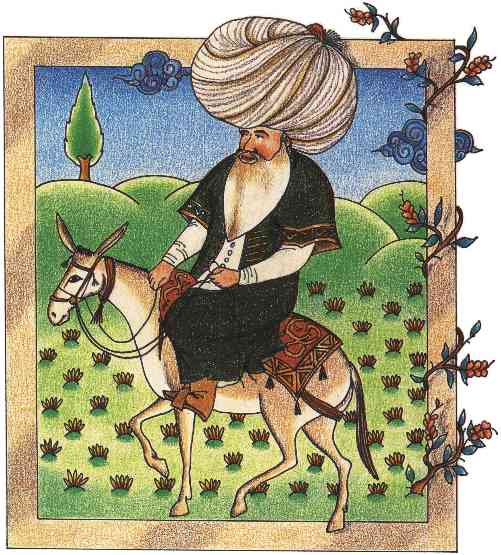
Nasreddin - 17th century miniature - Tokapi Palace Museum

In my world, Mulla Nasreddin, the famous wise fool from the East, could not possibly be stuck in one place or one time. I call my inversion of him ‘Allum.’ Warning: He always has the last word. If you have a problem with this then just add another word, for your pleasure.

I hope to occasionally post more of Allum, should his voice come through the white noise surrounding our planet.

(The image of Nasreddin  is from a 17th century miniature – in Tokapi Palace Museum)

World News

Allum is seated on his favourite bench from where he overlooks the town.

A kid, making sure that none of his peers is nearby, sneaks up to Allum.

‘You’re known as a wisecrack. Tell me – why are grown-ups so obsessed with World News?’

Allum shudders. ‘World News has become a mega-mirror to humanity. People are mesmerised by the comical clashes of ideas. Factions are stretched on the cross between being and becoming, that is, final answers and dynamic change. It’s a conflict most humanely and economically fought inside each of us.’

The boy looks puzzled. ‘Aren’t there final answers?’

Allum sighs. ‘I hope not in my lifetime. If that was so the illusionary charm of reality would evaporate. Life would have no meaning. There’d have to be another big bang.

*    *    *

Bang head hereFor those stressed over solutions to the divide between being and becoming, here an academic exploration from Stanford  academia. To shorten the  tortuous exploration: … We are not inertial observers …

I figure we have plenty of potential to develop in ourselves, and there is always more we can contribute to the world.

My Sufi teacher, Fazal Inayat Khan, summed up being and becoming eloquently:

   ‘Being is death. Becoming is life.’

Here some of my former posts that are related …

https://courseofmirrors.wordpress.com/2014/11/06/not-now-later/#comments

https://courseofmirrors.wordpress.com/2013/02/18/global-vision-synchronicity/

https://courseofmirrors.wordpress.com/2013/02/06/why-spin-tales

10 Comments

Filed under Blog

… love …

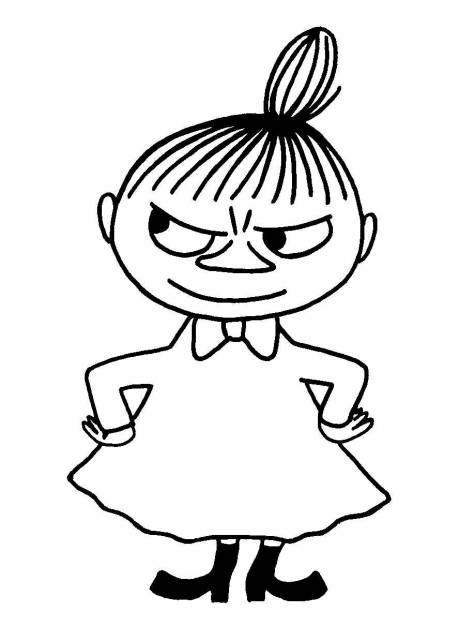
Little My - Tove JanssonLike me less or more, I’ve no qualms sharing that my persona hosts a little devil, an entity suspicious of principles, endless re-branding of what is obvious and free, including pearls of wisdom, and annoyed with much else in the world. This little sprite is my soul’s guard, my bullshit detector, and my Cara (friend.) She mocks hypocrisy, sanctimonious attitudes, power games and manipulation. Every now and then this sprite, like Tove Jansson’s Little My, when enraged, oversteps a mark and creates wanton conflict with my otherwise gentle nature and, at times, too trusting persona.

When a resolve is needed but not forthcoming, I resort to tools of remembrance – head-clearing techniques that calm the mind. Sometimes this works beautifully, but not today, when, of all subjects, I intended to write about ‘love.’

I’ll go ahead anyway, stating that the illuminating intelligence we call love is a core reality inside us. Words are kind of inept, but Rumi got it right.

‘The minute I heard my first love story, I started looking for you, not knowing how blind that was. Lovers don’t finally meet somewhere. They’re in each other all along.’

Rumi (translated by Moyne/Barks)

Irrespective of the despair and suffering experienced around the world, there are plenty of instances when people realise love moves in cracked hearts, and the sun dawns – things are the way they are because we observe them that way. This is our creation, our prison cell and our freedom. Fear may kick in when reliable walls suddenly dissolve, but equally, a realm of exquisite frequency can transcend the exacting laws of dense physicality, and stun us with the simplicity of an underlying truth. People wary about being laughed at keep silent, others start creeds, and there’s the occasional genius – the teacher, artist, writer or outsider, who convinces with plain yet startling expressions of the intelligence living inside us, the one being, pulsing through life’s revolution with wings of beauty.

What, I ask myself, would ensue in the unlikely event of every conscious being on this planet becoming enlightened to this deeper reality simultaneously?

I am interested to know what you think …

My thoughts go like this. In the temporal physical world, at least, friction yields energy we can use and direct. When it comes to the psyche, maybe we need to look at the yearning for love as a means to expand consciousness rather than a goal that promises the laurels of eternal life. Life is eternal without this nonsense of enlightenment as a goal, because, think about it, anything that has achieved wholeness stops becoming. A perfectly ripe apple that drops to the ground does not magic itself back to its branch, a new dream begins.

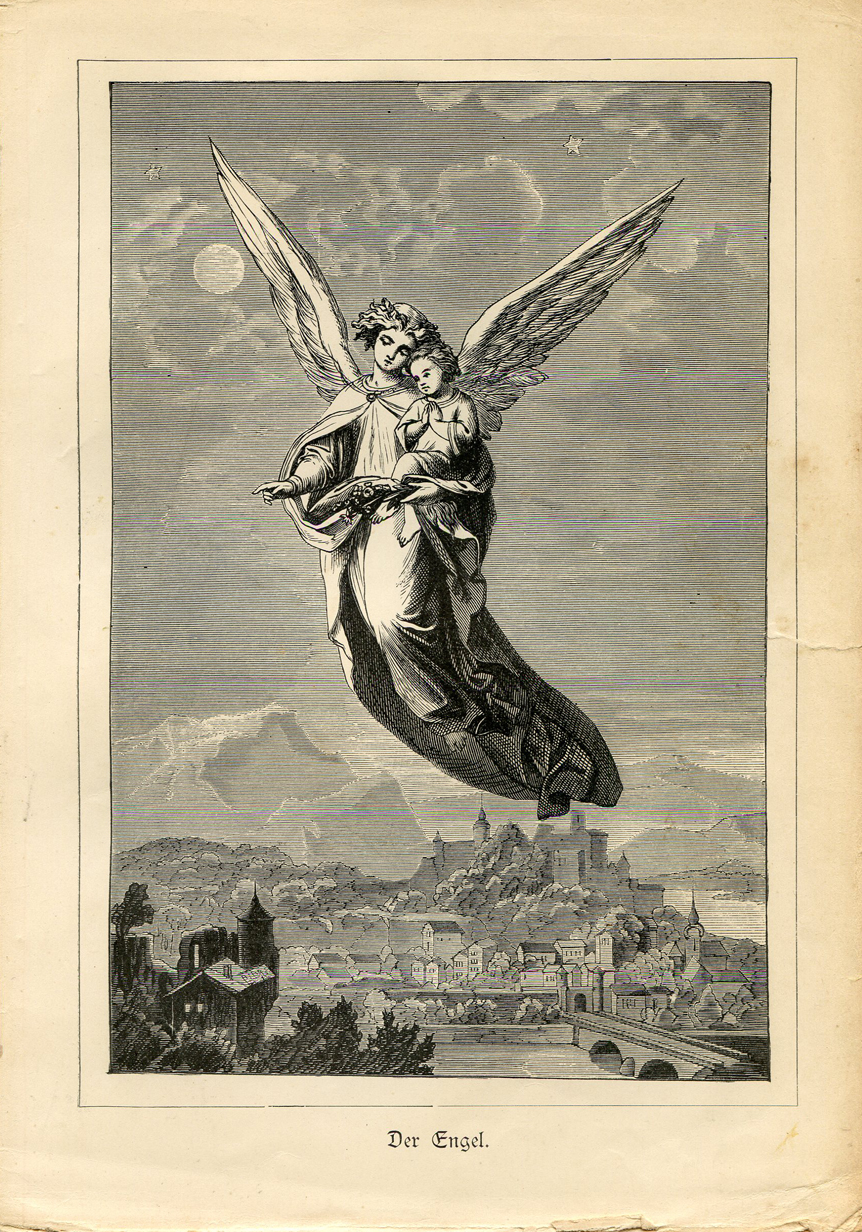
While appearances overwhelm and dazzle us with joy, pain, suffering and confusion in ongoing fluctuation, we can, at times, become aware of this soft rippling breath flowing through the visible and the invisible universe, sustaining the beauty and intelligence that life is ultimately animated by. When this love spins its hidden silver thread through us we are inspired. Angel - Der Engel - Woodcut for H C Andersen 1888 - smallerEven my little devil is charmed when our angel appears, serene or with a humorous smile – ah, you remembered, hello again, eternal child, welcome to warmth, elation, wonder and respect for all differences. For a while there is no judgement, no right or wrong. We’re moving in a vastly different dimension, of which the visible world is just one expression.

Various traditions propose or speculate on a purpose to life, but ultimately we create our own purpose by committing to a path and changing its meaning on the go, only the intelligence of love seems to be a constant.

The separation between past, present, and future is only an illusion, although a convincing one’ – Einstein

24 Comments

Filed under Blog

… what is your bliss? …

My moments of bliss come out of the blue, when I glimpse something moving in a certain way, in a certain light, not ordinary light, but a mysterious light that shines through nature.

P1070862 - smallerLike the day after the sky was veiled by thick curtains of rain and next morning the sun spun its brilliance through the cleansed air, and a warm breeze played through my washing on the line. Such joy, when for an instant my whole attention is timelessly merged with a particular quality of being, transporting me beyond my senses in ways I can’t fathom.

I draw these tricks of light to me, like a collector tends to attract the objects he/she desires. When days or weeks pass without such moments, I feel deprived and nothing quite chimes.

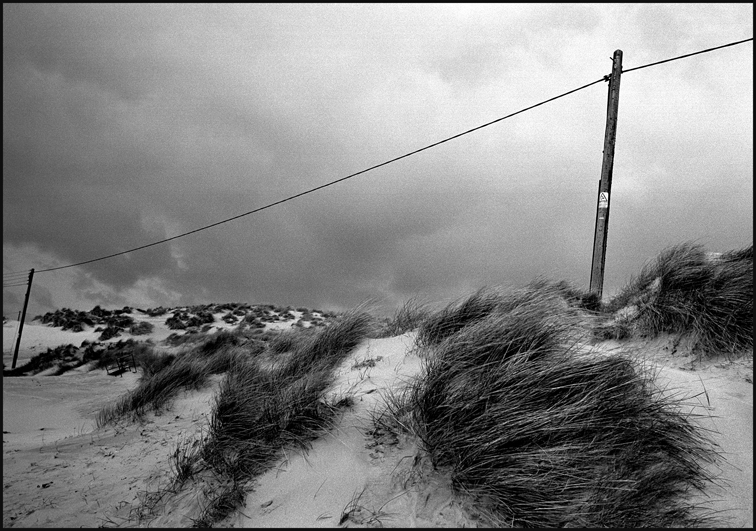
Maybe it’s a rare beauty that takes the mind by surprise and stops time. The washing line reminded me of another bliss I met on a stormy day in the sand dunes of Rye on the Sussex coast. Imacon Color ScannerTo take the photograph I balanced with difficulty on a lifeguard tower that was rocked by strong winds, leaning precariously backwards to get the frame right. The light was sombre, the stirring in the air not playful but intense, yet bliss was present.

When I lose my bliss I pray for its return, like one would call on an imagined angel to make itself known. Occasionally I find a feather on the ground and think – it came and I missed it. Then again, no instance of bliss is lost; the experience is incorruptible and lives on in the calm depth of life’s pulsing heart. Everyone has their own kind of bliss.

What is your bliss?

24 Comments

Filed under Blog

… marginalia of bodies …

moon's swing door

moon’s swing door

the white rock sails adored –

silent swing door to sanctuaries

imagined beyond where

each being claims its mystery

un-evidenced


winged by unknown purpose

spirit seeks shelter

tumbling through cells

to the orb of a home –

embodied in you and me spirit mimics

nature’s mirrors moments after now

though once inner vision unfolds

our dreams are branded …

framed by the one eye

supreme to all eyes …

sun’s furnace illuming draperies

history sanctioned

seemingly evidenced

but for the singular breath

of insight needling between

obvious fabrics to thread

intense tales of beauty …

sample of my occasional art, 1998

sample of my occasional art, 1998


The poem was inspired by June’s full moon.

Places accumulate impressions, snippets of reality that draw us forever into experiences from different directions and points in time. The one place we carry with us – OUR BODY – remembers what reason does not. While the intellect sorts memories into virtual boxes and slaps on the tag ‘facts,’ the body, animated by each breath, deeply informs our singular perception, helps us to adjust the past, refine the relationship with ourselves and others in the present, and opens a new wavelength and vision towards the future.


The experience you have within yourself of your separate identity, to allow right and wrong to be re-defined by you, your singular contribution, is where evolution really happens. You, by becoming yourself, can open a new wavelength. What you reflect immediately influences your environment, people close and far away.’

Fazal Inayat-Khan, notes from an attended lecture, 1989

‘Spirit without soul has no vessel – soul without spirit has no direction.’ Roberto Assagioli

10 Comments

Filed under Blog

… leaving – returning …

the father tree

the father tree

to reshuffle thoughts

a short journey is enough

leaving – returning …

legends undulate

in glowing brittle wood – sighs

from swaying branches –


Jasmin blessings

Jasmin blessings


Jasmin on the breeze

laments of grief in the rain –

ancestors speak

first sounds glide on ice

circling the affirmative

leisurely routine


my beloved Alps

my beloved Alps


between dusk and dawn

all words sink to un-squared time

rounding in fish eyes

as poems probing

the deep meshes of oceans

for heart connections …


‘What else, when chaos draws all forces inward to shape a single leaf …’  C. Aiken

Visiting my early landscapes, friends in Munich, my father of 97, with my son, whose work in London means I rarely see him,  was a rich experience. I had to capture the essence in a poem, which started out in German:

In der Dämmerung glänzt Gold aus der Wurtzel

Gedanken gleiten auf Eis in Kreisen herum

doch manche sinken in die Tiefe um

im Wassergewebe nach Erinnerungen

zu fischen … Gesichter ziehen vorbei 

in sanften kalten und warmen Wogen …

I’ll work on this, inspired by a writer Herta Müller – (English translation on screen) introduced to me by friends whose guest I was in Munich. Anyone fascinated by language will be moved. Also this article in The Paris Review   I am presently reading ‘Mein Vaterland war ein Apfelkern,’ a remarkable dialogue.

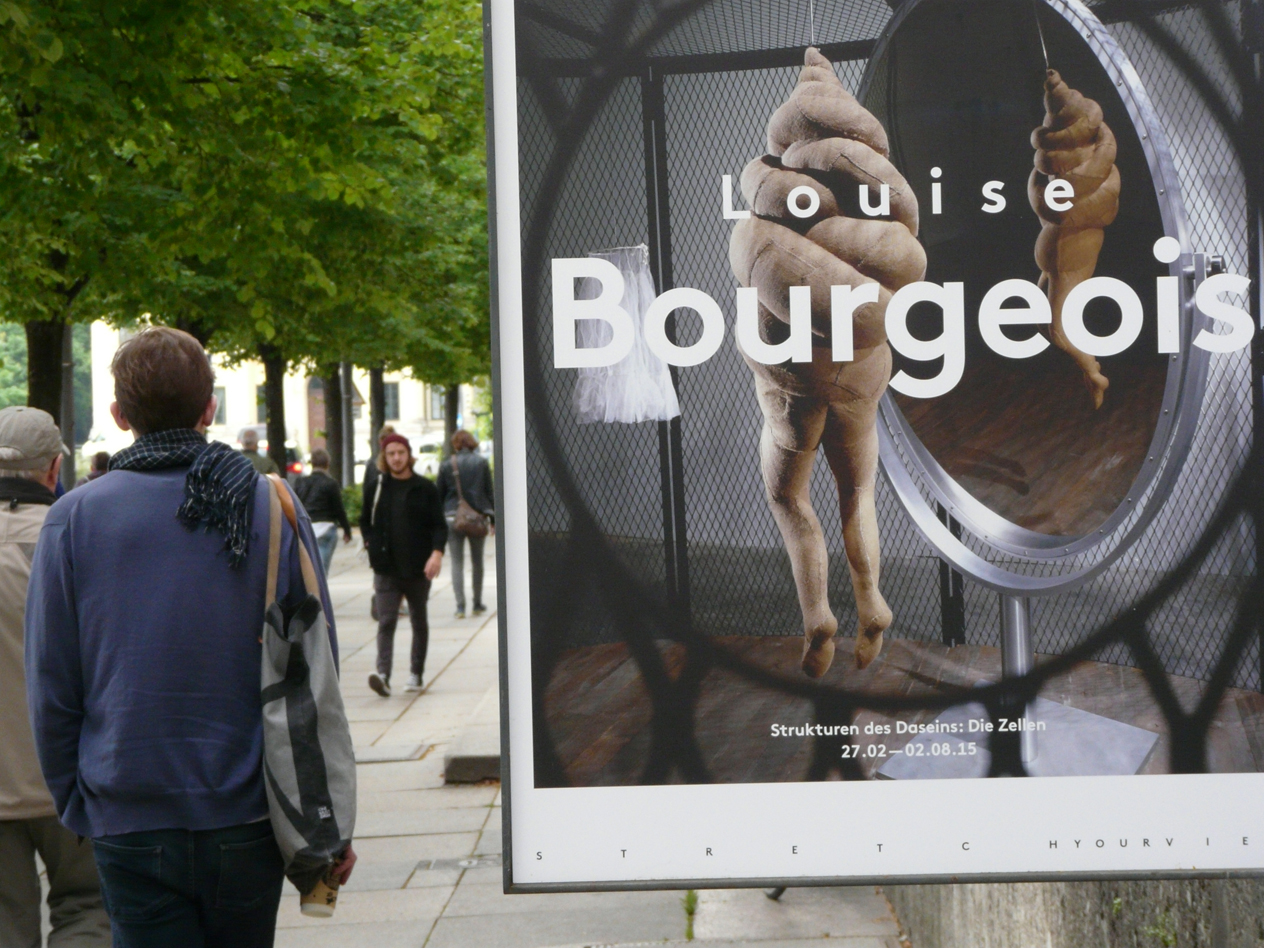
Louise Bourgeois at 'Hause der Kunst.'

Louise Bourgeois at ‘Hause der Kunst.’


In Munich’s ‘Haus der Kunst’ I visited a wonderful exhibition of Louise Bourgeois (1911 – 2010) an artist I much admire, whose installations about the Cells of Structures of Existence are deeply impressive.

Londoners my have seen her huge spider on display in the Turbine Hall of Tate Modern. I wish I had cheated and made photos of her beautifully arranged installations in the generous spaces in Haus Der Kunst.


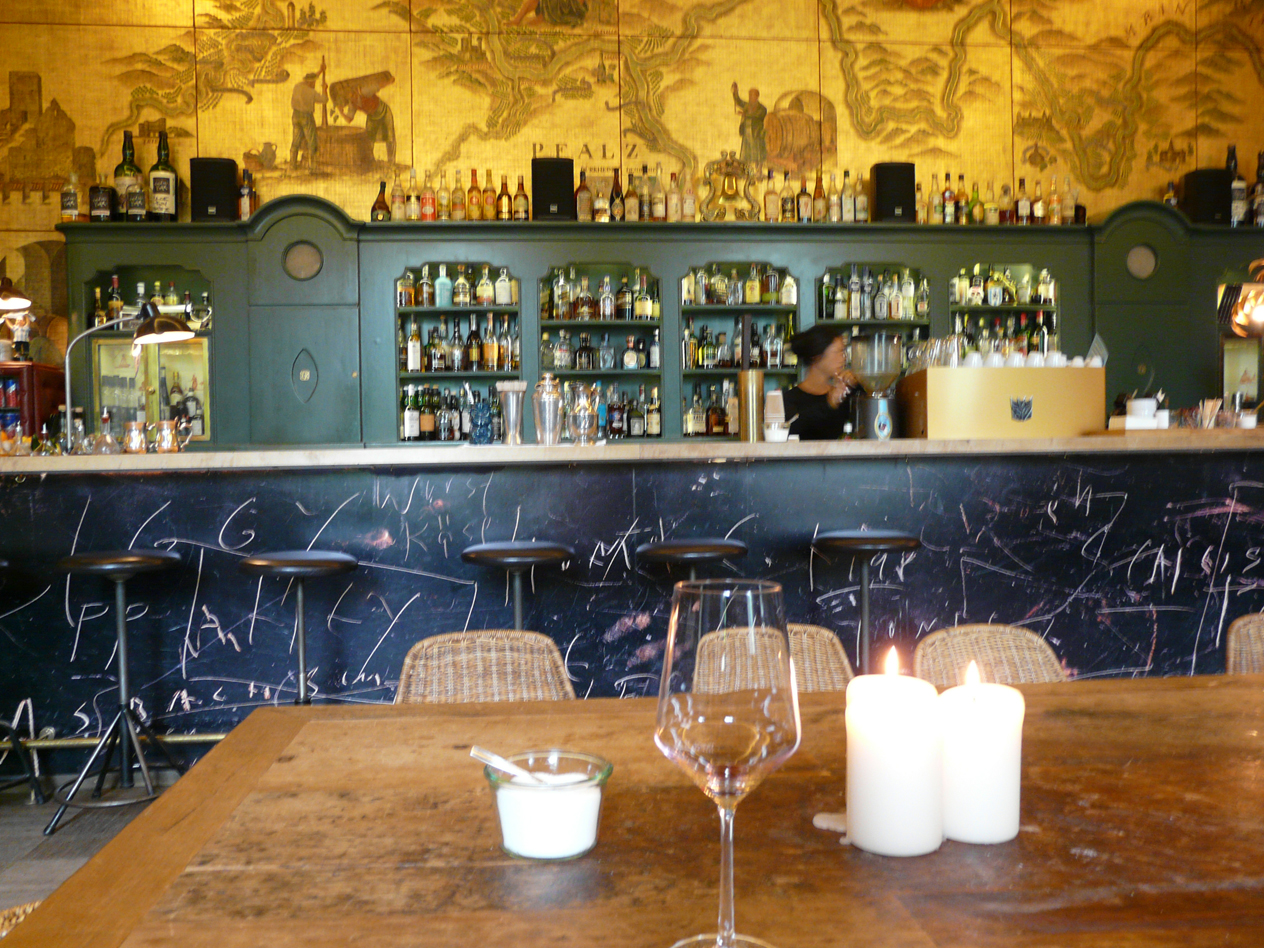
bar at 'House der Kunst.'

bar at ‘House der Kunst.’

To compensate, here is the wonderful golden bar at the ‘House der Kunst.’ And returning home – a blue invasion.

a blue invasion

a blue invasion

10 Comments

Filed under Blog

… recent instances that caused a smile …


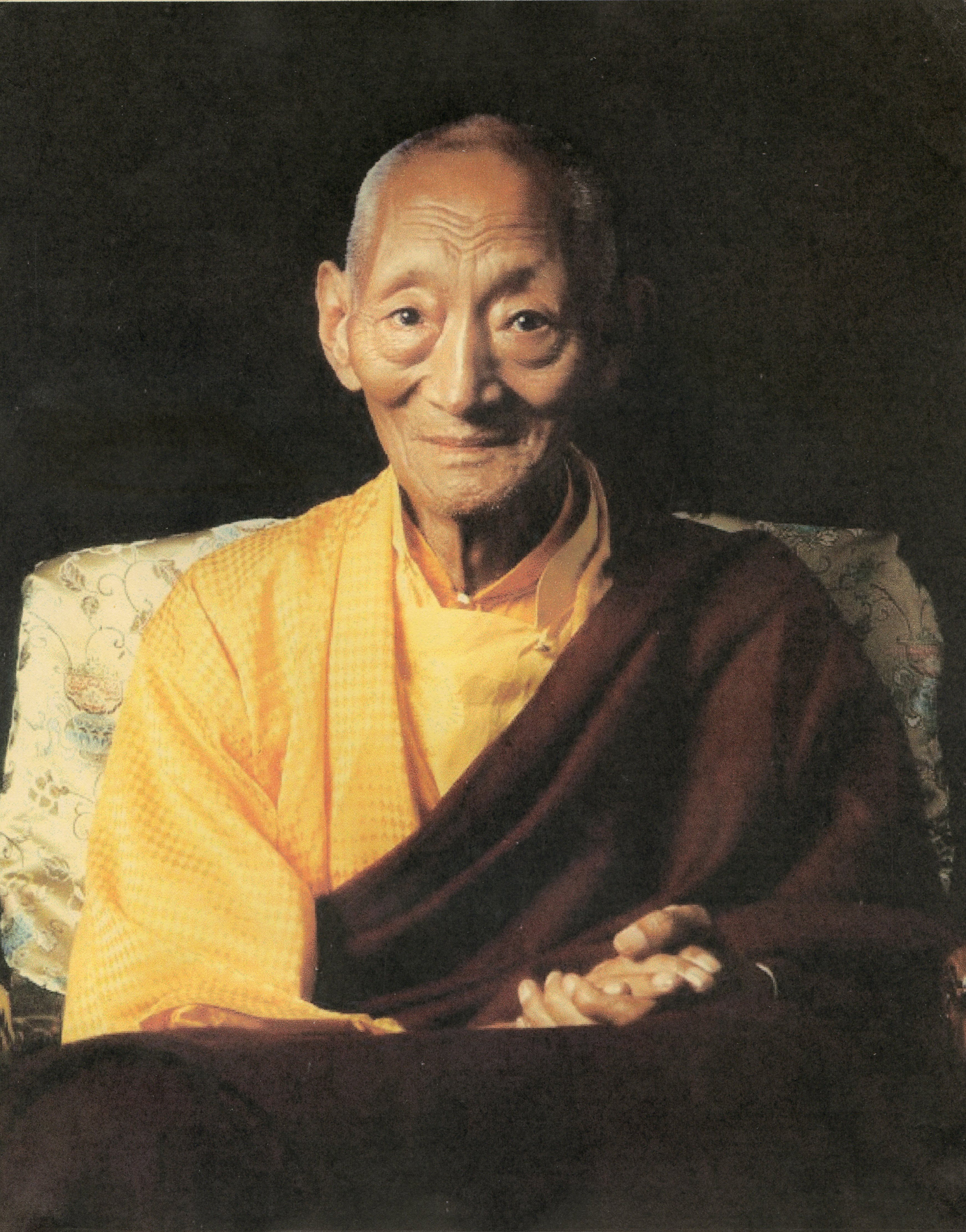
Kalu Rinpoche

Kalu Rinpoche

Maybe brought on by the longer days and the increasing sunshine, there were more than the usual instances making me smile during the last few days, so I thought I share some of them …

Exploring with a client what it is that can shine through our eyes, and sharing an image of a Tibetan Lama, Kalu Rinpoche. We reflected on what is communicated  through our eyes. It is certainly informed by our inner attitude, by our projection. The way we look at ourselves, at others, at our surroundings, and at the world at large

Irrespective of the Lama’s Mr Spock ears, I feel deeply nourished by what shines through his eyes.

Hazrat Inayat Khan spoke of the smiling forehead. https://wahiduddin.net/mv2/XIV/XIV_1.htm


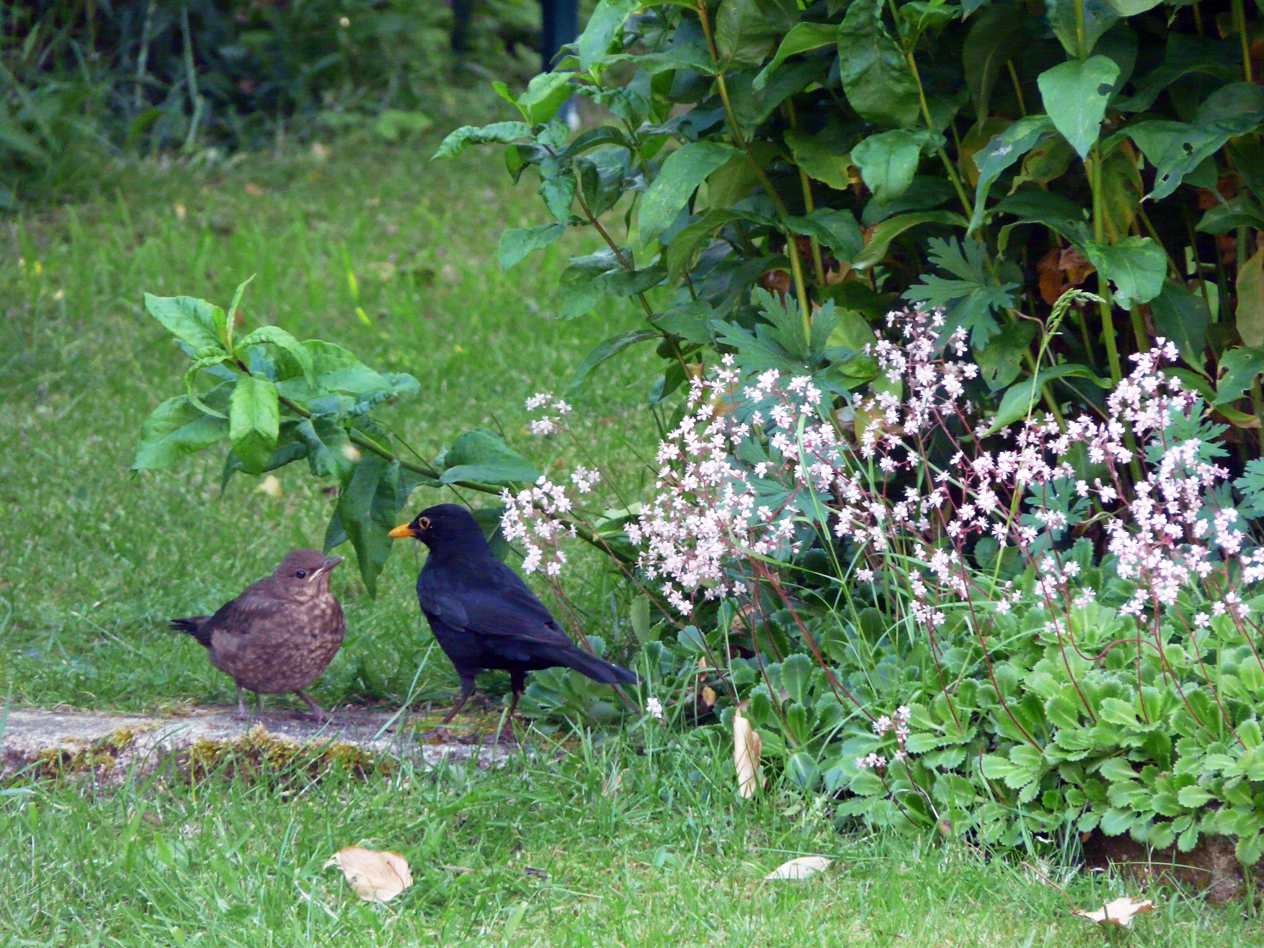
My resident blackbird family.

My resident blackbird family.

My resident blackbird family – dad plucking worms for his offspring.

Tiny plants in my garden, like Creeping Moss Phlox and London Pride.

Stories shared among friends about invisible presences that have come to say, ‘Hello.’

The intimation found in an old graveyard brushed by the evening sun – ‘Ha, ha, there’s no death – we’re having a wonderful time.’


Rhododendron flowers

Rhododendron flowers

A broken rhododendron branch – its budding flowers shouting, ‘Take us home and we’ll open’

The friend for whom I did photographic portraits, saying:

‘I must get to know this stranger.’

Strawberry soup my mother used to make – slice berries, add sugar to draw juices, let it stand, the longer the better, add milk and dabs of whipping cream.


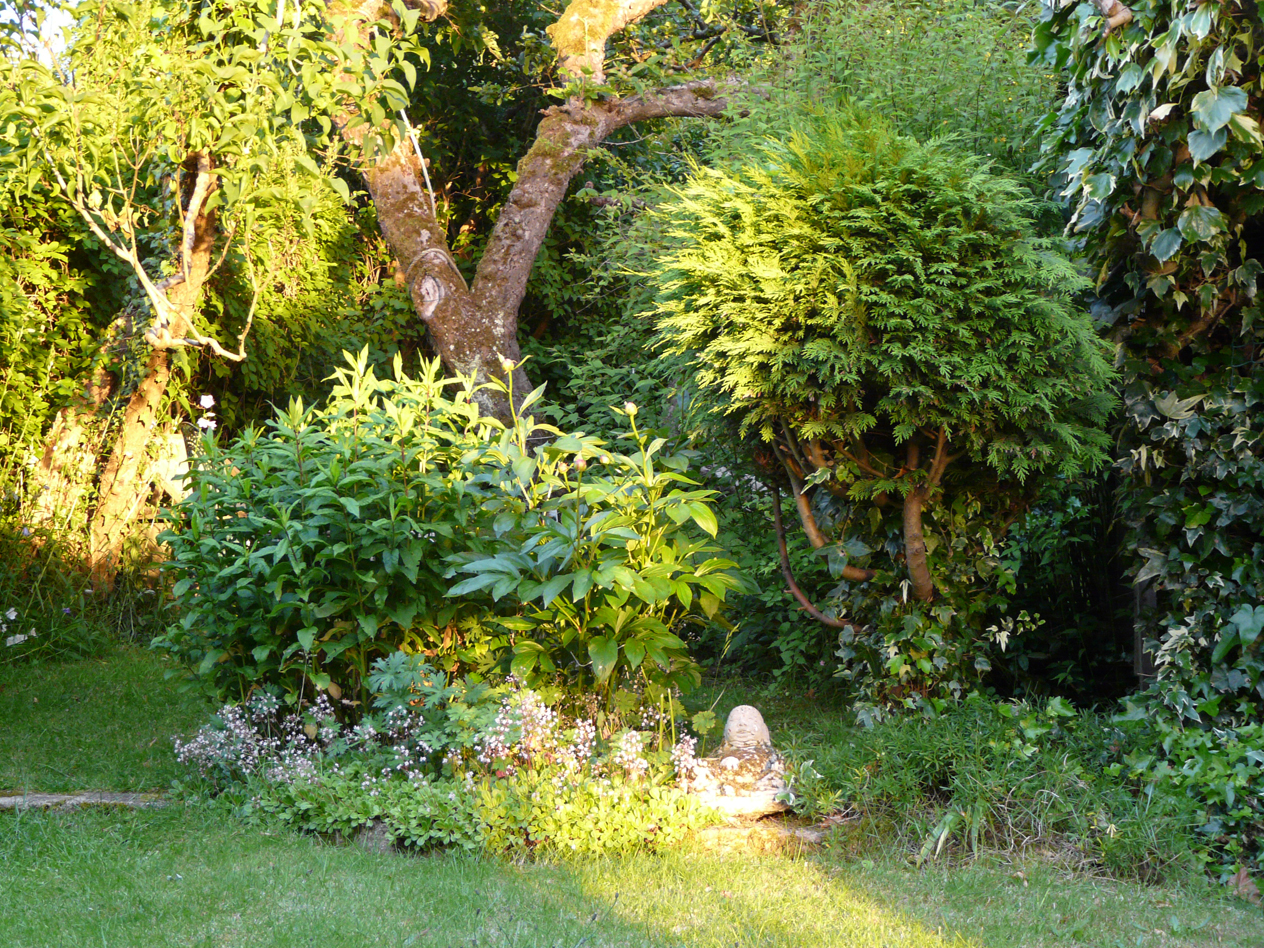
And on days like today, the late sunrays visiting my garden.


Late sun rays in my garden.

Late sun rays in my garden.

Moments of being – an aware and restful state of mind, an empty sphere from where anything can emerge.

*    *    *   emptiness   *   *   *

… only the unfettered mind holds

the virtual teasing in poise

screeners ponder its Socratic

wisdom in the bright light of day

peals of laughter – a burst of love …

17 Comments

Filed under Blog

… surfacing …

surfacing

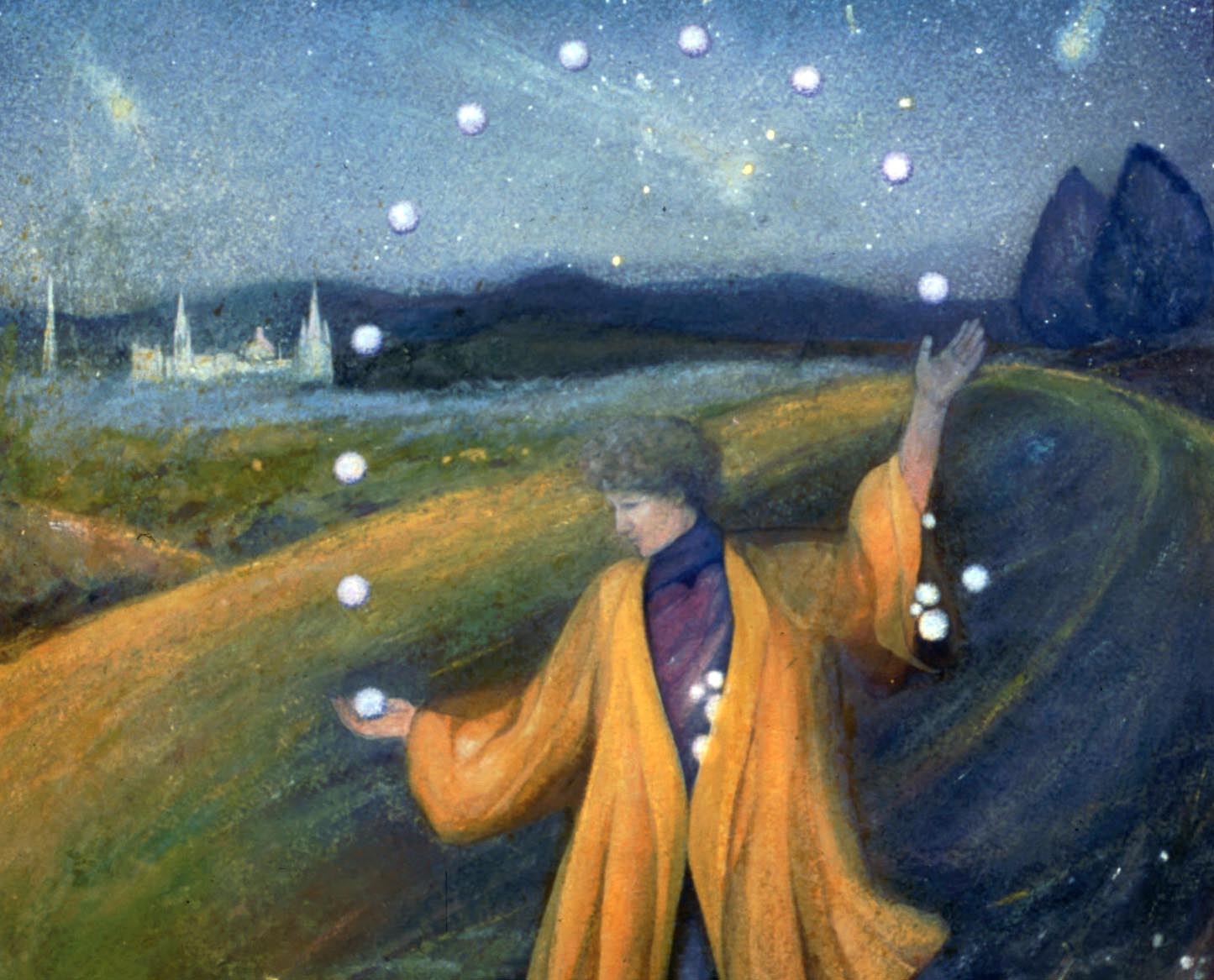
Segment of 'The Magician,' a painting by Silvia Pastore

Segment of ‘The Magician,’ a painting by Silvia Pastore

her nocturnal creature mourns as meshes of  night disband the Other of her dream into strands that flow like oil colours –

marbling still waters under grey or rain-bowed sky as canvas for inventing random patterns of each day

beneath the mirrors an ever-turning gyre of souls in deep wordless liaison keeps churning the ocean

her inward creature drifts through curls of emptiness sifting strata of seasons

to gathered wisdoms of the human heart

its patina of touch and wear

sediments of ache and bliss

its gilded secret

cypher for another Eden

from which her inversed image falls

to the next fluid mirror always desiring the Other …

Ashen 10th July 2015

Maybe needless to say, just about everything I post here is relevant to my novels.

In relation to the poem, I thought you might enjoy the fascinating Art of the Marbler https://www.youtube.com/watch?v=Vyga8VMWXKg

And a short introduction to The Churning of the Ocean of Milk https://www.youtube.com/watch?v=MItyUwPAjLA

The segment of the Magician image is the work of a fine painter, Silvia Pastore http://www.silviapastore.com/ … Time and space are illusions …  Having obtained the copyright of the Magician as a cover for ‘Course of Mirrors,’ it seems my publisher, who I re-signed a contract with, has other ideas. I love Silvia’s work, but will remain open to suggestions, as long as my first novel is launched within the year. It’s been sitting quiet since 2011. Maybe all good things take time. A sequel is waiting in line, and I’m working on a third book in the series.

11 Comments

Filed under Blog

… a cartography of the psyche …

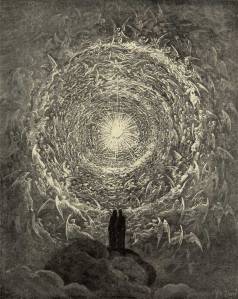
Celestial Rose - Gustave Doré

Celestial Rose – Gustave Doré

My novels (yet to be published) are inspired by transpersonal incidents I experienced, even as a child. Learning that I was not alone with my interpretations of what happened to me during so-called non-ordinary states of consciousness was a great relief, when during the 70s and 80s I explored, in practice and theory, the major maps of psychology. Jung’s ideas especially rhymed. After training with Psychosynthesis, my interest turned sharply to innovative transpersonal approaches, myth, archetypal psychology, and contemporary science.

People who inspired me were Abraham Maslow, Gregory Bateson, David Bohm, Joseph Campbell and others, many who happened to be among the same people Stanislav Grof met and was supported by when he devoted his life to map the experiences of non-ordinary states of consciousness.

For the first ten years Grof did psychedelic research in Czechoslovakia. By the 70s he had found a family of open-minded scientists and enthusiastic supporters at the Californian Esalen Institute. Since the use of psychedelics became illegal, he developed the Holotropic Breathwork, together with his with wife, Christina.

Around this time I found my own, smaller family of mind and heart in England, where Fazal Inayat Khan saw the huge potential of what was to be the transpersonal psychology movement initiated in Esalen. Fazal involved his students in experiential approaches to self-development, an endeavour that brought him into conflict with the traditional Chisti Tariqa his grandfather Hazrat Inayat Khan had established in the west as Sufi Movement, which Fazal represented at this point. I co-edited ‘Heart of a Sufi,’ a prism of reflections on Fazal by his students. Here is a previous post https://courseofmirrors.wordpress.com/2013/03/16/a-rare-book-now-on-line/

Grof sees global consciousness evolving through an increasing number of individuals achieving inner transformation, and considers symptoms of spiritual emergence (often seen as mental illness) as part of a healing process needing to be lived through, not supressed. This totally chimed with me.

Obviously, such a project does not attract investment. Shareholders look to own a brand, a patent, a method, a franchise. Many innovations are lost, since the way ideas and things hang together is not finite, but dance in ever new combinations. Also, in areas of specialised and fast-changing knowledge practitioners can become so absorbed with new discoveries and concept that they tend to forget about lay persons who might not be able to grasp the newly coined language, or won’t take the time to look at other fields of knowledge. A major insight may be broadcasted ahead of its time and spark endless quotes but no understanding. Some messages cry for a new context, where insight, beauty and meaning can be shared through passion, combined with apt metaphors, like a fine tune can travel through the heart and make it shiver with the recognition of new connections. Often it’s a matter of waiting for an idea to fall on fertile ground.

Assuming my readers represent a fertile island in this vast internet ocean, I would be amiss not to share what inspires and influences my writing. Few people are familiar with transpersonal psychology; let alone with the work of Stanislav and Christian Grof, so here a short (promise) introduction.

Born to parents that care for us, or not, into environments that encourage or hinder our development, usually both, we learn (hopefully) to understand that our attitude towards ourselves and the world is coloured by early experiences, and fixed further by our reactions to what happens to us. The psychological maze we lay down is difficult to walk away from, because it pops up from inside wherever we go. An interest in our personal history and the willingness to explore our behaviour certainly help to make life easier.

However, there are memories we can’t access intellectually.

They are perinatal impressions, which don’t necessarily end in a triumph that promise self-confidence and later success in life. Western psychology does not take somatic imprints happening in the womb, during birth, and after birth, serious. The assumption is that the cerebral cortex of an infant lacks the myelin sheaths on neurons, so the brain can’t be sufficiently developed to record experiences, this, irrespective of the fact that memories reside in our cells and muscles.

The powerful non-ordinary states people experience during Grof’s perinatal holotropic sessions often relate to a time before, during and after birth. Participants report strong sensations and images of a mythological and archetypal nature that live in the collective psyche and significantly shape our individual myths.

From the people bringing alive perinatal imprints during Grof’s workshops, he has mapped the Birth Matrixes, which shed a bright light on symptoms medicine tends to label as psychotic and usually supresses with counterproductive drugs, whereas Grof looked at symptoms as a healing attempt of the psyche.

This fear of the imagination questioning accepted realities also explains the ambivalent attitude of our culture towards the arts, though it’s no secret that the archetypal myths populating our psyche inspire our most renowned artists.

Dore - public-domain-image

Dore – public-domain-image

To guide a person through a phase of psychotic or transpersonal emergency without suppressing drugs requires a paradigm shift that has, as yet, not happened, which is why Grof’s considerable data of experiential work has been tucked away in the transpersonal section of psychotherapy, seemingly too esoteric to grapple with. Early imprints, though decidedly physical, create powerful condensed experiences that draw upon themselves alike situations. Much like self-affirming prophecies, they constellate throughout every phase of life, from infancy to adulthood. Such early imprints are the source of the psychology and psychopathology of ecstasy. Please note – the types of ecstasies I show below, are only clipped markers and in no way convey the richness of the material Grof presents, which he divides into Basic Perinatal Matrixes (BTM 1, 2, 3 and 4) that include related psychosomatic problems and periods of depression people struggle with.

  • Oceanic or Appollonian ecstasy, cosmic consciousness, symbiotic union with mother during intrauterine existence, and during nursing. Expressions of this state in the arts radiate purity and serenity.
  • Volcanic or Dionysion ecstasy, orgastic sexual energies, orgies, pain and rapture. Dangerous activities, sensual and instinctual aspects of life. Think o the surrealist freeing their imagination in ways that powefully speak to us all.
  • Illuminative, Promethean ecstasy, proceeded by agonising struggles and intense yearning for answers, followed by divine lightning that brings entirely unexpected solutions, cosmic inspiration and insight.

When feelings emerge during the remembrance of the birth process, be they nightmarish,like EdgarAlanPoe’s A Descent into the Maelstrom: http://en.wikipedia.org/wiki/A_Descent_into_the_Maelstr%C3%B6m  or blissful, like in Gustave Doré’s Celestial Rose, image above, the opportunity such symbolic images provide for deep psychological work is invaluable. 

Given the complexities around birth, why are not all babies delivered by pre-planned C-section?  http://en.wikipedia.org/wiki/Caesarean_section   A fascinating page, if you have the time to read it. Knowing people whose delivery was pre-planned as C-section, I observe a surprising feature. If in trouble, they shout for help, and usually help comes …  expectation does its magic. When being whisked from the womb before the struggle through the birth canal commences, struggle is simply not familiar, nor, of course, the potential sense of liberation. By contrast, many people have difficulties asking for help, fearing the distress of not getting help. I include myself in this category. A recent comment I left on Jane Alexander’s blog touches upon a personal experience, an early imprint that had a decisive impact on my life. As an example, I elaborate …

… I patiently endure scarcity for long stretches, until the energy switches and everything happens at once. Then I tend to surrender to the flow, or I would feel overwhelmed.

When I was pregnant, I discovered a connection to these periods of extreme scarcity and abundance in my life, leading back to an incident after my birth. Knowing I was breastfed for many months, I asked my mother on the phone to tell me about my birth. She related my birth was long and exhausting. The midwife suggested my mother needed a break. She took me to another room where I cried myself to sleep. ‘It’s good for her voice,’ she insisted. But, of course, I must have missed my mother’s heartbeat.

While listening to this story on the phone, I observed the skin around a silver ring I was wearing turning black. Heat flashed through me, of rage, for which I had no words. By way of apology my mother said it hadn’t felt right and she should have resisted the midwife. Then she went on to describe how, next morning, I was taken to her very full breasts, at first acting stupid but eventually drinking until I could drink no more. 

In later studies I learned about Stanislav Grof’s birth matrix maps, how condensed experiences draw onto themselves alike experiences, like self-affirming prophecies. Certain expectations are set up very early indeed. This made sense and helped to soften the pattern of my extreme life phases somehow. 

So there – now you know my autogenic secret. In the end, our vastly different conditioning makes us into interesting people 🙂 not mass produced and pre-packed, as it were

Bringing to awareness the unconscious somatic patterns underlying our existence offers us choices to respond rather than react to situation. As a collective, we swim together in a psychic ocean that is both threatening and benign. We regress and progress together, each of us bringing our little light towards the expansion of consciousness. Let’s not buy into the shallowness of our material age, but keep the conversation going.

Here Stanislav Grof speaks for himself – Psychology of the Future –                                  https://www.youtube.com/watch?v=rI5oG-WNqvM

If you who would like to explore the maps Stan created, and the images that illustrate the in-depth experiences of people who encountered powerful feelings during a typical re-birthing experience – which enlighten the source of our idiosyncrasies and some of the most prevailing human pathologies, I would recommend Grof’s book ‘Beyond the Brain,’ Birth, Death and Transcendence in Psychotherapy, published 1985 by State University of New York. The book does not offer a simplified and popularised version of Grof’s work but significantly challenges our global policies, and the seriously outdated neurophysiological model of the brain, showing the reach of consciousness beyond time and space.

… ultimately we cannot do anything to other people and nature without simultaneously doing it to ourselves …

A post from 2012 that maybe relevant:                               https://courseofmirrors.wordpress.com/2012/05/25/pattern-which-connects/

Incidently, yesterday I attended a talk called ‘the One who cannot die’ given by my dear friend Malcom Stewart, whom I wrote about in 2013 https://courseofmirrors.wordpress.com/2013/10/07/patterns-of-eternity-humbly-opens-your-mind /

 

22 Comments

Filed under Blog

How do I read?

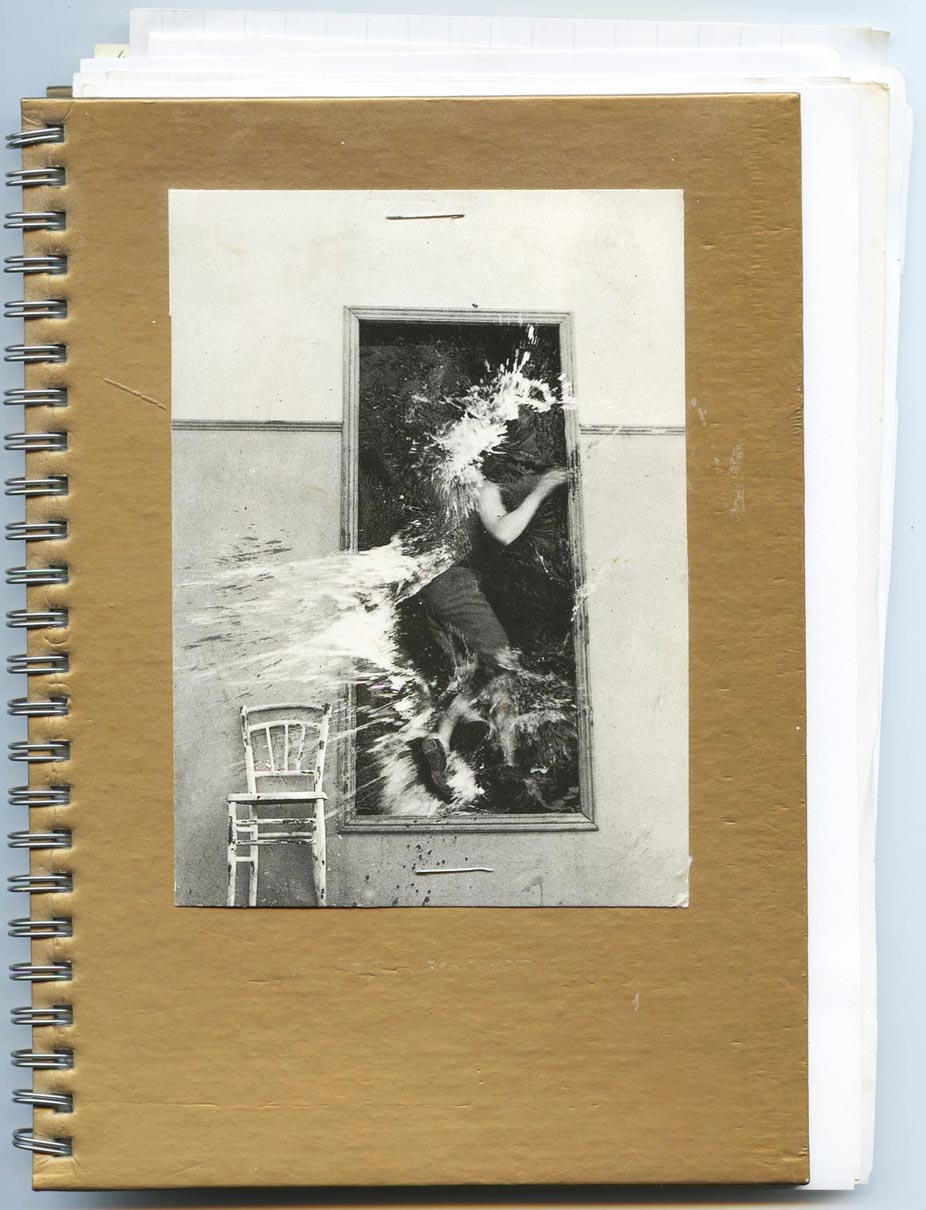
one of my notebooks

one of my notebooks

I jotted this question in my notebook a while ago. How do I read, in the widest sense? There is plenty of observation and advice on the art of writing, composing music, painting, photography, film. Less is said about on the art of reading, perceiving, interpreting, or how we reject or embrace what is expressed by others, and ourselves, even how we read our dreams.

I conclude there’s no difference between, let’s say writing, and reading, other than visibility, since any creative composition derives from an inner process of reading, the picking and shuffling of impressions into our frame of reference in relation to the larger myth of reality.

One could say the secret of being read lies in one’s talent and ability to read one’s inner psychic world, even when filtered through one’s most personal and eccentric imagination.

Long before communication was easily reproducible and reached greater audiences, people were reading the world, though only a tiny fraction of inspirations and inventions was circulated. Today’s media channels swamp us with communications. It’s confusing. We must choose.

In reading novels, I follow my intuition. The gimmick of an instant attention grabbing action scene puts me off. A proposal may be impossibly fantastic, but if I detect an authentic voice, rhythm and movement, I travel along. Invited into a mind, an atmosphere, a time, a place, I want to be absorbed in this other world and experience myself anew in a conflict between light and shadow from within the heart of another consciousness.

Whether meaning is intended or not, I read my own meaning into what has been imagined by another mind. An insight, a memory may surprise. Some books I treasure for one or two illuminating sentences, so I guess reading for me is a bit of a treasure hunt, which begs a question. What am I hunting for?

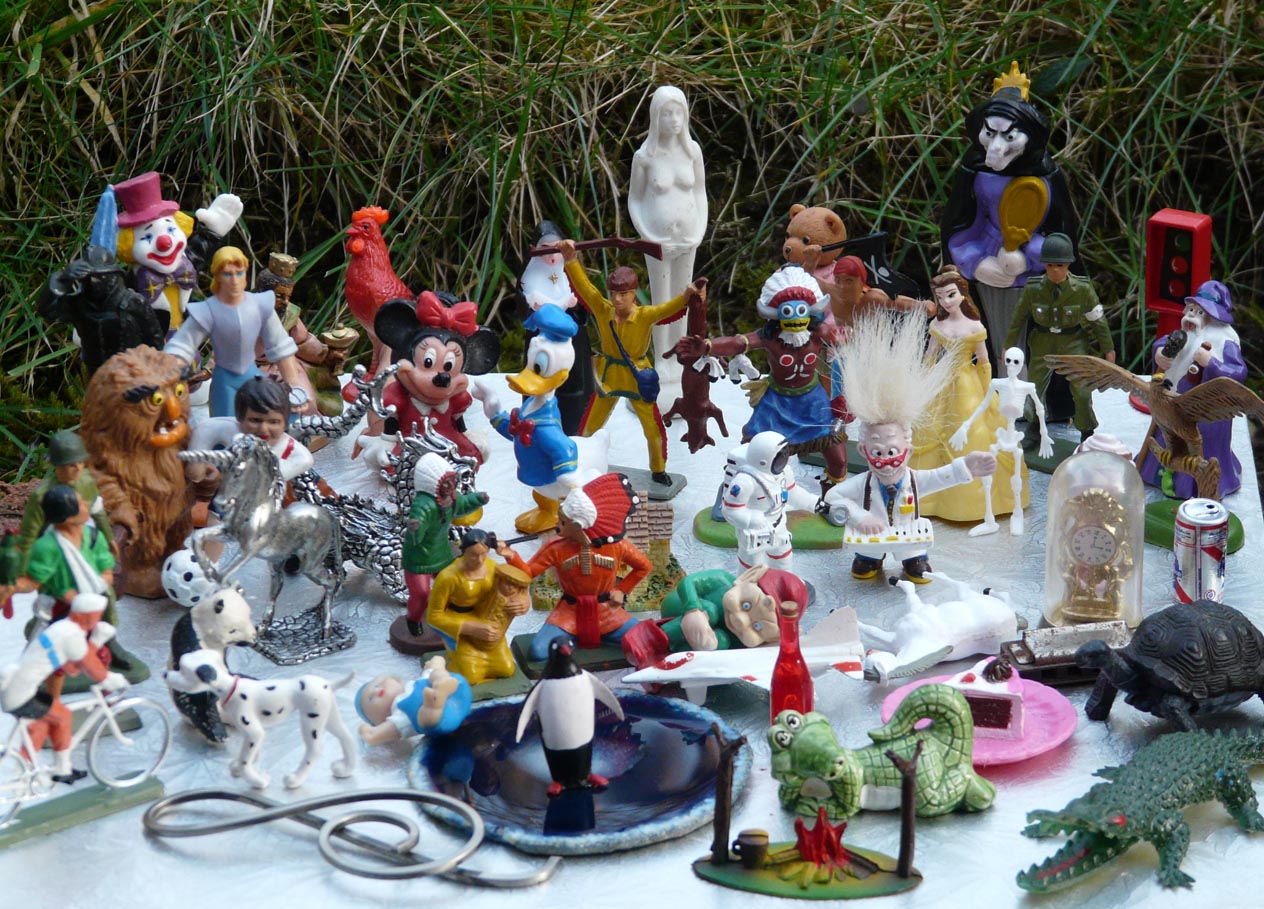
world objects for sandtray work

world objects for sandtray work

My interest is fleeting when events are contrived, plucked from the air. Characters convince me when they are embodied and grow around obstacles, reaching towards the light, while spreading roots and producing seeds (new thoughts,) even when they come from mythical creatures, kings and slaves of the past, or explorers of distant futures. As long as events happen in a believable psychological setting, I engage.

Then again, I’ve been convinced by writing that made no sense at all, until, with a little patience, I discovered a new comprehension shining through an abstract form. It’s a wonderful feeling, and important feedback for writers, who may be surprised by what is evoked in readers. Once I finished my present project, I intent to spend more time on reviewing – a most giving art of reading.

Stories for stories sake can be dull, while stories in which nothing much happens outwardly can be riveting when they resonate with the human condition, where, quite often, what seems true becomes false, and what seems false becomes true.

It is said we write the books we want to read. When writing, I search to combine words that convince intellectually and emotionally, until something true is mirrored back. Maybe what I’m hunting for in my reading and writing are fitting metaphors for the miracle of existence.

I always delight in discovering neglected writers, like Marlene Haushofer,  or the poet W S Graham, whom I wrote about here as part of a post in Sept 2013.  And beyond new works, there are innumerable old favourites, including H G Wells. The link connects to a post I did about one of his lesser known stories.

Thinking about photography, my other passionate reading, I was inspired by Henri Cartier Bresson – the link leads to my post about him.  And here the archive of the street photography of Andre Kertesz – enjoy.  I’ll leave film alone, that’s a whole other story.

What are your reflections on reading?


Some related blogposts:

Storytelling and the primary world.

Mother-tongue and other tongue.

Memory and Place.

11 Comments

Filed under Blog

… four years of blogging …

The host of my virtual island – wordpress – alerted me to the four-year anniversary of my blog.

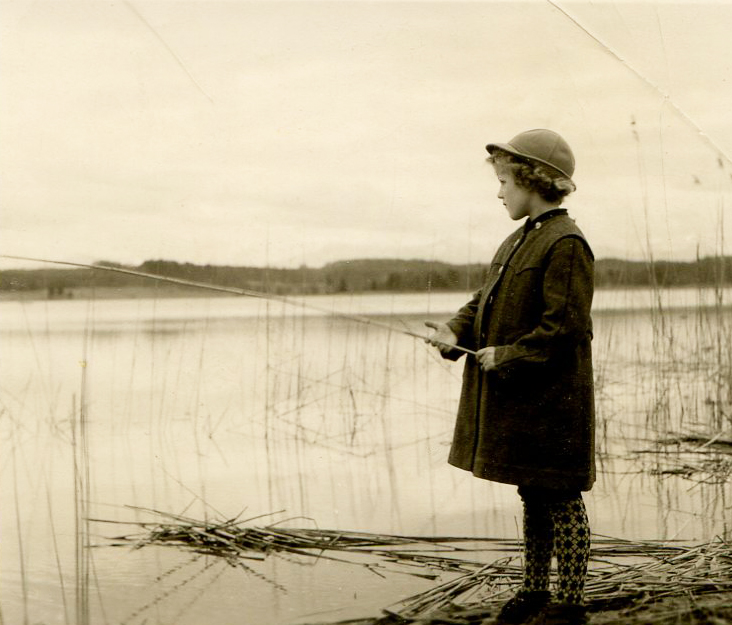
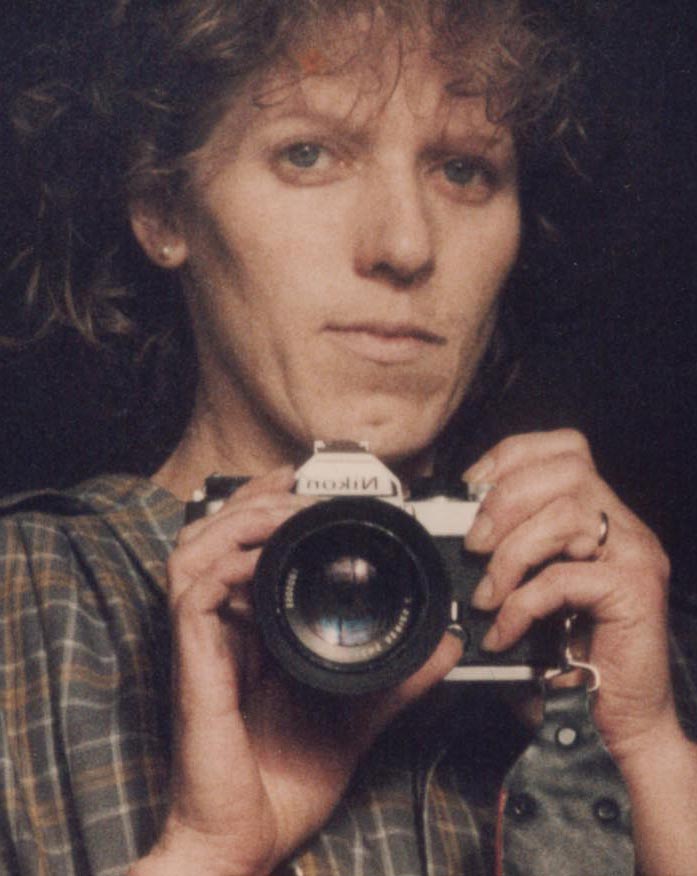
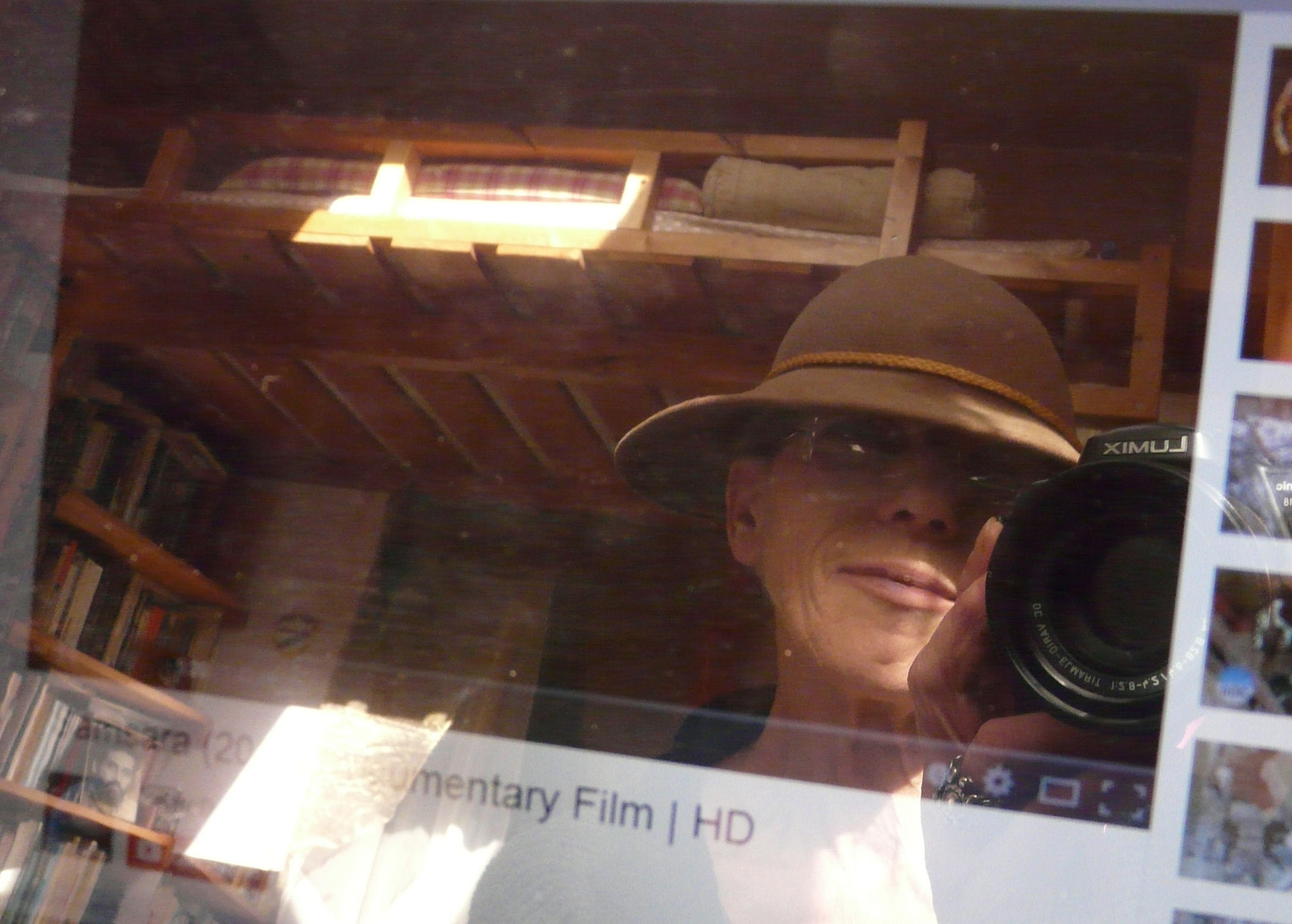
I thought I share with my followers some private photos. I’m not good at private sharing, but since my first book is going to be published this year, one way or another, some visuals of myself are in order.

pretending to fish

pretending to fish

about 30 years ago,  before selfies were vogue

about 30 years ago, before selfies were vogue

more recent, four or so years ago, a young sixty something

more recent, four or so years ago, a young sixty something

Lack of time limits my interactions, so I assume my over 300 readers are truly genuine. Thank you all for reaching out, for your friendships. It’s heartening to know my posts are enjoyed, and occasionally inspire. I sample your islands at random, and delight in how everything posted resonates. I appreciate your likes, and will respond to every comment left here.

Looking back, this was my first short post in March 2011 – just one sentence:

                                           We are each of us born a star in search of our world.

The second post was: A recent series of Haiku – for those who like Haiku

a town is gone

hawthorn flowers

white in the sun

*   *   *

among rubble

the snapshot of a child

splashing in a wave

*   *   *

spring morning

a ginger cat leaps home

across frosted lawns

*   *   *

the robin arrives

sampling dry grass for its nest

sky is cut by a plane

*   *   *

sunlight in a puddle

birds dowse their wings

no other sound

*   *   *

emerald shoots

on brittle cement

patter of feet

*   *   *

plastic bags rattle

in wire and branch

blobs of colour

*   *   *

a wave is rolling

over the grid of streets

hush among crumbled walls

*   *   *

lichen dried silver

in the hot spring

a rain of blossoms

*   *   *

a golden leaf

in the shade

white plumes rise

*   *   *

under smooth ice

a shimmering carp

visible silence

The concluding post in March 2011 was a letter to my shadow, ending …

         … Without you, I’d only be fluff on the coat of real human beings …

Time-permitting, please explore my posts, listed in the archive column to the right of my home page.

I hope you bear with me. Heartfelt thanks to all my readers.

21 Comments

Filed under Blog