Tag Archives: awareness

… the house-guests of body electric …

SHE calls me body electric. SHE – incarnate as hu-wo-man – oh the mystery – and such hard problem for the scientists who establish evidence of truth via the elimination of untruths. Meanwhile they identify my parts, their functions and complexities …

I’m a miracle, my ears perk at the slightest sound – the little groan in the joints of wood and brick when the house moves a fraction as the weather swings about, soft tweet of a bird, the hum of fridge and its sudden shudder, a rumbling pipe, creak of loose floorboards, or the faint scrape on the stair in the middle of night, when the tip-toeing lodger sneaks to the kitchen to pinch a little honey. Not my concern, I only notice. Exquisitely attuned to my network of neurons, I pick up irregularities, tiny fluctuations of mood, unfamiliar smells, odd tastes, taut muscles … the chatter of Jego, but more of him later.

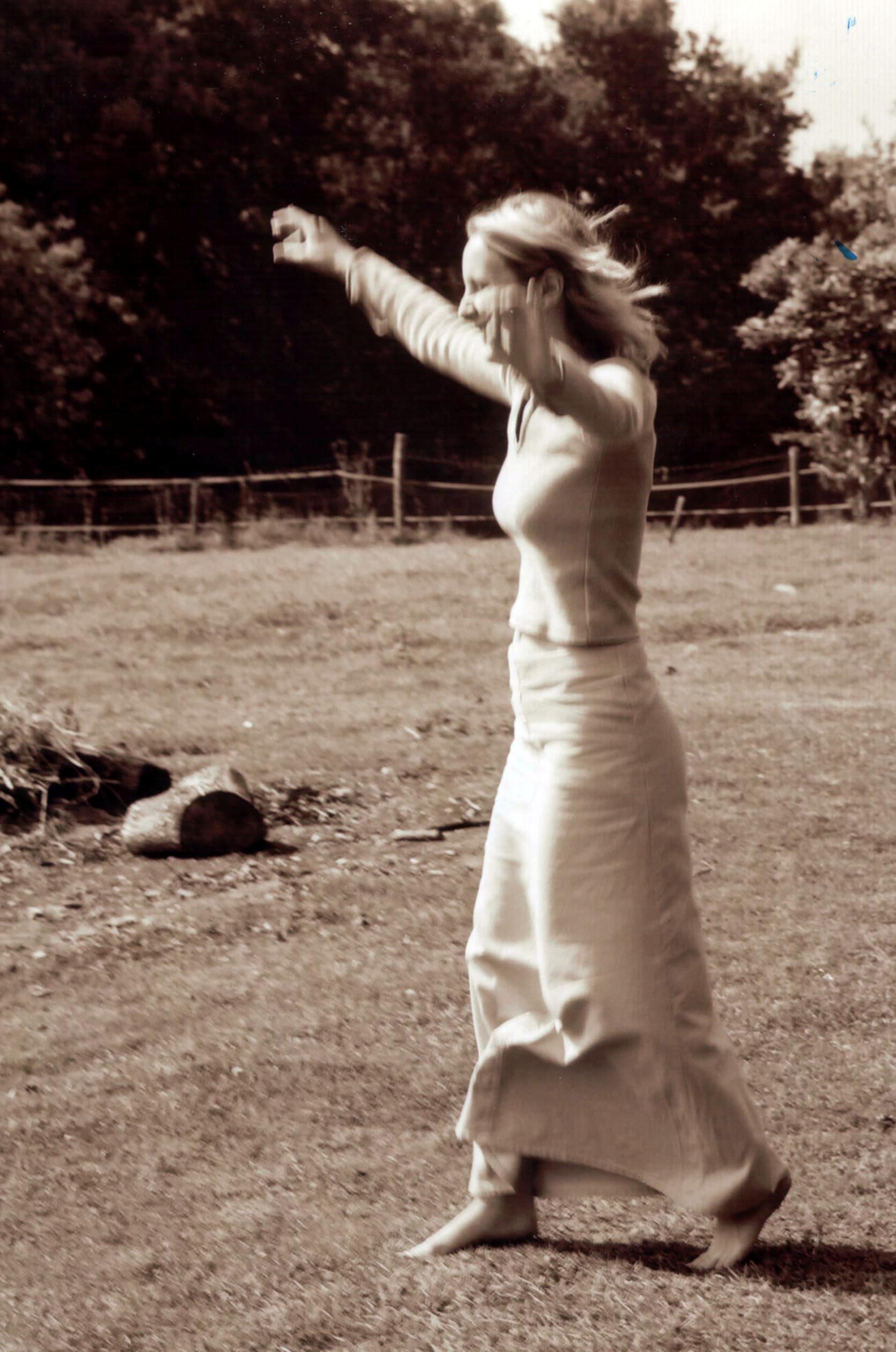
Magic-Leila's wings02Whoever I house, I prompt stretching exercises, crack joints to unblock energy, flex shoulder-blades that still mourn their wings, and shortly massage cold fingers-tips, my antenna for vibes. I rejoice in my multitasking, my handling of objects with skills no programmed AI creature could ever hope to achieve. With the unfailing accuracy of a spy, I pick up signals against the faint background buzz of the blood river and readily adjust to spheres beyond my skin palace.

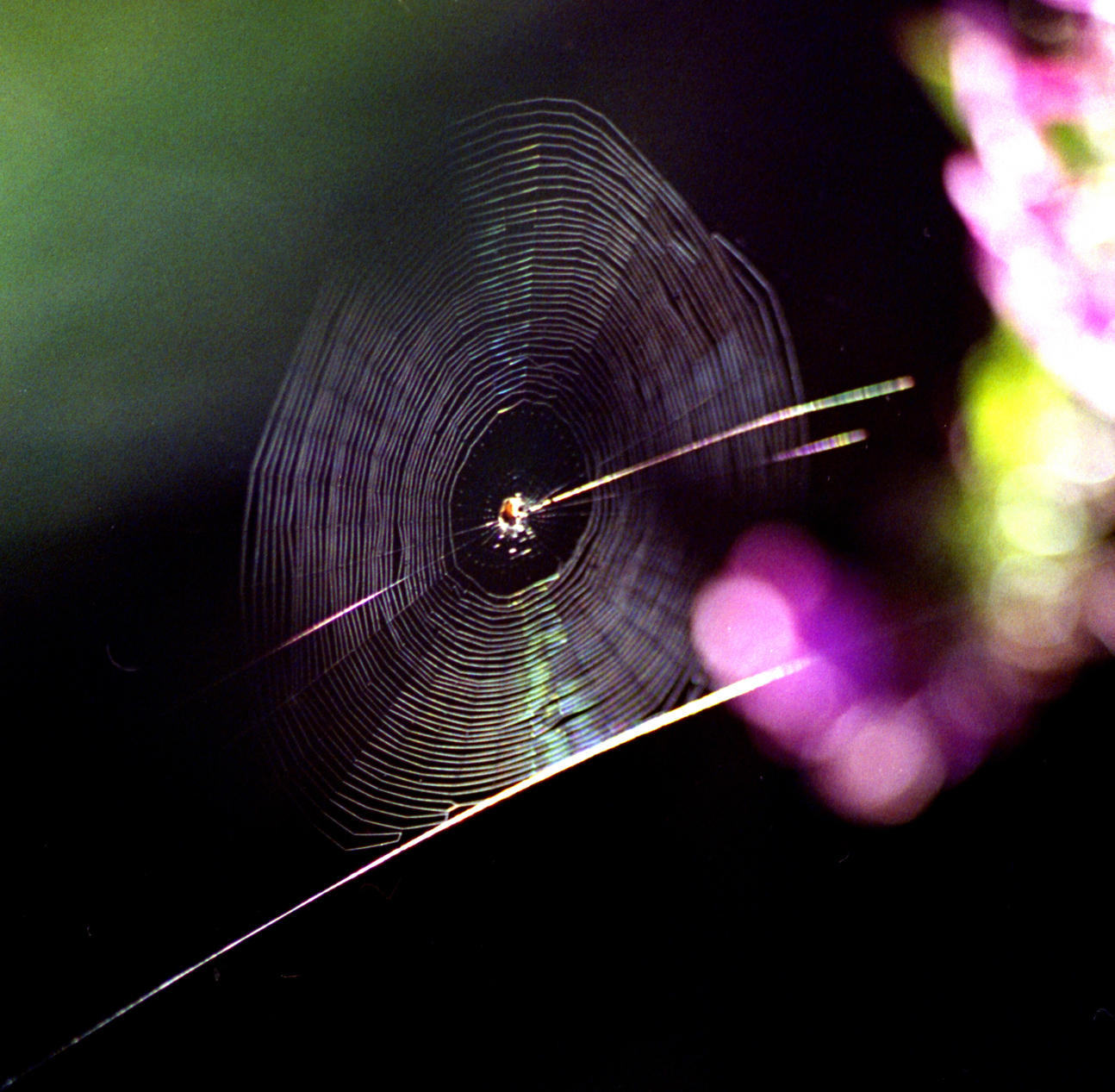
And SHE – my occupier – revels in the fleeting novelties of my gift, the senses – the paradox of pain and joy, where humour lurks between tears and laughter, moments with friends, bliss in a garden, like pruning branches for light to fall through foliage. SHE loves light. A breeze lifts the smoke of a roll-up, diaphanous shapes flow illuminated against a sunbeam until the shade swallows the spectacle, fluorescent spider webs, and blossoms fall.

Spider, 3

I have bouts of melancholy, made aware that my fine architecture is only a short, temporary abode for my occupier. It saddens me when SHE pays no attention to my signals, or is absent, travelling in abstract realms.

One day she’ll be gone altogether, leaving me behind. There’ll be no more breath and currents flowing through my organs, cells, brain — switchboards to her mind-spheres. Will she take along her impressions and associations?

I perceive phenomena in passing, pure and simple, with an artist’s sensibility. Semi permanence is the business of Jego, a sophisticated but battered and nervous entity that draws conclusions from what my senses transmit.

Example – SHE lets me drive a car to visit a friend. On instinctive pilot, I allow Jego to grab surplus energy. He elaborates on what he perceives through my senses.

That pub, why did the new owner paint it dark grey? A monstrosity, insulting the eye, aesthetically revolting, this must be someone’s idea of a cool concept, what a waste of paint!

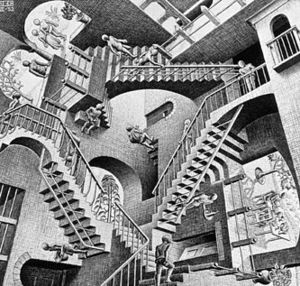
Escher's_RelativityThough amusing, his habit of sending spam into mind-clouds affect my equilibrium.

I draw attention to a stomach-cramp. Jego quickly analyses the cause before chasing another thought. It’s marvellous, and thoroughly compulsive, how he creates realities, juggles thoughts, day and night, unless SHE attempts a pause – counting breaths, reciting mantras to calm my overexcited synapses, or diligently monitoring Jego’s pranks to get him to focus on something coherent and creative.

On occasions he achieves concentration, calms, then we all relax into harmony, and for a short while a crystal-clear comprehension dawns …

Ah – we are dancers in a hologram – oh – who’s in charge?

Here Pomp makes an appearance, an intuitive entity, a messenger born of many traditions, with equally many names and disguises, a channel to the universal psyche. Though Pomp is not in charge, he knows stuff, and brings a tribute, the remembrance of an unfathomable awareness behind timeless intelligences every particle has contributed to, is essentially part of …

‘We are more than dust,’ SHE confesses, ‘and to fulfil our purpose I must embrace you, little body electric, and partake of your pain and joy.’

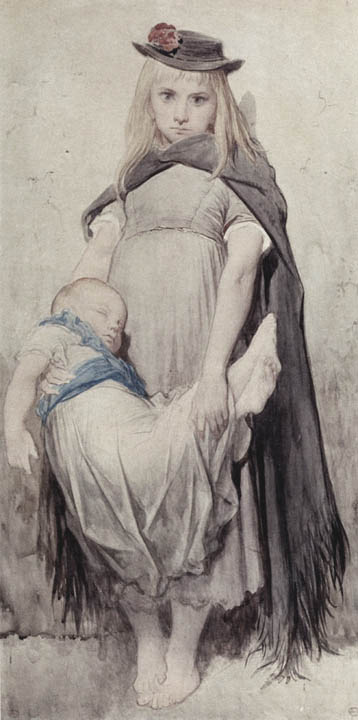
‘What about Jego?’ I ask.Dore - Jeune_Mendiant - desat

‘Poor chap, either he’s praised to heaven or cursed to hell. Some spiritual experts blame him for everything, and label him the greatest obstacle to higher evolution. It’s evidenced what happens to children we treat like that … we must be gentle with Jego.

His task is the hardest. In time, if we model tolerance and patience, he’ll learn to create more coherent realities.’

Her kind words calm me, and make me feel all warm and fuzzy.

Neti neti – not this, not this – no description suffices – what prevails is supreme consciousness, unidentified and unidentifiable, slipping in and out of embodied existence like a wind of light.

Though it gives us equal joy and pain, do you like your body electric?

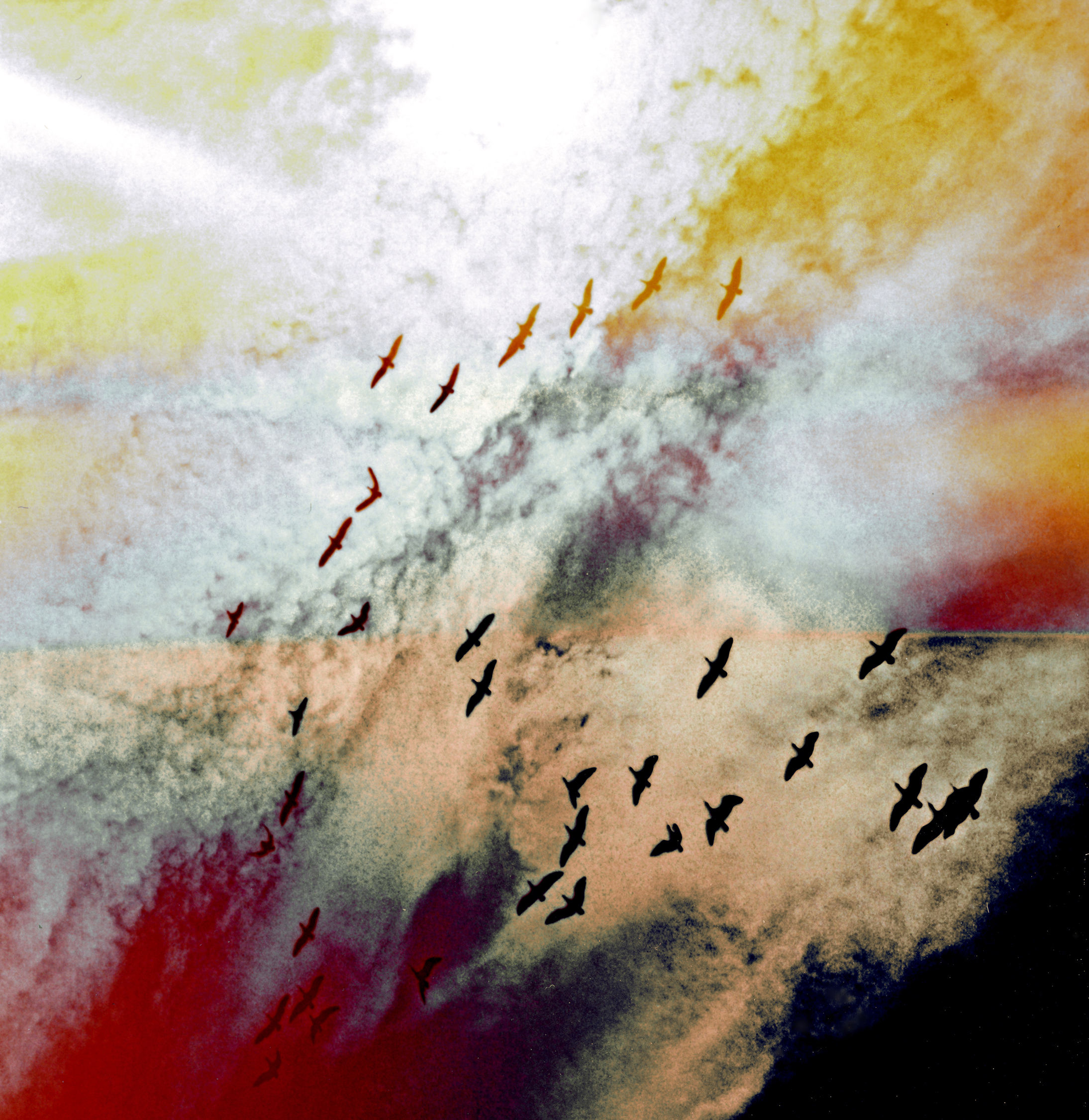
birds-1a.jpg

And are you on a warpath with your neurotic ego, or do you exercise patience?

‘There is a strange frenzy in my head, of birds flying, each particle circulating on its own. Is the one I love everywhere?’ 

~ Rumi ~ transl. Coleman Barks.

14 Comments

Filed under Blog

… consciousness – the mystery …

People who engage in therapeutic work with me often ask – why dig up my past, it holds pain, why look at attachment patterns, why explore the theme (myth) of my life? What a waste of time. I only want to get rid of my symptoms.

We all, without exception, suffered injuries. The creative question to ask is – how has the injury shaped my life, and what purpose does it serve? Many years ago, during a group dialogue following the inspirational talk of my Sufi teacher, we discussed three basic kinds of injuries. I connect my own experience to the third injury.

1        Having experienced physical injury can result in fight and flight behaviour – it brings a heightened sensitivity and develops a sharpening of the senses.

2        Having experienced sexual, sensual and emotional injury can result in escape from one’s self into others, estrangement from self, lack of differentiation and boundaries – the great challenge is to accept one’s self, differentiate as an individual from the tribe and take responsibility for one’s unique potential.

3        Having experienced injury on a cognitive level accelerates individuation – the escape is into deeper realities, a search for authenticity and truth and the development of symbolic reality – universal reality.

My novel, Course of Mirrors, is the fictionalised account of an aspect of my personal myth made universal – in the sense that memories of events don’t have to be real for a story to be true.

@ Natasha Tonkin

@ Natasha Tonkin

Even the most die-hard materialists among us grok that life is animated and guided by an all-pervading spirit? We are vessels, psychic switchboards for the spirit that animates and records all life.

An ungraspable phenomenon we try to name in vain.

Mental states pass through us. We call in and then process thoughts and feelings, seeking coherence, and – given we assign meaning to what happens to us – are gaining wider perspectives and deeper insights. With every new connection made and every little light brought to what is forgotten and unknown – collective consciousness grows.

Our body knows, if we care to notice, what stirs in our psyche, what wants to unfold and emerge. When energy flows freely through us our essential nature is uplifted, and our desire is aligned with the potential in us that seeks actualisation – in the way a cocoon reveals the butterfly. Our life has many cocoon and wing stages. The proverbial flutter that causes a stir in all spheres of the universe is like yet another love-transcended aspect of us emerging from yet another cocoon.

Presence, responding to situations, accepting differences and contradictions, frees energy that is ghosted and stagnant. While blocked energy creates frustrations and often painful symptoms, it is totally inevitable, since every organism evolves through condensed experiences. Life enhancing and life destroying events subject us to a pattern of repetition in time until we embrace change.

‘A truth outgrown crushes you under its weight.’   Fazal Inayat-Khan

To bring a repeating pattern to a higher level of flow requires a kind of quantum leap of consciousness. Small leaps occur frequently, especially when we befriend the unconscious and allow fresh symbols into awareness. The released light/energy brings new meaning and allows the self-actualisation of new potential.

‘It is obvious that the percolation of a timeless NOW is penetrating everything!’  –  Philippa Rees

*      *      *

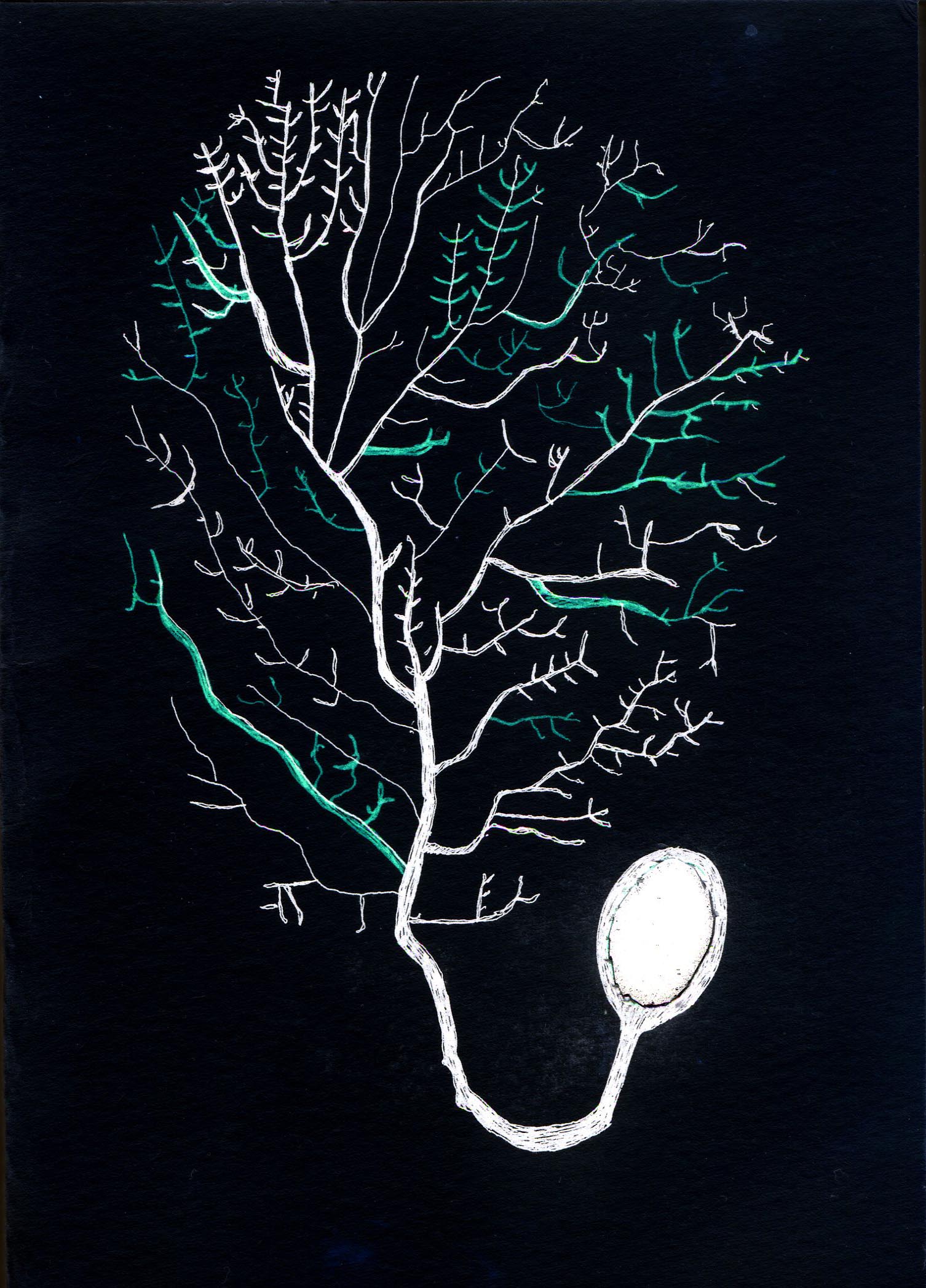
The image above is by Natasha Tonkin, my son’s partner. It was done two years ago as Christmas card and gift idea towards illustrating my novel, to help bring it to life. I scanned and inversed the image for the mirror to appear light. Natasha’s animation website: http://pandahorse.com/

Link to a book I co-edited about the Sufi teacher I mentioned above, Fazal Inayat-Khan. http://www.amazon.co.uk/Heart-Sufi-Inayat-Khan-Reflections-ebook/dp/B00BFUO0T6/ref=sr_1_1?s=books&ie=UTF8&qid=1369084226&sr=1-1&keywords=heart+of+a+sufi

Link to ‘Involution,’ an exceptional book by a kindred spirit, Philippa Rees.                                         http://involution-odyssey.com/  her book will soon hit the market. Her site is being developed.

6 Comments

Filed under Blog

… prayer …

When I hear of colleagues and friends who are having a stressful time, I usually exit my often self-defeating stream of thoughts and clear my mind – so my well-wishes can broadcast clearly. What works for me is tuning into thankfulness and often a little prayer or song comes to mind.

An image transformed during a rare attempt to be adventurous with photoshop.

An image transformed during a rare attempt to be adventurous with photoshop.


Who or what are my little prayers addressed to?                                                                                                                       The One in me I’m not ready to manifest and therefore bow to.


Below is a German song that came to me just now.

The text misses two dots above the ‘o’ in the word ‘schonen.’ I’d be grateful if someone could point me to a source for dots.


Dank Dir fur jeden schonen Morgen

Dank Dir fur jeden neuen Tag

Dank Dir dass ich all meine Sorgen

Auf Dich legen mag.

Very freely translated: Thank you, for every lovely morning, thank you for every novel day. Thank you, that I may leave my sorrows in your wisdom’s way.

Some time ago I shared my favourite prayer, also a song, with words by Hazrat Inayat Khan: …https://courseofmirrors.wordpress.com/2011/05/08/my-favourite-prayer/

11 Comments

Filed under Blog

… why spin tales? …

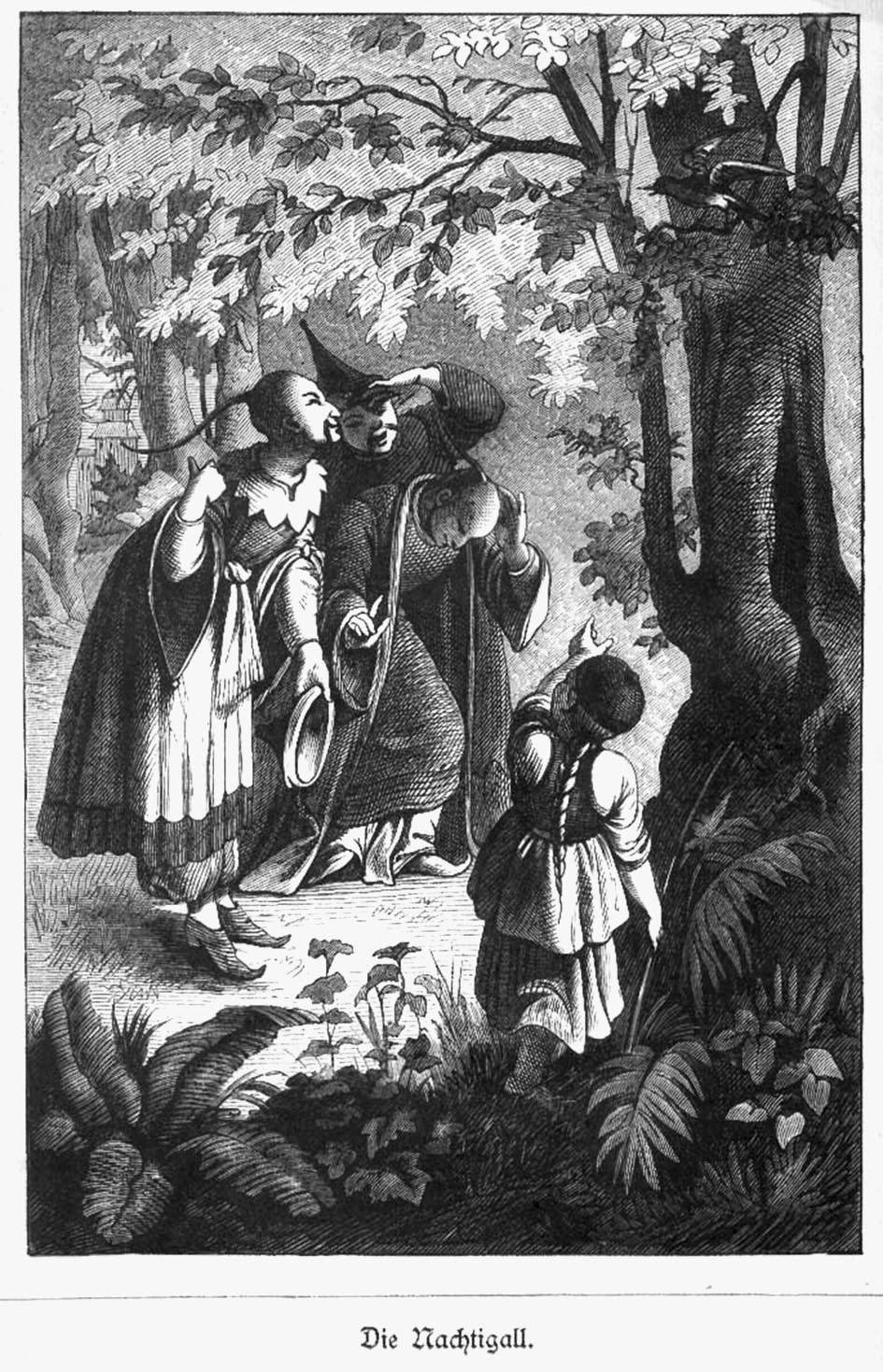
Die Nachtigall-02 Why spin tales, why listen to them, enact them on stage, dance them, ritualise them, read them, write them, re-write them?    We tell stories to ourselves and each other, to entertain, inspire, amplify events, or in search for meaning.

When it comes to stories, fact-finders tend to miss the point. Too many sequential facts can befuddle a truth that lingers in the higher or deeper layers of consciousness, from where vital symbolic insights shine through a narrative.

We owe much to Joseph Campbell, who with life-long passion explored the origins of myths and their functions throughout human history: http://en.wikipedia.org/wiki/Joseph_Campbell

And check out these fantastic documentaries: http://en.wikipedia.org/wiki/The_Power_of_Myth

A myth is a public dream – a dream is a private myth. – Joseph Campbell


In my psychotherapy practice, clients present their story in unique ways that occasionally include lucid dreams of past lives. I deeply respect the power of the imagination. In neutral mode, I listen. So it happens that a trauma set in thirteenth century Languedoc, when Cathars were branded as heretics and massacred by the Catholic Church, can deeply trouble a person’s psyche with visceral images. I travel along, and as the story is released, I may bridge the emotional resonance of a pattern to the present life of a client. In this process profound cognitions can soften a psychological complex.

Lasting examples of deeper truths are mirrored in Fairy-tales and myths, where basic patterns of our collective unconscious psyche are brought into relief. That is, if we can grasp the metaphors under the primary meaning of words. Fictional settings for heroic or anti-heroic characters are particularly suited to convey powerful emotional themes infused with archetypal elements.

… the spirit of an age is more essentially mirrored in its fairy-tales than in the most painstaking chronicle of a contemporary diarist … Raymond Chandler – Realism and Fairy-land

Some religions persist in the literal truths of their sacred texts. Scientists, too, get stuck in dogma, but I emphasize more with the frustration of the latter, since, with the courage of doubt, scientists have pushed the horizon of knowledge outwards by painstakingly reading the book of nature through the language of data, evidencing processes poets and mystics before them intuited, but physical eyes cannot perceive – like radiations other than light. I’m trying to overcome the conflict of the scientist and poet in me. They interpret the world in different but equally significant ways. There is a need to read nature in both languages, so greater understanding and tolerance can develop.

‘With faith one attains and realises peace and harmony. With doubt one destroys and gains freedom to move ontowards.’    – Fazal Inayat-Khan

Memory, objectively true, or false, affects our lives every day. Stories lodged in the heart endure in a timeless dimension of the imagination. We can however alter their interpretation by exploring our perspective, be it from a pit of fatalism, a sense of insecurity, a belief in magic, faith in divine guidance, or the certitude of natural laws. Even the simple acceptance of life’s continuous dynamic change can shift the meaning of our stories, and, of course, it helps to overcome literal mindedness and make an effort to decipher the metaphors.

‘The mystical warrior is trying to reduce the obstruction in the doorway, and the worshipper is attempting to reach the construction behind the doorway, almost out of sight. There is a gap between the two … the vague band between the known and the unknown. In that band rapture is possible.’   – Fazal Inayat-Khan

Stories are the sap of life nourishing the roots and branches of humanity. We spin stories because during the birth of this universe the symmetry between matter and antimatter was broken, kicked out of balance, which resulted in a slight predominance of matter, the stuff we bump into. It’s a poignant thought that this little quirk caused the dynamic asymmetry that evolved into the universe we live in. Without this asymmetry between matter and antimatter our world would be empty, there would be light only – sans elements, sans plants, sans animals, sans night, sans saints, fools, villains – sans consciousness – no story.

*     *     *

For those interested in nuclear physics:

http://www.slac.stanford.edu/pubs/beamline/26/1/26-1-sather.pdf


5 Comments

Filed under Blog

… erotic charge of flawed characters …

Literature thrives on flawed characters. With the sinister Heathcliff in Wuthering Heights, for example, Emily Bronte tapped into the shadowy aspect of masculinity.

C G Jung calls the latent masculine within women the Animus. Both in its light and dark aspects, this archetypal blueprint can put women under a spell.

I can see Jonny play the disparate twins in my novels :)

I can see Jonny play the disparate twins in my novels 🙂

Equally, the latent feminine potential within men, the Anima, can evoke both, the guiding wisdom of Sophia or the dark erotic charge of Medusa, causing tremendous fear of nature and its awesome power.

Rather than using the image of a femme fatal, I choose to show what  fear of the feminine inspires in some cultures.

Rather than using the image of a femme fatal, I choose to show what fear of the feminine inspires in some cultures.

Our irrational attractions can be sparked and coloured by the parent of the opposite sex. Like a woman with a brooding and unapproachable father may have to kiss many frogs before she discovers the prince inside, while an idealising father can trap his girl in vacuous fantasies. And the boy of a manipulative mother may develop resentment or idealisation for women, or both in a toxic mix. What we tend to project onto the opposite sex is however deeply sculpted by a collective archetypal storehouse of experiences with dual aspects. Paradoxically, this storehouse is also the source of our most powerful experiences and innovations. Whether in a life-giving shape or a dark and petrifying shape, either way, the Animus and Anima hold a numinous fascination until their autonomous grip on us emerges into awareness, becomes conscious, is redeemed, turns creative and makes us truly human.

In my first novel, Course of Mirrors, my protagonist, Ananda, is torn between two disparate men, twins. The theme continues into the sequel – Shapers – with higher stakes in another time zone. In the excerpt below, Gart is rescued from a dangerous impasse by a trickster and transported into the twentieth century, where he meets the story teller and myth-maker, Cara.

*     *     *

Short excerpt from chapter 12, Shapers

Back in Derrynane

Five hundred years back, at the Kerry peninsula, Gart pondered how he came to sit at this familiar coast, under a dull sky that matched his mood, the sea before him rolling and spitting at his soiled boots. It was the trickster’s doing, of course. He did not thank Zap for transporting him back here, where an old crone had hexed him and a group of weird artisans had made him look like a fool. Yet it was here that he first met Mesa, who he now pined for in his bones. He must get back to Rhonda and outdo Crim. And Leo must be terminated, since he had obviously gone mad, and courted disaster if he planned to control Rhonda’s army. The Governor of Guardians, ha, they despised the fat man. It was him, Gart they followed.

‘I messed up,’ Zap acknowledged, stretching on the wet sand nearby and cracking his joints. ‘Forgot, I can’t activate coordinates for the hub, and this happens to be the only other place we’ve been in together before. I had little choice. ’

‘You’re not so bright after all, are you?’ Gart grunted.

‘At least we’re not consumed by noxious fumes of our own making. Best not dwell on the past.’

‘We are in the past, eejit.’

‘Local slang, eh? You’re a fast learner. You score a point. Zap jumped up and ran a circle of cartwheels. ’Let’s go up to the estate, see who’s there.’

Derrynane estate looked deserted. ‘Nippy air on the plateau,’ Zap said, ‘you would’ve thought they’d light a fire, but not a whisk of smoke from the chimneys.’ The men slipped through the narrow gap between green-smothered walls, the two dragons, Zap recalled, though now their shape was lost under rampant ivy. The yard, empty of dogs, cats, geese or horses, had a silver car parked near the main entrance. Zap whistled, ‘Flashy design, time’s moved on since we’ve been here last.’

Gart’s heart lurched at the sight of the woman appearing in the porch.

‘Hi,’ she said, ‘do I know you? You’ve been here before, haven’t you?’

Zap, in Shaper style, put a hand to his heart. He too recognised her, though she had turned into a mature woman. ‘You’re Cara, I remember. Where’s everybody?  Saki, Anke, Mushki …’

‘Oh the troupe, goodness, that was years ago. When Gutch and Craig joined them they hit the road together. I think they operate from a place at the English coast.’

‘And that witch?’ Gart wanted to know.

Cara gave him a piercing look. ‘You mean the oracle of my mentor, Tilly. She has sent me here, for a retreat. I only just arrived. I plan to spend some time writing on my story of Mesa.’

‘I hope the story includes us,’ Zap said, we’re friends of Mesa.’ He shot a glance at Gart, whose mouth opened and shut in confusion.

‘You better come in.’ Cara’s scalp tingled. This must have been what Tilly had had in mind, to process the strange occurrences from so many years ago. ‘Zap and Gart, is it?’ Like Tilly, they hadn’t aged at all, while she herself had gained ten years. To mask her excitement she whizzed around the kitchen. She stacked kindling in the cooker, emptied her shopping into the fridge, plonked bread and cheese on the table, put a kettle on, fetched plates and cups and cutlery, all the while feeling Gart’s eyes on her. She told her guest about her life, her journeys, and studies. Zap helped with arranging the table and kept nodding, eager to hear all she had to say. Cara only tried to gain time to collect herself before she was ready to ask the questions pressing on her mind, about Sax, about Rhonda, about Mesa.

‘Shall I get logs?’ Zap asked sweetly.

‘Oh yes, please. I was planning to camp in the cottage, but we might as well get rid of the chill in the big house. The cooker is attached to a central heating.’ She watched Zap walking out with a basket, charmed by the ease of his manner.  Gart made way for Zap but did not offer any help. Rooted to one place since entering the kitchen, he resumed his position, leaning casually against the door frame  Now they were alone Cara couldn’t avoid him. Their eyes met. She blushed. He had followed her every movement with an air of aloofness. A hint of curiosity sneaked into his eyes.

‘I look like her. Is that it?’ Cara said.

‘In a way.’ Gart moved towards the table and pulled out a chair to sit on. ‘What happened to your lover, Dillon?’

‘We split, went our different ways. He had his quest.’

‘What quest?’ Gart asked. The term perked his interest since Oruba had called his underground journey a quest.

‘Not my tale to tell. He may have found whatever he was looking for.’

Zap returned, groaning under the heavy basket of wood on his shoulders. He piled logs over kindling in the cooker and neatly stacked the rest against the wall before he went to get another load. Cara lit the fire. Gart, intrigued about her remark regarding Dillon’s quest, struggled to grasp what precisely intrigued him. He scratched his ear, as if hoping for a message. He resented how confusion undermined his confidence. The kettle whistled. To snap out of his dazed state, Gart got up to pour the boiling water over the coffee in the percolator Cara had prepared. ‘Thank you,’ she said, surprised. When Zap returned they settled to a meal. It was Cara’s turn to ask questions. Intermittently Zap fed the fire and they moved from coffee to drinking wine. The story Cara was so eager to hear unfolding was punctured by heated disagreements between Zap and Gart.

‘Some names have changed, but I recognise the characters.’ Cara said, jotting down notes, pen hot in her hand. ‘I thought they’d outlawed weapons in Rhonda. Where did the laser guns come from?’

Gart said. ‘Leo must have raided the Archives. Everything from ancient pasts is stored in the pyramids surrounding the archives – and there maybe catacombs under them. I know this because Leo let it slip once. ‘The man’s a danger to Rhonda. I’ll put an end to him.’

Zap shook his head. ‘Killing Leo, and start a war! Use your imagination. He turned to Cara. ‘If you’ve a say in this story, keep this man away from Mesa. He’s murdered in the past, he can do it again. Mesa deserves better.’

Gart pushed back his chair and sent it cluttering to the tiled floor. He stormed from the kitchen. Cara felt the hurt pride under Gart’s rage. Zap crunched his fist and stared into space. Fiercely protective of Mesa, he had clean anger under his pain. ‘Please keep the fire going, Zap, there may be frost tonight. I’ll talk to Gart,’ Cara said. And she knew where to find him.

The sky had cleared towards the horizon. Beyond the yard, the autumn breeze picked up, biting through Cara’s light coat. She saw him standing at the cliff, looking towards the faint silver band that now divided sea and sky. A diaphanous layer of cloud screened the late sun, against which Gart’s lean body looked delicate, like a feather drawing. Why had she invested her story with two lovers, men who did not see eye to eye, men as different as Assisi and Caligula?  He did not turn to look at her as she stepped close to him. He did not move at all, his mind had wandered off through time’s veil, searching for Mesa, no doubt. ‘You see,’ Cara said, ‘once we have given life to something we can’t control it, we can only try to influence an outcome with truth, which is not always in tune with our wants.’

‘I don’t understand.’ Gart finally met her eyes. ‘You created this damn story. Whose side are you on?’

‘Truth is hard to discern, its meaning is held in another reality, where on-going myths are spun. You became part of my story because you walked into it, in a most brutal and controlling manner, though it wasn’t entirely your fault. Does the name Batin mean anything to you?’

Gart felt a stab of fear, but quickly shrugged it off. ‘I think I met a ghost of that name.’

‘How your path unfolds depends on your engagement with what you attract. It’s the same for me, but in addition I’m recording fates, yours, Leo’s, Zap’s, Mirre’s, Oruba’s, Mesa’s, Crim’s… ‘

He cut in. ‘Crim’s one too many.’

Cara sighed. ‘I care for all of your fates, they affect me deeply.  My feelings swing about, gyrate like a weathervane does when it storms, which should kind of answer your question. Right now, as I stand here next to you, sensing the pain you can’t quite admit, I’m on your side, but my alliance can change, from moment to moment, from day to day, from chapter to chapter, since like you, I’m compelled by this quest for truth.’

‘Truth again …’ Gart’s lips curled and broke into a devastating smile. ‘Tell me this then – why does Mesa look like you?’

Cara swallowed her shock. He had touched on her core identification, revealing her disparate affections, the turmoil she experienced between the two types of men she was enmeshed with across time, of whom one now exploited her vulnerability, took complete possession of her with his eyes. And faithful to his nature, he relished in the conquest. Cara’s heart quickened. From deep inside her body she felt his pull, as if by a rope. His seductive power made her tremble. Yet she knew he cared only about himself. And coerced by her divided nature, her concern instantly switched to Crim.

*    *    *

If you’re not familiar with the concepts of the Shadow, Animus or Anima, the Wikipedia pages can serve as introduction.

http://en.wikipedia.org/wiki/Shadow_(psychology)

http://en.wikipedia.org/wiki/Anima_and_animus

And anyone who has never heard of Joseph Campbell – this book is a must for writers.

http://www.amazon.com/Thousand-Faces-Collected-Joseph-Campbell/dp/1577315936

2 Comments

Filed under Blog

… the rose trick …

As white clouds sail above my garden today, and robins peck at morsels the fat turtle-doves dislodged from the feed-balls I hung into tree branches, I’m thinking of the hectic buying-frenzy in town, and what springs to mind is that it’s all about feeling loved. In that spirit – a Christmas gift for you, my readers and friends – The Rose Trick – a guided imagery from another dimension. I use this imagery in my work, though it turns out different each time. Once you have read the text, close your eyes and make it real – imagine…

A garden, your inner garden – in it grows a rose bush that carries one bud about to open. Stand still and observe – a luminous tip of colour peeks from the enfolding calyx – the sepals gradually separate and turn their green tips outward. See the rose bud stir – see its petals open in a slow and fluid movement – until the luminous rose has attained its perfect shape and exudes its delicate fragrance.

As the garden fills with radiant light, imagine the open rose growing into another dimension, expanding in size to a sphere that is inviting you in. Overcome the weight of your thoughts, walk barefoot with  feather-light steps towards the centre of the rose-orb and sit and rest there for a while …

Absorb the soothing resonance, the exquisite tenderness of the petals, and the subtle scent of the rose-sphere through every cell of your body. Be loved. Become the perfect rose.

Autumn Rose

Now rise and return to the former dimension of your garden. Look back. Watch how the rose grows small and folds back into it sepals – watch the bud floating into the palm of your hand – sense the rosebud in your hand, and how its power wishes to stay alive in your heart so you can call upon its unfolding whenever you need loving. Do it, place the rose and the whole experience of rose-becoming into your heart.

*    *    *

Do this imagery when you feel a lack of harmony, or if you lost someone dear. It will re-animate the attar of roses in your heart.

The inspiration behind this imagery, which, done with an open attitude, can be  powerfully transforming, comes from great beings like Hazrat Inayat, Khan, Fazal Inayat-Khan, Roberto Assagioli, R M Rilke, Rumi, Bette Midler, and from roses grown in many gardens …

————-

‘When one of us gets lost, is not here, he or she must be inside us.

There’s no place like that anywhere in the world.’  Rumi

————-

The following are thoughts from ‘The Mind World’ – Volume Four of Hazrat Inayat Khan’s lectures.

The Function of the Heart

The heart, in Sufi terms, is called the mirror. Whatever is reflected in the heart does not only remain a reflection but becomes a creative power productive of the phenomenon of a similar nature.

For example, a heart that is holding in itself and is reflecting the rose will find roses everywhere. Roses will be attracted to the heart and roses will be produced from it and for it. As this reflection deepens and becomes stronger it becomes creative of the phenomenon of roses and the symbolic qualities we associate with roses.

Equally, the heart that holds and reflects wounds will find wounds everywhere. It will attract wounds and it will create wounds; for that is the phenomenon of reflection. There are examples to be found in the world of people who by retaining a thought have created on the physical plane its manifestation, its phenomenon. The reason is – that the phenomenon is not only an image as produced in the mirror

but that reflection in the heart is the most powerful thing. It is life itself – and it is creative.

If the heart is calm enough to receive reflections fully and clearly, one can choose for oneself which reflection to repel and which to retain.

*    *    *

Maybe we are the particle science is chasing ...

Maybe we are the particle science is chasing ..

See also Bette Midler – The Rose: http://www.youtube.com/watch?gl=GB&hl=en-GB&v=oR6okRuOLc8

And https://courseofmirrors.wordpress.com/2012/07/14/imagination/

And …

Arvo Pärt – Alina!

http://www.youtube.com/watch?v=rmafNVimRbI

16 Comments

Filed under Blog

… the mystery of character versus genre …

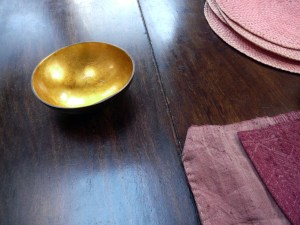
Flicker, flicker, speed, speed – time is flying – here is a genre – an inviting golden bowl – let’s drop a story into it. A well-defined genre promises the best route to financial success for many aspiring writers.

the golden bowl of genre Human traits that make up characters are unfathomable in their combination, which is why we traditionally veer to an index of types. The adage of the writing guru – don’t tell, show – suggests character is revealed through traits that imply qualities. Traits fascinate us, but if they are mechanical in their emotional and logical processes, they seldom surprise. In such case the page-turning tension must be provided by the plot.

During the nineteenth century’s advent of psychology and individuation many writers moved away from the Greek model of plot-driven stories. Curiosity shifted to the complex inner life of characters and their individual way of creating meaning was employed to unfold narratives.

The search for a unique self beyond the collectively orientated ego personality is relatively new, and while time-engraved archetypal energies hold us in their emotional grip, we have now psychological maps to help us become more conscious of their compelling powers, more conscious of our personality, which, for the writer, informs their fictional characters and opens new worlds and new choices. Irrespective of the rich psychological and scientific knowledge available to us, the process of character formation present us with the greatest mysteries of our time – as exciting as discovering new territory, new planets, new eyes on the universe.

Here I am making up a scene from scratch:

He stiffly dragged his feet along the polished marble floor of the shopping mall, his head forward as if pulled by a rope, though his eyes did not focus forward, nor up or down, they swivelled, left, right, left right, alert for what? Alert for anyone who might observe him? Nobody did – apart from one person who sat still on a seat moulded into the stone replica of a toy train. She raised her eyes from her book and looked straight at him …

Now as reader, and as the writer of this entry into a scene without blueprint for a story, I’m curious – where is he heading, where is this going? I search for a deeper layer, a narrative unfolding from the mysterious core of the character walking through the mall. I want a substance to chew on, to extract a flavour from his unique world.

The woman’s stare broke his set rhythm of surveillance. His face contorted in fear, his feet lost touch with the marble floor, sailed on air, while his arms flattered like duck wings failing to lift. All he could think of before his fell flat was – she knows, she knows I’m not present in this body. All he perceived were veins of light in a glittering darkness. He chose to vacate.

Are you hurt? While approaching the sprawled body of the man, the woman shot a stern glance at her boy who stood by guiltily. She had noticed him drop the sweet wrap. She had noticed the man stepping on the slippery cellophane. She had caught his eyes – and what she saw in that instant had made her shiver …  

I’m not going to follow up this scene. Anyone who reads this is welcome to do so. It would give me a thrill.

We all enjoy our stock characters and their antics, types set into situations and conflicts we can readily identify with, heroes we can like, villains we can despise. We enjoy themes that fall into definite genres that entertain us away from tedious daily concerns. I’m not knocking these stories. I enjoy them myself.

But hey you, all writers out there, why not take a risk and be drawn to the mystery of the unpredictable that challenges you to think in new ways, why not evoke characters who, even while using known containers, allow their (your) unconscious past and future to fill in the content, characters who explore their personal experience to a depth where it becomes universal, characters who play with time and space and are directed from their inner spirit, even when it requires a new container?

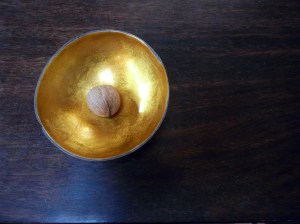
In my writing, I like the adventure of discovery, a nut to crack. I like to allow my character to walk ahead and unfold the story, and if it spills over the frame of a convenient genre, so be it.

P1100981And here my little gripes with how-to-does:

The advice-filled internet spheres turn and turn like gyres.

Answers sum up being and are full of promised abundance – yet they are dead.

Questions sum up becoming and are full of challenging limitations – yet they are alive.


‘One does not discover new lands without consenting to lose sight of the shore for a very long time.’

Andre Gide

8 Comments

Filed under Blog

… another poignant Alice moment …

‘Let the jury consider their verdict,’ the King said, for about the twentieth time that day.

No, no!’ said the Queen. ‘Sentence first – verdict afterwards.’

‘Stuff and nonsense!’ said Alice loudly, ‘the idea of having the sentence first.’

‘Hold your tongue!’ said the Queen, turning purple.

‘I won’t!’ said Alice.

‘Off with her head!’ the Queen shouted on top of her voice. Nobody moved.

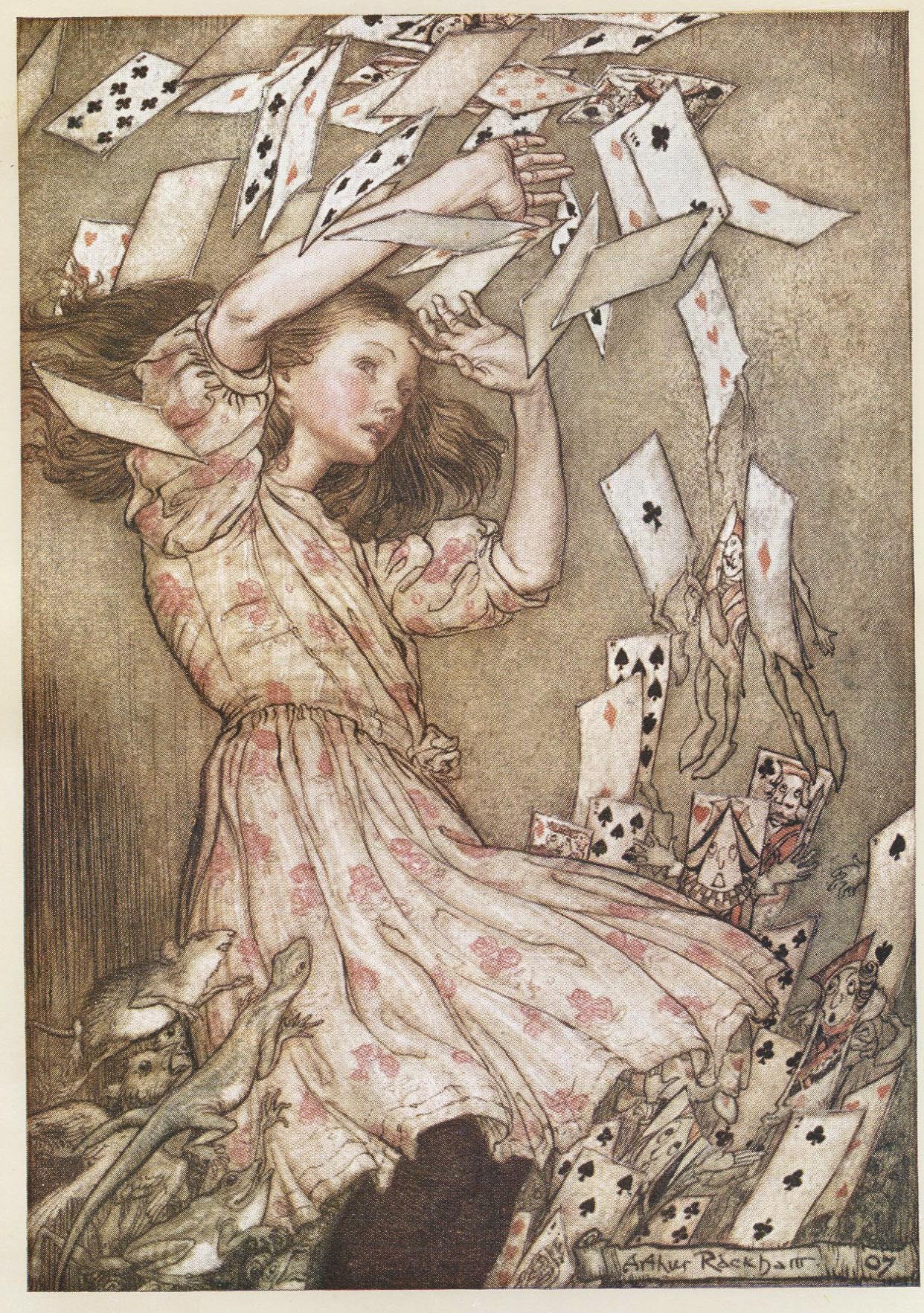
‘Who cares for you?’ said Alice (she had grown to her full size by this time.) ‘You’re nothing but a pack of cards.’

Do we ever grow to our full size, psychologically speaking? I frequently throw my pack of cards into the air – a good practice in this hilariously mad world, where a rational outlook focusses on particulars while missing the whole picture, the full proportion and variety of human experience. The turmoil of our time creates stress that becomes endemic, where hardly anybody can remain relaxed enough to really listen to their own anxieties, let alone others’ – so they can be aired.

Many dear familiar things are vanishing from our lives, including people. People we met on our path at certain times, people that moved apart again or remained close and intimate. Being reminded that nothing lasts, haunts us with a sense of futility, originating from within us as anxieties, which, depending on our sensitivity, are fed by collective anxieties. The turmoil, while a natural part of transformation, also created stress – which takes different forms in us.

I acquired skills to reduce my stress, am fortunate to be able to listen to myself, often a pre-requisite during the training of any vocation that involves listening to others who suffer stress.

This morning on the news, the poor support offered to those who suffer from periods of schizophrenia was highlighted. It most poignantly illustrates the point. Instead of non-judgemental listening to the anxieties people experience under stress, no matter what fantasy grabs a mind as a kind of metaphor – drugs are prescribed, straight away. And so distrust worsens anxieties, without giving a person under stress the opportunity to explore the relevance of their anxieties. This is how schizophrenia is sanctioned and maintained. In short – the most sensitive people become the victims of our schizophrenic society. How sad.

Are you burdened by anxieties? Don’t insult your anxieties with soothing quotes. Forced development weakens the organism. Don’t be intimidated by expert opinions. Express your anxieties creatively – write, draw, create surreal representations of your fantasies, air them and play with them. Give space to the tension. See that the burden is not all on your shoulders. You are having part in a period of transition, a culture that struggles with confusion. Find your own truth, and establish your own evidence, before you arrive at a false verdict and sentence yourself as a victim.

Don’t adjust your truth to prescribed reality, create a reality to express your truth.

10 Comments

Filed under Blog

… the recycling of unease …

Merciless downpours – I occasionally dash between strings of rain to trim the green jungle in my garden and pick a handful of wild strawberries. Tonight, looking east, the sky is grey. And not a leaf stirs, due to the full moon. In the next room a brilliant sunset reflects in a glass-framed painting. And as I look east again, a high cloud is blushed in rose-colour. More rain announced. It is the wettest summer in my many lifetimes, of late a tumultuous time. I was indirectly affected by a trauma, not mine, not my story to tell, though I’m proud of two dear young people who dealt admirably with the fallout of having their flat in London broken in. Several flats in the same block were crashed into with crowbars within the span of two hours and in bright daylight. Picture the scenario: you leave your home for a short while and return to find your front door broken and all means of communication, including the creative tools needed for your livelihood – gone. The logistics of solving the problem are, to put it mildly, overwhelming.

I bemoan the motherly welfare state and the infantile moral consciousness it feeds. I observe signs in my relatively crime-free little town. As an illustration, the other day in a car park I observed a woman tossing an empty plastic bottle from her car- window before she drove off. Her children in the backseat looked on. What motivates careless behaviour? What jumped to my mind – probably a negative mother (state) dependency, a resentment of mother’s permissiveness, having being patronised and cheated out of meaningful relationships and been entranced by the material world.

Next day I visited a car boot sale in search of world-objects for my sand tray therapy work. A young girl spilled coins from her purse over the stall while paying for a trinket. A few coins fell to the grass. A boy behind her casually covered one of the coins with his foot. He didn’t even smile at his clever trick. His face was blank. This chilled me. Without parents to model self-respect, how will children become psychologically independent individuals?

We all experience the acceleration of change. The changes in my lifetime eroded structures of meaning that carried values I held dear. Change is however the only constant. Navigating change without straining our nervous system and by implication the nervous system of our planet is a challenge that requires an attitude of self-respect and tolerance: the ability to bear contradiction and confusion.

While collisions of mythologies storm all around us, we have the elation about the Higgs particle, indicator of a Higgs field. The single-minded work of a scientific community including 20 member states is remarkable, I’d be proud to be part of it. But wait, many more billions will now be spent on search for super symmetry (SUSY).  Imagine what could be achieved if even a tiny portion of this budget would go towards exploring the autonomous postulates spouting from our collective unconscious, in other words, exploring the underlying structure of the human psyche, of which the visible particles populate our dysfunctional societies.

Light is both particle and wave, and though we can only observe one at a time it is one light.

*      *      *

What In The World IS A Higgs Boson?

http://thelede.blogs.nytimes.com/2012/07/04/what-in-the-world-is-a-higgs-boson/?src=un&feedurl=http%3A%2F%2Fjson8.nytimes.com%2Fpages%2Fscience%2Findex.jsonp

An interview with Dr Lisa Randall, from last year but more informative

http://www.nytimes.com/2011/12/12/science/physicists-anxiously-await-news-of-the-god-particle.html

Sandplay therapy

http://www.youtube.com/watch?v=GD6PPwUlgGM&feature=related    Not me

http://sandplayvideos.com/sandplay-therapy-training

6 Comments

Filed under Blog

… pattern which connects …

For a recent book-sharing with a group of irreverent friends (archventures), I had the wish to share so many books that I instinctively reached more or less blindly into one of my shelves. Books in my home, I must add, are in a muddle. The only order to speak of is their relationship to each other through time. I picked Alice in Wonderland and Mind and Nature. During our afternoon of reading there was not enough time to do honour to the latter, Gregory Bateson’s work. So I said I’d write up something. Oh dear. After pages and pages, I finally recalled this was supposed to be a blog-post, not a novel .

I first came upon Gregory Bateson books, ‘Steps to an Ecology of Mind’ and ‘Mind and Nature,’ during the early 1980’s, after his death. The clarity of his notion that biological forms arrange themselves through relationships struck a deep chord. What totally resonated with me was his thought that the structure of nature and the structure of mind are reflections of each other.  He had a broad perspective for a Biologist, and wanted to build a bridge between the facts of life and behaviour, and what we know of the nature of pattern and order. He was active in, and connected up many different fields of study – anthropology, psychiatry, biological evolution and genetics and the new epistemology which comes out of system-theory and ecology. He challenged basic assumptions and methods of scientific investigations, pointing to the processes beneath structures. He quoted Goethe …

A stem is what bears leaves

A leaf is that which has a bud in its angle

A stem is what was once a bud in that position …

And he provoked new thinking: ‘What pattern connects the crab to the lobster and the orchid to the primrose and all four of them to me. And me to you?’ 

His interest in morphology, the study of structure and form of organisms, involved context, meaning and communication. He distrusted reductive models of cause and effect, the scientific approach that lines up parts and classifies them, focussing on quantity.

Comparing systems, one to another, he perceived the mind as an ecological system. And he used the analogy that ideas, like seeds, can only take root and flourish according to the nature of the system receiving them. This thought alone deserves deep contemplation.

He had a way with stories … ‘There was a man who had a powerful computer, and he wanted to know whether computers could ever think. So he asked it – Will you ever be able to think like a human being? – The computer clicked and rattled and blinked, and finally it printed out its answer on a piece of paper, as these machines do. The man ran to pick up the printout, and there, neatly typed, read the following words: ‘That reminds me of a story.’ 

Concerned about the decimation of aboriginal populations (he did field-work with Margaret Mead), the degradation of ecological systems, economic oppression, and senseless wars and arms races, he took these ominous signs of contemporary life to be manifestations of deeper disorders, which he defined in terms of cybernetic systems of communication and meaning that comprise life, mind, and society. In his view, consciousness dominated by purposeful thought has a linear structure that establishes goals and ways for attaining them without being necessarily sensitive to the circular network of cause and effect that orders the systems.

Looking at human consciousness as an adaptive system, he thought the cure for its inadequacies, evidenced by the negative side-effects of purposive rationality, was not to reject it in favour of a passionate non- rationality, as in the extreme romantic position, but to augment and complete it by engaging with non-discursive, pattern-comprehending and emotional processes. He advocated the befriending of the unconscious aspects of the mind through utilising images and metaphors.

In a civilization which separates mind from body, mythologies about the survival of a transcendent mind are often meant to soften the idea of death, or even deny death as part of life. For Bateson, who saw the mind as being immanent not only in pathways of information which are located inside the body but also in external pathways, death took on a different aspect. ‘The individual nexus of pathways which I call ‘me’ is no longer so precious because that nexus is only part of a larger mind. The ideas which seemed to be me can also become immanent in you. May they survive, if true.’  (Afterword to a collection of celebratory essays, 1972)

Yet there are scientists that can no more perceive the language of nature, and politicians who feel beleaguered by sections of society that seek balance and a fresh context towards ‘an ecology of mind.’  The extreme factions of believers, for what else are they, should look again at the bridge  Bateson prepared.


This lovely video gives a taste of what it is all about :

Update … I discovered recently, in 2019, that some the links in this post don’t seem to work anymore. Here , however, is his daughter’s great documentary on Vimeo, unfortunately not free, apart from the trailer.  https://vimeo.com/ondemand/bateson

Looking at the structure of nature and the structure of mind being reflections of each other, it becomes obvious that not only does nature mirror our habit of thinking, but our thinking also mirrors the state of nature. Ecology and psychology must therefore both engage in listening, and seeing, and working ceaselessly towards the integration of knowledge and the re-adjustment of a dynamic balance.

I could go on, but want to bring in a famous painting of Icarus by Brueghel.                                                             Anthony Stevens, a brilliant expositor of Jung’s thought, used the painting as cover for the first hard-cover edition (1995) of his book Private Myths.

http://www.anthonystevens.co.uk/index.html


Stevens quotes from a poem by Wystan Auden:

In Brueghel’s Icarus, for instance: how everything turns away

Quite leisurely from the disaster; the ploughman may

Have heard the splash, the forsaken cry,

But for him it was not an important failure; the sun shone

As it had to on the white legs disappearing into the green

Water; and the expensive delicate ship that must have seen

Something amazing, a boy falling out of the sky,

Had somewhere to get to and sailed calmly on.

What goes up must come down. Who knows how many Big Bangs there were before the one we so ardently explore? There is an organising intelligence behind life’s cycles, while consciousness forever expands. Thinking in metaphors we can perceive similar patterns, forms in nature and mind, cosmos and psyche, mirroring each other across scale and time. In other words, life teems with realities we can tune into, as long as we assign context and meaning.

Check out Gregory Bateson’s books ‘Steps to an Ecology of Mind’ and ‘Mind and Nature.

His family continue his work: His daughter Nora and his wife – Mary Catherine Bateson:   http://www.interculturalstudies.org/main.html

Peripheral Vision

 http://www.amazon.com/exec/obidos/tg/detail/-/0060926309/mead2001centenni

Free chapters of Angels Fear:  http://www.oikos.org/angelsfear.htm

Nora Bateson, recently created a film:

http://www.anecologyofmind.com/

Last not least, the themes:  pattern which connects, mirroring and bridging, are subjects of my novels.

25 Comments

Filed under Blog