Tag Archives: interconnectedness

… thoughts of an old woman …

I’m reluctant to call myself old. As common perceptions go, I feel at least 20 years younger, being curious and interested in everything. I just got a bit slow with manual tasks, procrastinating in executing them when my superego demands action. I’ve never been at easy terms with my superego; love/hating my hilarious authority complex.

Among parents, siblings, children, writers, artists, philosophers, teachers, the circle of minds that influenced and still influence me and in some cases vice versa seems vast. Despite being a hermit at heart, circumstances led me to engage with a rich variety of people, groups, colleagues, communes, film teams, social projects, journeys, clients. Like in a well-lived-in home with accumulated treasures, our countless interconnections with others settle and live on in us. Some memories are only partly woven into the fabric of our lives, with loose threads keen to be integrated.

A bonus of old age for me, are vivid dreams. The characters playing are usually people, dead or alive, I related to over time. In these dreams I experience undercurrents of feelings, rarely expressed but also informing the relationships. I catch my subtle projections onto people and their projections onto me. Like I tend to be guarded of controlling people, but like to be in charge myself J

These messages are quite confusing to absorb, and I ponder whether the awareness of such subconscious narratives changes the memory in my psyche, and has any subliminal effect on the characters involved, dead or alive – based on my belief that the psyche is a timeless phenomenon. Insights can arrive during daydreams. It could be a slight lift of the spirit or a feeling of unease, like a cloud swirling round the head.

Do we sense when people think of us? My paternal grandmother considered this happens when my nose itches. She also advised me to pull unpleasant thoughts from my nose via a downward stroke with my fingers, and then flick the thoughts away.

Her quirky tips were what a modern day influencer might employ.

I’m sometimes embarrassed about my ignorance – that is – not seeing where people might be coming from, be it the motivation for their interactions, secrets withheld, questions not asked, missed resonances, words meant in kindness, or in sudden spite or error, all the subtle hurts we inflict on each other, all of which just as well applies to me.

There seem to be polarized opinions regarding narratives … if it ends badly so be it. Attempts to make things well are soppy. Resolved and happy endings, though desired by some, can come over as insincere or boring to others. My preferences vary, according to the mood of the day, maybe yours too.

Our media is dominated by bad news, often too weird to be real, feeding a hunger for sensation, an entrenched feature of human nature that may be based on a masochistic and self-destructive mechanism in response to grief, rejection, resentment, disillusionment or lack of gratification.

All is Well … All is Bad, and a labyrinth between them for getting lost.

Clearly, we seek acknowledgement for our existence, be it through love or hate, but at least a nod for having some function in this game of living. Some players cause mayhem and are reviled or heralded; others are envied or applauded for personal or social achievements, sharing a life’s work, or for nourishing friendships.

Attention is never guaranteed, one moment we are valued by some, scorned by others, and next we are forgotten. Some of us get too much attention, some too little, some the wrong kind, some none at all.

It’s the way of life.

I conceive of the concept of soul families, whose members meet again and again, in different times and environments, with different roles … psychological constellations that provide a precious testing ground for becoming human.  I don’t think it is farfetched. It chimes with some eastern traditions, like Karma.

What annoys us in others often pinches at a trait we have ourselves, sobering when revealed. C. G. Jung put a bright beam on the unconscious complexes and shadow aspects of personhood. It should make us marvel at the intricate dynamic intelligence by which the psyche adjusts our perspectives in unseen energetic ways, sometimes surfacing during odd moments in relationships, and, quite regularly in dreams – for this I’m grateful.

Nature works in such mysterious ways we can’t possibly out-think it.
4 Comments

Filed under Blog

… To Witness Daisies and Earth Rise …  

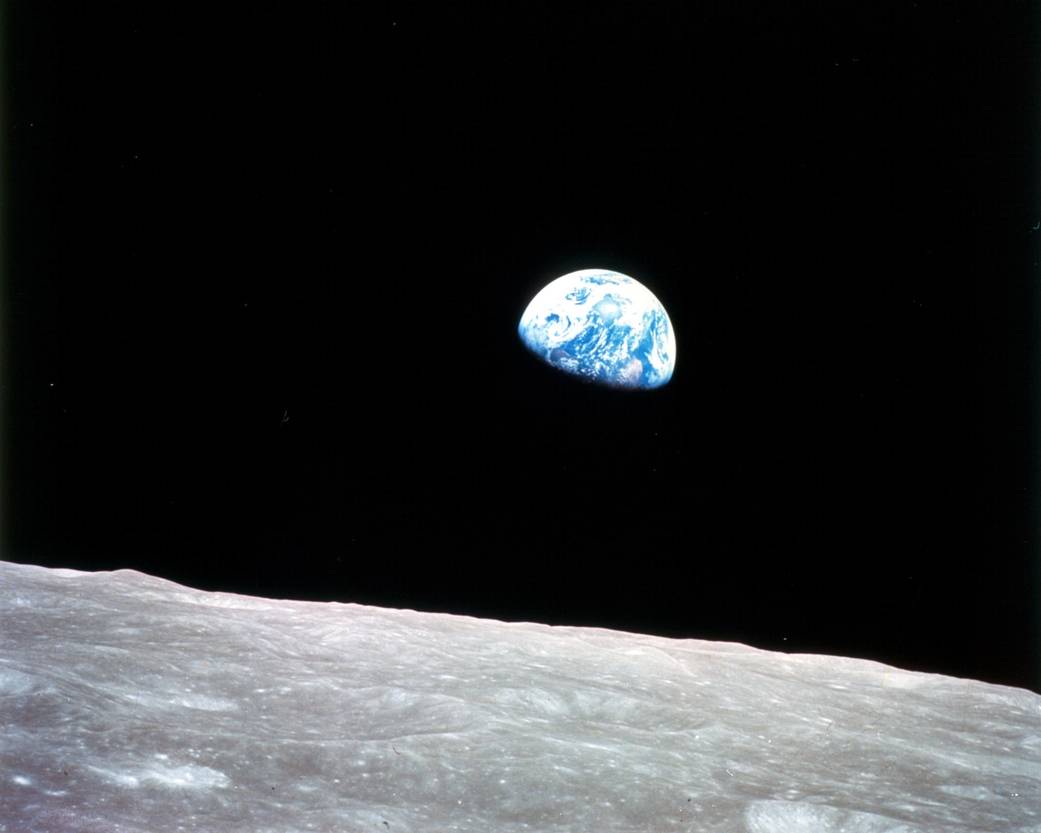
1968 Earth Rise, Apollo Mission 8

1968 Earth Rise, Apollo Mission 8

A change in collective attitudes often takes momentous events. While the moon-landing of 1969  was mildly underwhelming, the image captured in preparation for the American eagle’s landing, a year earlier, was immensely moving – revealing a vastly expanded mirror to our home that spoke then, and speaks now, directly to our physical and spiritual senses. Guiseppi Ungaretti had fitting words …

‘What are you doing earth in heaven? Tell me what are you doing silent earth?’

With hindsight we can see how major historic events are being incubated years in advance to their happenings. Artists have a knack for shocking us before a message becomes endorsed, which is why I connect the film  ‘To Witness Daisies’ (1966)   with the earth-rising image, both testing limited perceptions.  A click on the title should bring up the movie on your tube.

Věra Chytilová

Věra Chytilová

Not unlike the awesome view from outer space,  Věra Chytilová presented an equally powerful pointer to our poor stewardship of earth. Initially forbidden in the former Czechoslovakia, her tragic comedy was released two years before the Prague Spring, and two years before the earth-rise image promised a new respect for nature. I hoped for a greater understanding of cosmic interconnectedness, and an assessment of the fear-based need to subdue and control the wild, the primitive, the imagination, soul … all the ignorant projections on the feminine principle, which, I think, are responsible for spoiling our planet and wounding the psyche of men and women.  Film critics felt uncomfortable with Věra Chytilová’s controversial, iconoclastic statement on the demeaning role assigned to women in our cultures. Niels Bohr expressed, ‘As long as an atom is not seen it does not exist, it is a ghost.’ To me, this implies that seeing, individually and collectively, is an active process, influencing the reality of our existence.

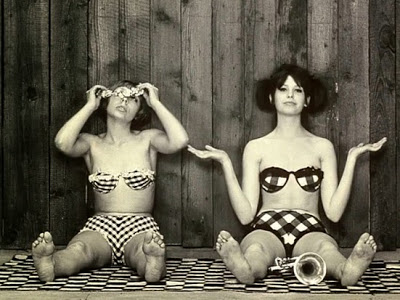
The Daisies

The Daisies

Watching ‘To Witness Daisies’ for the first time in 1994, I was struck by its theme of psychic starvation – sharply relevant today – and the insanity of societies where women are kept in an infantile state so as not to threaten male supremacy. The symbolic power of the film’s images, with their rhythmic and gradually peaking orchestration, creates a timeless sphere of magical reality, where meaning is expanded and revealed. The opening sequence of the film gives the context. A mechanical wheel turns relentlessly to the sound of regular drumming. The scene is interspaced with silent images of war, bombs exploding, mainly into the sea, symbolically representing the mother of all life on earth. Next, the frame shows a sun-deck by a pool. Filmed in black and white, the deck re-appears as a transitional stage. and one could add, a place at the edge of the personal unconscious. Here a question is voiced, ‘What next?’ The two teenage girls wear bikinis and their movements are mechanical, like the wheel. The sound indicates a lack of oil in the system, and the funfair trumpet played by one of the girls suggests a flat and mocking victory.

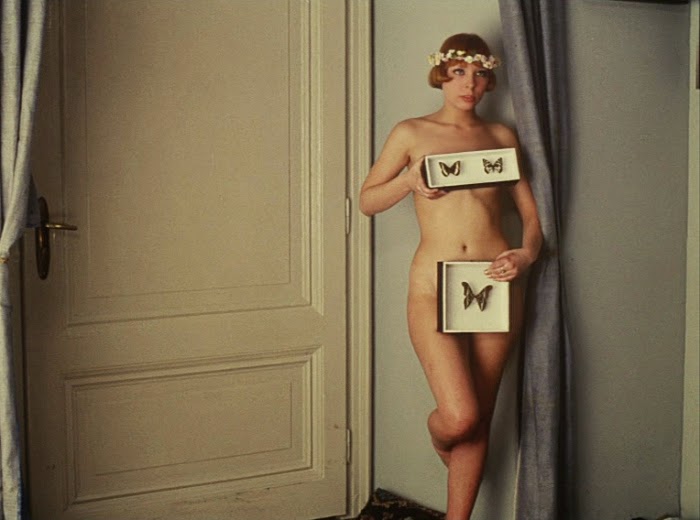
Posing for the Collector

Posing for the Collector

The outlook is set. ‘I’m a doll, everything is been spoiled in this world.’ And, as a way out of boredom, ‘If everything is being spoiled, we will be spoiled too.’ The decision to mirror a spoiled world is made, a death wish gains momentum. Daisy Blond wears a daisy chain and uses it at intervals as divination device. When the chain is thrown out of the frame, it lands on water and signals the next mise-en-scène, like a Garden of Eden where the girls dance, and where Daisy Blond picks the legendary fruit, affirming ‘their kind’ are products of a biblical myth with politically useful interpretation that prevail.

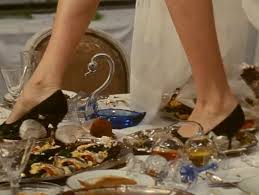
The end-feast

The end-feast

Film critics felt uncomfortable with Věra Chytilová’s controversial, iconoclastic statement about the role assigned to women in our cultures. Acted by Jitka Cerhová and Ivana Karbanová, the Daisies have various names throughout the film. I call them Daisy Black and Daisy Blond, though they are one and the same, since their communication resembles an internal dialogue trying to deal unsuccessfully with a moral conflict that offers no bridge between good and bad. To Daisy Black nothing matters, she has a timeless distance to things, everything is a game. For Daisy Blond, the extrovert, hunger makes food a central theme of the film – hunger in the sense of wanting to fill her sense of emptiness with substance. I won’t venture into psychology, but it’s easy to draw a connections to the Anorexic symptoms many young women suffer from.

During a film degree course in 1994, I wrote a long essay on ‘To Witness Daisies.’ Unable to transfer the old Mac files when switching to a PC with internet connection, many essays need re-typing, which I hope to achieve once other projects are out of the way. For now, I thought I inspire you to watch the film – and maybe share your thoughts about it.

11 Comments

Filed under Blog

… the mystery of thoughts …

Every child is truly switched on to the imagination. But frequently the environment belittles the imagination, and the gift can end up suppressed under the blanket of rationality. People with a strong creative drive may settle down to live in a straitjacket, and then find themselves overwhelmed by images, thoughts and associations, especially around full moon.

As a child I was intensely curious about the spaces between things, and about light. Had I not locked horns with an opinionated physics teacher I might have taken up the challenge to study sciences. Another fascination of mine was pattern repetition – how the veins in a leaf resemble the shape of a tree. And scale – how tiny bodies, big bodies, our planet, galaxies, the universe, are all reflected in each other.

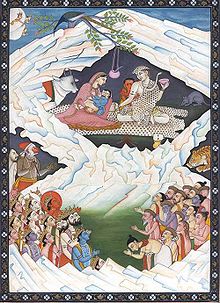
 Hindukailash, image from wikipedia.

Hindukailash, image from wikipedia.

Like Indra’s net of pearls in Vedic mythology, where the surface of each pearl mirrors all other pearls, a metaphor for the interconnected networks of mutual relationships between parts and systems. Mount Kailash is depicted here as the timeless and motionless centre of this net, housing Shiva’s family.

Not only visible structures are held together by interactive nets, our social systems, political systems, spiritual systems and the internet operate within a network. We can observe that the invisible psyche (mind) functions not only through logic, but also through aesthetics, independent of space/time, and is held by another kind of coherence – a net of meaning. And what is generated from this net of meaning is a finer kind of energy, not evidenced by present scientific methods – namely intelligence.

We knew it all along – research established that our emotional experiences leave an imprint in the cells of our body, that the brain is more than the squishy mass under our skull but a medium spread throughout the body via a network of neurotransmitters. There have been hair-splitting arguments for and against the idea that the recipient of an organ can experience personality traits of the donor, based on the speculation that each cell carries a hologram of the whole body and its memory.

Feelings and thoughts arising in my consciousness are filtered through my body’s memory. They also depend on my state of anxiety or calm, my interest, attitude and other variables, such as the weather, my relationship with the elements, with people, the collective mood, solar flares, or the constellation of planets. On some days, maybe after a meaningful dream, or a spell of mantras, thoughts are forming clearly on the breath, like reflections in a still pond, on other days, thoughts rush in on water rapids threatening to drown me, or they plod in like turtles, slow and guarded.

Objective reality is not the only game there is – what in the universe has not interacted at some point in time, irrespective of distance? Everything is linked up. Einstein called it the ‘spooky action.’

The motherboard for this wonderful instrument we call the brain, which comprises our whole body, is formed in the womb. I believe the intelligence involved in creating any specific body must lay in more than known DNA codes, must include the indeterminable non-local DNA of a spirit world. Our body foremost operates like a receiver and transmitter for as many wavelengths our radio station in time attracts or is able to tune into.

From this station, stabilized by repetition, I sort clusters of sensations and feelings, and process thoughts and ideas attracted to me from the collective psyche, a vast sea, which the individual mind must learn to navigate. Images and signifiers are coloured by whatever I consciously or unconsciously mirror and relate to.

No matter how much information we absorb, through our senses, through language and concepts, through comparing patterns, reasoning and calculation, everything, comprehended or not, will be filtered through the body’s motherboard that keeps adjusting to experiences and expanding fields of perception, fields that extend way beyond personal memory. All this information is continuously re-shuffled, as is the meaning we assign to it.

Our body is a motherboard – planet earth is a motherboard – the whole cosmos is a motherboard for a spirit we cannot comprehend, an invisible hand that touches us like a breeze, made visible through what it animates.

All we know is that images, thoughts and ideas are reflected in us. They travel via synapses in the neurons of our body, they travel on the air between minds, they travel among stars, they echo from under the sea, waving to us as plankton, they speak to us from every creature, from every blade of grass, from every stone, and they beep from within our bodies through tweaks of pleasure or pain. All matter, all people and objects we interact with store the memory of that interaction, including interactions with things we hate or nurture, and with places we live in.

We don’t invent anything, we re-discover, re-connect and re-create from the vast storehouse of knowledge and information provided to us by nature, and by the spirit between matter that makes up the cosmos, an embodied being that is becoming conscious of itself.

We are on the air, sent, programmed, radioed and broadcast, identified with all manner of things, ideas and beliefs. Yet if we look deep inside our emptiness, we know, the non-material aspects of us can potentially detach and be free, maybe enjoy tea with Shiva’s family and witness the world turn on its axis – a state some people experience spontaneously or through meditation. A state of pure consciousness not identified with this or that. In the meantime, we could at least be kind to ourselves …

‘Thoughts are beings that generate … One thought of kindness gathers a thousand beings of love and kindness around one.’            Hazrat Inayat Khan

I don’t know if a singular mind/psyche, the incredible art of a lifetime, survives the physical death of the body. Maybe a coherent individuated mind leaves a dent, an influence within the collective psyche. Like the organ of the heart, over time, achieved its definite function. But does it matter? Nothing is lost. All information is continuously re-shuffled into new forms and constellations.

Digital storage provides a metaphor – information exists and roams freely in the wind of the collective psyche (unconscious) until it is embodied and gathered towards a purpose. Every event has a consequence. Nature is exacting, but also generous, what has been repressed in the flow of evolution will always return in one form or another.

Everything alive speaks to us, and all such relationships are processed in the stories we share, stories being containers of the richest kind of information. 

*    *    *

You can source other posts on the theme of reflection in the tag cloud on the right of this page. Like this sequenc of posts: https://courseofmirrors.wordpress.com/tag/hazrat-inayat-khan/

And you might want to check out posts under the tag ‘psychology,’ especially the one on ‘awareness,’ where I share R. Assagioli’s 10 psychological laws – how the body affects the mind and the mind affects the body. https://courseofmirrors.wordpress.com/tag/psychology/

*     *    *

This post also appeared at  Third Sunday Blog Carnival: September 2013 | Third Sunday Blog Carnival

17 Comments

Filed under Blog