Tag Archives: writing

… Goats are Goats … part 1

Recently, Jane Alexander, another spiritual warrior, had a blog-post sparking a dialogue that brought up the theme of goats, in the widest sense :) and it reminded me of an episode with goats. So I dug up my notes and wrote a Short Story. Here the first part, one or two more to come … enjoy.

*     *     *

Friends warned me – goats are trouble, they’re stubborn, they gobble up everything in reach and reach everything, fences are useless – to no avail, my brain cells were committed. The image of a she-goat had acquired deep saturation in my heart and was fixed. At the time, none of our group who had rented the old house was keen on gardening. We were surrounded by weed-smothered acres. I envisaged the jungle cleared and converted into snow-white milk and cheese. A deeper image chimed, of the orphan Heidi sent to live with her grandfather in an alpine hut where she met Peter and his goats. The story had left an indelible impression; especially how the healing of Heidi, Peter and the wholesome milk of his goats worked on Clara, a paralysed girl. Sediments of memory that push up times’ layers and seep into new situations often justify my otherwise irrational actions.

The local farmer told me of a place where they kept goats. ‘A rarity these days,’ he said. I got up at dawn, bemoaning the grey sky. Ellie was awake, eager to join me, a curious act of will for someone who tended to apathy. I had not planned on company, but could hardly refuse since she had already prepared coffee in a Thermos, good strong coffee. We raided the fridge for provisions and folded into my old estate. The destination was a smallholding in a Bavarian hamlet, an hour’s drive away. Ellie was silent. She liked to daydream. When she talked, it was about what she noticed in her immediate vicinity. ‘See the pretty flower box up on that window?  It’s tilting and might fall on someone’s head.’ Or, commenting on a woman who offered directions, ‘She squeaks like a mouse in a trap.’  Her observations tended to ripple the air with uncanny prognostic qualities that made me shiver.

The overgrown dwelling nestled like the green-speckled cap of a giant mushroom in the slope of a hill. Across the black earth in the yard waddled flocks of white geese. I parked the car, which made a couple of birds chase their goslings under the branches of an elm that served as roof for a medley of neglected farming tools and scrap wood. An enchanted world in which a silver-haired woman stood motionless among her goose sentinels. ‘Is she aware of us?’ I wondered.

‘She wouldn’t miss a worm stirring in her yard,’ Ellie said.  Her impression mirrored mine, of the ageless crone being rooted to her environment as through fungal filaments. Stepping from the car was like agitating the boundary to another universe. There was a bout of nervous honking, and a gander hissed as I walked up to the woman. Her kind eyes twinkled, animating a leathery face inscribed with immeasurable knowledge of the elements. She told the tale of her last goat, in slow detail, giving it shape with her bony hands, as if I was a neighbour passing by who deserved the latest instalment.

Back in the car, I took a last glance and wished I had my camera. The woman stood as before, on the same spot. Ellie was humming.

‘What’re you humming?’ I asked.

‘Some tune, can’t recall – this place, you know, could be spirited away any moment.’

‘Good luck then that she gave me another lead,’ I said, ‘a place not far from here.’

The farmer ten miles down the road looked us up and down. Not an inch of ironed cloth on us, my mirror-embroidered vest, the charms dangling from Ellie’s neck – hippies – I heard him judge. ‘Goats, gosh, they’re a luxury. I sell you sheep, less hassle.’

‘Sheep are sheep,’ I said, bluntly. He carefully gauged my sanity and shook his head. The thoughts of a simple soul can be read in capital letters, not flattering, but always enlightening. I made small talk to navigate through our discord.

Eventually he offered a hint. ‘There’s a farm I used to do business with, in the mountains, near the Austrian border.’

This search was going to be a longer than anticipated. We stopped at a river for a picnic. ‘It’s not going to be straightforward, is it?’ Ellie said. ‘I hope we don’t get lost … exciting really’, she added, as if to undo her fretfulness. I never tried to persuade her of anything.

She was a strange one, Ellie, a cautious spectator, longing for others to take charge, which got her into trouble when someone she considered a friend laced her birthday cake with psychedelics. She lost coherence and was sectioned. When our small community heard about her plight, we got her released from the institution and took her in. The trauma had shaken Ellie, but opened her mind, though she swayed from moments of brightness to moments of despair.

‘We can sleep in the car,’ I said. ‘There’re blankets in the hatch.’ Determined, I drove on – into the unknown. Another 30 miles, and my Estate laboured up the steep serpentines of a gorge. The sky drew dark curtains and it began to rain.

Close to our next destination, flashes of lighting zigzagged among the cliffs. The narrow road became a roaring stream. Ellie clasped the crystals she wore for protection round her neck. I could smell her fear and tried to be brave for both of us. ‘I’ll stop at the next layby.’ To my relief, a cluster of farm buildings came into view. Sheep huddled for shelter under a copse.

‘No goats!’ Ellie said. She had a habit of stating the obvious.

‘Goats hate rain,’ I assured her. ‘They’ll be under cover on a day like this.’ Once we reached the farmhouse it poured rivers. I parked and turned off the engine. The mass of water pressing against the windshield was impenetrable, and it didn’t look as if the downpour was about to stop. ‘Let’s run for the porch,’ I said.

…   a link to part two is at the top of this page …

Do not seek to follow in the footsteps of men of old; seek goats.  Basho

*     *     *

The illustration, Goat and Vine, is by A. Rackham
19 Comments

Filed under Blog

… the wonderful visit …

I loathe most talk of angels since they became best-selling brands, but the synchronicity of Annie Lennox wearing wings and singing to an angel at the Queen’s Diamond Jubilee, and the discovery of a rare book among my shelves, brought angels up close.

H G Wells (1866-1946) has been referred to as the Father of Science Fiction. A neglected story, The Wonderful Visit, published shortly after The Time Machine, was regarded as a mocking reflection on attitudes, beliefs and the social structure of a typical English village in Victorian times. I read the social commentary as ornamentation, the comical human attempt to stay the same, round a more essential theme, the conflict that can accompany awakening.

The edition below is from 1922 and has an illustration by Conrad Heighton Leigh. The line under it is from chapter 5 – ‘He fired out of pure surprise and habit.’

A strange bird was sighted.

Ornithology being a passion of the Vicar of Siddermorton, Rev. K. Hilyer, he was going to outdo his rivals and hunt the strange bird. So it came to be that on the 4th of August 1895 he shot down an angel.

… He saw what it was, his heart was in his mouth, and he fired out of pure surprise and habit. There was a scream of superhuman agony, the wings beat the air twice, and the victim came slanting swiftly downward and struck the ground – a struggling heap of writhing body, broken wing and flying blood-stained plumes … the Vicar stood aghast, with his smoking gun in his hand. It was no bird at all, but a youth with an extremely beautiful face, clad in a robe of saffron and with iridescent wings … never had the Vicar seen such gorgeous floods of colour …

‘A man,’ said the Angel, clasping his forehead … ‘then I was not deceived, I am indeed in the Land of Dreams.’ The vicar tells him that men are real and angels are myth … ‘It almost makes one think that in some odd way there must be two worlds as it were …’

‘At least two,’ said the Vicar, and goes on pondering … he loved geometrical speculations, ‘there may be any number of three dimensional universes packed side by side, and all dimly aware of each other.’

They met half way, where reality is loosely defined, and truth has no hold. And they shared the nature of their worlds. Eat, pain, and die were among the new terms the strange visitor had to come to grips with.

‘Pain is the warp and the waft of this life,’ said the Vicar. Riddled with remorse over having maimed the Angel’s wing he decides to looks after him. But to adjust to the Vicar’s world, the Angel must eat and accept pain, and learn all manner of things very fast indeed … Starting to read, during a phase of now legendary sunshine, I settled in my garden with a glass of red, and consequently spilled the wine on my wild strawberry blossoms due to sudden bursts of laughter.

‘What a strange life!’ said the Angel.

‘Yes,’ said the Vicar. ‘What a strange life! But the thing that makes it strange to me is new. I had taken it as a matter of course until you came into my life.’

Mr Angel is nothing like the pure and white angel of popular belief, more like the angel of Italian art, polychromatic, a musical genius with the violin. Listening … the Vicar lost all sense of duration, all sense of necessity … The reactions of the villagers oscillate across a hair-thin-divide between comedy and tragedy, while the bone of the story is psychological, and spiritual. Indirectly, the Vicar encounters his anima (his inner female) through the Angel’s love for Delia, the maid servant of the house. There is no escape. Things get intense. The Angel, over the span of a short week, is tainted by the wickedness of the world, and it crushes him. And the Vicar’s awakening from his narrow prison brings him into tragic conflict with his community.

*    *    *

Not much has changed. The world is crowded with wounded angels seeking compassion, and since our daily vocabulary offers little more than clichés for other realities, awakening rarely convinces, unless it is embodied and conveyed through atmosphere. Look out for the artist… the musician, painter, writer, animator, filmmaker … and the children.

‘If the doors of perception were cleansed every thing would appear to man as it is, Infinite. For man has closed himself up, till he sees all things thro’ narrow chinks of his cavern.’
― William Blake, The Marriage of Heaven and Hell

The painting heading this post is by the Finnish symbolist painter Hugo Simberg.

18 Comments

Filed under Blog

… pattern which connects …

For a recent book-sharing with a group of irreverent friends (archventures), I had the wish to share so many books that I instinctively reached more or less blindly into one of my shelves. Books in my home, I must add, are in a muddle. The only order to speak of is their relationship to each other through time. I picked Alice in Wonderland and Mind and Nature. During our afternoon of reading there was not enough time to do honour to the latter, Gregory Bateson’s work. So I said I’d write up something. Oh dear. After pages and pages, I finally recalled this was supposed to be a blog-post, not a novel .

I first came upon Gregory Bateson books, ‘Steps to an Ecology of Mind’ and ‘Mind and Nature,’ during the early 1980’s, after his death. The clarity of his notion that biological forms arrange themselves through relationships struck a deep chord. What totally resonated with me was his thought that the structure of nature and the structure of mind are reflections of each other.  He had a broad perspective for a Biologist, and wanted to build a bridge between the facts of life and behaviour, and what we know of the nature of pattern and order. He was active in, and connected up many different fields of study – anthropology, psychiatry, biological evolution and genetics and the new epistemology which comes out of system-theory and ecology. He challenged basic assumptions and methods of scientific investigations, pointing to the processes beneath structures. He quoted Goethe …

A stem is what bears leaves

A leaf is that which has a bud in its angle

A stem is what was once a bud in that position …

And he provoked new thinking: ‘What pattern connects the crab to the lobster and the orchid to the primrose and all four of them to me. And me to you?’ 

His interest in morphology, the study of structure and form of organisms, involved context, meaning and communication. He distrusted reductive models of cause and effect, the scientific approach that lines up parts and classifies them, focussing on quantity.

Comparing systems, one to another, he perceived the mind as an ecological system. And he used the analogy that ideas, like seeds, can only take root and flourish according to the nature of the system receiving them. This thought alone deserves deep contemplation.

He had a way with stories … ‘There was a man who had a powerful computer, and he wanted to know whether computers could ever think. So he asked it – Will you ever be able to think like a human being? – The computer clicked and rattled and blinked, and finally it printed out its answer on a piece of paper, as these machines do. The man ran to pick up the printout, and there, neatly typed, read the following words: ‘That reminds me of a story.’ 

Concerned about the decimation of aboriginal populations (he did field-work with Margaret Mead), the degradation of ecological systems, economic oppression, and senseless wars and arms races, he took these ominous signs of contemporary life to be manifestations of deeper disorders, which he defined in terms of cybernetic systems of communication and meaning that comprise life, mind, and society. In his view, consciousness dominated by purposeful thought has a linear structure that establishes goals and ways for attaining them without being necessarily sensitive to the circular network of cause and effect that orders the systems.

Looking at human consciousness as an adaptive system, he thought the cure for its inadequacies, evidenced by the negative side-effects of purposive rationality, was not to reject it in favour of a passionate non- rationality, as in the extreme romantic position, but to augment and complete it by engaging with non-discursive, pattern-comprehending and emotional processes. He advocated the befriending of the unconscious aspects of the mind through utilising images and metaphors.

In a civilization which separates mind from body, mythologies about the survival of a transcendent mind are often meant to soften the idea of death, or even deny death as part of life. For Bateson, who saw the mind as being immanent not only in pathways of information which are located inside the body but also in external pathways, death took on a different aspect. ‘The individual nexus of pathways which I call ‘me’ is no longer so precious because that nexus is only part of a larger mind. The ideas which seemed to be me can also become immanent in you. May they survive, if true.’  (Afterword to a collection of celebratory essays, 1972)

Yet there are scientists that can no more perceive the language of nature, and politicians who feel beleaguered by sections of society that seek balance and a fresh context towards ‘an ecology of mind.’  The extreme factions of believers, for what else are they, should look again at the bridge  Bateson prepared.


This lovely video gives a taste of what it is all about :

Update … I discovered recently, in 2019, that some the links in this post don’t seem to work anymore. Here , however, is his daughter’s great documentary on Vimeo, unfortunately not free, apart from the trailer.  https://vimeo.com/ondemand/bateson

Looking at the structure of nature and the structure of mind being reflections of each other, it becomes obvious that not only does nature mirror our habit of thinking, but our thinking also mirrors the state of nature. Ecology and psychology must therefore both engage in listening, and seeing, and working ceaselessly towards the integration of knowledge and the re-adjustment of a dynamic balance.

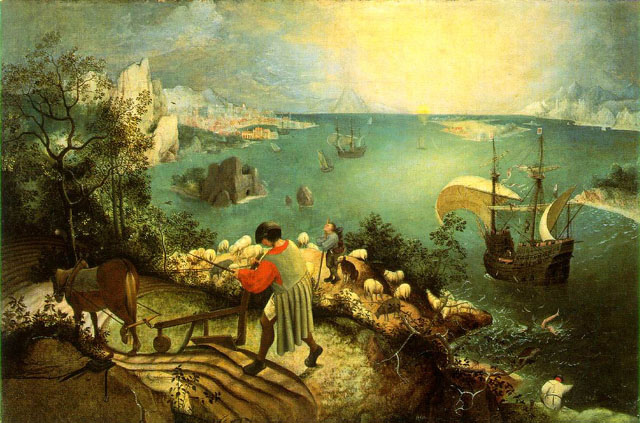
I could go on, but want to bring in a famous painting of Icarus by Brueghel.                                                             Anthony Stevens, a brilliant expositor of Jung’s thought, used the painting as cover for the first hard-cover edition (1995) of his book Private Myths.

http://www.anthonystevens.co.uk/index.html


Stevens quotes from a poem by Wystan Auden:

In Brueghel’s Icarus, for instance: how everything turns away

Quite leisurely from the disaster; the ploughman may

Have heard the splash, the forsaken cry,

But for him it was not an important failure; the sun shone

As it had to on the white legs disappearing into the green

Water; and the expensive delicate ship that must have seen

Something amazing, a boy falling out of the sky,

Had somewhere to get to and sailed calmly on.

What goes up must come down. Who knows how many Big Bangs there were before the one we so ardently explore? There is an organising intelligence behind life’s cycles, while consciousness forever expands. Thinking in metaphors we can perceive similar patterns, forms in nature and mind, cosmos and psyche, mirroring each other across scale and time. In other words, life teems with realities we can tune into, as long as we assign context and meaning.

Check out Gregory Bateson’s books ‘Steps to an Ecology of Mind’ and ‘Mind and Nature.’

His family continue his work: His daughter Nora and his wife – Mary Catherine Bateson:   http://www.interculturalstudies.org/main.html

Peripheral Vision

 http://www.amazon.com/exec/obidos/tg/detail/-/0060926309/mead2001centenni

Free chapters of Angels Fear:  http://www.oikos.org/angelsfear.htm

Nora Bateson, recently created a film:

http://www.anecologyofmind.com/

Last not least, the themes:  pattern which connects, mirroring and bridging, are subjects of my novels.

25 Comments

Filed under Blog

… I write here …


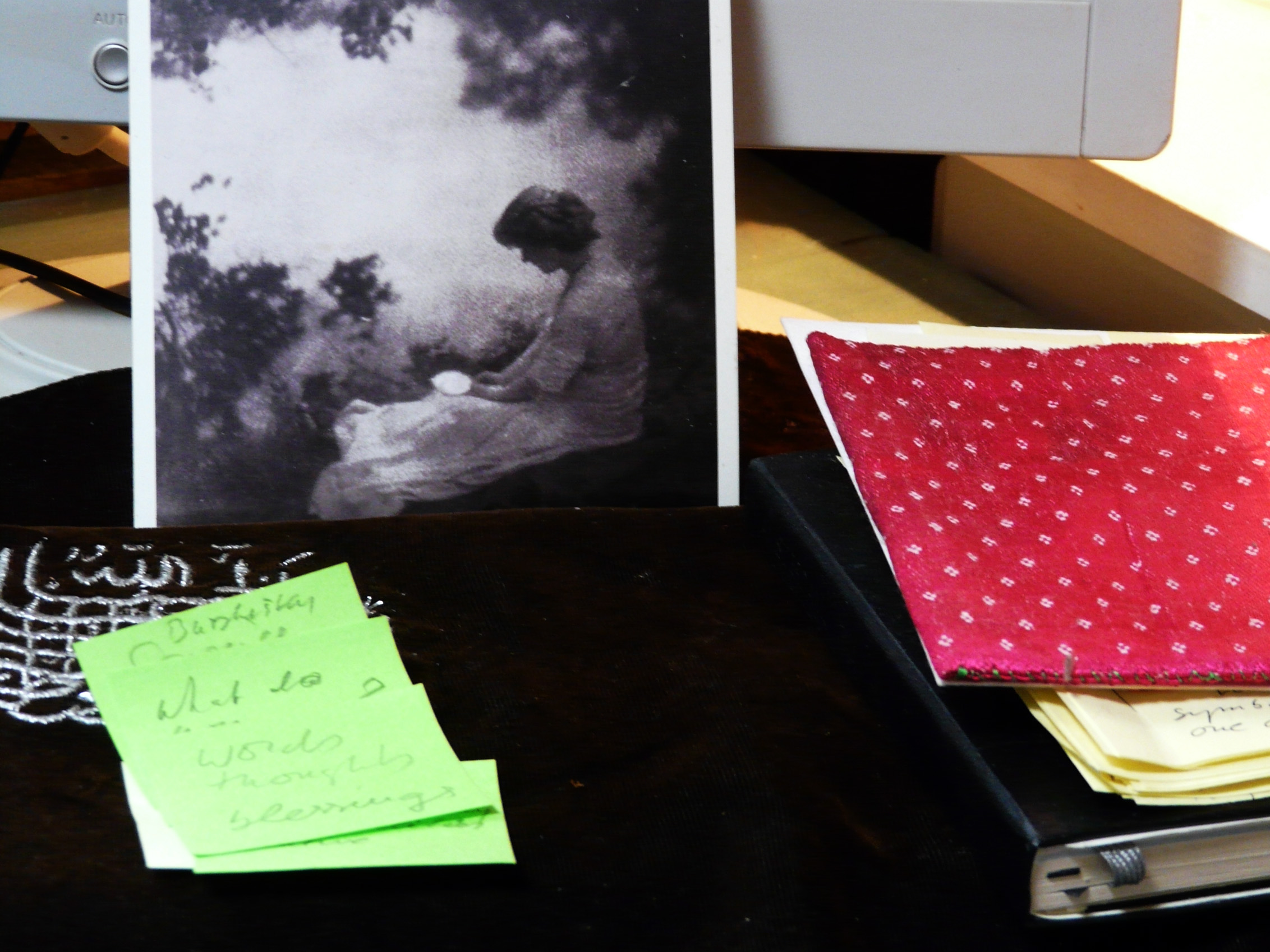
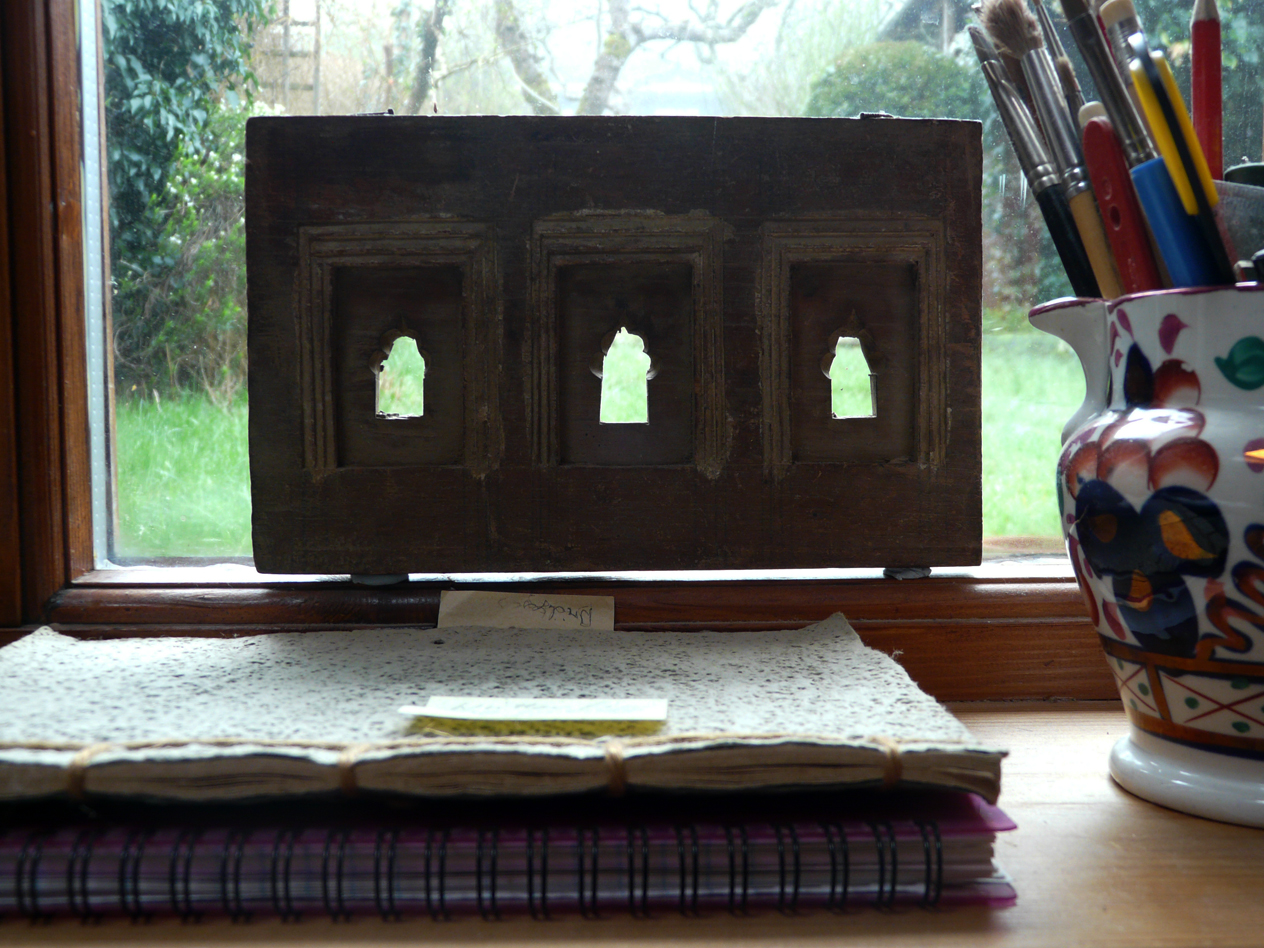
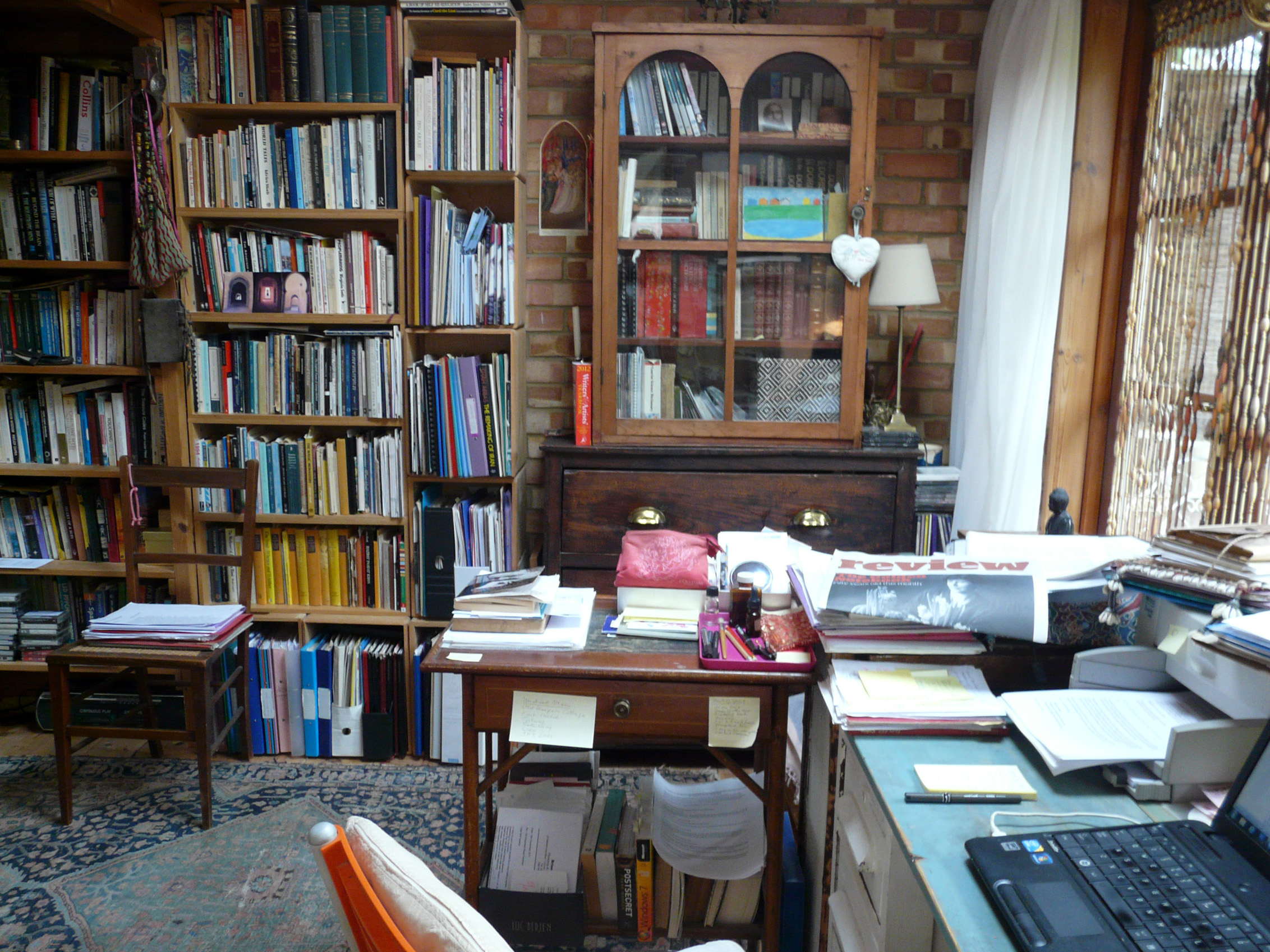
Images tend to bring us instantaneously closer.  A recent writing workshop given by a friend, made me think how inner and outer spaces affect our writing.  And I was also  inspired by Roz Morris, a generous and effective blogger http://nailyournovel.wordpress.com/page/3/ who featured her writing space in February.

I write through

the heart chamber

and the drone

of its circular charm

I write in earth

branching to the dark solitude

of birthing

the unknown

I write in water

fractals spinning

plankton under stars

coding the cosmos

I write in air

flexed by the wishbone

that loops breath to lift

wings of longing

I write in space

where spirits linger

in the scent-cloud

of a former home

I write in ether

where dreams free

greening visions

and murmur of bloom

I write here

in a room that is everywhere

bridging hearts

with companions like you

26 Comments

Filed under Blog

Alice Meynell

I had an evening online,  jumping from link to link, randomly hunting, then serendipitously finding, coming upon treasures, like the essays by Alice Meynell. The writer had been recommended to me by a tutor when I first studied in the UK  –  as example of good essays in English. Alice Mynell’s essays  helped me back into writing at the time – which is another essay.

*    *    *    *

The Illusion of Historic Time

He who has survived his childhood intelligently must become conscious of something more than a change in his sense of the present and in his apprehension of the future. He must be aware of no less a thing than the destruction of the past. Its events and empires stand where they did, and the mere relation of time is as it was. But that which has fallen together, has fallen in, has fallen close, and lies in a little heap, is the past itself—time—the fact of antiquity …

http://essays.quotidiana.org/meynell/illusion_of_historic_time/ (direct link)

Enjoy – the general link to more essays on the right, under blogroll.

And there’s another treasure I found tonight … Writers No One Reads – check the link.

Alice is one of them, I think.

2 Comments

Filed under Blog

how my dad was attacked by a tree

Here some random thoughts, interspersed with more random thoughts as well as random quotes and random links, all to do with ideas about TRUTH and REALITY …

To start with – a piece written by my son when he was, huh, quite young, describing a true experience. He gave me permission to share it.

*    *    *    *

On Tuesday the 3d of May 1989, at eleven o’clock, me and my dad set off to Driebergen, about 20 miles from Amsterdam. It took us 45 minutes to get there. We went to see dad’s old house and it looked still the same as when he had lived there 16 years ago. Then we drove to a tennis club, called Manger Cot’s (Cat?). Dad went to the club house to meet some of his old friends, like his tennis trainer, Bill, and his father, can’t remember the name. Then we had a look if the squash club was still there, but it wasn’t, so we had some lunch. After that we went to a music shop, and I mucked about on the drums while dad talked business with the shop keepers. Later we went into the woods and walked about.

On the way back, dad was brutally attacked by a TREEbrandishing a knife stained with blood from its previous victim. Dad fell over and when he got up he looked like Frankenstein with a massive cut down his forehead and blood dripping all over the place.

Dad said it didn’t hurt, but we still went to Peter’s house (a friend of my dad) to wash off the blood. But Peter wasn’t there, and neither was his wife. So we had to walk back to the car and drive to the music shop to clean up the wound. Then the shopkeeper said he knew where there was a surgery, so we went there. When we got there, dad went in to see the doctor, and I waited outside in the lobby. Dad came out with three stitches in his forehead and a big plaster over it.

By Yeshen

*    *    *    *

The etymology of the word TRUTH indicates – good faith, fidelity, sincerity, veracity – and agreement of fact or reality. TRUTH has been subjected to many theories and definitions, here are some of them:

1        Correspondence Theory: In the words of Thomas Aquinas, ‘Truth is the equation of things and intellect.’

2        Coherence Theory: Truth is only what is coherent with the whole system.

3        Constructive Theory: Perceptions of truth are viewed as contingent to convention, human perception and social experience, in other words, every truth is socially constructed.

4        Consensus Theory: Whatever is agreed upon …

5        Pragmatic Theory: Truth is verified and confirmed by the results of putting one’s     concept into practice. It is self-corrective over time.

6        Kierkegaard says – ‘Objective truths are final and static. Subjective truths are continuing and dynamic.’

7        Nietzsche thought untruth is better than truth if it has life-enhancement as consequence.

8        Fromm held Truth to be a functional approximation of reality.

9        Foucault refers to ‘Regimes of Truth’ that shift constantly throughout history.

10    Baudrillard: The simulacrum is true because it conceals that there is no truth.

11    Lao Tzu: Words of truth are always paradoxical.

12   A mystic, Hazrat Inayat Khan, expressed TRUTH like this: Those who see the truth uncovered, abandon reason and logic, good and bad, high and low, new and old … As water in a fountain flows in one stream but falls in many drops, divided by time and space, so are the revelations of the one stream of truth. Not everyone can comprehend the idea of different truths being derived from one truth. Common sense has been so narrowly trained in this world of variety that it naturally fails to realize the breadth and subtlety of a spiritual fact so far beyond the reach of its limited reasoning.

*    *    *    *

2 Comments

Filed under Blog

… battling with the branding goddess …

A branding-class expert is something to be … anyone can be an expert, but branding the expertise takes imagination combined with determination. Establish a need, provide a context, add a striking image, a name, and presto, you attract a following of customers. Be like a dog, bury the bone, and bury it well, then dress it up virtually, mark it, package it, and you have a brand, it’s your invention. Don’t deviate; be like the dog, only tolerate your own teeth marks on it. We admire the sheer ingenuity of branding, which has turned into an art form. Take computers – they are memory devices, communication devices, and much more. Apple took a sumptuous bite out of the computing potential by developing an aesthetic language, a shiny package, and a logo with irresistible symbolic power.

Examples of successful branding have helped the growth of a fat goddess that pervades all fields of commerce. Her indulgence irks. There is the ambient kind of branding, like-minded people gathering around new mind tools, new therapies and self-help advice. Creative approaches I’d playfully developed in my work with clients for over two decades are presented as the latest invention, the latest trick revealed. By naming an approach or concept anew and creating a media platform, an idea becomes owned with the shield of a trademark. No free lunch. The trend is relentless. Even common herbs are re-named and patented.

Today, as ever, survival of the fittest means assertiveness, magnetism, influence, and, or material resources. I wouldn’t talk like this if I had a rewarding brand going, would I? While I resist the branding-bug I am free to ask … what will be the consequences? Where will it all lead? Will there come a time when a cooperation so inclined could offer you a tempting reward for a scratch-sample of your skin and patent your DNA? Would our human-rights-act guard against this invasion? Could the race over ownership, patenting and branding spread as far as shaking together a new race in a test-tube?

I am selectively brand-blind. I try to resist slogans, signatures, icons or familiars that aim to burn and mark my memory. It takes alertness, counter-programming. Subliminal stimuli in advertisement were banned, but subliminal messages abound. I prefer to make fresh associations each day. I want to choose my own habits. I want a flexible identity, and space to grow irrationally, no forced order, please. My inner world deserves a room within the social order. I seek no fault, but I make a stand for my inner silence, and my trust in the unknown. Don’t package me, label me or fit me in pre-fabricated boxes. Meet me when and wherever we meet as if it was the first time … like this …

Am I fooling my contradictory self? Surfing virtual networks, I am drawn to a new brand, the no-brand orphans. I’ve met you out there, searching for kinship.  You’re my audience. I wrote a story for you, about a heroine who does not want to comply with what is expected of her, knows well what she does not want and attracts more of the same, until she steps through the mirrors that reflect her.

Yet even when we are empowered by what we want, and this is the secret behind the presently fashionable ‘The Secret’ – psyche is not two-dimensional, it has multiple layers, and whether we are aware of this or not, life will pull us into another myth, and we will create another goddess we bow to.

Let me come clear, this is a plug for my book, a story in search of a platform, an attempt at branding  :) Established publishers – big brands – may well have a niche for a heroine who starts out not knowing what she wants, a story transgressing genres, it remains to be seen. I haven’t begun querying yet. But if it came to self-publishing, I would need to address my kinship, other branding orphans. Are you out there?

4 Comments

Filed under Course of Mirrors, my book

… on awareness …

Magic or what? According to the Hindus everything is food, including sounds and visual vibrations – all kinds of impressions: stories, architectural proportions, union of forms and colours, harmonics and rhythms, dissonance, conflict and all the ideas with which we come in contact. All this, absorbed mechanically and mostly without awareness throughout the day, has made up our being and continues to do so, unless we wake up to this process and adjust our rituals.

*    *    *    *

Psychological laws: excerpt from ‘The Act of Will’ by Roberto Assagioli M.D.

*    *    *    *

1   Images or mental pictures and ideas tend to produce the physical conditions and the external acts that correspond to them. Every image has in itself a motor element.

2   Attitudes, movements, and actions tend to evoke corresponding images and ideas; these, in turn evoke or intensify corresponding emotions and feelings.

3   Ideas and images tend to awaken emotions and feelings that correspond to them.

4   Emotions and impressions tend to awaken and intensify ideas and images that correspond to or are associated with them.

5   Needs, urges, drives and desires tend to arouse corresponding images, ideas and emotions.

6   Attention, interest, affirmation, and repetitions reinforce the ideas, images and psychological formations on which they are centred.

7  Repetition of actions intensifies the urge to further reiteration and renders their execution easier and better, until they come to be performed unconsciously.

8   All the various functions, and their manifold combinations in complexes and sub-personalities, adopt means of achieving their aims without our awareness, and independently of, and even against, our conscious will.

9   Urges, drives, desires and emotions tend to and demand to be expressed.

10   The psychological energies can find expression: 1. directly, through discharge and catharsis, 2. indirectly, through symbolic action, 3. through a process of transmutation.

*    *    *

After carefully contemplating these laws you will draw your own conclusions.

Here some practical examples:   Having experienced Feldenkreis work, and practices deriving from it  –  after doing a gentle physical exercise and repeating it in my imagination only, with eyes closed, the same physical reactions happen in my body. This  explains why active imagination can affect mind and body at a deep level and change physical symptoms as well as states of mind.

When I hit my toe, elbow or head on an object, I repeat the exact contact and, in my imagination, send the impact back. There remains hardly any pain and the usual swelling is mild or does not occur at all.

Therapeutically, if a tense or hurtful part of the body is listened to and  allowed a voice, the result can be  instantaneous,  much like when you lower yourself at eye-level to a toddler who has a tantrum, and do nothing else but acknowledge the rage, surprise, surprise, the tantrum stops.

What seems like magic, is actually simple and applies both ways: physical activity influences mood and mind,  active imagination influences mood and body.  Many of our modern-day ailments derive from people not being able to listen to their bodies and/or not being able to use their imagination in a constructive way.

Reading and, even more deeply, writing, are indirect symbolic expressions of psychological energy, which explains the incredible power of stories :)

9 Comments

Filed under Blog