Tag Archives: nature

… apples, flu, altered states, wedding plans …

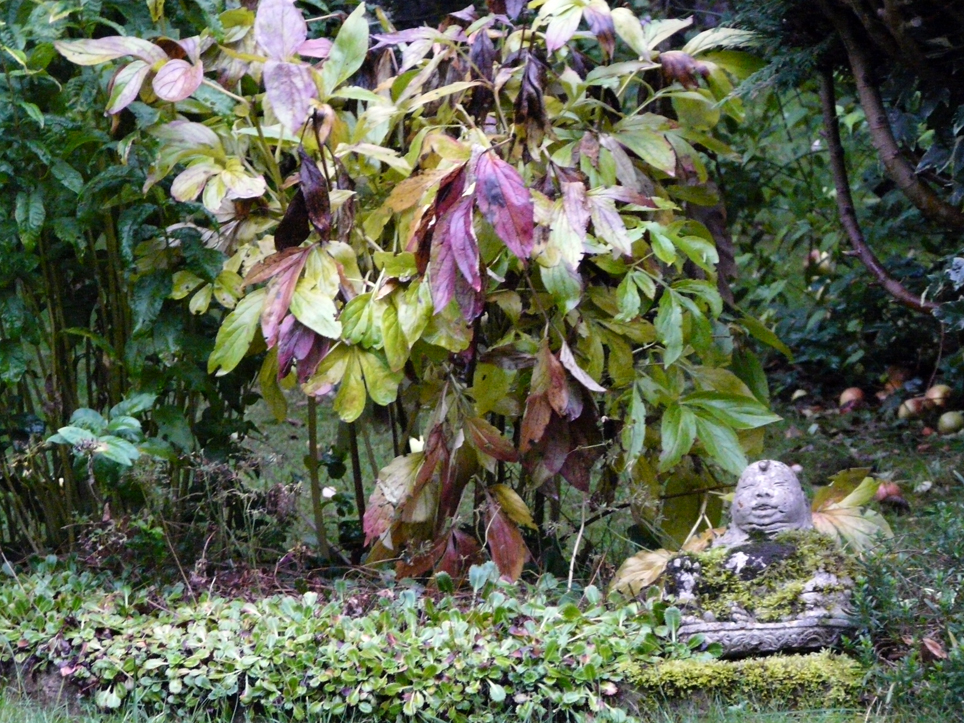
This autumn is drunk with colours and fruit. Red-blushed, in their own sweet time, apples have been falling with soft thuds onto the dewy lawn for weeks. Each morning they blink at me, and shout – help, pick me up, the slugs are coming. They’re good for something, but did you know that slugs and snails are hermaphrodite, and lay up to 500 eggs a season? Re: fruit, after last year’s poor crop, this year’s harvest is a tad overwhelming. The scale by which nature balances excesses evades rational comprehension.

autumn colours

autumn colours

Too much of a good thing brings obligations. Eaters taste best when fresh, so I’m urged to act fast. Slug-nibbled and bruised fruit lands on the compost heap. The bulk of apples, several kilos a day, I wash, dry, box and put out on the road for passers-by, mainly kids on their way home from school. This time-consuming and noble deed has left me exhausted, and with numerous bumps on my head. Here’s the apple saint, drop now. For lack of a resident family to boss into cider-making, I’m left with ‘waste not’ ringing in my ears. If you remember scarcity, you’ll co-suffer the enforced hypocrisy of a  twenty-first-century system that thrives on waste.

I could blame the nagging ‘waste-not‘ guilt for frustrating the flow of my writing. I could blame three early morning trips to London on crowded trains, or  alien dust settling on my skin … whatever …  my body succumbed to the annual purge of flu. So a week ago I sneezed and coughed through fever and chills. Sweaty nights occasioned surreal dreams and visions, and there were days when I lost faith in my invulnerability, reminded that I need to clarify some matters in my Will. I survived – with tons of lemons. You’ve guessed by now that I’m shy of conventional medics, a story I won’t regale you with. The last official need for a doctor’s visit to my home was benign, and over three decades ago,  after I’d given birth to a healthy baby in deepest rural Somerset.

So last Sunday, following a week of altered states, I ventured out to put petrol in my car. I support small enterprises for their human idiosyncrasies. The cashier gazed absent-mindedly over the forecourt and across the street towards a line of taxies, while automatically debiting my Visa and, at my want, pressing another button to produce a tax receipt. Sensing a process at work, I said, ‘You’re bored.’

His head moved independently from his neck. You may remember the craze of bubble-head mascots:  http://en.wikipedia.org/wiki/Bobblehead that’s exactly how his head moved while his eyes rolled in their sockets to take note of my witnessing. His mouth then rounded and huffed before emitting a speech he must have rehearsed all morning. Slow, precise thoughts poured out, including snippets of existential dialogues he had had with taxi drivers from across the road. Written down, it could have edged itself towards some literary prize. His exposition ended with : ‘Nothing to be done. I’m bored stiff.’ Reminiscent of Beckett. Promises, waiting … in tune with my dull-witted flu-states. Missing most words, I was captivated by the man’s brilliant and spooky slaying of meaning. Another customer entered the cubicle. On leaving, some wise-crack in me I’ve no control over, said, ‘You’re reading …’ thinking, you’re observing life  from a distance, co-creating  its absurdities and joys. It’s what writers do.

 ‘Boredom is the dream bird that hatches the egg of experience. A rustling in the leaves drives him away.’   –  Walter Benjamin. 

*    *    *

This post was meant to be short and about my son and his partner, to brag a little.

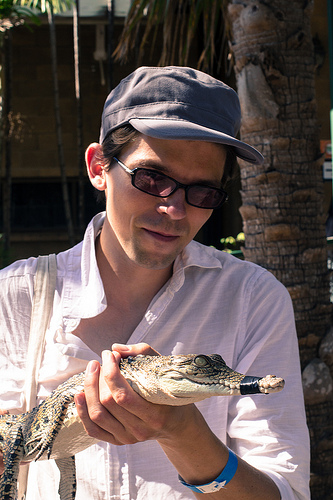
Yeshen with baby croc, photo by Natasha, Aug. 2013

Yeshen with baby croc – there’s a story

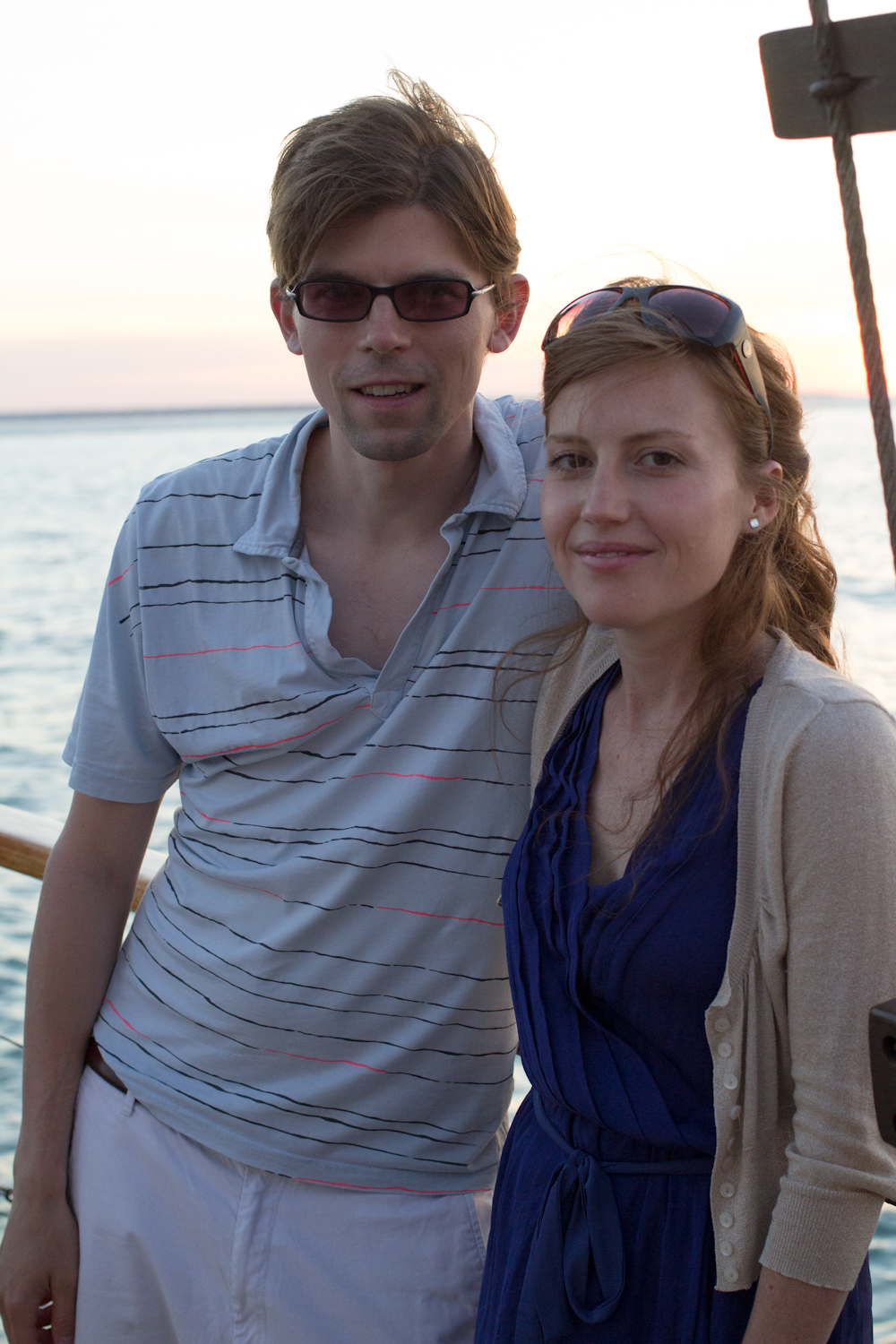
Yeshen and Natasha

Yeshen and Natasha

They were engaged this year and their August journey to Australia had been a reconnaissance for their wedding plans next July, organised by Natasha’s family, who live in Darwin and Perth.

I asked if I could share a few images from their trip. Yesh and Tash have featured on my blog before, indirectly. You’ll find them, for example, under ‘Inspiration’ or ‘Story of an Animation.’ They’re self-employed and work extremely hard, like many young people in super-expensive London, to make a living. They’re lucky being able to do creative and fulfilling work.


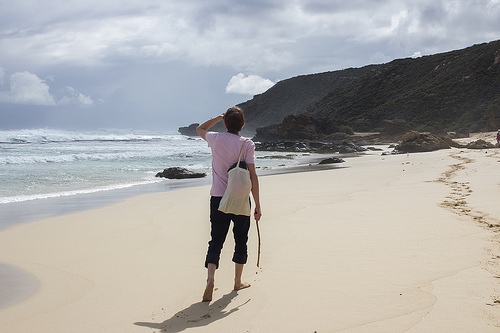
I’ve not been to Australia, and am now looking forward to this journey – you can see why.  

Australia's west coast

Australia’s west coast

17 Comments

Filed under Blog

… the mystery of thoughts …

Every child is truly switched on to the imagination. But frequently the environment belittles the imagination, and the gift can end up suppressed under the blanket of rationality. People with a strong creative drive may settle down to live in a straitjacket, and then find themselves overwhelmed by images, thoughts and associations, especially around full moon.

As a child I was intensely curious about the spaces between things, and about light. Had I not locked horns with an opinionated physics teacher I might have taken up the challenge to study sciences. Another fascination of mine was pattern repetition – how the veins in a leaf resemble the shape of a tree. And scale – how tiny bodies, big bodies, our planet, galaxies, the universe, are all reflected in each other.

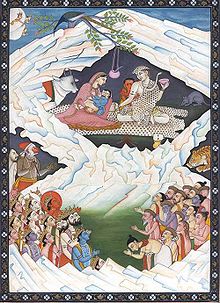
 Hindukailash, image from wikipedia.

Hindukailash, image from wikipedia.

Like Indra’s net of pearls in Vedic mythology, where the surface of each pearl mirrors all other pearls, a metaphor for the interconnected networks of mutual relationships between parts and systems. Mount Kailash is depicted here as the timeless and motionless centre of this net, housing Shiva’s family.

Not only visible structures are held together by interactive nets, our social systems, political systems, spiritual systems and the internet operate within a network. We can observe that the invisible psyche (mind) functions not only through logic, but also through aesthetics, independent of space/time, and is held by another kind of coherence – a net of meaning. And what is generated from this net of meaning is a finer kind of energy, not evidenced by present scientific methods – namely intelligence.

We knew it all along – research established that our emotional experiences leave an imprint in the cells of our body, that the brain is more than the squishy mass under our skull but a medium spread throughout the body via a network of neurotransmitters. There have been hair-splitting arguments for and against the idea that the recipient of an organ can experience personality traits of the donor, based on the speculation that each cell carries a hologram of the whole body and its memory.

Feelings and thoughts arising in my consciousness are filtered through my body’s memory. They also depend on my state of anxiety or calm, my interest, attitude and other variables, such as the weather, my relationship with the elements, with people, the collective mood, solar flares, or the constellation of planets. On some days, maybe after a meaningful dream, or a spell of mantras, thoughts are forming clearly on the breath, like reflections in a still pond, on other days, thoughts rush in on water rapids threatening to drown me, or they plod in like turtles, slow and guarded.

Objective reality is not the only game there is – what in the universe has not interacted at some point in time, irrespective of distance? Everything is linked up. Einstein called it the ‘spooky action.’

The motherboard for this wonderful instrument we call the brain, which comprises our whole body, is formed in the womb. I believe the intelligence involved in creating any specific body must lay in more than known DNA codes, must include the indeterminable non-local DNA of a spirit world. Our body foremost operates like a receiver and transmitter for as many wavelengths our radio station in time attracts or is able to tune into.

From this station, stabilized by repetition, I sort clusters of sensations and feelings, and process thoughts and ideas attracted to me from the collective psyche, a vast sea, which the individual mind must learn to navigate. Images and signifiers are coloured by whatever I consciously or unconsciously mirror and relate to.

No matter how much information we absorb, through our senses, through language and concepts, through comparing patterns, reasoning and calculation, everything, comprehended or not, will be filtered through the body’s motherboard that keeps adjusting to experiences and expanding fields of perception, fields that extend way beyond personal memory. All this information is continuously re-shuffled, as is the meaning we assign to it.

Our body is a motherboard – planet earth is a motherboard – the whole cosmos is a motherboard for a spirit we cannot comprehend, an invisible hand that touches us like a breeze, made visible through what it animates.

All we know is that images, thoughts and ideas are reflected in us. They travel via synapses in the neurons of our body, they travel on the air between minds, they travel among stars, they echo from under the sea, waving to us as plankton, they speak to us from every creature, from every blade of grass, from every stone, and they beep from within our bodies through tweaks of pleasure or pain. All matter, all people and objects we interact with store the memory of that interaction, including interactions with things we hate or nurture, and with places we live in.

We don’t invent anything, we re-discover, re-connect and re-create from the vast storehouse of knowledge and information provided to us by nature, and by the spirit between matter that makes up the cosmos, an embodied being that is becoming conscious of itself.

We are on the air, sent, programmed, radioed and broadcast, identified with all manner of things, ideas and beliefs. Yet if we look deep inside our emptiness, we know, the non-material aspects of us can potentially detach and be free, maybe enjoy tea with Shiva’s family and witness the world turn on its axis – a state some people experience spontaneously or through meditation. A state of pure consciousness not identified with this or that. In the meantime, we could at least be kind to ourselves …

‘Thoughts are beings that generate … One thought of kindness gathers a thousand beings of love and kindness around one.’            Hazrat Inayat Khan

I don’t know if a singular mind/psyche, the incredible art of a lifetime, survives the physical death of the body. Maybe a coherent individuated mind leaves a dent, an influence within the collective psyche. Like the organ of the heart, over time, achieved its definite function. But does it matter? Nothing is lost. All information is continuously re-shuffled into new forms and constellations.

Digital storage provides a metaphor – information exists and roams freely in the wind of the collective psyche (unconscious) until it is embodied and gathered towards a purpose. Every event has a consequence. Nature is exacting, but also generous, what has been repressed in the flow of evolution will always return in one form or another.

Everything alive speaks to us, and all such relationships are processed in the stories we share, stories being containers of the richest kind of information. 

*    *    *

You can source other posts on the theme of reflection in the tag cloud on the right of this page. Like this sequenc of posts: https://courseofmirrors.wordpress.com/tag/hazrat-inayat-khan/

And you might want to check out posts under the tag ‘psychology,’ especially the one on ‘awareness,’ where I share R. Assagioli’s 10 psychological laws – how the body affects the mind and the mind affects the body. https://courseofmirrors.wordpress.com/tag/psychology/

*     *    *

This post also appeared at  Third Sunday Blog Carnival: September 2013 | Third Sunday Blog Carnival

17 Comments

Filed under Blog

… a Sunday in July …

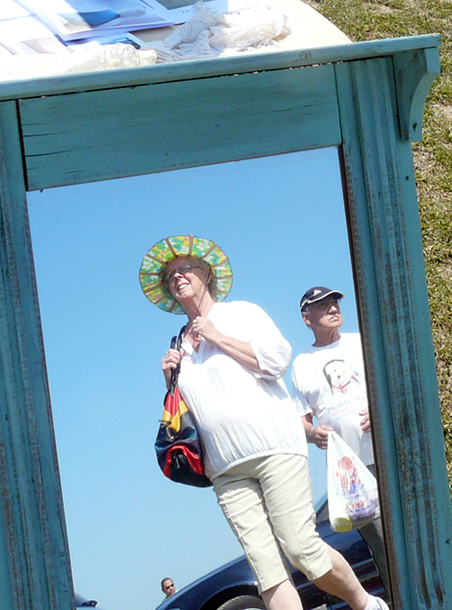
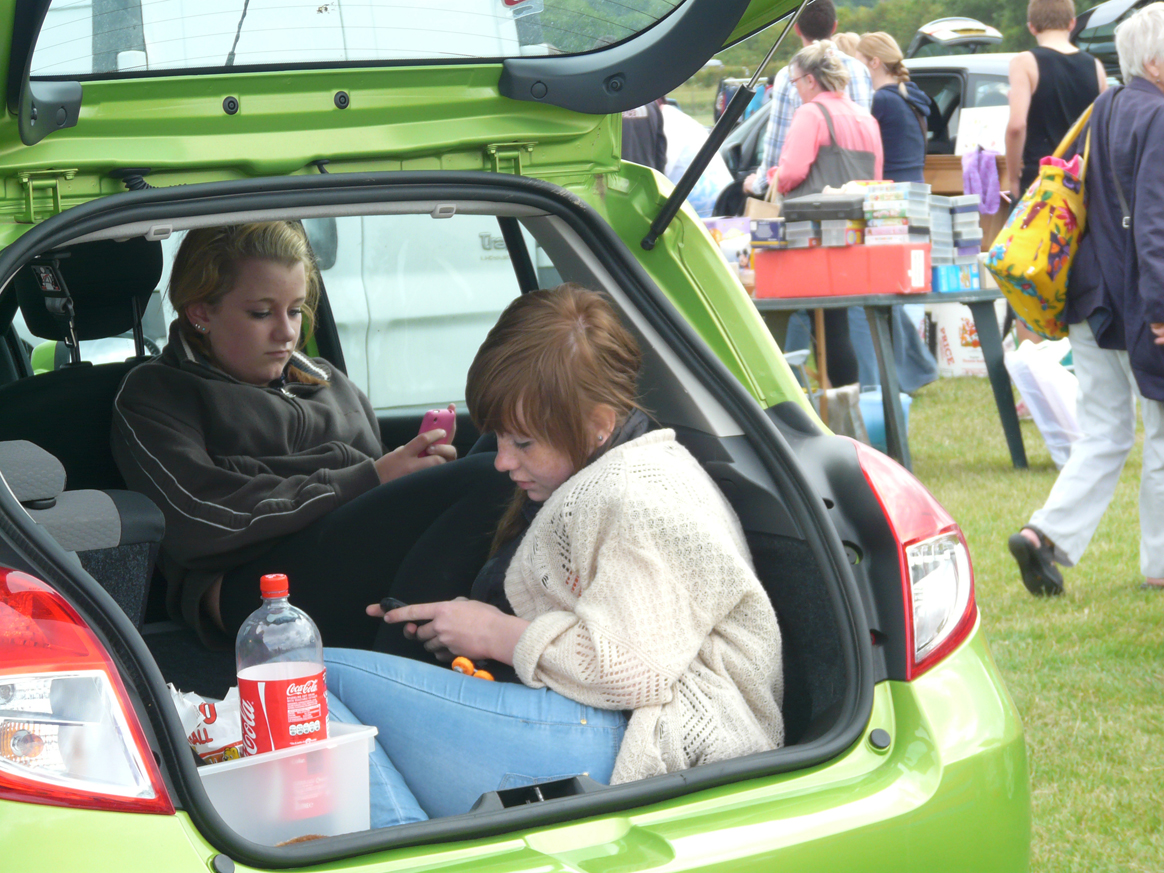
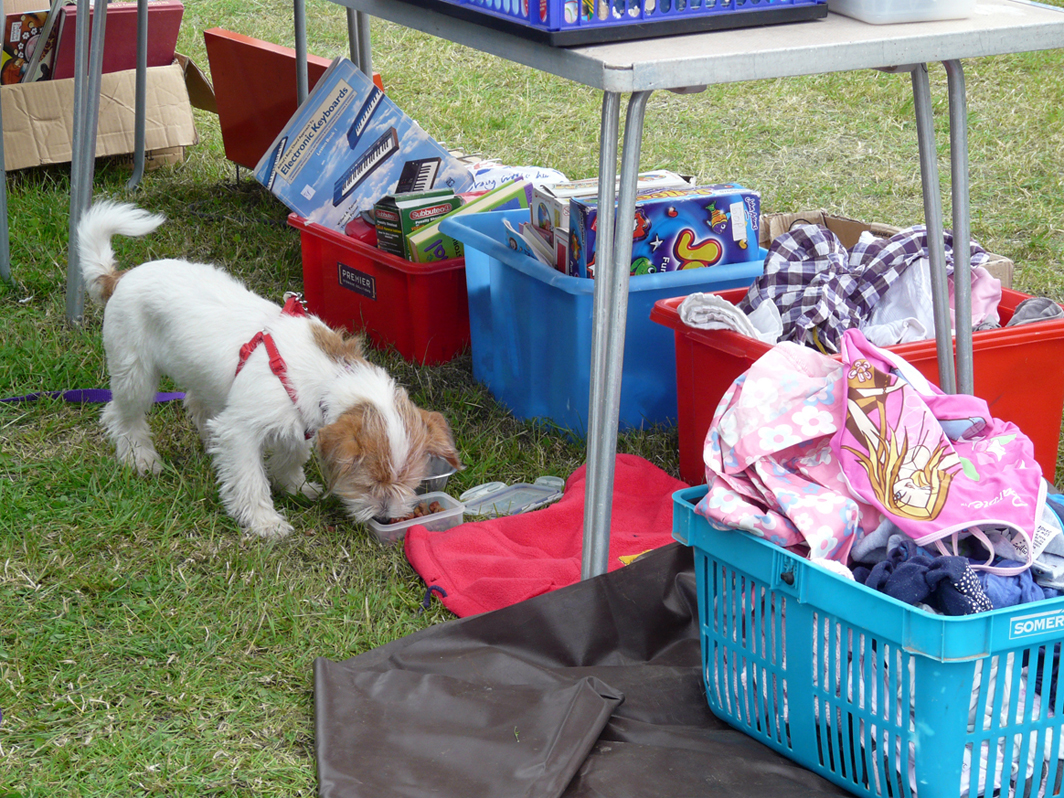
A Sunday car boot sale. Eyes swivel left, right, down, up, for value. People dream or stop to chat … how much for that? A fiver … three, two, one, or nearest offer … teddies, dolls and plastic swords, toys on wheels … she’ll love that … glasses, cables, plugs, unwanted gifts, mugs, pots, rags, shawls, jumpers, trousers, frocks, linen, shiny trinkets, books, mags, prints, discs, records, chairs, shelves, mirrors, bells, rugs, tools … objects of desire lure as metaphor … stuff … beautiful and ugly scraps, are carried off in plastic bags.

P1110274

Carboot 3


Carboot 1People, thin and fat observe each other, nod or shrug shoulders, roam … ladies walk stately in big hats, toddlers run off, sunburned babies sleep, bored kids tweet or text, dogs strain on a leash or are fed, men with tattoos strut, a batman rises from the neck, geometric arms, flowery legs, stars form a line down a spine …

Leaving the cross currents of the human aspirations, I retreat …

P1110278 - lowres

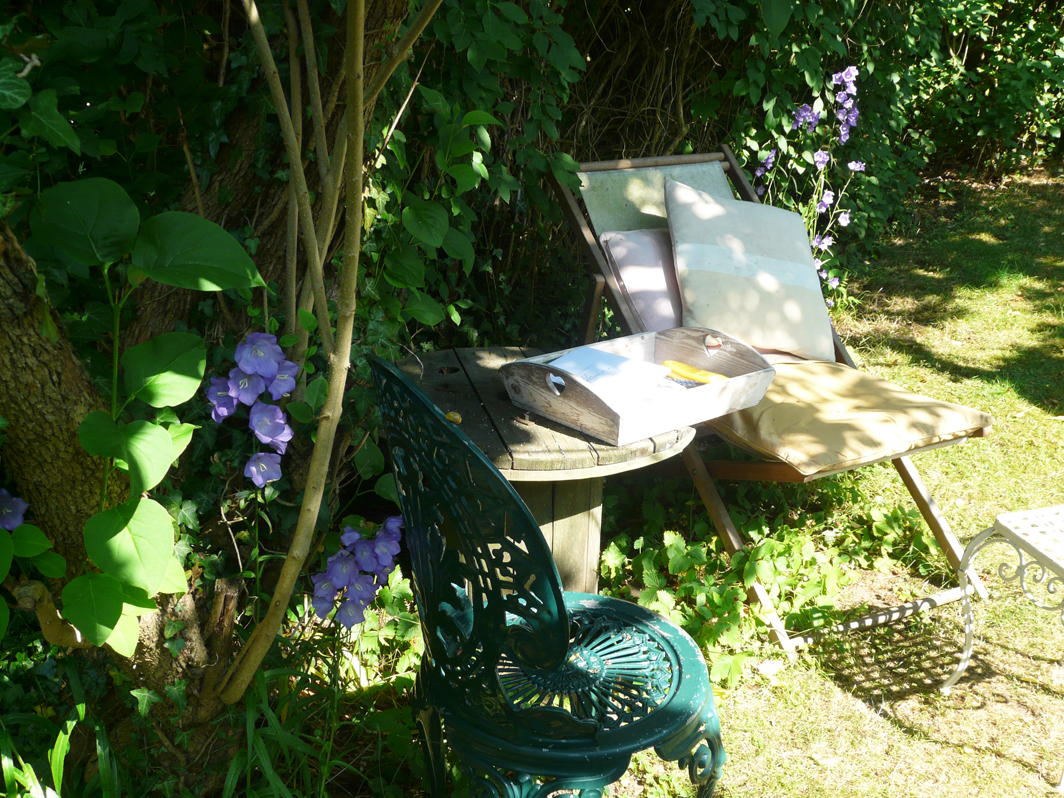
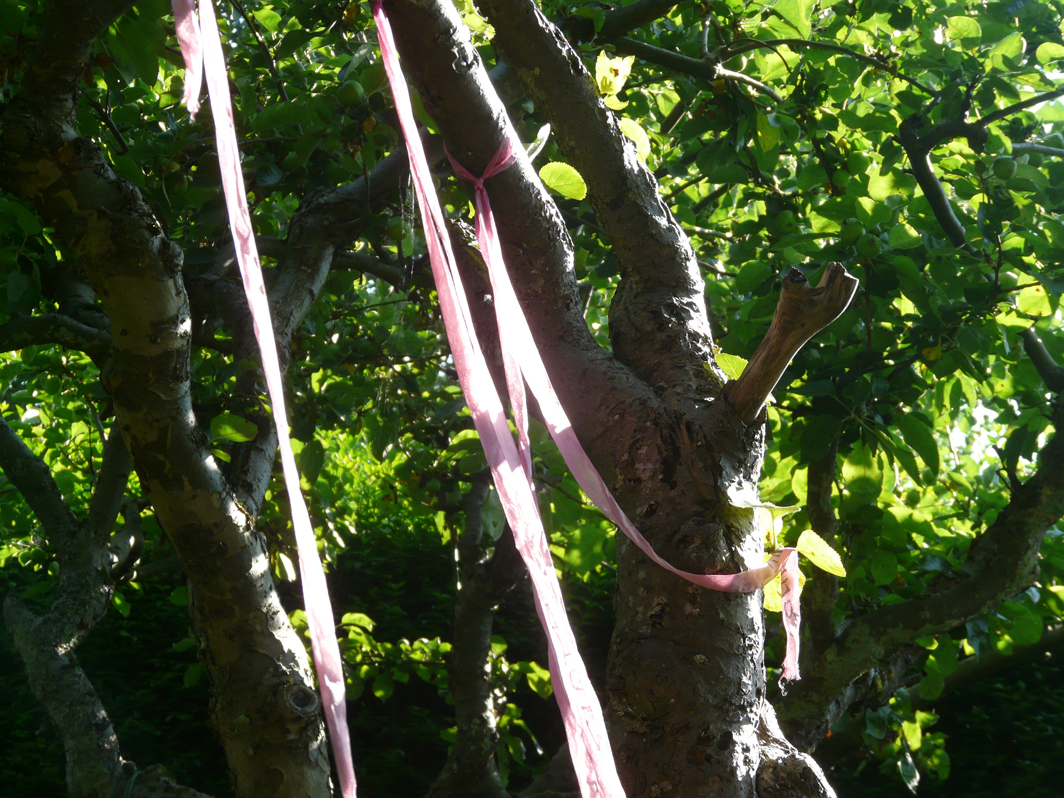
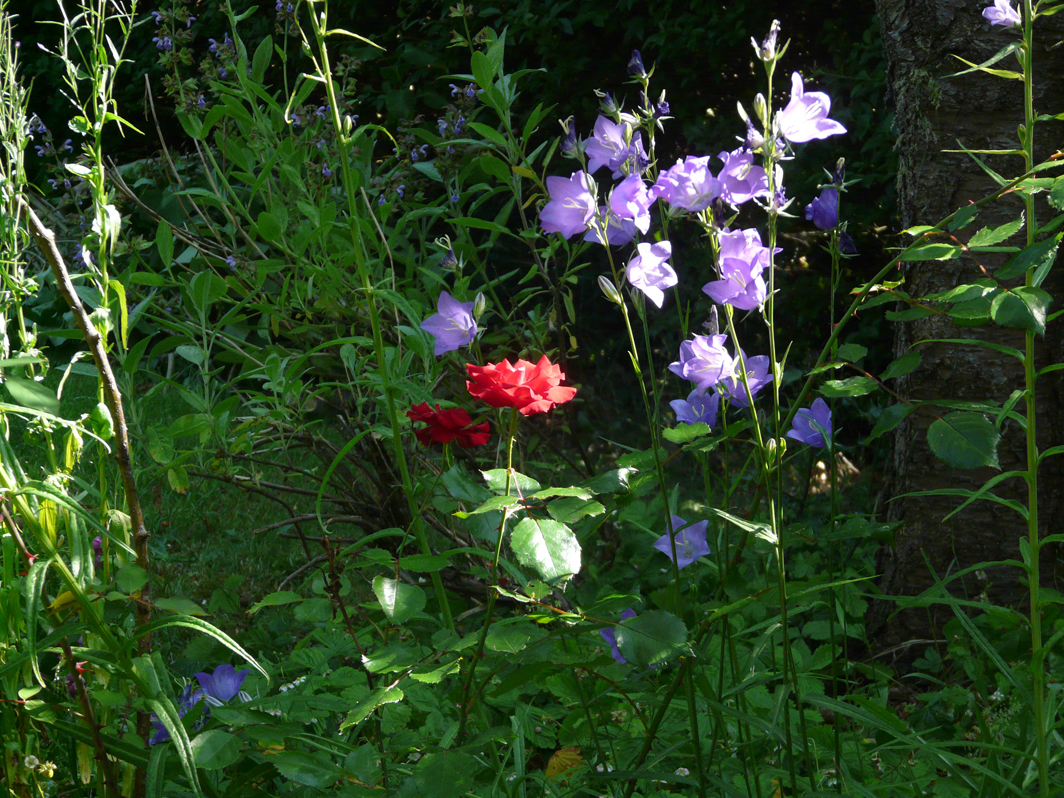
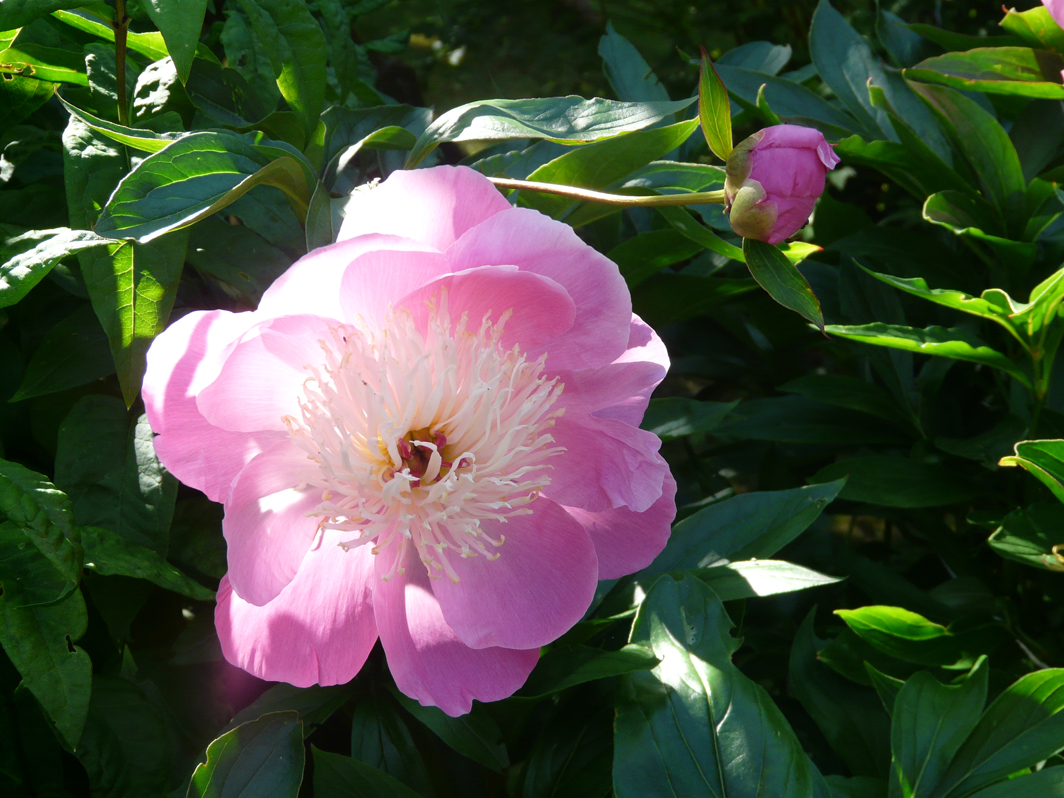
back to my peaceful patch, where ribbons flutter in the breeze, endowed with wishes. Colours glow with life, ever changing. And simplicity affords my gaze inside – through the gap of nature’s light and shade.

P1110284 lowres


P1110279 - lowres


P1110291 lowres


And later that night I watch the wide screen … tragic accidents, people fighting for what they presume right, trapped in beliefs, and, oh, Andy Murray wins a tennis match for the UK, and is glorified as UK’s knight.


20 Comments

Filed under Blog

… snow and silence …

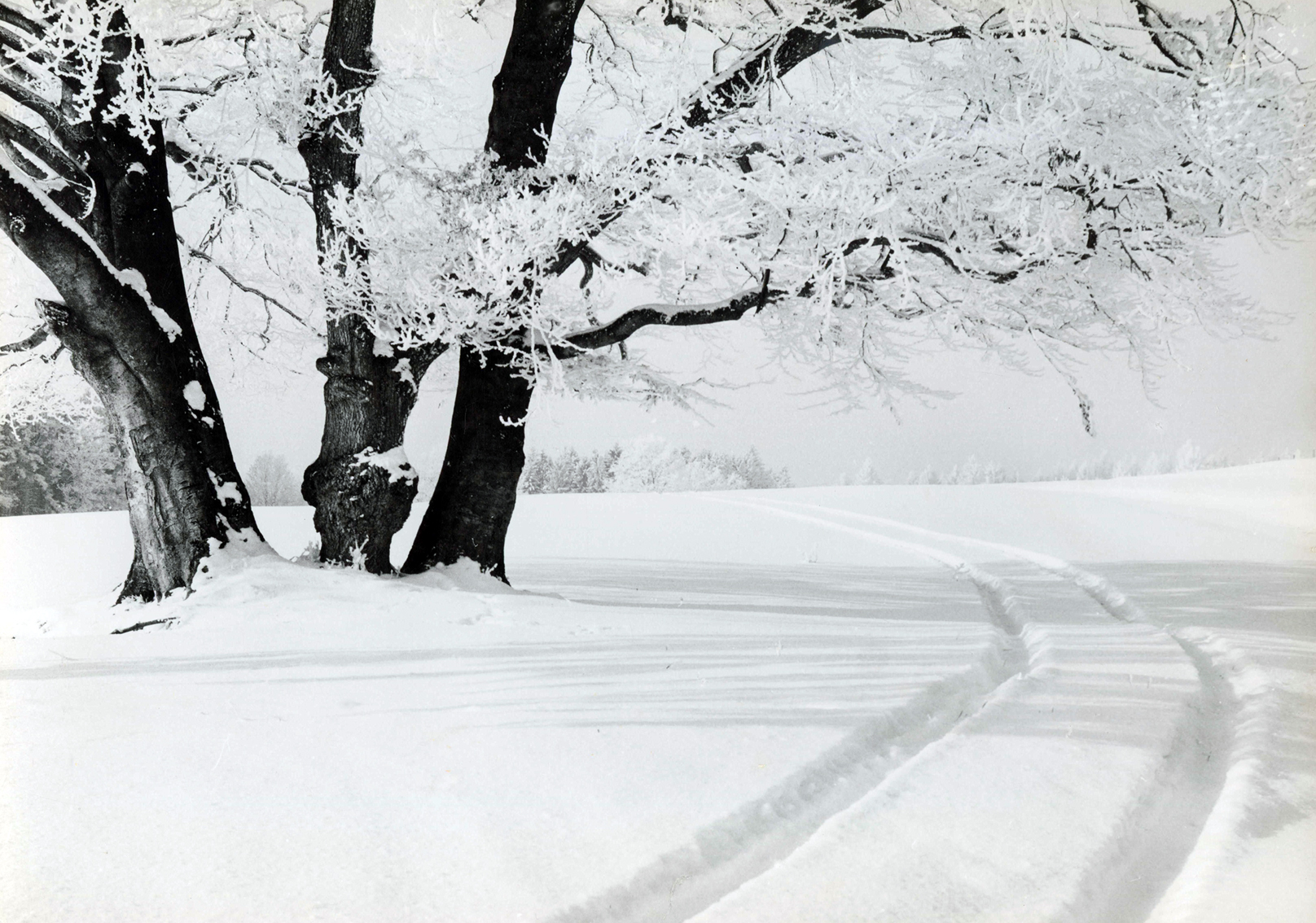
Snow is a miracle that touches a deep silence in me, a silence I cannot speak of well – words seem wanting. And still I try, as many of us continue doing in various ways.

We may share the banter of our lives, our witty observations, our advice, our humour, our existential pain, or we may reach out with a warm hand of reconciliation. I do all these things, at times, but underlying my often competing voices, I tend to channel my experiences into the roaming eye of future becoming. If friends misread me, I like to console myself with this Ralph Waldo Emerson’s quote –

Nothing is at last sacred but the integrity of your own mind.’ 

Each one of us has unique perceptions, and there is enormous inspiration and joy in our differences.

P1110081

So much for the still sphere snow touches in me. The other miracle about snow is that it draws my attention to the surreal nature of reality, highly sensuous, yet stripped of  bright colours and removed from habitual seeing – to the bones of shapes, to deeper gestures and essences. For me, a snow-covered scene is a metaphor of restraint that slows down or speeds up time to alien levels of dimension. It occasions one of those time-independent spheres, where I make pattern-connections and create new meaning.

A simple poem follows my thoughts on the miracle of snow.  I tried to limit myself to  5/7/5  Haiku count, and hope it delights:

in silvery vaults

an angel ruffles her wings –

a leisurely shrug –

Grass and snow, low

the sparkle begins –

slipping from her hand as a

powdery shower

of crystalline downs –

feathery light on the silence

hidden between breaths –

fine gauze swirls and drifts

across the tired features

of a dreaming land

to drape every

plane and angular slope in

white geometry

Snow-tracks, 2 low

My appreciation for the geometry of life resonates with my love for black & white photography, see two posts back:

https://courseofmirrors.wordpress.com/2012/12/31/the-inner-silence-of-henri-cartier-bresson/

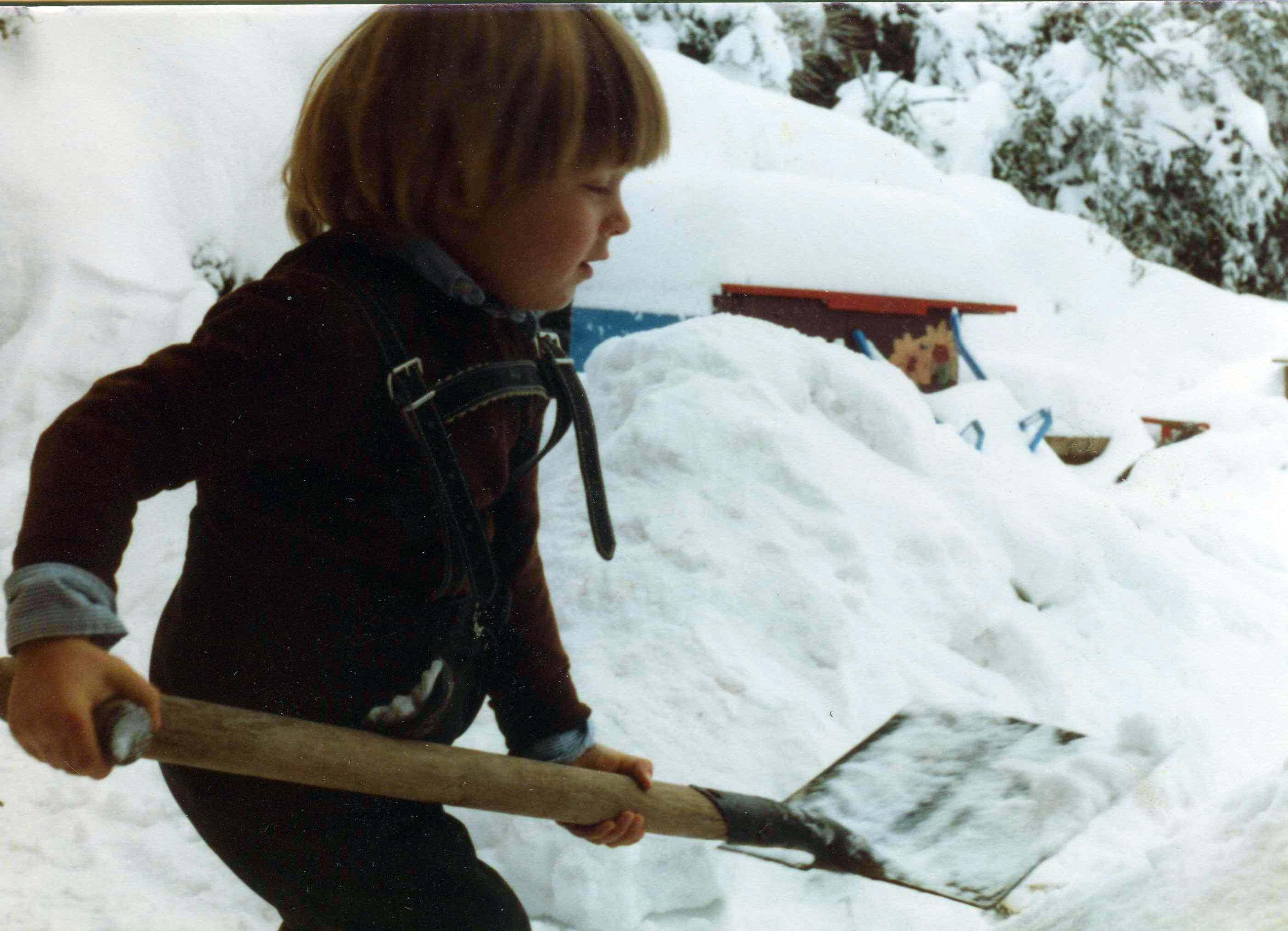
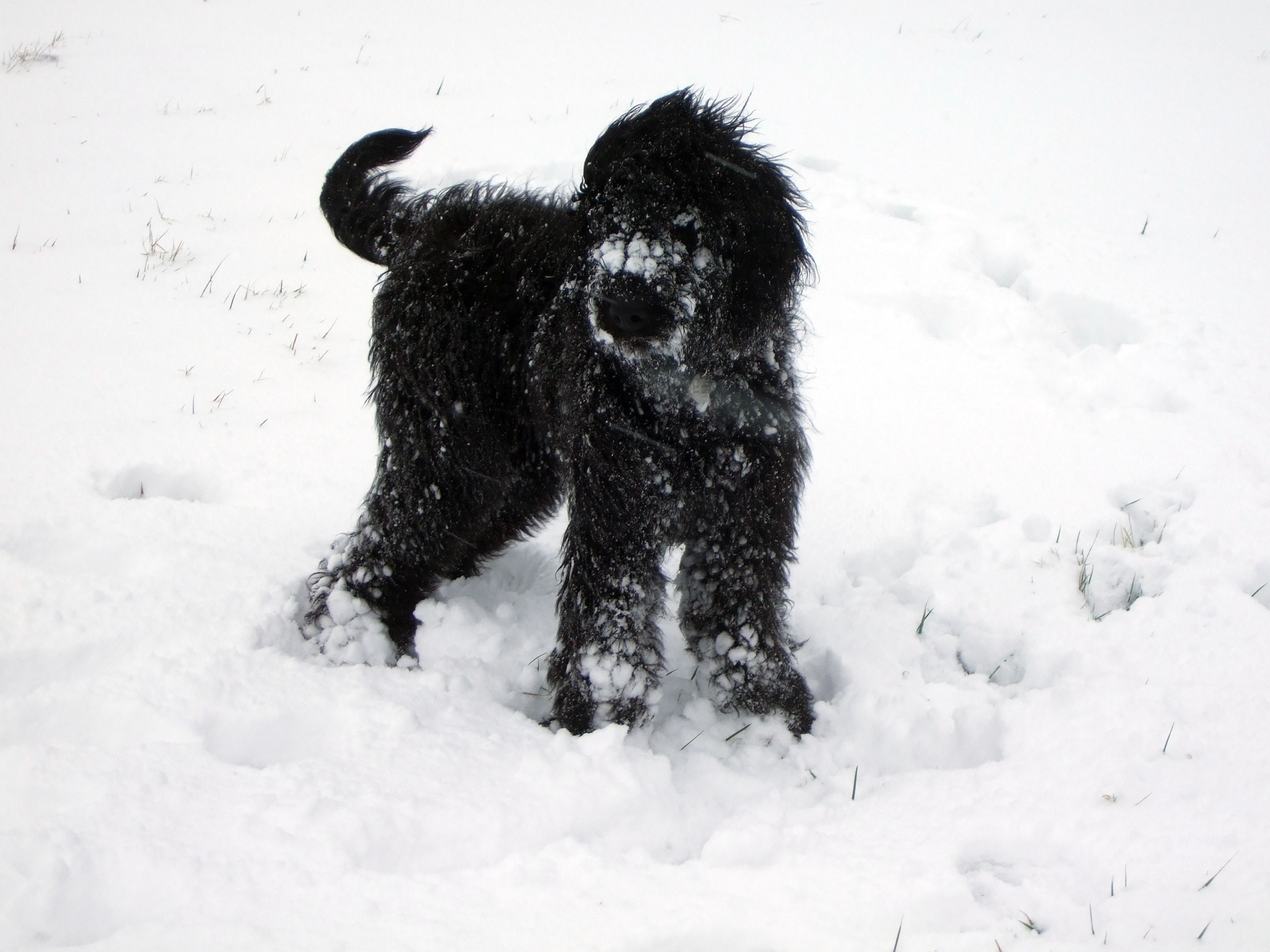
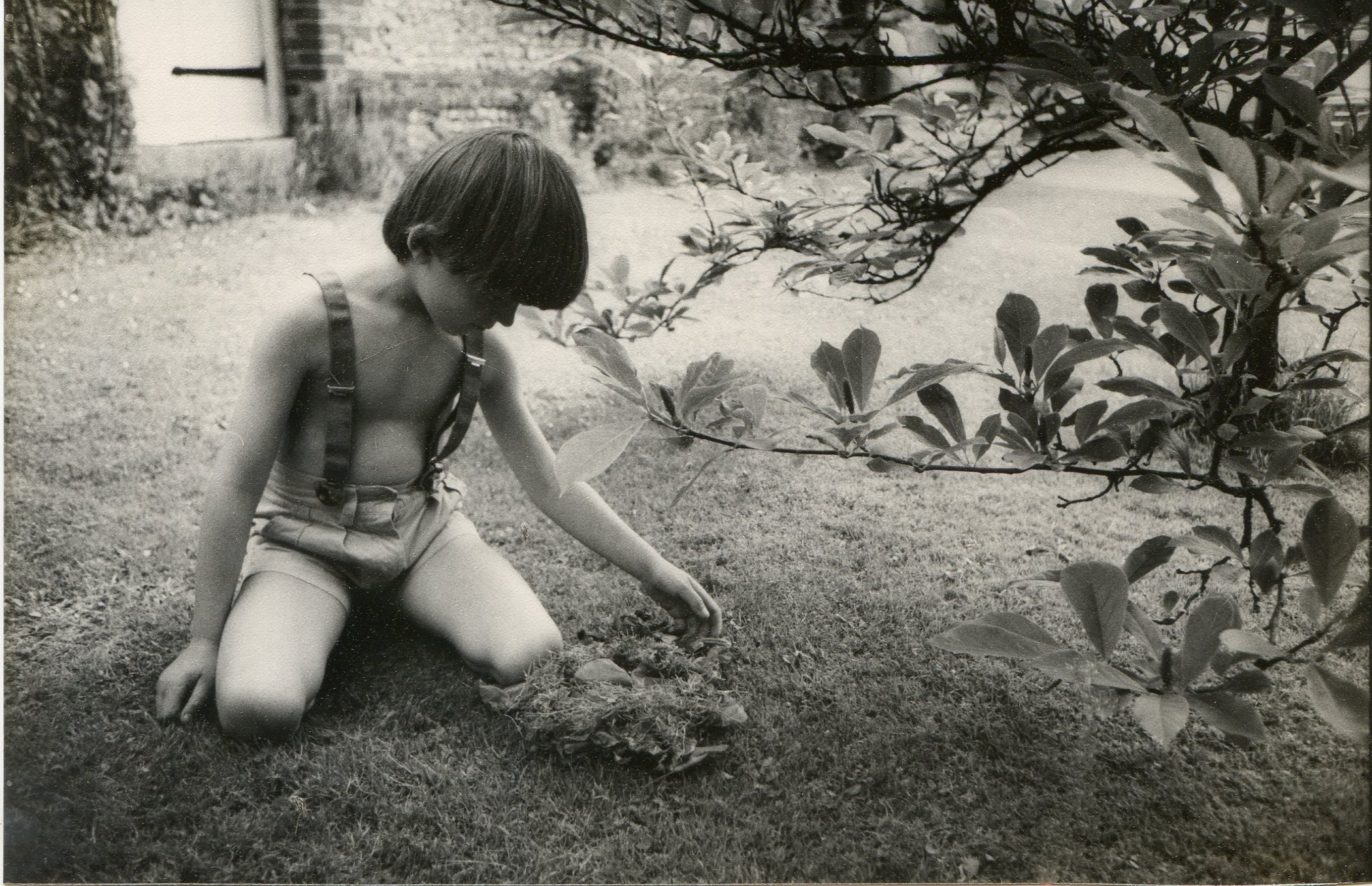
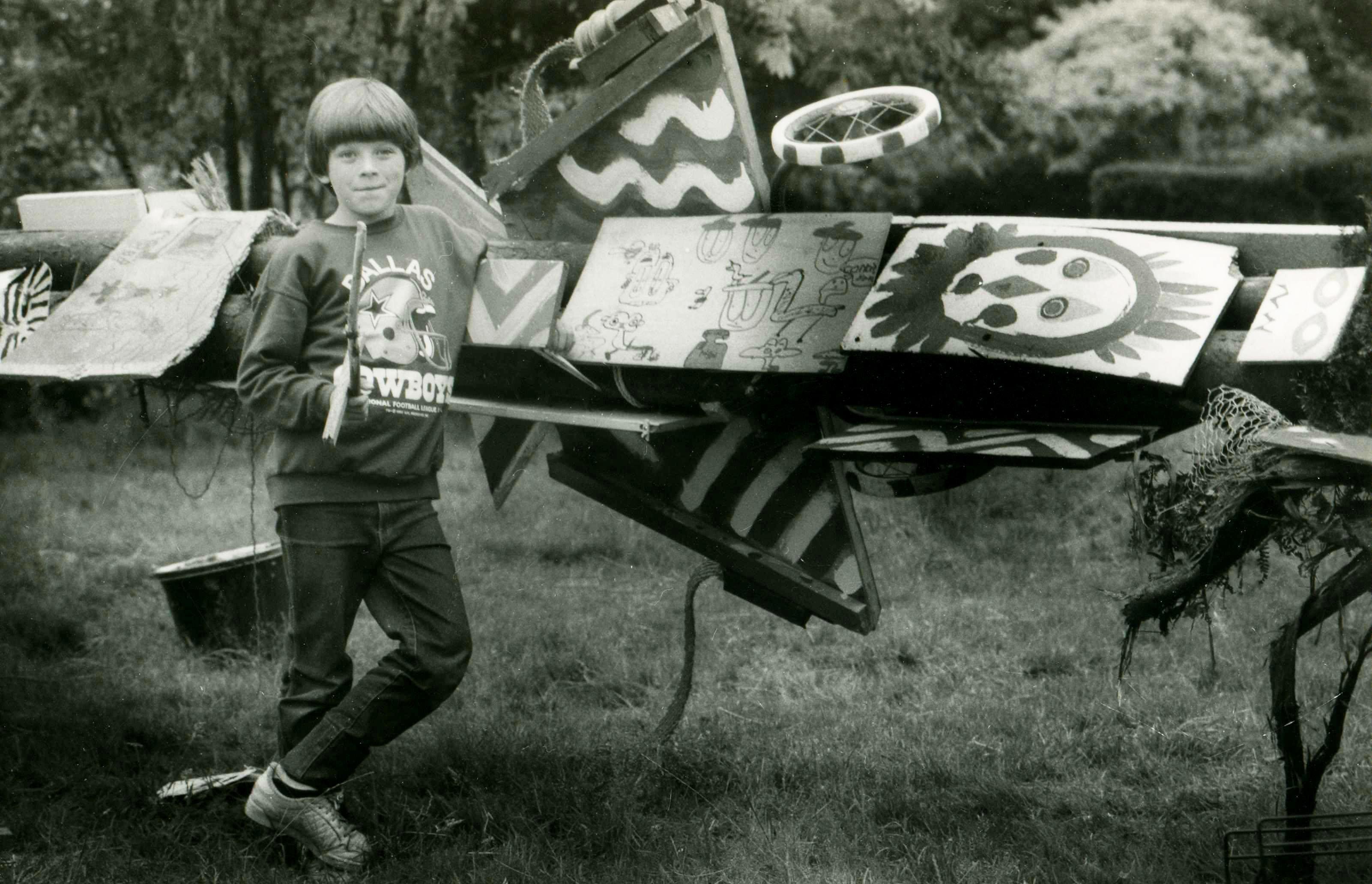
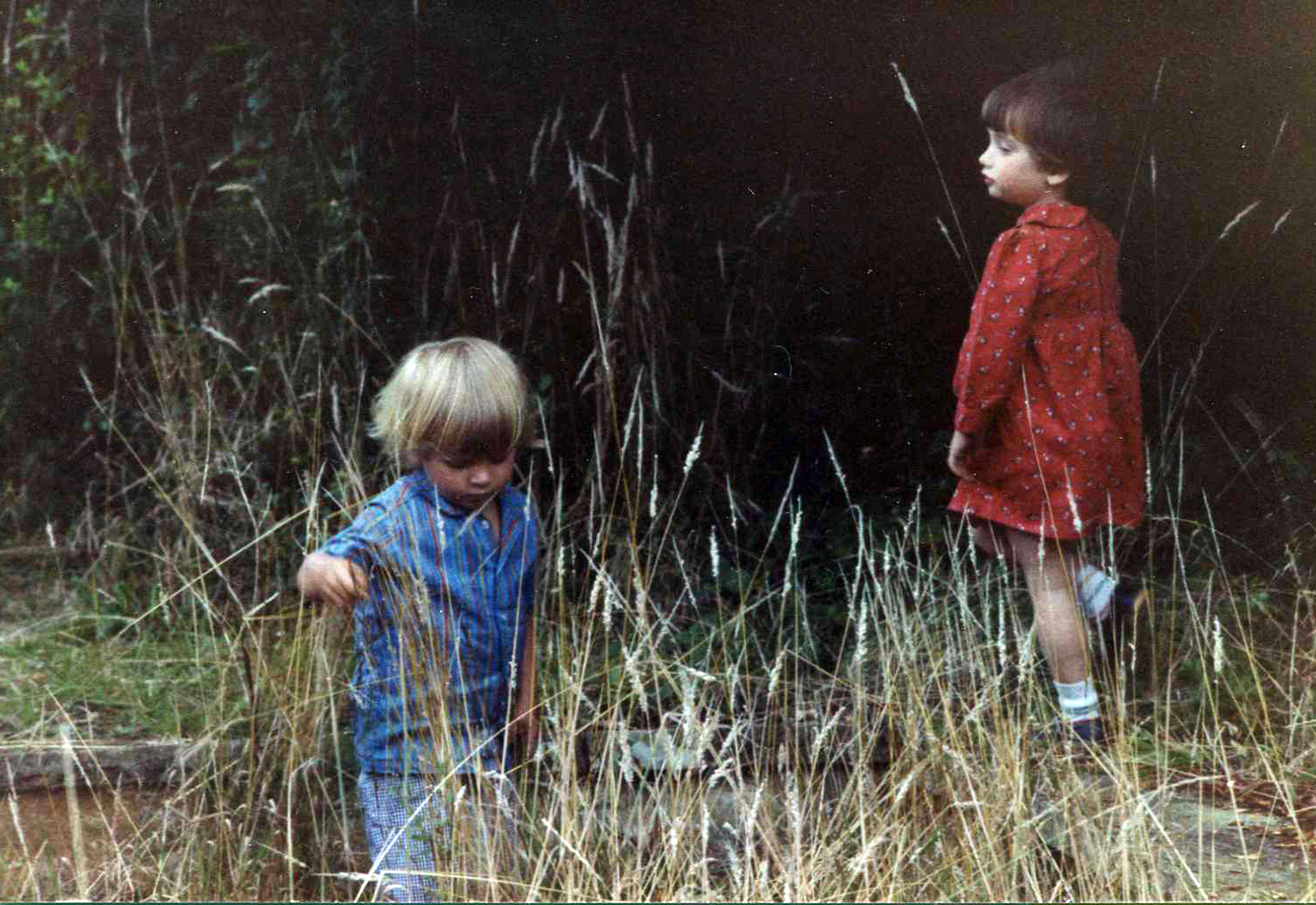
There are other pleasures to be had from snow, as my enthusiastic and capable son demonstrated in 1982 Somerset, and as the adorable puppy of a friend of mine discovered in Dorset yesterday.

Yeshen shovelling snow, 82

Susanne's puppy

16 Comments

Filed under Blog

… erotic charge of flawed characters …

Literature thrives on flawed characters. With the sinister Heathcliff in Wuthering Heights, for example, Emily Bronte tapped into the shadowy aspect of masculinity.

C G Jung calls the latent masculine within women the Animus. Both in its light and dark aspects, this archetypal blueprint can put women under a spell.
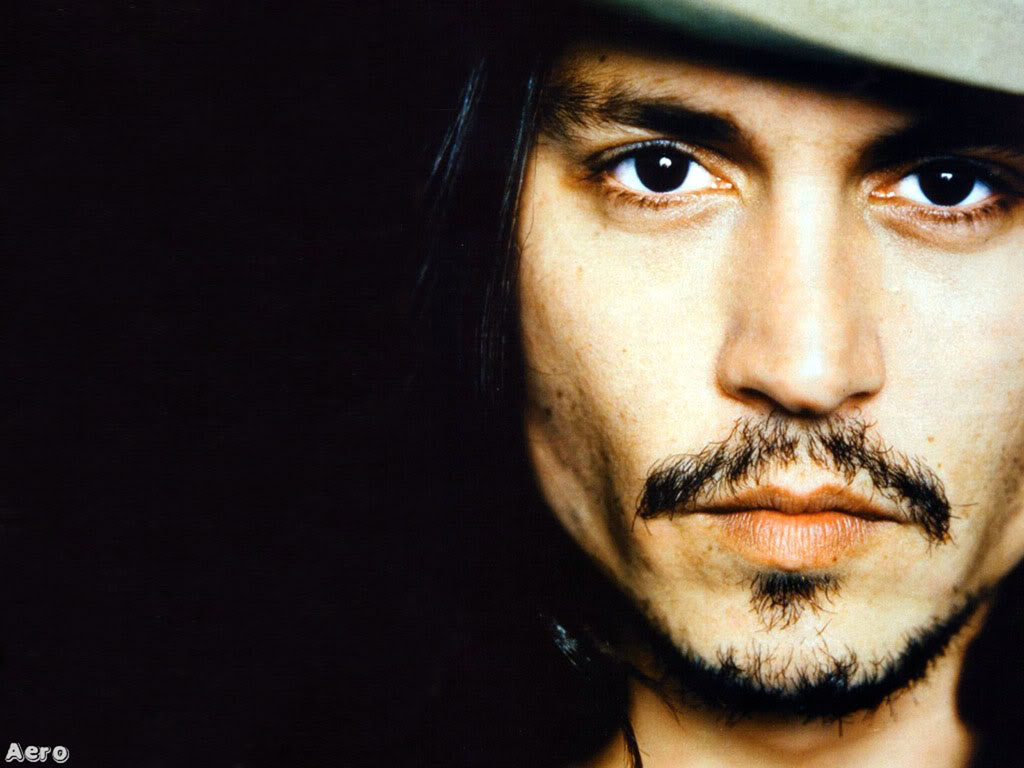
I can see Jonny play the disparate twins in my novels :)

I can see Jonny play the disparate twins in my novels :)

Equally, the latent feminine potential within men, the Anima, can evoke both, the guiding wisdom of Sophia or the dark erotic charge of Medusa, causing tremendous fear of nature and its awesome power.
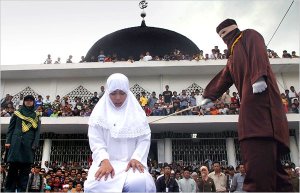
Rather than using the image of a femme fatal, I choose to show what  fear of the feminine inspires in some cultures.

Rather than using the image of a femme fatal, I choose to show what fear of the feminine inspires in some cultures.

Our irrational attractions can be sparked and coloured by the parent of the opposite sex. Like a woman with a brooding and unapproachable father may have to kiss many frogs before she discovers the prince inside, while an idealising father can trap his girl in vacuous fantasies. And the boy of a manipulative mother may develop resentment or idealisation for women, or both in a toxic mix. What we tend to project onto the opposite sex is however deeply sculpted by a collective archetypal storehouse of experiences with dual aspects. Paradoxically, this storehouse is also the source of our most powerful experiences and innovations. Whether in a life-giving shape or a dark and petrifying shape, either way, the Animus and Anima hold a numinous fascination until their autonomous grip on us emerges into awareness, becomes conscious, is redeemed, turns creative and makes us truly human.

In my first novel, Course of Mirrors, my protagonist, Ananda, is torn between two disparate men, twins. The theme continues into the sequel – Shapers – with higher stakes in another time zone. In the excerpt below, Gart is rescued from a dangerous impasse by a trickster and transported into the twentieth century, where he meets the story teller and myth-maker, Cara.

*     *     *

Short excerpt from chapter 12, Shapers

Back in Derrynane

Five hundred years back, at the Kerry peninsula, Gart pondered how he came to sit at this familiar coast, under a dull sky that matched his mood, the sea before him rolling and spitting at his soiled boots. It was the trickster’s doing, of course. He did not thank Zap for transporting him back here, where an old crone had hexed him and a group of weird artisans had made him look like a fool. Yet it was here that he first met Mesa, who he now pined for in his bones. He must get back to Rhonda and outdo Crim. And Leo must be terminated, since he had obviously gone mad, and courted disaster if he planned to control Rhonda’s army. The Governor of Guardians, ha, they despised the fat man. It was him, Gart they followed.

‘I messed up,’ Zap acknowledged, stretching on the wet sand nearby and cracking his joints. ‘Forgot, I can’t activate coordinates for the hub, and this happens to be the only other place we’ve been in together before. I had little choice. ’

‘You’re not so bright after all, are you?’ Gart grunted.

‘At least we’re not consumed by noxious fumes of our own making. Best not dwell on the past.’

‘We are in the past, eejit.’

‘Local slang, eh? You’re a fast learner. You score a point. Zap jumped up and ran a circle of cartwheels. ’Let’s go up to the estate, see who’s there.’

Derrynane estate looked deserted. ‘Nippy air on the plateau,’ Zap said, ‘you would’ve thought they’d light a fire, but not a whisk of smoke from the chimneys.’ The men slipped through the narrow gap between green-smothered walls, the two dragons, Zap recalled, though now their shape was lost under rampant ivy. The yard, empty of dogs, cats, geese or horses, had a silver car parked near the main entrance. Zap whistled, ‘Flashy design, time’s moved on since we’ve been here last.’

Gart’s heart lurched at the sight of the woman appearing in the porch.

‘Hi,’ she said, ‘do I know you? You’ve been here before, haven’t you?’

Zap, in Shaper style, put a hand to his heart. He too recognised her, though she had turned into a mature woman. ‘You’re Cara, I remember. Where’s everybody?  Saki, Anke, Mushki …’

‘Oh the troupe, goodness, that was years ago. When Gutch and Craig joined them they hit the road together. I think they operate from a place at the English coast.’

‘And that witch?’ Gart wanted to know.

Cara gave him a piercing look. ‘You mean the oracle of my mentor, Tilly. She has sent me here, for a retreat. I only just arrived. I plan to spend some time writing on my story of Mesa.’

‘I hope the story includes us,’ Zap said, we’re friends of Mesa.’ He shot a glance at Gart, whose mouth opened and shut in confusion.

‘You better come in.’ Cara’s scalp tingled. This must have been what Tilly had had in mind, to process the strange occurrences from so many years ago. ‘Zap and Gart, is it?’ Like Tilly, they hadn’t aged at all, while she herself had gained ten years. To mask her excitement she whizzed around the kitchen. She stacked kindling in the cooker, emptied her shopping into the fridge, plonked bread and cheese on the table, put a kettle on, fetched plates and cups and cutlery, all the while feeling Gart’s eyes on her. She told her guest about her life, her journeys, and studies. Zap helped with arranging the table and kept nodding, eager to hear all she had to say. Cara only tried to gain time to collect herself before she was ready to ask the questions pressing on her mind, about Sax, about Rhonda, about Mesa.

‘Shall I get logs?’ Zap asked sweetly.

‘Oh yes, please. I was planning to camp in the cottage, but we might as well get rid of the chill in the big house. The cooker is attached to a central heating.’ She watched Zap walking out with a basket, charmed by the ease of his manner.  Gart made way for Zap but did not offer any help. Rooted to one place since entering the kitchen, he resumed his position, leaning casually against the door frame  Now they were alone Cara couldn’t avoid him. Their eyes met. She blushed. He had followed her every movement with an air of aloofness. A hint of curiosity sneaked into his eyes.

‘I look like her. Is that it?’ Cara said.

‘In a way.’ Gart moved towards the table and pulled out a chair to sit on. ‘What happened to your lover, Dillon?’

‘We split, went our different ways. He had his quest.’

‘What quest?’ Gart asked. The term perked his interest since Oruba had called his underground journey a quest.

‘Not my tale to tell. He may have found whatever he was looking for.’

Zap returned, groaning under the heavy basket of wood on his shoulders. He piled logs over kindling in the cooker and neatly stacked the rest against the wall before he went to get another load. Cara lit the fire. Gart, intrigued about her remark regarding Dillon’s quest, struggled to grasp what precisely intrigued him. He scratched his ear, as if hoping for a message. He resented how confusion undermined his confidence. The kettle whistled. To snap out of his dazed state, Gart got up to pour the boiling water over the coffee in the percolator Cara had prepared. ‘Thank you,’ she said, surprised. When Zap returned they settled to a meal. It was Cara’s turn to ask questions. Intermittently Zap fed the fire and they moved from coffee to drinking wine. The story Cara was so eager to hear unfolding was punctured by heated disagreements between Zap and Gart.

‘Some names have changed, but I recognise the characters.’ Cara said, jotting down notes, pen hot in her hand. ‘I thought they’d outlawed weapons in Rhonda. Where did the laser guns come from?’

Gart said. ‘Leo must have raided the Archives. Everything from ancient pasts is stored in the pyramids surrounding the archives – and there maybe catacombs under them. I know this because Leo let it slip once. ‘The man’s a danger to Rhonda. I’ll put an end to him.’

Zap shook his head. ‘Killing Leo, and start a war! Use your imagination. He turned to Cara. ‘If you’ve a say in this story, keep this man away from Mesa. He’s murdered in the past, he can do it again. Mesa deserves better.’

Gart pushed back his chair and sent it cluttering to the tiled floor. He stormed from the kitchen. Cara felt the hurt pride under Gart’s rage. Zap crunched his fist and stared into space. Fiercely protective of Mesa, he had clean anger under his pain. ‘Please keep the fire going, Zap, there may be frost tonight. I’ll talk to Gart,’ Cara said. And she knew where to find him.

The sky had cleared towards the horizon. Beyond the yard, the autumn breeze picked up, biting through Cara’s light coat. She saw him standing at the cliff, looking towards the faint silver band that now divided sea and sky. A diaphanous layer of cloud screened the late sun, against which Gart’s lean body looked delicate, like a feather drawing. Why had she invested her story with two lovers, men who did not see eye to eye, men as different as Assisi and Caligula?  He did not turn to look at her as she stepped close to him. He did not move at all, his mind had wandered off through time’s veil, searching for Mesa, no doubt. ‘You see,’ Cara said, ‘once we have given life to something we can’t control it, we can only try to influence an outcome with truth, which is not always in tune with our wants.’

‘I don’t understand.’ Gart finally met her eyes. ‘You created this damn story. Whose side are you on?’

‘Truth is hard to discern, its meaning is held in another reality, where on-going myths are spun. You became part of my story because you walked into it, in a most brutal and controlling manner, though it wasn’t entirely your fault. Does the name Batin mean anything to you?’

Gart felt a stab of fear, but quickly shrugged it off. ‘I think I met a ghost of that name.’

‘How your path unfolds depends on your engagement with what you attract. It’s the same for me, but in addition I’m recording fates, yours, Leo’s, Zap’s, Mirre’s, Oruba’s, Mesa’s, Crim’s… ‘

He cut in. ‘Crim’s one too many.’

Cara sighed. ‘I care for all of your fates, they affect me deeply.  My feelings swing about, gyrate like a weathervane does when it storms, which should kind of answer your question. Right now, as I stand here next to you, sensing the pain you can’t quite admit, I’m on your side, but my alliance can change, from moment to moment, from day to day, from chapter to chapter, since like you, I’m compelled by this quest for truth.’

‘Truth again …’ Gart’s lips curled and broke into a devastating smile. ‘Tell me this then – why does Mesa look like you?’

Cara swallowed her shock. He had touched on her core identification, revealing her disparate affections, the turmoil she experienced between the two types of men she was enmeshed with across time, of whom one now exploited her vulnerability, took complete possession of her with his eyes. And faithful to his nature, he relished in the conquest. Cara’s heart quickened. From deep inside her body she felt his pull, as if by a rope. His seductive power made her tremble. Yet she knew he cared only about himself. And coerced by her divided nature, her concern instantly switched to Crim.

*    *    *

If you’re not familiar with the concepts of the Shadow, Animus or Anima, the Wikipedia pages can serve as introduction.

http://en.wikipedia.org/wiki/Shadow_(psychology)

http://en.wikipedia.org/wiki/Anima_and_animus

And anyone who has never heard of Joseph Campbell – this book is a must for writers.

http://www.amazon.com/Thousand-Faces-Collected-Joseph-Campbell/dp/1577315936
2 Comments

Filed under Blog

… the shock of disorientation – the unknown …

Change is the only reliable constant. I sometimes wished I could pledge my life to a convincing reality. For me, what is derived from facts or beliefs in our culture often lacks a vital ingredient – the acceptance of the continuous process of harmony unfolding from cycles of necessary chaos – so I watch the river flowing and imagine stories and create worlds.

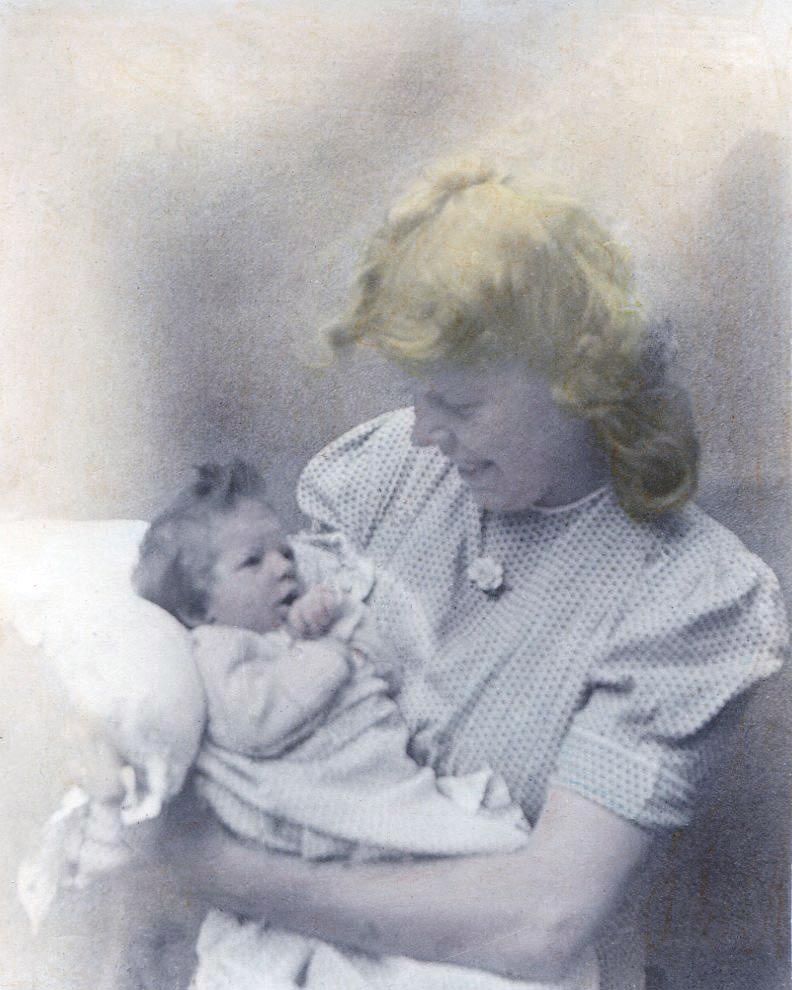
four weeks old

Though my childhood had its trials, I was lucky to be held during my early years, both physically and metaphorically, which gifted me with a sense of basic trust, a right to exist, a right to question, and a playful irreverence. Maybe this is why my little wisdoms play with facts and beliefs, dust the inner mirror, value what is emerging, the ever higher level of coordinates of truth and beauty, like a trajectory of the love I received.

For someone not held at birth, change can be dreaded, or seen as a means of escape from an unsafe environment. What we all have in common, is a longing for sufficient containment, and periods of relaxation.

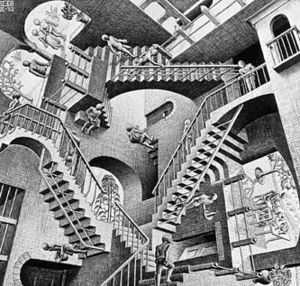
Some years ago, I walked up the stairs of the Social Services centre where I worked. The building had two sections of offices that mirrored each other in design, with exactly the same stairway on each side. A lift in the middle accesses both sections. Being lazy, I usually took the lift up to the third floor, though I liked to take the stairs down on the far side. On this particular day I wanted exercise, and time to ponder a logistic problem. Steeped in thought, I headed for the staircase in sight. Arriving at my floor, I entered the office with its familiar layout and was hit by a sense of total disorientation. Wrong, all wrong, on my desk sat a row of bright, fluffy soft toys, not the company I had round my computer. In a split-second I noticed other irregularities, the quality of light – a smell of heady perfume. The entire atmosphere in this office was alien, the wrong music – alien to my expectations.


M. C. Escher

First thought – I must have time-jumped, returned from the past – my mother often marvelled at my vivid imagination. More laser-fast thoughts – perceptions are tenuous and dreamlike reality is self-made and its boundaries are fragile. Calling in episodes of lucid dreaming, my fear switched to wonder, until I grasped the situation. With my thoughts dwelling in abstract orbs, I had walked up the wrong set of stair, expecting to see my desk, which was however in the other, mirror-part of the building.

Being sandwiched between two realities, the expected and the unexpected, the cognitive familiar and the unknown, tends to cancel time for an instant, long enough to escape the compulsion of identifying with objects or thoughts. Shocked awake, the mind is free and spacious, a delightful state.


Disorientation, if tolerated, can bring a sudden glimpse of unidentified consciousness in action.

Not discounting trance and meditation, or the vast variety of personal experience – mind and body work in synergy if we loosen up our ideas and learn to relax. In synergy the combined intuitive intelligence of body/brain and the collective mind brings us into resonance with a reality beyond our comprehension – the reflection of a universal order. Not a miracle.

As a child I once dived into a swimming pool. The brilliant sky was of the same blue as the tiles that lined the floor and walls of the pool, which would have been fine had I not opened my eyes under water – the blue world overwhelmed. I lost all sense of direction and panicked. With no way out, I instinctively shut my eyes, which calmed my racing heart and allowed my muscles to relax. My body naturally floated upwards.

I later learned, during experiential Sufi practices, that apt intentional exposure to situations depriving us of habitual coordinates, can prepare us to face change, the unknown, with less stress and more equanimity.

Have you had moments of disorientation – even if it was putting a cup to your lips expecting coffee and tasting tea?

*    *    *

The theme of ‘disorientation’ came up after recent posts by a blogger friend, Joe Linker (see blog roll), on Buckminster Fuller – his thoughts on synergy are powerfully relevant today – http://en.wikiquote.org/wiki/Buckminster_Fuller

… We are now synergetically forced to conclude that all phenomena are metaphysical; wherefore, as many have long suspected — like it or not — ‘life is but a dream’ …

Buckminster Fuller

So we might as well dance … http://www.youtube.com/watch?v=pXpaI5IMQsg&feature=related


13 Comments

Filed under Blog

… imagination …

From its fountain, the psyche pours compositions of light and darkness, images shaping the natural elements that engender our sensual experiences. Countless composite images trickle through our mind. Do we pause to ponder which to let pass, like dry leaves floating down the river, and which to absorb deeply into our heart – and give life to?  

The images we energise are re-envisioned and re-told through our perception. Nature spirits, archetypes, monsters and fairies, heroes and villains, deities, gods, devils and angels, the dark unknown – mankind’s entire mythical landscapes are encapsulated by the imagination and affect our everyday life.

Through this phenomenological process we discovered language, numbers and geometry, tools that potentially enable us to re-create nature. Some scientists maintain that matter constitutes the real and all phenomena derived from nature’s building blocks is not real. But deep inside we know … our search for the world we intimately desire attracts to us enlightened scripts. Through trial and error we learn to apply these scripts, and, for better or worse, we make our worlds real. Worlds within worlds are born from the imagination.

The young in heart have a natural curiosity to play and explore what lies beyond the horizon, literally and metaphorically, with a keen drive to discover facets of their soul reflected in all matter, experiencing matter not as dead, but as vibrantly alive and animated.

Consider the present demand for SF or its playful sister, fantasy, or magic realism. These genres overlap, they deal with the human condition, the desire for a home, in the widest sense – be it for another planet, an island, a heaven, a yesterday, a tomorrow, or the grail of now. To achieve the latent desire for the ineffable, a writer, any artist, becomes a deep-sea-diver of the psyche, and, on coming up for air, re-arranges the booty found there. Some of my favourite writers are R Heinlein, C S Lewis, R Bradbury, I Asimov, M Atwood, Garcia Marquez. Jorge Luis Borges, Doris Lessing and Ursula Le Guin …

It’s time to re-discover the bridge between the two hemispheres of our brains and balance the outlook of our material societies, value reverie, art and fresh perspectives, engage in play, song, dance and storytelling.

Time to embrace unstructured activities, which sidestep reason’s often pre-conceived observations, the epistemological obstacle, as Gaston Bachelard calls it, the grid of unconscious mental patterns that block seeing through our deeply personal and grounded experience, through the heart.

I’ll never forget the visit during the 70s, instigated through a Sufi friend, to a small Trappist community in the vicinity of Washington DC. The handful of monks rotated duties in house and gardens, interspersed with reading time in their fabulous library. Each one of them also enjoyed an annual 40-days-silent-retreat in one of the huts sprinkled over the many-hectare-estate. My then partner and I were privileged to listen to some of the monks sharing their vastly different cosmologies, psychologies and spiritualities. What struck me was that each monk had a vastly different idea about God, including one admitting that he thought God was man-made and no less real for that. What a stimulating place to be, where you are respected for the envisioning of your world.

 ‘The imagination is not a state; it is human existence itself.’ – William Blake

‘In our most private and most subjective lives we are not only the passive witnesses of our age, and its sufferers, but also its makers. We make our own epoch.’  – C G  Jung, 1934 

‘If children grew up according to early indications, we should have nothing but geniuses.’ – Johann Wolfgang von Goethe

Relevant links:

Re: CS Lewis  http://users.etown.edu/d/DOWNINDC/dungeon.htm

Gaston Bachelard  http://www.newworldencyclopedia.org/entry/Gaston_Bachelard

The World Within, C G Jung video  http://www.youtube.com/watch?v=Z6MHRHKd4Ps&feature=related

See also https://courseofmirrors.wordpress.com/2012/05/25/pattern-which-connects/

For those with a metaphysical interest in the imagination, here is an article of mine: https://courseofmirrors.com/wp-content/uploads/2011/03/science-of-the-heart.pdf

Excerpt … The mystic aims to raise sensory data to a higher level. This happens via the visionary imagination, the ‘presence of the heart’, and it happens precisely in that intermediate world where material beings take form and where material beings dissolve again to become subtle bodies. This intermediate world exists not at the other end of the universe, but right here with us, between each of our breaths. This is how the presence of the heart affects, how ideals, in whatever way we conceive of our Ideal, become realised. What we give being to in this intermediate sphere inevitably appears and becomes endowed with an outward reality. This is so, even when it is visible only to the inner eye, the eye of the heart, just beyond what can be perceived by the senses.

*     *     *

The rose image: detail of ‘The virgin of the unfading rose,’ eighteen century.

13 Comments

Filed under Blog

… pattern which connects …

For a recent book-sharing with a group of irreverent friends (archventures), I had the wish to share so many books that I instinctively reached more or less blindly into one of my shelves. Books in my home, I must add, are in a muddle. The only order to speak of is their relationship to each other through time. I picked Alice in Wonderland and Mind and Nature. During our afternoon of reading there was not enough time to do honour to the latter, Gregory Bateson’s work. So I said I’d write up something. Oh dear. After pages and pages, I finally recalled this was supposed to be a blog-post, not a novel .

I first came upon Gregory Bateson books, ‘Steps to an Ecology of Mind’ and ‘Mind and Nature,’ during the early 1980’s, after his death. The clarity of his notion that biological forms arrange themselves through relationships struck a deep chord. What totally resonated with me was his thought that the structure of nature and the structure of mind are reflections of each other.  He had a broad perspective for a Biologist, and wanted to build a bridge between the facts of life and behaviour, and what we know of the nature of pattern and order. He was active in, and connected up many different fields of study – anthropology, psychiatry, biological evolution and genetics and the new epistemology which comes out of system-theory and ecology. He challenged basic assumptions and methods of scientific investigations, pointing to the processes beneath structures. He quoted Goethe …

A stem is what bears leaves

A leaf is that which has a bud in its angle

A stem is what was once a bud in that position …

And he provoked new thinking: ‘What pattern connects the crab to the lobster and the orchid to the primrose and all four of them to me. And me to you?’ 

His interest in morphology, the study of structure and form of organisms, involved context, meaning and communication. He distrusted reductive models of cause and effect, the scientific approach that lines up parts and classifies them, focussing on quantity.

Comparing systems, one to another, he perceived the mind as an ecological system. And he used the analogy that ideas, like seeds, can only take root and flourish according to the nature of the system receiving them. This thought alone deserves deep contemplation.

He had a way with stories … ‘There was a man who had a powerful computer, and he wanted to know whether computers could ever think. So he asked it – Will you ever be able to think like a human being? – The computer clicked and rattled and blinked, and finally it printed out its answer on a piece of paper, as these machines do. The man ran to pick up the printout, and there, neatly typed, read the following words: ‘That reminds me of a story.’ 

Concerned about the decimation of aboriginal populations (he did field-work with Margaret Mead), the degradation of ecological systems, economic oppression, and senseless wars and arms races, he took these ominous signs of contemporary life to be manifestations of deeper disorders, which he defined in terms of cybernetic systems of communication and meaning that comprise life, mind, and society. In his view, consciousness dominated by purposeful thought has a linear structure that establishes goals and ways for attaining them without being necessarily sensitive to the circular network of cause and effect that orders the systems.

Looking at human consciousness as an adaptive system, he thought the cure for its inadequacies, evidenced by the negative side-effects of purposive rationality, was not to reject it in favour of a passionate non- rationality, as in the extreme romantic position, but to augment and complete it by engaging with non-discursive, pattern-comprehending and emotional processes. He advocated the befriending of the unconscious aspects of the mind through utilising images and metaphors.

In a civilization which separates mind from body, mythologies about the survival of a transcendent mind are often meant to soften the idea of death, or even deny death as part of life. For Bateson, who saw the mind as being immanent not only in pathways of information which are located inside the body but also in external pathways, death took on a different aspect. ‘The individual nexus of pathways which I call ‘me’ is no longer so precious because that nexus is only part of a larger mind. The ideas which seemed to be me can also become immanent in you. May they survive, if true.’  (Afterword to a collection of celebratory essays, 1972)

Yet there are scientists that can no more perceive the language of nature, and politicians who feel beleaguered by sections of society that seek balance and a fresh context towards ‘an ecology of mind.’  The extreme factions of believers, for what else are they, should look again at the bridge  Bateson prepared.


This lovely video gives a taste of what it is all about :

Update … I discovered recently, in 2019, that some the links in this post don’t seem to work anymore. Here , however, is his daughter’s great documentary on Vimeo, unfortunately not free, apart from the trailer.  https://vimeo.com/ondemand/bateson

Looking at the structure of nature and the structure of mind being reflections of each other, it becomes obvious that not only does nature mirror our habit of thinking, but our thinking also mirrors the state of nature. Ecology and psychology must therefore both engage in listening, and seeing, and working ceaselessly towards the integration of knowledge and the re-adjustment of a dynamic balance.

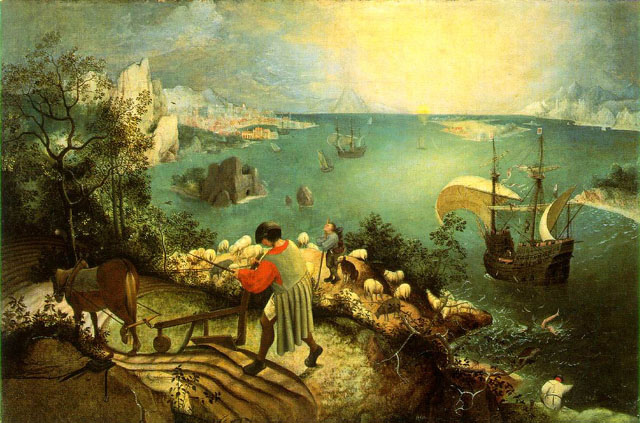
I could go on, but want to bring in a famous painting of Icarus by Brueghel.                                                             Anthony Stevens, a brilliant expositor of Jung’s thought, used the painting as cover for the first hard-cover edition (1995) of his book Private Myths.

http://www.anthonystevens.co.uk/index.html


Stevens quotes from a poem by Wystan Auden:

In Brueghel’s Icarus, for instance: how everything turns away

Quite leisurely from the disaster; the ploughman may

Have heard the splash, the forsaken cry,

But for him it was not an important failure; the sun shone

As it had to on the white legs disappearing into the green

Water; and the expensive delicate ship that must have seen

Something amazing, a boy falling out of the sky,

Had somewhere to get to and sailed calmly on.

What goes up must come down. Who knows how many Big Bangs there were before the one we so ardently explore? There is an organising intelligence behind life’s cycles, while consciousness forever expands. Thinking in metaphors we can perceive similar patterns, forms in nature and mind, cosmos and psyche, mirroring each other across scale and time. In other words, life teems with realities we can tune into, as long as we assign context and meaning.

Check out Gregory Bateson’s books ‘Steps to an Ecology of Mind’ and ‘Mind and Nature.

His family continue his work: His daughter Nora and his wife – Mary Catherine Bateson:   http://www.interculturalstudies.org/main.html

Peripheral Vision

 http://www.amazon.com/exec/obidos/tg/detail/-/0060926309/mead2001centenni

Free chapters of Angels Fear:  http://www.oikos.org/angelsfear.htm

Nora Bateson, recently created a film:

http://www.anecologyofmind.com/

Last not least, the themes:  pattern which connects, mirroring and bridging, are subjects of my novels.

25 Comments

Filed under Blog

… solitude …

Weather-defying, I had my first Pimms with ice cubes this year, imagining warmth, sun, swinging in my hammock under apple blossoms, listening to birds, walking barefoot and having friends round to watch the sun go down and the moon come up. The Brits are fed up with the rain. More than darkening the sun, clouds also obstruct the brighter aspects of the mind. Signals from the noosphere get muffled, or so it seems. There remains solitude, a tranquil space where questions arise, and thoughts have space to dream and play without being overstimulated. Allow your children periods of solitude and they will come to value it later in life.

I mulled over a question these last days, not for the first time. And an answer came, an angel whispered it into my ear while I slept – if all incarnated beings living on this planet were enlightened at the same time, the whole developmental cycle of the psyche would collapse, and consciousness would expand into a new matrix all over again. I’m making no claim to truth, angels can’t always be trusted. But the message seems to be – all is well-tuned as it is.

This is what solitude does to me – I get answers that beg more questions, like, what about multiverses? My body lives in this house in England that is at times difficult to maintain, but my mind also has another house, an interior house, free from mundane pressures, a house that exists in a dimension invisible to the physical eye … built from bricks of meaning rather than clay.

Here to the Noosphere, an interesting concept:  http://en.wikipedia.org/wiki/Noosphere

7 Comments

Filed under Blog

… sculpture park …

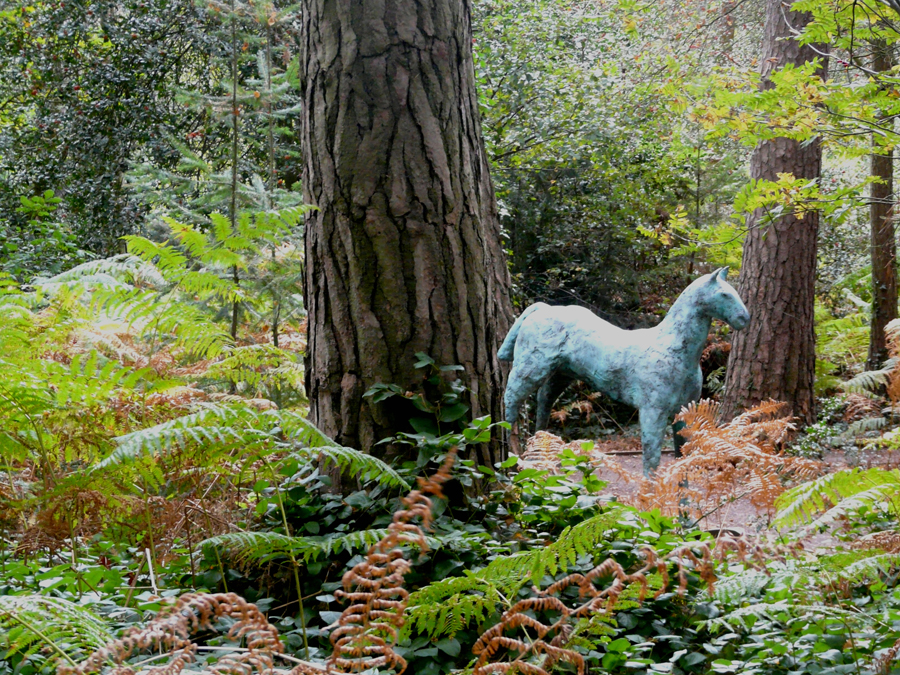
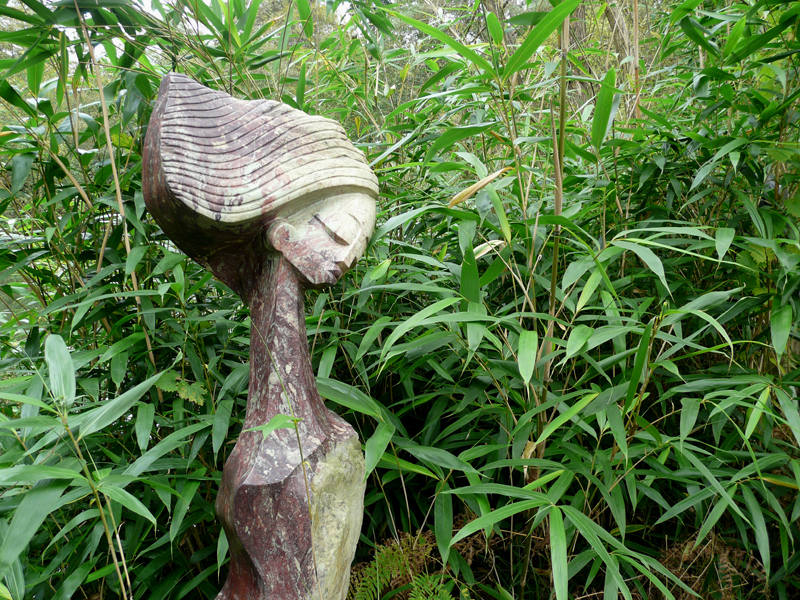
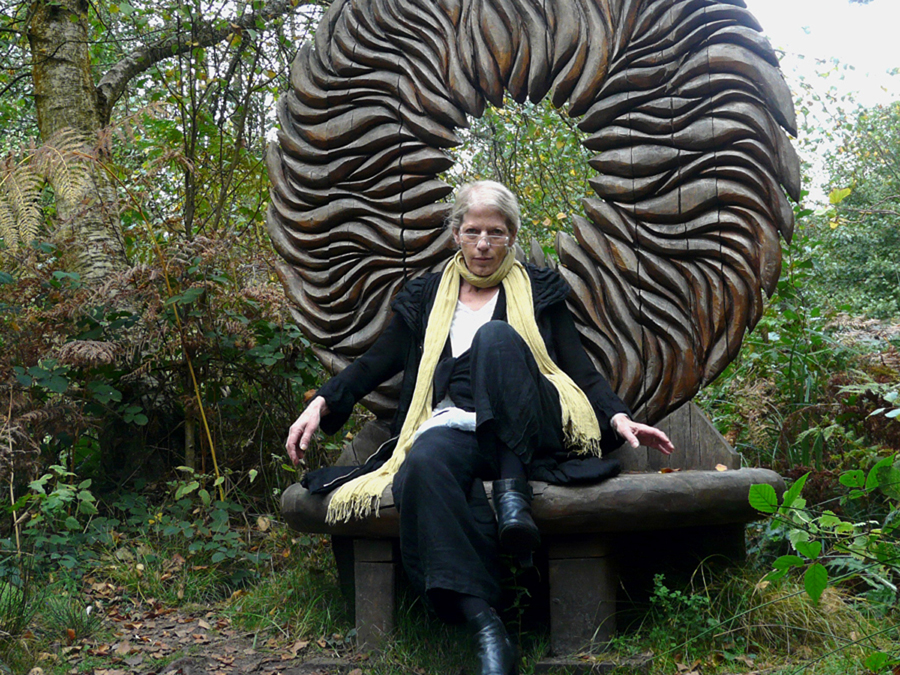
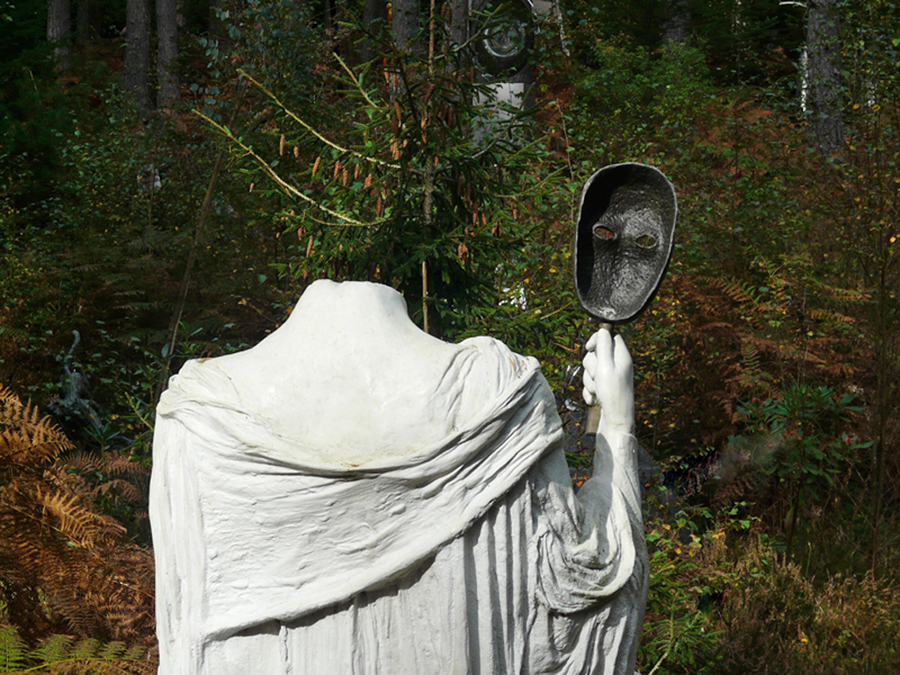
Dreams in stone, fairy horses, quills that use earth as ink, see-through elephants, surprises in the ponds, ghosts, flowing stone, water magic and mysterious circles …

Inspirational hours with my son and his partner at the ‘Sculpture Park’ in Surrey, near Churt.  So  close – and yet I had never visited the place. Like the man behind the bar in the pub opposite, who worked there for many years and not once stepped through the gate across the road. Makes me think of worlds we miss by the blink of an eye.

Here are some images of the place …

magic circles to other worlds …  

If you’re in the area, don’t miss it: http://www.thesculpturepark.com

9 Comments

Filed under Blog