Tag Archives: metaphors

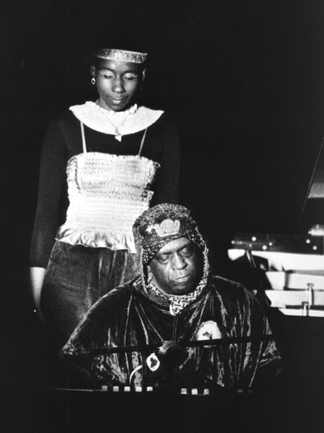
… sun ra – a glittering show …

Fallen angels being such a wonderful subject – had I been black, and a talented musician with total passion for jazz, I’d have joined Sun Ra’s Akestra. He was an intense and fascinating man, one of those people who move through chaos to get to harmony, who have their pulse on the future. They tend to attract a select fellowship. Tuned into a novel wavelength, they enjoyed an accelerated period of growth together, a hell of a time.

With his experiential musicians, Sun Ra expanded the bandwidth for the performances of his cosmic vision and shared the breadth of his trickster consciousness with a larger audience, exemplifying a crash course in creativity.

You might like to watch this excellent BBC documentary by Don Letts. Sun Ra, Brother from another Planet:

http://www.youtube.com/watch?v=LqZHzpAYVIk

Listening to musicians and friends who worked with Sun Ra, I noticed how they respect each other, all through the elation of creating a fresh sound-language. One interviewee remarked on Sun Ra’s urgency, his alacrity, another quoted him: ‘Are you going to be replaced by a button? If you can do THIS you always have a job,’ you might not make any money but you have a job.’ Everyone in their way confirms Sun Ra’s genuineness, his seriousness, and his humour. He was a catalyst. His compositions were often off-chord, which some found off-putting, couldn’t get into.

It’s a sound form other spheres  that transcends known categories and opens new horizons. I love the saxophone doing what it can do, almost playing by itself. And I love the glittering hats of the musicians.

Here’s the early cult movie – Space is the Place – from 1974 – The mystery of Mister Ra. http://www.youtube.com/watch?v=NwNtxFH6IjU&feature=fvwrel

Sweet show of a joker, the film shows a mythological duel between Sun Ra and The Overseer, between an angel from Saturn and a fallen angel.

                ‘You just want to talk about realities, no myth.

                 Well, I’m the myth talking to you.’ 


The photo of Sun Ra with June Tyson

Is by Michael Wilderman

http://www.jazzvisionsphotos.com/

10 Comments

Filed under Blog

… the wonderful visit …

I loathe most talk of angels since they became best-selling brands, but the synchronicity of Annie Lennox wearing wings and singing to an angel at the Queen’s Diamond Jubilee, and the discovery of a rare book among my shelves, brought angels up close.

H G Wells (1866-1946) has been referred to as the Father of Science Fiction. A neglected story, The Wonderful Visit, published shortly after The Time Machine, was regarded as a mocking reflection on attitudes, beliefs and the social structure of a typical English village in Victorian times. I read the social commentary as ornamentation, the comical human attempt to stay the same, round a more essential theme, the conflict that can accompany awakening.

The edition below is from 1922 and has an illustration by Conrad Heighton Leigh. The line under it is from chapter 5 – ‘He fired out of pure surprise and habit.’

A strange bird was sighted.

Ornithology being a passion of the Vicar of Siddermorton, Rev. K. Hilyer, he was going to outdo his rivals and hunt the strange bird. So it came to be that on the 4th of August 1895 he shot down an angel.

… He saw what it was, his heart was in his mouth, and he fired out of pure surprise and habit. There was a scream of superhuman agony, the wings beat the air twice, and the victim came slanting swiftly downward and struck the ground – a struggling heap of writhing body, broken wing and flying blood-stained plumes … the Vicar stood aghast, with his smoking gun in his hand. It was no bird at all, but a youth with an extremely beautiful face, clad in a robe of saffron and with iridescent wings … never had the Vicar seen such gorgeous floods of colour …

‘A man,’ said the Angel, clasping his forehead … ‘then I was not deceived, I am indeed in the Land of Dreams.’ The vicar tells him that men are real and angels are myth … ‘It almost makes one think that in some odd way there must be two worlds as it were …’

‘At least two,’ said the Vicar, and goes on ponderinghe loved geometrical speculations, ‘there may be any number of three dimensional universes packed side by side, and all dimly aware of each other.’

They met half way, where reality is loosely defined, and truth has no hold. And they shared the nature of their worlds. Eat, pain, and die were among the new terms the strange visitor had to come to grips with.

‘Pain is the warp and the waft of this life,’ said the Vicar. Riddled with remorse over having maimed the Angel’s wing he decides to looks after him. But to adjust to the Vicar’s world, the Angel must eat and accept pain, and learn all manner of things very fast indeed … Starting to read, during a phase of now legendary sunshine, I settled in my garden with a glass of red, and consequently spilled the wine on my wild strawberry blossoms due to sudden bursts of laughter.

‘What a strange life!’ said the Angel.

‘Yes,’ said the Vicar. ‘What a strange life! But the thing that makes it strange to me is new. I had taken it as a matter of course until you came into my life.’

Mr Angel is nothing like the pure and white angel of popular belief, more like the angel of Italian art, polychromatic, a musical genius with the violin. Listening … the Vicar lost all sense of duration, all sense of necessity … The reactions of the villagers oscillate across a hair-thin-divide between comedy and tragedy, while the bone of the story is psychological, and spiritual. Indirectly, the Vicar encounters his anima (his inner female) through the Angel’s love for Delia, the maid servant of the house. There is no escape. Things get intense. The Angel, over the span of a short week, is tainted by the wickedness of the world, and it crushes him. And the Vicar’s awakening from his narrow prison brings him into tragic conflict with his community.

*    *    *

Not much has changed. The world is crowded with wounded angels seeking compassion, and since our daily vocabulary offers little more than clichés for other realities, awakening rarely convinces, unless it is embodied and conveyed through atmosphere. Look out for the artist… the musician, painter, writer, animator, filmmaker … and the children.

‘If the doors of perception were cleansed every thing would appear to man as it is, Infinite. For man has closed himself up, till he sees all things thro’ narrow chinks of his cavern.’
― William BlakeThe Marriage of Heaven and Hell

The painting heading this post is by the Finnish symbolist painter Hugo Simberg.

18 Comments

Filed under Blog

… pattern which connects …

For a recent book-sharing with a group of irreverent friends (archventures), I had the wish to share so many books that I instinctively reached more or less blindly into one of my shelves. Books in my home, I must add, are in a muddle. The only order to speak of is their relationship to each other through time. I picked Alice in Wonderland and Mind and Nature. During our afternoon of reading there was not enough time to do honour to the latter, Gregory Bateson’s work. So I said I’d write up something. Oh dear. After pages and pages, I finally recalled this was supposed to be a blog-post, not a novel .

I first came upon Gregory Bateson books, ‘Steps to an Ecology of Mind’ and ‘Mind and Nature,’ during the early 1980’s, after his death. The clarity of his notion that biological forms arrange themselves through relationships struck a deep chord. What totally resonated with me was his thought that the structure of nature and the structure of mind are reflections of each other.  He had a broad perspective for a Biologist, and wanted to build a bridge between the facts of life and behaviour, and what we know of the nature of pattern and order. He was active in, and connected up many different fields of study – anthropology, psychiatry, biological evolution and genetics and the new epistemology which comes out of system-theory and ecology. He challenged basic assumptions and methods of scientific investigations, pointing to the processes beneath structures. He quoted Goethe …

A stem is what bears leaves

A leaf is that which has a bud in its angle

A stem is what was once a bud in that position …

And he provoked new thinking: ‘What pattern connects the crab to the lobster and the orchid to the primrose and all four of them to me. And me to you?’ 
His interest in morphology, the study of structure and form of organisms, involved context, meaning and communication. He distrusted reductive models of cause and effect, the scientific approach that lines up parts and classifies them, focussing on quantity.

Comparing systems, one to another, he perceived the mind as an ecological system. And he used the analogy that ideas, like seeds, can only take root and flourish according to the nature of the system receiving them. This thought alone deserves deep contemplation.

He had a way with stories … ‘There was a man who had a powerful computer, and he wanted to know whether computers could ever think. So he asked it – Will you ever be able to think like a human being? – The computer clicked and rattled and blinked, and finally it printed out its answer on a piece of paper, as these machines do. The man ran to pick up the printout, and there, neatly typed, read the following words: ‘That reminds me of a story.’ 
Concerned about the decimation of aboriginal populations (he did field-work with Margaret Mead), the degradation of ecological systems, economic oppression, and senseless wars and arms races, he took these ominous signs of contemporary life to be manifestations of deeper disorders, which he defined in terms of cybernetic systems of communication and meaning that comprise life, mind, and society. In his view, consciousness dominated by purposeful thought has a linear structure that establishes goals and ways for attaining them without being necessarily sensitive to the circular network of cause and effect that orders the systems.

Looking at human consciousness as an adaptive system, he thought the cure for its inadequacies, evidenced by the negative side-effects of purposive rationality, was not to reject it in favour of a passionate non- rationality, as in the extreme romantic position, but to augment and complete it by engaging with non-discursive, pattern-comprehending and emotional processes. He advocated the befriending of the unconscious aspects of the mind through utilising images and metaphors.

In a civilization which separates mind from body, mythologies about the survival of a transcendent mind are often meant to soften the idea of death, or even deny death as part of life. For Bateson, who saw the mind as being immanent not only in pathways of information which are located inside the body but also in external pathways, death took on a different aspect. ‘The individual nexus of pathways which I call ‘me’ is no longer so precious because that nexus is only part of a larger mind. The ideas which seemed to be me can also become immanent in you. May they survive, if true.’  (Afterword to a collection of celebratory essays, 1972)

Yet there are scientists that can no more perceive the language of nature, and politicians who feel beleaguered by sections of society that seek balance and a fresh context towards ‘an ecology of mind.’  The extreme factions of believers, for what else are they, should look again at the bridge  Bateson prepared.


This lovely video gives a taste of what it is all about :

Update … I discovered recently, in 2019, that some the links in this post don’t seem to work anymore. Here , however, is his daughter’s great documentary on Vimeo, unfortunately not free, apart from the trailer.  https://vimeo.com/ondemand/bateson

Looking at the structure of nature and the structure of mind being reflections of each other, it becomes obvious that not only does nature mirror our habit of thinking, but our thinking also mirrors the state of nature. Ecology and psychology must therefore both engage in listening, and seeing, and working ceaselessly towards the integration of knowledge and the re-adjustment of a dynamic balance.

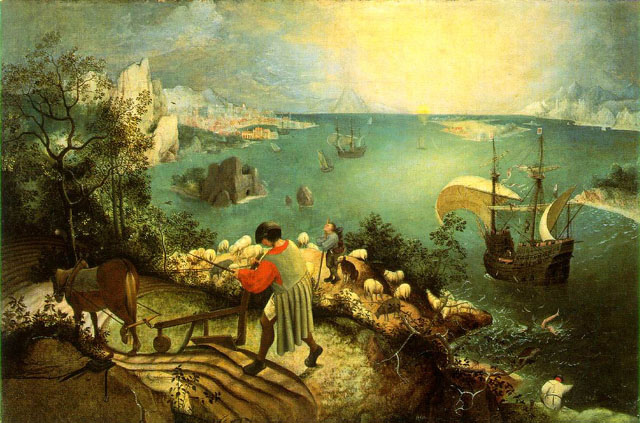
I could go on, but want to bring in a famous painting of Icarus by Brueghel.                                                             Anthony Stevens, a brilliant expositor of Jung’s thought, used the painting as cover for the first hard-cover edition (1995) of his book Private Myths.

http://www.anthonystevens.co.uk/index.html
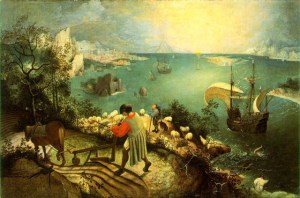


Stevens quotes from a poem by Wystan Auden:

In Brueghel’s Icarus, for instance: how everything turns away

Quite leisurely from the disaster; the ploughman may

Have heard the splash, the forsaken cry,

But for him it was not an important failure; the sun shone

As it had to on the white legs disappearing into the green

Water; and the expensive delicate ship that must have seen

Something amazing, a boy falling out of the sky,

Had somewhere to get to and sailed calmly on.

What goes up must come down. Who knows how many Big Bangs there were before the one we so ardently explore? There is an organising intelligence behind life’s cycles, while consciousness forever expands. Thinking in metaphors we can perceive similar patterns, forms in nature and mind, cosmos and psyche, mirroring each other across scale and time. In other words, life teems with realities we can tune into, as long as we assign context and meaning.

Check out Gregory Bateson’s books ‘Steps to an Ecology of Mind’ and ‘Mind and Nature.

His family continue his work: His daughter Nora and his wife – Mary Catherine Bateson:   http://www.interculturalstudies.org/main.html

Peripheral Vision

 http://www.amazon.com/exec/obidos/tg/detail/-/0060926309/mead2001centenni

Free chapters of Angels Fear:  http://www.oikos.org/angelsfear.htm

Nora Bateson, recently created a film:

http://www.anecologyofmind.com/

Last not least, the themes:  pattern which connects, mirroring and bridging, are subjects of my novels.

25 Comments

Filed under Blog

… the wild horse of the mind …

I thought I open the window a bit to what I’m immersed in, drafting the sequel to Course of Mirrors, called Shapers. Another mythic adventure, and more. The short piece below is not representative of the tense action this story has plenty of, but depicts a pivotal moment. The scenery is  Eire, where time-zones overlap. In 2550 AD the island is called Sax, where Rhonda, the super-controlling power, cast their misfits.  In the excerpt below, Tilly (Cassia in Ana’s story) has arranged for Cara and Mesa to meet in Kerry during the 1970s.

The theme touches on the creative process. Something for my writer friends. I welcome any feedback to the draft.

*    *    *

Tilly’s ruined estate on the Kerry peninsula was one among many places around the world where past and future began to cross or run parallel during the 1970s. Not all drop-outs travelling through Derrynane were aware of the phenomenon. Those open to the new wavelengths either tuned in, or received no more than garbled white noise. The going slogan was – love, don’t think – though it should have been – love and think – and stay grounded. These were turbulent times. Traditionalists abhorred the breaking free of conditioning. Leaps into the unknown frightened them.

This is Cara’s time, and these are her thoughts: Personal myth is a complex self-creation, mainly unconscious, but less so once we replace the postulates we inherited with our own, and are drawn to our psychic kin. Every night when the body rests we visit beings in other spheres. We may discount these sojourns as dreams unrelated to our daily existence. Yet bridging occurs when we value inner dynamics and re-story the associative symbols of images. Resonance momentarily fills the void between the known and the unknown, and meaning is assigned to events. Some good people trust in God, but then abnegate their creativity. Are we not the desire of a divine will? Are we not the ears, eyes, nose, hands and feet of a universal intelligence, of which we are the deed? Does not our speech derive from one sound? And is love not the creed that breathes all things and directs the movement of all spheres? I don’t understand the need to prove or disprove a universal intelligence that is within and all around us. The world I create is imperfect and suffers from on-going flux. But I can bring my small flame to its shadows.

Now that Cara’s myth caught up with her, and she was confronted with the net of postulates she had cast into the future. She found herself challenged to engage with what she animated, because she was animated by it.

Gutch spotted Tilly talking to Cara and Mesa in the hall. He was bursting with pleasure. ‘I found my clan,’ he said. ‘This place is teeming with talented actors. We’re going to do some magic theatre. Are you joining us?’

‘I need to take care of something,’ Tilly said. Can you keep an eye on Gart?’

‘That devil had some weird conversion trip and is sound asleep under the table.’

‘Excellent. Let him sleep.’

When Cara and Mesa arrived at the cottage across the atrium, Tilly had lit a fire in the hearth. A nest of chairs invited them, and the smell of fresh coffee. ‘Have some,’ she said, ‘pointing to a steaming pot, ‘and there’s chocolate cake, too.’ Mesa soaked up the atmosphere, transported to Ana’s world, reminded of Cassia’s kitchen. Tilly placed a small leather pouch in Cara’s lap. ‘Here, forged by fire, polished by the sea, a gift of remembrance.’

Cara opened and turned the pouch. A black stone fell into her hand – smooth as marble, yet radiating warmth and shining in the glow of the fire. ‘Ana’s talisman!’

‘Yes, and you might as well own it.’ Tilly paused, gazing into the flames. ‘I have a favour to ask from you, for Mesa’s benefit.’

‘What favour?’ Cara poured cups of coffee for everyone, dished out giant slices of chocolate cake and added a dollop of whipped cream to each.

‘Your future, Cara, has come to visit you. Mesa returned to assimilate what was lost to her. With Ana’s story you re-animated her soul. Certain events in history require beings to return, to right things or bring a message.  Mesa will take on her role in the odyssey of the Ypocs. And she’s going to be the narrator of your story, Cara.’

‘Huh, this takes a leap of the imagination. I haven’t even smoked the weed.’

Tilly smiled. ‘You know what it takes. Uncovering a personal myth is different from writing a Hollywood script. To help Mesa to re-connect with random creative processes, I want you to explain to her in as much detail as possible how your mind works.’

Cara heaved a breath. ‘The idea sucks every thought from my head.’

‘That’s a good start.’

‘All right, here goes a slice of random micro processing … Momentarily stuck with a paragraph, I remember to stretch my legs. In the kitchen I snatch a yogurt from the fridge. I notice a sticky shelf – mental note – clean it soon. Dark clouds gather outside, looks like rain. I run up to the bathroom and close the window. On the way down, I see dust-clouds on the stairs – mental note. Heading for the desk I stop by the fridge again because I’m now really hungry. I prepare a sandwich – mental note – put butter on shopping list. I use the loo – mental note – toilet paper is running out. Telephone rings. The answer machine kicks in. Just as well, I’ll return the call later – mental note. A letter that needs sending sits next to the phone, I put a stamp on it – mental note – post it. A fly is trapped in the window. I release the fly and study a tree out front that leans over and needs pruning. I quickly assess which branch to cut – mental note. Off to my desk. Passing a shelf I spot the book I couldn’t find earlier. What a relief! I plonk it on my research file and am reminded of an article I need to chase – mental note. The sun shines again. I open the backdoor and listen to the birds. Grass needs cutting – mental note. Finally back with my paragraph the writing flows, sheer bliss. At a natural break in the narrative I decide to go shopping. In the car I have an epiphany relating to a character in my story, to do with birds – mental note. The walker I pass reminds me to visit a certain person – mental note. I recall this person collects small antique tins. I could find him a present – mental note. I think of metaphors, how obsessions, like collecting tins, are really personalised teachings – mental note.’

Mesa had listened with rapt attention. ‘What happens to all the mental notes?’

‘Ha, ha … they’re promises. They’re torture. They heap up. They demand execution. My way to deal with accumulative pressures and gain time to focus on my writing is through procrastination. I’ve become patient with nagging voices. They’re not jailors. They’re easily humoured until the time is right for a blitz. Then I act fast and achieve a great deal in a short time, happy to have cleared the space.

‘But why give these mental notes the power of demands over you? Mesa asked.

Cara glanced at Tilly, who had taken up knitting, as if the dialogue bored her.  What was her agenda? Was this really for Mesa’s benefit? Tilly smiled and said, ‘Go on.’

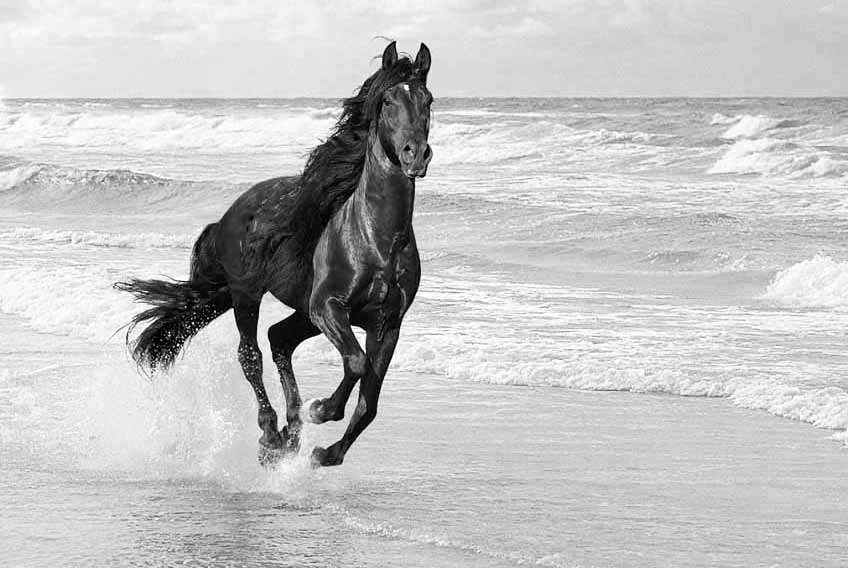
‘It started out as compulsive pattern. I was conditioned to respond to the needs of my environment, and to maintain order. There are exceptions. Some days, it could be the weather, a dream, the stars … from the moment I open my eyes everything flows effortlessly. My brain is relaxed and I attract harmonious thoughts, like I’m fine-tuned to a subtler station, beyond the busy bandwidth of neurotic naggers. The tuning can be learned. It’s like taming a wild horse. I can actually do it, when necessary. But I like letting the horse run wild. I find wild things that way.’

‘We have different conditioning,’ Mesa said. ‘From early on I was trained to tame my mind, to let it rest like a still pond, or focus thoughts like laser beams. Then free play was introduced, disrupting Rhonda’s order, and all went wrong for the Ypoc.’

‘Aha! I bet you didn’t have to juggle a deep conflict, and oppose a controlling father.’

Tilly dropped her knitting. ‘This gets interesting. It’s what Mesa came back for.’

* * *

Apologies: The origin of the image of the horse is unknown to me.  Many thanks to the photographer.

10 Comments

Filed under Blog

… smoking elegies – another facet …

Fusion

He was clear-minded and ambitious, with precise plans for his career. We met at Munich’s Domicile, a jazz bar, where an intimate haze of smoke welcomed and embraced you like an accomplice. The cool gaze and pure intent of his grey-freckled eyes took exclusive possession of me. Jazz and smoke fused us. Our cellular resonance defied the gravity of committed brain cells and gave my heart wings. He moved into my flat, warning me upfront that on completion of his apprenticeship at the most prodigious hotel in town he would return to the States to put his culinary management knowledge to the test. He was going to own not just one restaurant, but a chain of them. He convinced on several points.

One: he totally and reliably engaged with what was before him. The moment he stepped through the door after his day at the hotel, the outside world was no more, only us, together. We showered, cooked delicious meals, listened to music and spent  most of our time in bed. The pure intensity of his presence ricocheted like a charge between us and left no room for anything besides. In this rarefied sphere, lovemaking became a cycle of small deaths and resurrections. Some of my friends had angry fits under the porch of my door, knowing full well I was home but inaccessible. My king-sized futon had become a sacred island floating in a vast ocean.

Two: he was a strategist, which, together with point one, makes an unbeatable combination for material success. But most of all, he understood branding, the powerful imprint repetition leaves in the mind. It happened religiously during our celebratory smoke after lovemaking and became a surreal ritual. With his thumbnail he cut a cross into the filter of his cigarettes. The cross was tied to a mantra he kept secret. I thought this was cute and took up the habit, inventing my own mantra.

Two months passed in eternal bliss of now, until the appointed time for his flight back to the States approached. I started hurting bad. He wanted no soppy goodbyes at the airport. He was not going to be tied down. Only when he had made a million by the age of 30, he said, would he focus on having a family. He left no address. For months I continued punching crosses into my cigarette filters to strengthen my ambition, and, inadvertently, remember him. It became an obsession. Only my mantra, unlike his, was not based on a strategy. And the branding thing annoyed me after a while. I favoured the meandering dance of a poetic life.

His clarity left a strong impression. Hopefully he found what he was looking for. I came to perceive my early ambition as metaphor, and owned up to a misspelling. The path my aim prescribed sharpened many skills, but was littered with Freudian slips that lead into emotional woods. And yet, looking back, every re-start, every detour in my life stimulated creativity and inventiveness, crucial unlearning, greater tolerance with myself and others, and a more symbolic understanding of my existence.

The ideal is the means – its breaking is the goal.   Hazrat Inayat Khan


10 Comments

Filed under Blog

… smoking elegies …

Her

I admired her calm, her mystery, unaware that she mirrored an enigma in me, hidden as yet under a muddle of neurotic insecurities. I didn’t have a clue who I wanted to be. She was a fellow art student, more mature than the rest of us. Her perceptions had a poetic flavour. Her contemplations surprised. I doubted the value of my perceptions. She was not beautiful by any means, with her dull and pockmarked skin. She was no Marlene …

Her eyes, inquisitively curious, were like gleaming coals, deep set. And her movements were a little wooden, apart from one gesture that made her elegant – the way she held her cigarette, the way she cast her eyes upwards and inhaled with deep satisfaction, and exhaled what seemed like all her woes by lowering her head. I had the impression her unwanted thoughts and feelings were ploughed into the ground and recycled. Because after each exhalation she had a Zen-like presence.

I accepted my first cigarette from her and thereby initiated myself into the eccentric tribe of smoking connoisseurs. Our rituals saw us through tumultuous college years. Camel was the brand in fashion at the time, evoking the image of adventurous travelling – desert excursions, vast horizons and hermit-like independence.

It was my caterpillar phase. The eerie red light in the photographic dark room offered a solitude I treasured. Bending over the emerging images in the chemical developing bath I took pleasure in my seeing, my metaphors. The feedback from tutors, who assumed I had planned my compositions, confused me. I hadn’t planned anything. Things appeared as in a mirror …

I was webbing a secret chamber in which to connect up all the dots before meaning would unfold its wings. A kind of trance was needed for that process. Smoking provided the trance. For our group of students any significant discussion required smoke, voluptuous swirls and veils lifting upwards between us. And as the mind raced ahead of itself, excited by ideas, there was the sucking pause, obligatory, to invest a thought with significance before it was voiced along with feathery wisp, ghostly white and blue cyphers suspended against light.

Unedited thoughts jotted down. More elegies to come …


2 Comments

Filed under Blog

the mysterious object, part three

… Memories awakened, of a time when it was possible to gaze straight at the venerable light-giver without being blinded … in the dark sky, shone the light-giver’s mirror image, pale and beautiful, shimmering, and stirring a deep longing in those who witnessed the phenomenon. The gentle orb puzzled minds, since it changed shape from night to night and periodically disappeared, only to re-emerge, gradually waxing from a sliver to gentle fullness. Some saw in the orb another divinity; others rejected this, not wanting to betray their bright and bountiful divinity. The two kinds of worshippers did not see eye to eye. More secretive circles formed, and stories spread. Ever now and then a night-walker claimed having been touched by the silver light, though was unable to explain what possible benefit there was in being touched by this new mystery? Incredulous stories spread, which were laughed at by the now established beneficiaries of ingenuity and industry, and the few night-walkers who sincerely tried to share their experience were regarded with suspicion and ostracised.

Let us relate just one incident, as told by witnesses, to give you a sense of the mystery. One night, or so it goes, a group of seekers gathered on a flat rock above a deep pool of water to watch the full silver globe in the sky. To their surprise, a perfect replica of their beloved object appeared in the still water of the rock pool, beautiful, beyond words. Everyone present gasped. One young woman who resembled her great, great grandmother, Lila, the famous light-seeker, was ecstatic with joy. ‘This is it,’ she exclaimed, and jumped from the rock’s ledge right into the glowing reflection.

The silver scattered and rippled out into circle upon circles on the water. The others looked on in astonishment as the soft light gathered itself back once more into round brilliance. Night’s divinity re-assembled its fullness, still quivering with the gentle, undulating movement of the water. There was no sign of the young woman.

To break the tension, all started talking at once, expressing in so many words and shouts what they thought they had witnessed. With the noise going on they did not hear the footsteps. Quietly, from the darkness around them, the young woman reappeared. Her skin gleamed and glittered, as if she had absorbed some of the mysterious light. Her friends inundated her with questions as to what happened, ‘What was it? No answers came, she had lost speech. Her silent gesture however firmly impressed itself in each men and women standing there on the rock and seeded in their memories forever more. The seeker pressed her right hand to her heart. She had many silent followers, as had many like her from there-on after.

~ the end ~

5 Comments

Filed under Blog

webs and networking

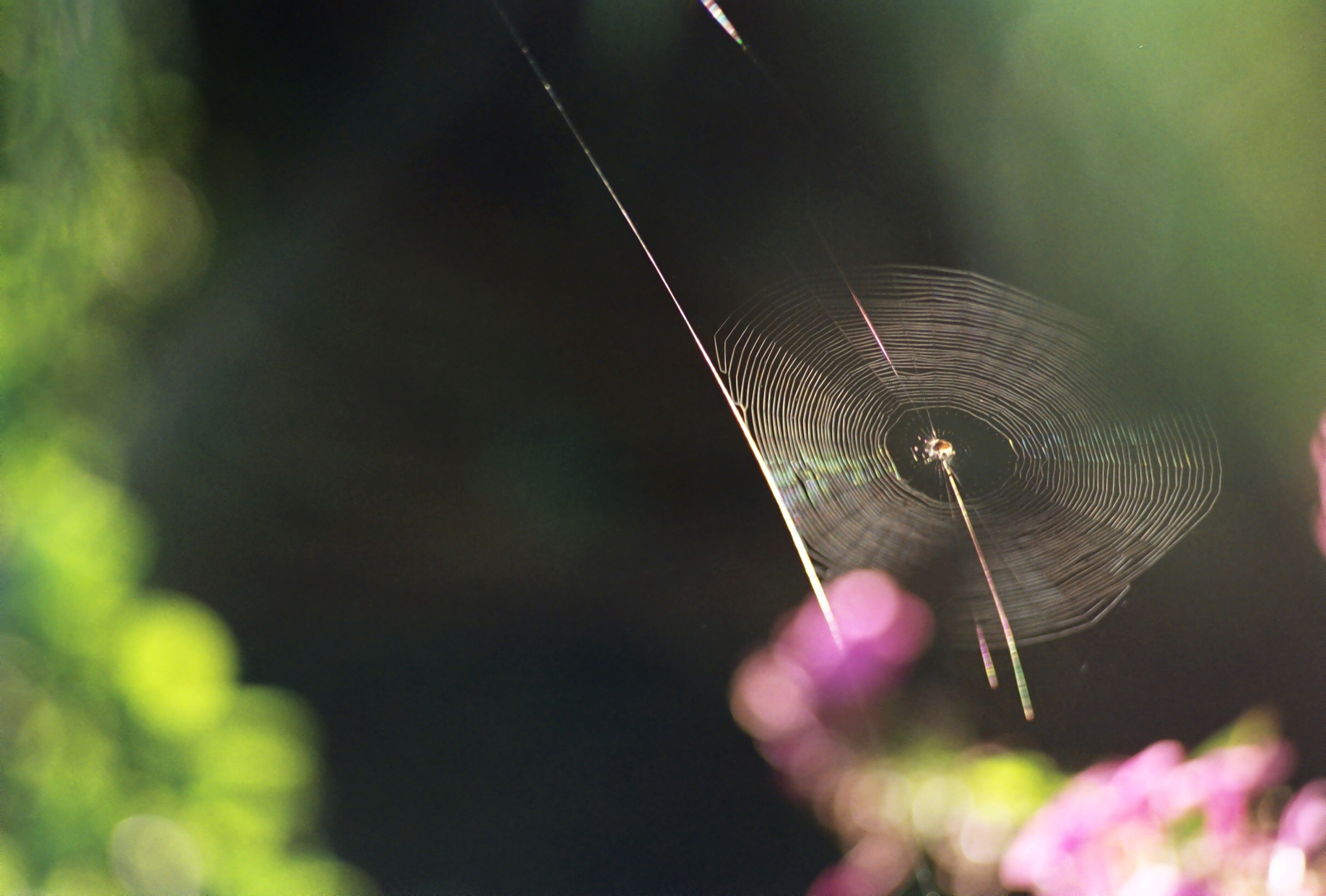
Some time ago I took this photo of a carefully designed spider net in my garden.

I have a serious question – it seems to me that spider webs are deteriorating. They still do the job of catching food, but they are irregular, arbitrary and carelessly designed. Is it my looking, is it that I tend to come upon haphazardly made nets as a reflection of my own state of mind, or is it a general condition of our time reflected in nature?

And yes, there are as many metaphors here as you wish to apply, the general lack of human engagement, the lack of stillness and concentration, and the virtual meaninglessness which pervades so much of our web and networking activities included.

2 Comments

Filed under Blog