Tag Archives: creativity

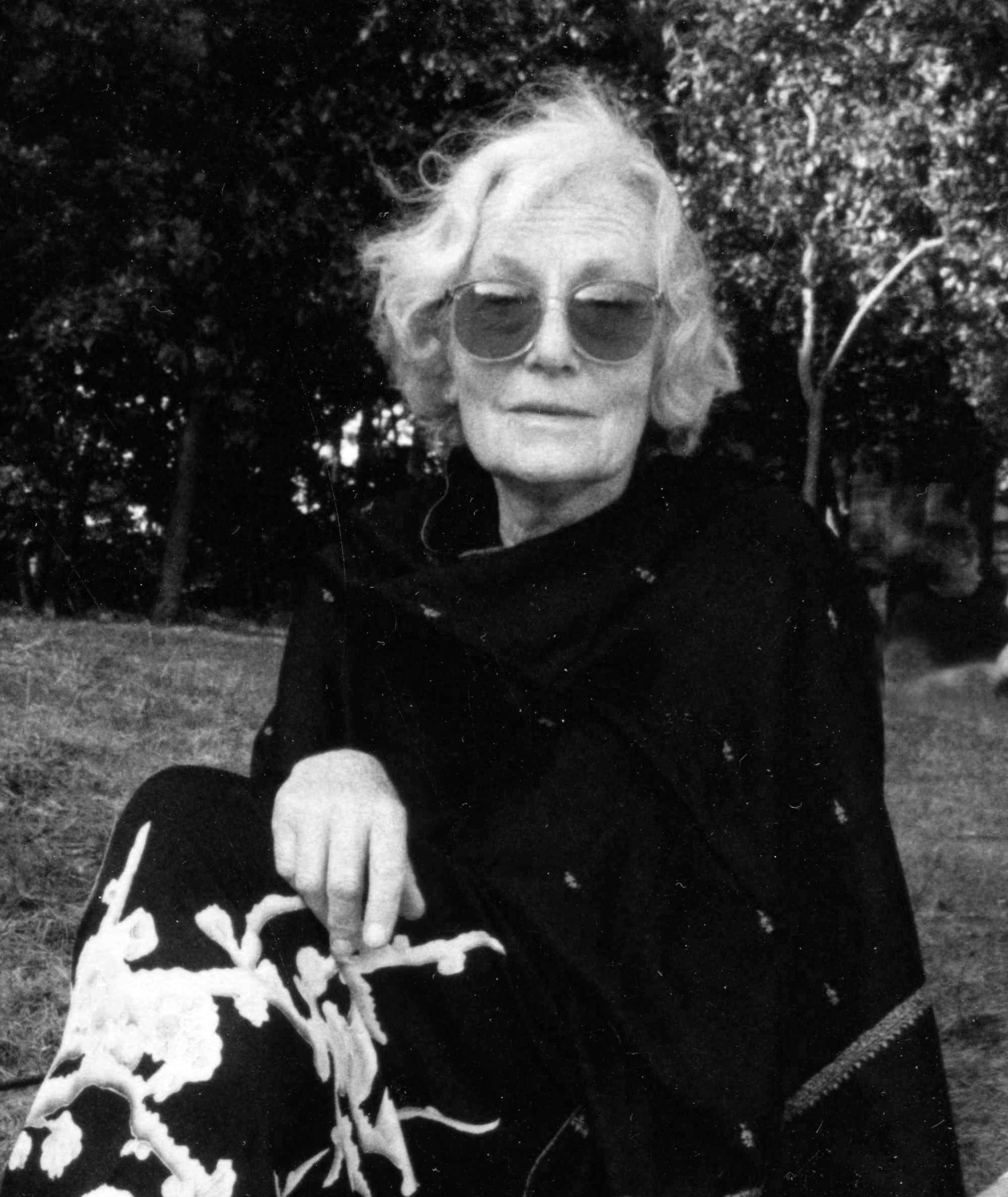
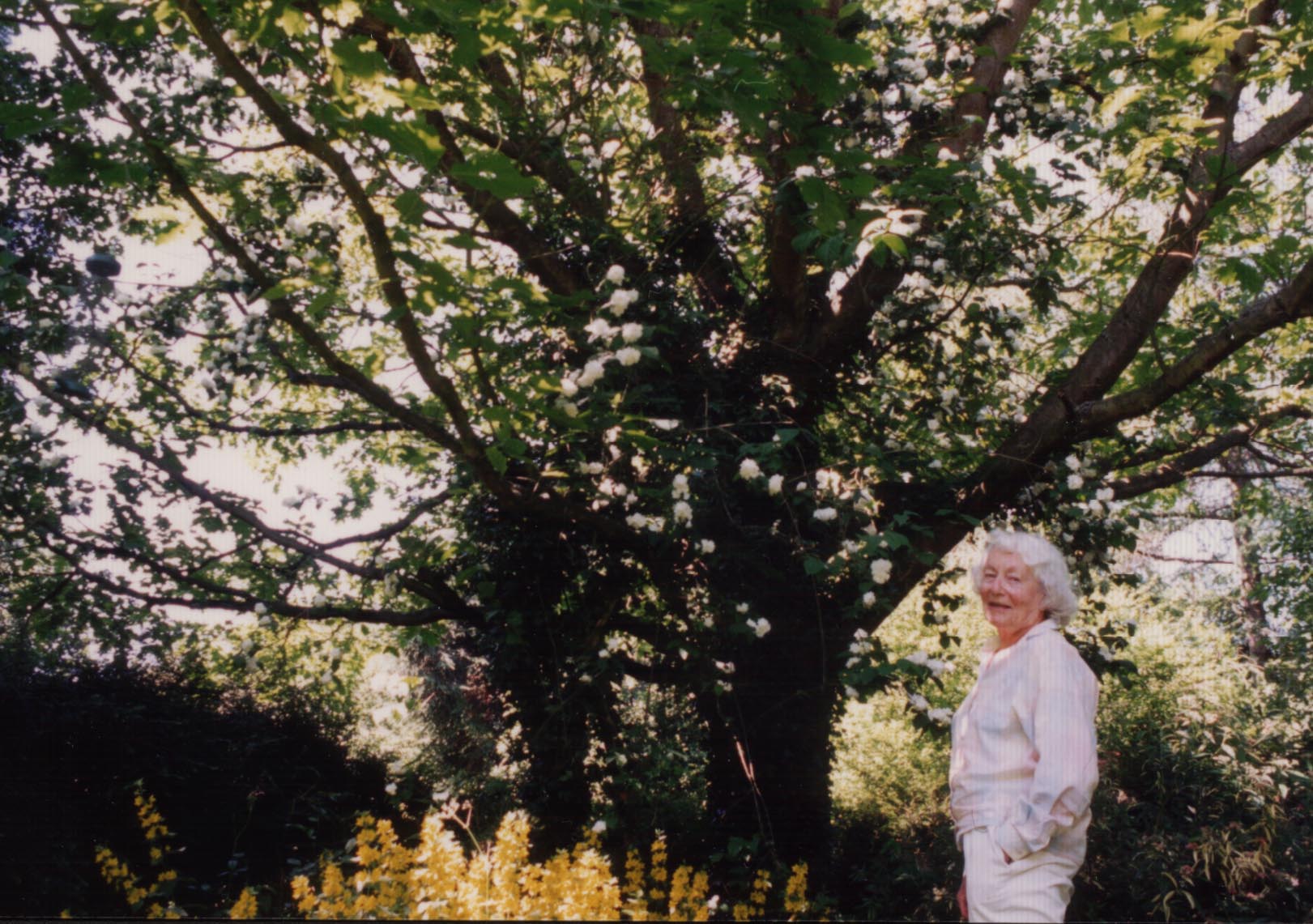
Sitara Brutnell – 1914 – 2004

Sitara Brutnell

Sitara Brutnell


Today’s post is to honour a remarkable woman who died ten years ago, aged nearly 90, having lived her life devoted to the Sufi Message of Love, Harmony and Beauty. Sitara Brutnell was a musician whose brilliant ear for pitch and rhythm extended to the fine-tuning of her personality. By enduring the dissonances life throws at us without dispensing blame, and reading people and situations deeper, she became receptive to the spirit of inner guidance.

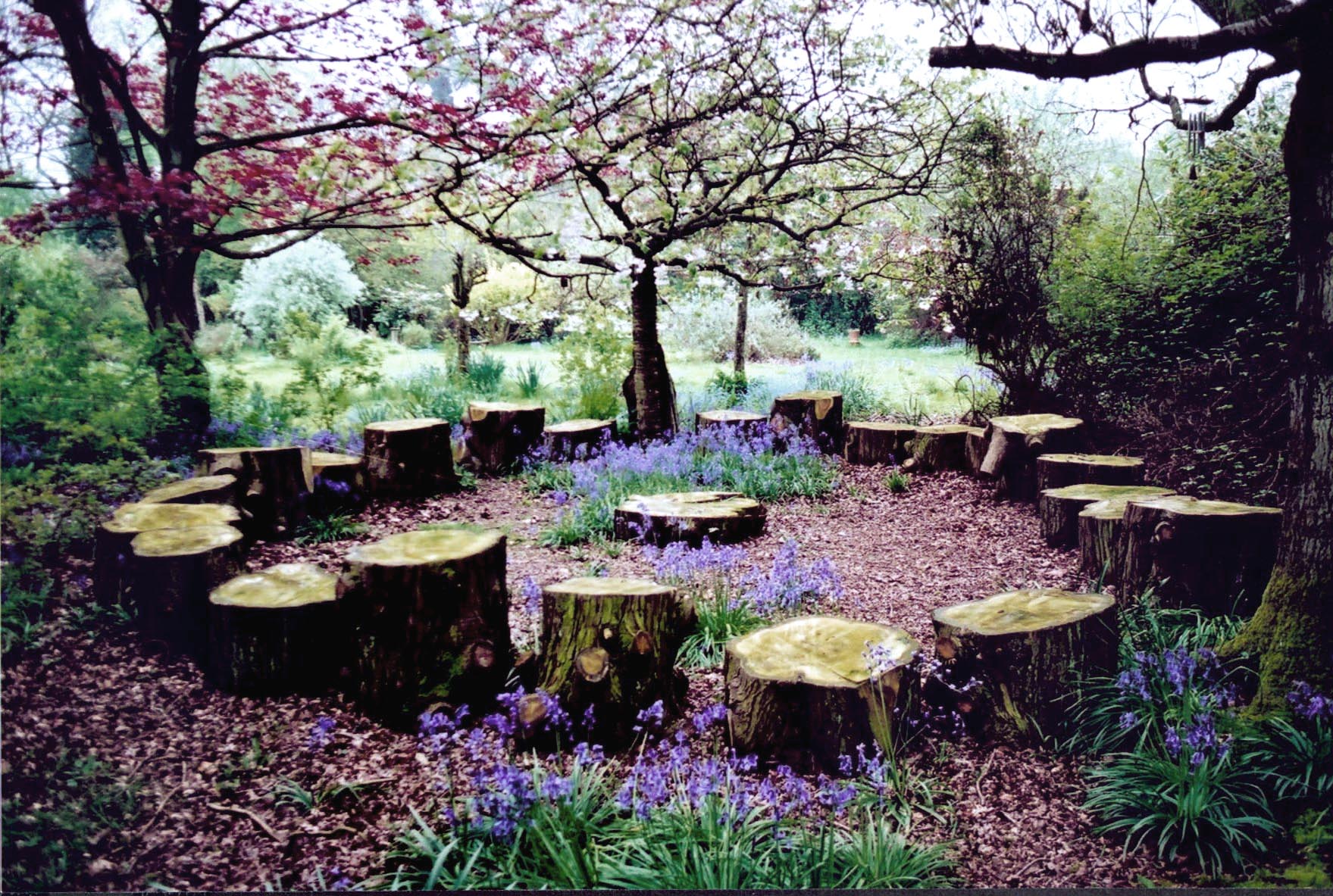
Like her parents before her, she supported the work of the Sufi Movement and continued hosting its leaders after Hazrat Inayat Khan in her home, enjoying many musical soirées. One of Hazrat’s successors was his youngest brother, Musharaff Khan (1895-1967), who handed his role to the 26-year-old Fazal Inayat-Khan. So in 1968 the Sufi Movement was challenged by a dynamic and innovative Pir and custodian, a position Fazal eventually surrendered, giving credence to his own unique teaching approach, calling it The Way of Action, and later Sufi Way. Sitara stood by him for almost three decades, and after his untimely death in 1990, the leadership of Sufi Way fell to her. My Pictures 438 - CopyAknar Circle in Roughwood

She is remembered as a wonderful musician, and for her kindness, humour, sparkling mind, frequent expressions of gratitude and her warm hospitality.

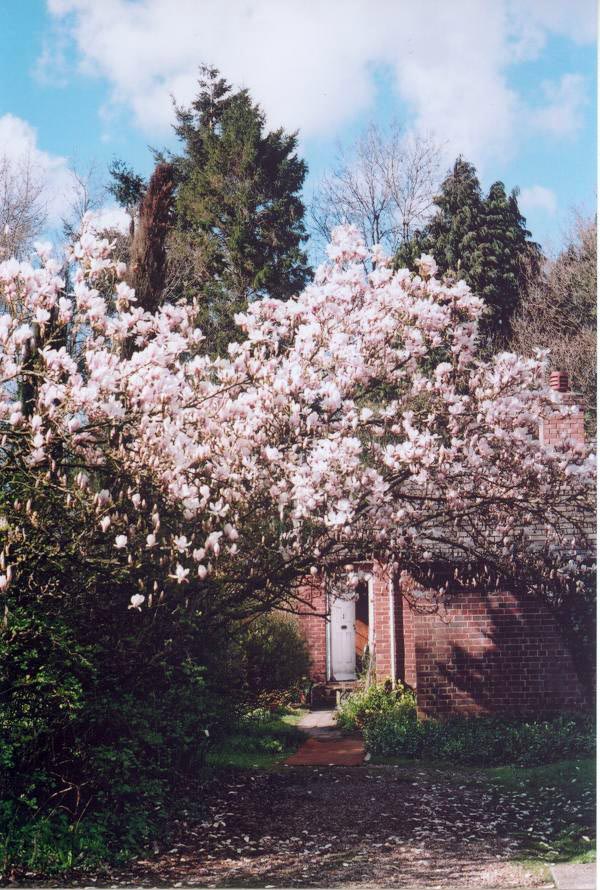
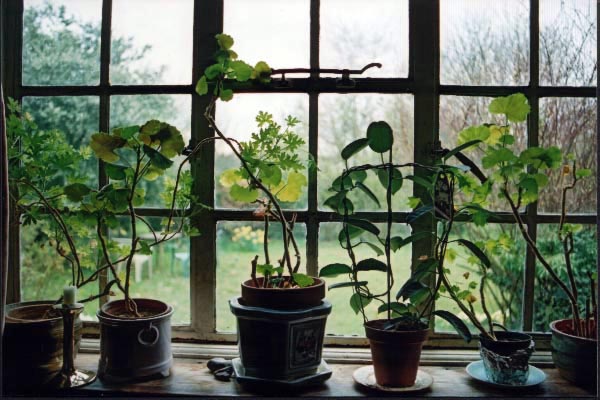
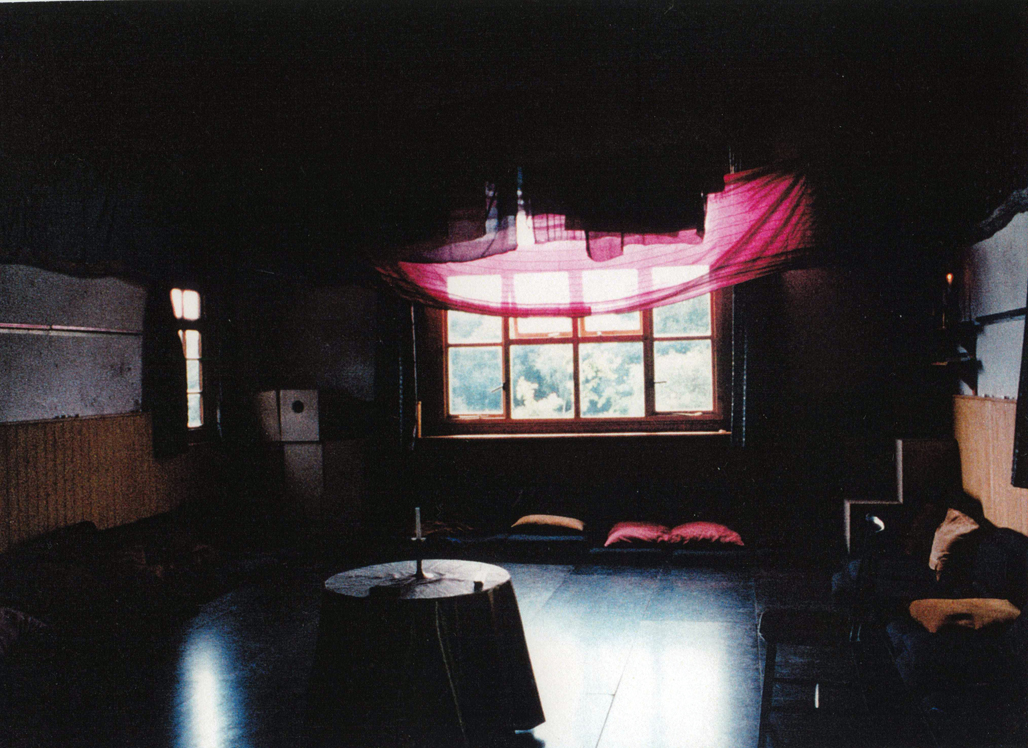
The door to Sitara’s home was always opens to her many friends spanning the globe. There was hardly a time when she did not gracefully entertain guests who treasured Roughwood as a place to relax and be nurtured, like she lovingly nurtured her pot plants, no matter how straggly they lined up on her windowsill. The wild flowers in the secret nooks of her garden looked after themselves. Sheltered by high trees and bounded by fields, this magical place was only a few miles away from Four Winds, Fazal’s residence, and the then official spiritual home of Sufi Way, which was like a buzzing metropolis of the psyche compared to the sanctuary of Roughwood. My Pictures 410 - Copyat Roughwood,window13-04-04

It is tremendously reassuring to come back to rooms where everything has over time claimed its place. Shelves packed with old books, well-worn furniture and carpets, paintings and prints on the walls, items on the mantelpiece, like the tiny carved gazelle, the Japanese ginger jar, red-veined serpentine stones from the Lizard – interspersed with rotating tokens of love – the photograph sent from a family in America, a child’s drawing, a postcard from South Africa … each object holding a story. And stories popped from shells with every question of where and what. We held garden working-parties, chasing away moles, poetry gatherings, celebrated birthdays …

The year roses grew in the tree.

The year roses grew in the tree.

Following Fazal’s death, his partner, Wendy Rose-Neil, a transpersonal therapist, put Four Winds on the map as a venue for London’s workshop facilitators, and Sitara, aged 76, though daunted by the task, embraced her spiritual leadership role with grace. Helped by the local and international community, she continued regular Sufi Way activities, and encouraged Sufi friends and professional therapists among us to run workshops. In this and many other ways Four Winds maintained itself financially for another decade and served a wide community.

This positive development ended abruptly after Sitara’s death. The new Pir, Elias Amidon, sold both Roughwood and Four Winds to raise money to achieve more flexibility for Sufi Way. I am still grieving the loss of the places and the multicultural network that was truly inclusive, beyond the brand of Sufism, which is not to say that the inclusive approach is not continued elsewhere. However, attempts of local people to buy Four Winds from the newly created charity failed. The two spiritual homes in England now only exist in the rich memory of companionships.

Barn at Four Winds

Barn at Four Winds

It was impressive how Sitara embraced the challenges of the next generation, how she joined the freedom of enquiry of the 70s and 80s. Over three decades, people from all walks of life and all corners of the earth gathered yearly for Summer, Winter and Spring schools at Four Winds, which was a vortex  of creativity, with stimulating lectures and discussions, psychological war games and intense experiential meditative and contemplative practices that deepened lives and formed lasting friendships.

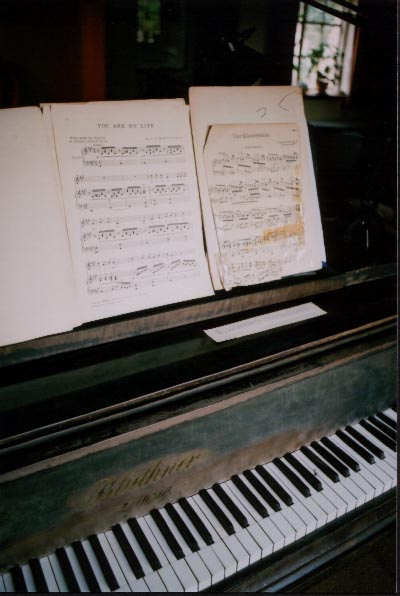
Though an unlikely team, Fazal and Sitara complemented each other. While Fazal, with the sincerity, contradiction of doubt and faith, intensity and humour of a Qalandar *, challenged the assumptions of his students and encouraged unlearning, Sitara was the blessing guardian, typed up hundreds of Fazal’s lectures and regaled us with piano recitals on her Grand, songs, esoteric readings, tea-time-treats of Battenberg cake, stories, and the consistency of her welcoming home. What they had in common, apart from disseminating the essence of Hazrat Inayat Khan’s message, was their love for music, keen curiosity in life and the playful deflation of any pretensions to grandiosity.

For one of the famed spontaneous Magic Theatre performances at Four Winds, Sitara offered a poem that gives a flavour of her delightful poise:

Lord thou knowest better than I know myself

that I am growing older and will someday be old.

Keep me from the fatal habit of thinking that I must say something

on every subject and on every occasion.

Release me lord from craving to straighten out everyone’s affairs.

Make me thoughtful not moody, helpful but not bossy.

With my vast store of wisdom it does seem a pity not to use it all …

but thou knowest lord that I want a few friends in the end.

Keep my mind free from the recital of endless details;

give me wings to get to the point;

seal my lips on my aches and pains …

they are increasing

and love of rehearsing them has become sweeter as the years go on.

I dare not ask lord, for grace enough to enjoy the tales of other pains,

but help me to endure them with patience.

Teach me that glorious lesson that, occasionally, I may be mistaken. 

Keep me reasonably sweet lord.

I do not want to be a saint …

some of them are so hard to live with,

but a sour old person is one of the crowning works of the devil.

Give me the ability to see good things in unexpected places

and talents in unexpected people.

And give me oh lord the grace to tell them so.


(The author of this poem is anonymous, but Sitara wrote poems in the same vein)

*    *    *

* A Qalandar is traditionally a wandering dervish, a free spirit with a strong love for humankind. Fazal Inayat-Khan once wrote a breath-taking poem called ‘Qalandar’ at Roughwood. It can be found in this book: Heart of a Sufi – A Prism of Reflections, link: https://courseofmirrors.wordpress.com/2013/03/16/a-rare-book-now-on-line/

The present Sufi Way: http://sufiway.org/ And an article by Fazal Inayat-Khan that sheds light on the various branches that grew from the tree of the Sufi Movement: http://sufiway.org/about-us/our-lineage/12-about/33-western-sufism

If you’re inclined to explore the spiritual message of Hazrat Inayat Khan, you’ll find plenty of links and source material on these and many other sites, all free: https://wahiduddin.net/mv2/   http://www.cheraglibrary.org/

Thank you Sitara, thank you Fazal, and thanks to all the friends in this adventure. You are still enriching my life.

10 Comments

Filed under Blog

… weddings still happen …

Come July, my son, Yeshen, is joining creative forces with Natasha, who magicked this invite for the intimate part of their wedding celebration. I’m allowed to share her delightful animation.

http://vimeo.com/89556579

The venue will be an old pearl-fishing boat in Darwin, where part of Natasha’s family live. I’ve never been to Australia, so I’m looking forward to the trip. Their UK friends, I understand, will be invited to a summer picnic in London.

I’m very happy for them. They’re a wonderful team.  http://www.yeshandtash.com/about/

Tash

Tash

Natasha working


Yesh & Tash

Yesh & Tash

15 Comments

Filed under Blog

… meeting the other …

None but nature could have written a better curriculum for becoming human …


Attend for a moment to you breathing. If you’re aware of heaviness in any part of your body, breathe the colour of water under a blue sky into that part and let the tension drift into the earth with the out-breath.

In your mind’s eye, find yourself in a meadow, abundant with scented wild flowers. Nearby is the outcrop of a mountain and a welcoming dry cave stirs your curiosity. Entering the cave, you find a spacious passage from which comes a luminous glow. All of a sudden you’re walking on air, and – like a feather on a breeze – you’re floating, floating gently downward into velvety twilight. In your heart you know you’re guided towards a special encounter.

A waft of fresh air brushes your skin. You find yourself standing in a soft beam of light from high above at the centre of a dome-shaped cavern. The circular wall of the dome has tunnels that lead in all directions. You must choose one. Be patient.

White Window, St Cathrine's Chapel - more lowresWithin your reach sits a small bronze bell. Lift the bell and give it a slight nudge. As the clear sound of the bell reverberates in your heart, you’re drawn to one particular tunnel and you know this is the one to follow.

Warm air greets you with otherworldly scents, the crystal walls of the passage glimmer. Soon brightness appears ahead, momentarily blinding. You step forward and slowly make out a landscape of rolling hills with the sun reflecting in a silver stream that meanders towards a distant sea. 

Close by, you notice a strong presence under a solitary tree and feel your heart chime in perfect harmony with the presence. A near transparent human form steps out and mirrors your innermost being. Eyes, radiating love and acceptance, completely affirm you. For an instant you are – you are natural mind, pure consciousness.

A soft voice says: Where is the other?

Pondering the question, a shrouded figure moves, from hiding behind your back, boldly into view. It is a repulsive creature and you want to shush it away.

Greetings to your other, the soft voice of your essence says. Then you realise what the apparition represents, everything you reject and prefer to keep hidden from your consciousness, all you find objectionable, embarrassing and unacceptable in others, and in yourself.

Understanding happens. By denying your inferior being you are also ruled by its whims. And realisation comes – of your body’s wisdom, and of knowledge gained from human frailty you were too proud to value. You see with fresh eyes  and extend the very love and acceptance you absorbed from your essence. The other straightens, lightens. There’s a new respect, an affirmation, a softening.

Turn and look again into the deep compassionate eyes of your essence, absorb this capacity for tolerance in your heart, allow the healing.

Then bow to your essence and return the way you came. Give a nod of acknowledgement to your other, so the shrouded figure won’t slink behind, become resentful and trip you up. Let it walk in view, accepted, even with gratitude for its imperfections and its treasures.

*    *    *

Continuing from my last two posts, this is further classic theme for an inner journey, usually adjusted to the context in which it is used. I kept the narrative short and succinct. Even if you don’t enter the journey experientially, alone, or read to by friend, and allow your own images to emerge, the scenario might spark reflections, and drawings or writings for your diary or chapbook.

It’s humbling to recognise our flaws and the blame we assign to others, and yet, no matter how many veils are falling from our eyes, there’ll always be more projections to be owned, more grudges to let go of, more misunderstandings to tolerate, more hurts to absolve, and more to be embodied of what feeds us from dark roots. Our struggles with conflict and contradiction polish the heart, feed our imagination and create our realities. None but nature could have written a better curriculum for becoming human.

http://www.youtube.com/watch?v=9NrAGJEMnHE          Marie Louise von Franz – The Way of the Dream 2.1 – Our Shadow Knows

One does not become enlightened by imagining figures of light, but by making the darkness conscious. – C G Jung, CW 13: Alchemical Studies. P.335

Everyone carries a shadow, and the less it is embodied in the individual’s conscious life, the blacker and denser it is. At all counts, it forms an unconscious snag, thwarting our most well-meant intentions. – C G Jung

If we could read the secret history of our enemies, we should find in each man’s life sorrow and suffering enough to disarm all hostility. – H W Longfellow

9 Comments

Filed under Blog

… the child in us …

Close your eyes and imagine standing on a beach … warm sand under your bare feet – a light sea breeze brushing your skin – gulls sailing above the sparkling crests of waves. Breathe a while, to the rhythm of the surf lapping at the shore – in – out – in – out – in – out – and let your eyes rest on the silver skyline.

There is nobody here but you – and a visitor – a child you invite to appear as it will.

At what distance does the little person appear?

Observe its posture, age, gender?

What do you sense about it?

Does it look at you, or not?

Is it curious, shy, withdrawn?

Notice your thoughts and feelings, don’t draw conclusions – do nothing.

Sense the realm of consciousness this little person lives in, and still your mind. If the child plays with shells do the same, remaining where you are. If the child skips along the surf, wait. If it takes one step towards you, wait. If it turns its back on you or walks away, sit down and wait. All the while communicate silently – I’m here as a friend.

Yeshen in Surf, colour - lowresHe or she may come close – or not – play with you – or not. Be patient. This little one represents your essence and must be free to approach the strange adult you’ve become as it chooses and when it’s ready. Maybe next time. Don’t over-act. Even if the child is friendly, keep in mind it may try to please your expectations. Remain calm, interested, approachable.

*    *    *

Visiting an imaginary coastline, metaphorically a boundary between the conscious and the less conscious psyche, brings insights even if no images emerge. Try and silence your usual thinking process. Enter the scene as in a daydream, or have a friend slowly read the text.

Insights change from day to day, according to mood. You could experience joy, get a glimpse of what’s important in your life, or be prompted to engage in frank reflections – a valuable process, helping us to develop empathy.

For example, if sadness or pain knock at the sight of this child, ask yourself … have guardians chided your curiosity and strong spirit, or humiliated your weakness and poor confidence? As a result your own adult may have unwittingly come to reject your child as unworthy, regarding it as ungrateful, stubborn, nagging, or awkward with the shame of buried secrets?  Consider – fear of abandonment, punishment or guilt about early fantasies may compel children to please grown ups in order to cope and emotionally survive. The legacy could be a distrust one’s own feelings. Signals received as pain, or love, might equally overwhelm.

Next time you hear a baby or toddler screams, let’s say, in a supermarket, observe what happens in your body, and watch other shoppers. It grates at our nerves at best, and can trigger physically embedded memories of helplessness, and sometimes more. Good to remember when we  judge people who shout and act irrationally. There are behavioural therapies to desensitize triggers that threaten to overwhelm people with rage. Then again, active imagination is more deeply transforming, and the symbolic expression of complex emotions (see later) frees energy and meaning, making a difference to our collective state of consciousness.

If some of these reflections ring true,  return to the imaginary shore as long as it takes to earn the trust of your child. Your adult’s task is simply to be present, reflect, and allow the younger being to initiate communication.

In daily life, begin to set aside pockets of time for that little person in you, encourage a symbolic process, without pressure, to write or draw about early joys, pains, hurts or dark thoughts, like having hated a parent, or once wished someone to drop dead. Children have such fleeting fantasies when they feel threatened and powerless. It’s normal. Holding on to self blame is the problem.

Suffering brought to consciousness lifts the spell of self blame. Despite appearances of confidence and adult bravado, the child in us is often anxious. Deep down may linger legitimate anger, and, deeper still, sadness and the longing for a precious moment of total acceptance. We call it love. It takes time to soften hearts.

Imagination serves multiple roles. It can draw us into habitual loops of negativity and self harm, or stimulate insights and enhance creativity. Artists know this. Imagination can also heal psychic wounds frequently handed down through generations. The healing aspect is especially powerful when employed consciously. Jung called it ‘Active Imagination.’

In this way, every imaginary journeys can be followed up by freeing condensed energy and meaning – symbolically – through drawing, painting, writing, movement, music or play, allowing what wants to emerge, be it forgotten wonders, or burdens, like unacknowledged anger a child had no means to express in early life.

And most significantly, nurturing a trusting relationship and rapport with our younger being invites the Beloved – our essence – and with it the light of intuition and inner guidance.

‘Lovers don’t finally meet somewhere. They’re in each other all along.’  ― Rumi –

Perhaps all the dragons of our lives
are princesses who are only waiting to
see us once, beautiful and brave.
Perhaps everything terrible is in
Its deepest being something
that needs our love.               
— Rainer Maria Rilke –


The imagery above is in continuation of my last post ‘journey into mystery.’

https://courseofmirrors.wordpress.com/2014/02/06/journey-into-mystery/

23 Comments

Filed under Blog

… she discovered her language …

Expelled from the womb as a bundle of around 100 trillion cells, our tiny body brings along a generous genetic tome of ingredients for traits that dance together in a myriad of potential formations – depending on chance and circumstance. The process of sequencing and mapping the tome of an organism is immeasurably more complex and unpredictable than sensational media articles tend to suggest. http://en.wikipedia.org/wiki/Common_misunderstandings_of_genetics

Add inherited family models and cultural traditions – blessings and curses – this bundle of potential is compelled to fit into a given coat that eventually becomes too tight, or the colour is off, the material too heavy, and most likely the design clashes with our sensibilities. In short, the coat can conceal our potential and our essence, even to us.

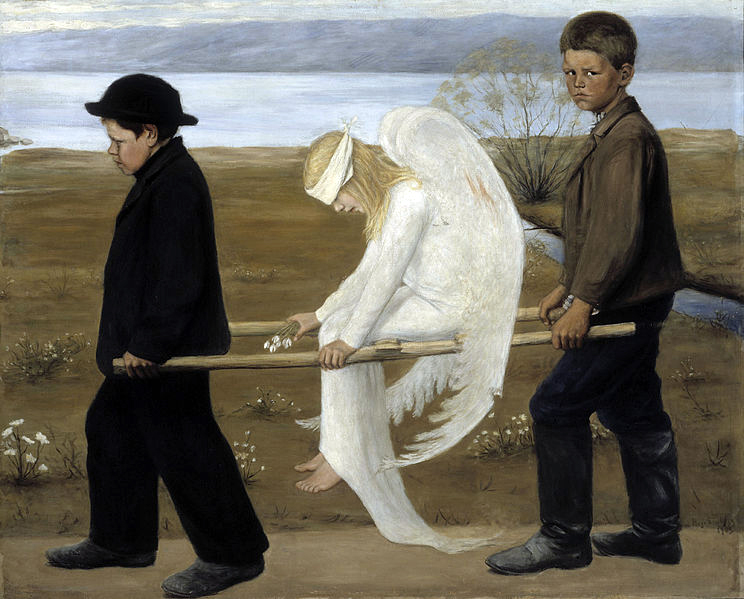
The Wounded Angel - Hugo Simberg

The Wounded Angel – Hugo Simberg

The challenge lies between two extremes: to squeeze into the coat or to alter it – and therein lies beauty – the full scale of our different stories unfolding.  We want to engage with the world, find a medium that communicates our unique myth – through being, play, work, service, music, dance, images, words, creating or dismantling ideas and objects. We crave for the ‘aha,’ the recognition, for symbolic understanding, and purpose.

The worst trials often sculpt the deepest processes. We deprive ourselves when judging those who don’t fit the norm, as demonstrated in this video about the Outsider artist, Judith Scott. Her works are exhibited in The Museum of Everything. When late in life she was welcomed in a creative space, Judith discovered a language for her inner history, her myth, and prayer. She devoted herself to wrapping up things, protecting things, keeping them safe and secure. Like many artists through whose very personal process shines the universal, she made psychological and spiritual sense of her genome.

<p>Video from <a href=”http://www.karmatube.org”>KarmaTube</a></p&gt;

In case the embedded video won’t show – it’s a great site:   http://www.karmatube.org/videos.php?id=3563&utm_content=buffer59550&utm_source=buffer&utm_medium=twitter&utm_campaign=Buffer

We’re all artists. Becoming a unique human being is a phenomenal creative achievement. In a culture that measures people against a uniform blueprint of perfection we easily lose sight of the unique perfections arising from within individuals, from within us.

*    *    *

The story of Judith Scott reminded me of a few lines from a Sufi prayer by Hazrat Inayat Khan

… Oh thou – life eternal –

we seek thy loving enfoldment …

15 Comments

Filed under Blog

… patterns of eternity humbly opens your mind …

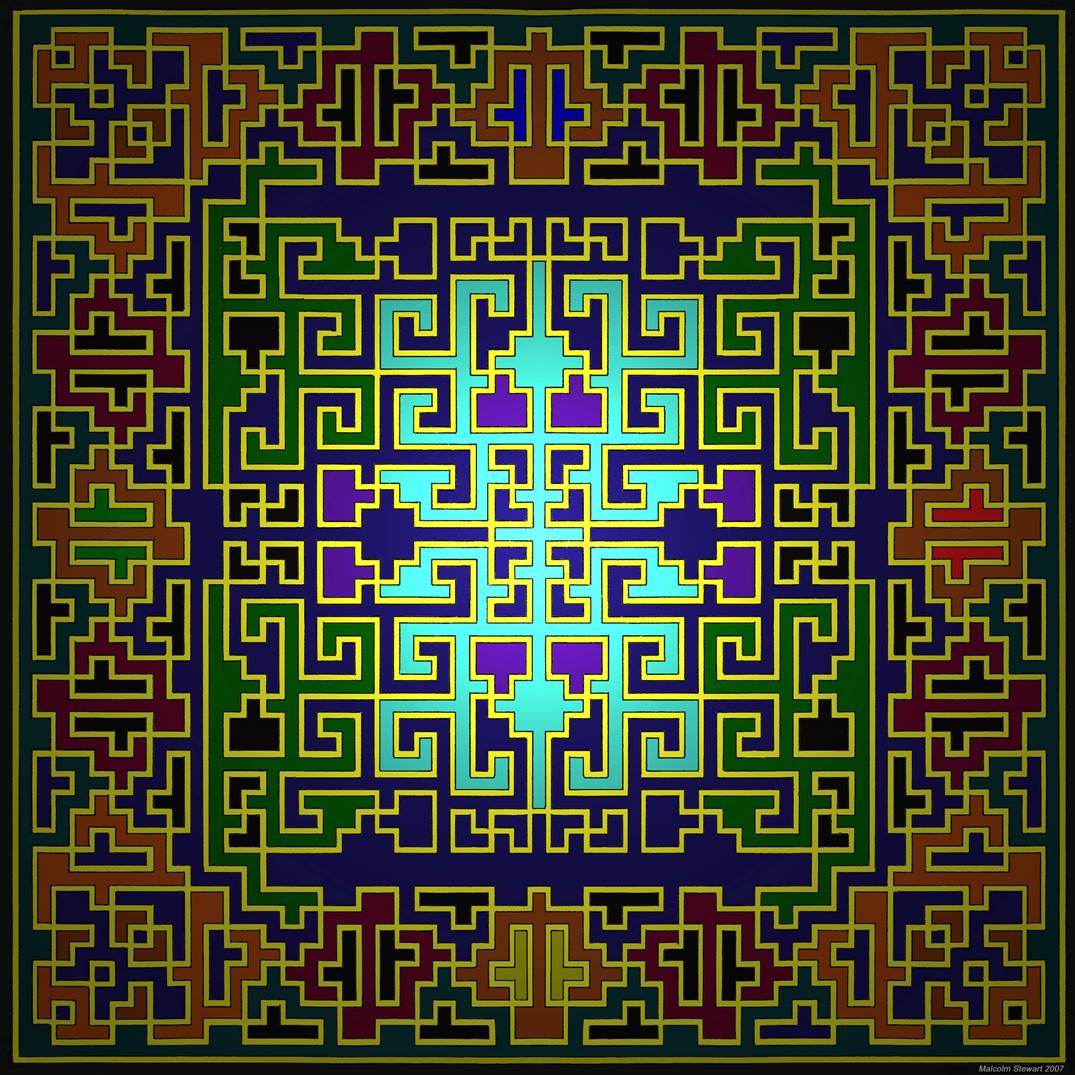
I want to tell you about a friend and writer – Malcolm Stewart – Initially a priest, Malcolm’s life sparkles with many roles – poet, singer-songwriter, editor, book jacket designer, cartoonist, BBC and ITV producer, UN project coordinator, NGO relief-aid and refugee organiser, artist, stained glass designer, lecturer and writer, friend, husband and father to 5 children … He is now in his 70s and lives with his wife, Nora, in Surrey. The Maze below is one of his many designs waiting to be collated and shared.

Maze design by Malcolm Stewart

Maze design by Malcolm Stewart

Having published Patterns of Eternity, of which more later, Malcolm wrote a second book, Symbols of Eternity. In the process of delivering the manuscript to his publisher, Floris Books, in March 2011, Malcolm suffered a stroke, which deeply shocked his family and friends.

He consequently lingered in a coma – drifting in and out of consciousness over a period of 5 weeks. Helped by the extraordinary determination of his wife, Nora, intense rehabilitation, the healing skills of friends, and the prayers of many, Malcolm gradually recovered speech and movement. During 2012/13 he improved in leaps and bounds. He now walks several miles a day, is his old delightful conversationalist, and has made friends with his computer again. He is working on another book, Light of Eternity (landmarks of a soul’s journey) and, in addition, is completing a novel he had kept hidden in drawers for years – Dictionary of Amazement.

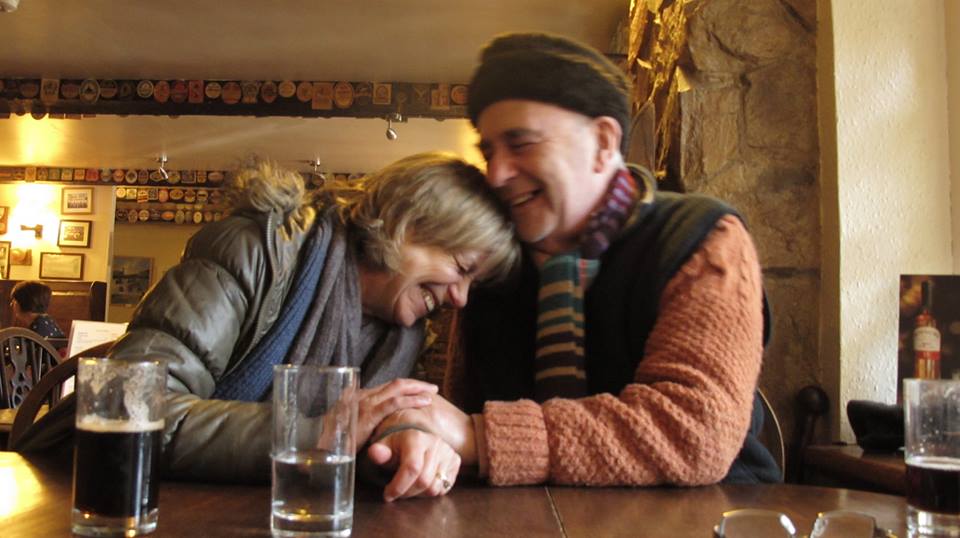
Malcolm and Nora Stewart, photo by Peter Langford

Malcolm and Nora Stewart, photo by Peter Langford

We met up last week, and I asked him to sum up Dictionary of Amazement in a single sentence (a question I dread when it comes to my own novels.) His face lit up – A Tall Story – he said. It was one of those moments when you can hear the angels clapping. He read me the first chapter from the screen of his computer, and I can’t wait to read more.

Malcolm’s work inspires me. Even as a child I was in awe of music, forms and patterns in nature, proportions in art and architecture, the cosmos … and though I remained shy of mathematics, I recall my joy on discovering that all these manifestations could be based on mathematical principles of numbers made visible through geometric shapes, revealing a golden mean that pervades all systems. As I see it, evolution is the adventure of discovering the intersections from which new forms forever develop. Or, to re-appropriate the line of a poem by John Masefield I came across the other day (through Brain Pickings) … the mind re-members the beauty of fire from the beauty of embers

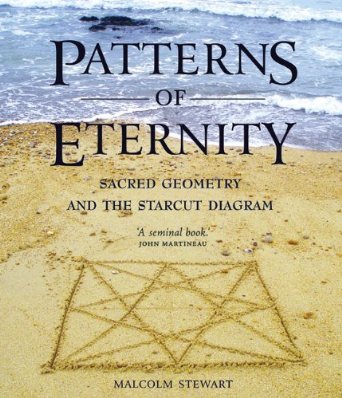
Patterns of Eternity - by Malcolm Stewart

At intervals to writing this, I was dashing into the kitchen to check on the setting point of my Damson jam, which requires a fine knack of proportions – fruit, sugar, lemon, a little water. We’re all born with a knack for proportions – though this tends to get obscured by an education that tips the scale of balance by valuing quantity over quality.

While much has been written on sacred geometry, Malcolm’s book is unusual. Not only does it welcome lay persons, like me, and entertain with rare, charming stories, and sumptuous illustrations, it also presents a simple device of great significance, the Starcut Diagram.

John Martineau writes in his review about Patterns of Eternity … the single most important addition to the body of sacred geometry to re-emerge in a decade …

Look up the book   Patters of Eternity (first time I try to do an ‘elegant’ link 🙂

An excerpt of my review: … The Star Cut Diagram introduced by Malcolm Stewart is an eye-opener in that it sheds light on one of the simplest and earliest geometric construction known, which he suspects pre-dates Euclid by thousands of years, a mnemonic device, and the template of many significant patterns throughout history and across the world … in architecture, art, rituals … a way of seeing and connecting things up.

Here a few themes from the book …

Chapter 8, The Hidden Geometry of The Divine Raphael. This chapter made me realise why Raphael’s paintings are so appealing. Malcolm first noticed the geometry in his painting The Transformation, which perfectly fitted the boundary rectangle of two circles interlocking as a Vesica Piscis, a ration that is also the perfect 5th harmony in music, like the notes C and G played together, or in sequence. The simple 2:3 ratio, root of all this, is as harmonious to the eye as to the ear or to the mind. What fascinates is how the directional gaze of the characters in the painting brings meaning to the theme.

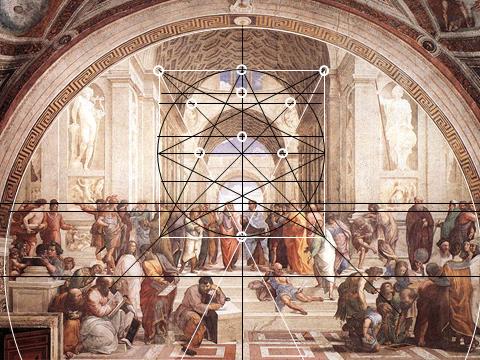
Raphael - The School of Athens

Raphael – The School of Athens

The chapter also explores Raphael’s fresco set in a semicircle, The School of Athens. In the ceiling medallion (not visible here) it says Causarum Cognito (Knowledge of Causes.) The female figure of philosophy in the medallion holds two books, one vertically, which is titled ‘Morals,’ the other horizontally, titled ‘Nature,’ resonating with the two central philosophers – where Plato points to heaven and Aristotle gestures to the earth. All the well-known philosophical figures in this stage-like painting also represent ideas, and Malcolm expands on their connections in detail, adding inspired meaning by overlaying the diagram of the Starcut.

Chapter 21, The Lyre of Apollo, applies the Starcut diagram to architectural spaces and relates to vibrations and resonances. Images show samples of standing waves created by sound within different elements. And the tonal vibrations of the human voice are discussed, like Psalm singing, the reciting of Indian puja, Sufi Zikhr, Buddhist sutra chanting or mantra. Practising this kind of tuning in groups (as I experienced) powerfully tunes mind and body. The chapter goes on to elaborate on the length, tension and ratio of musical strings, using once more the Starcut diagram to show the consistent harmony of numbers, and the hidden one that remains quiet.

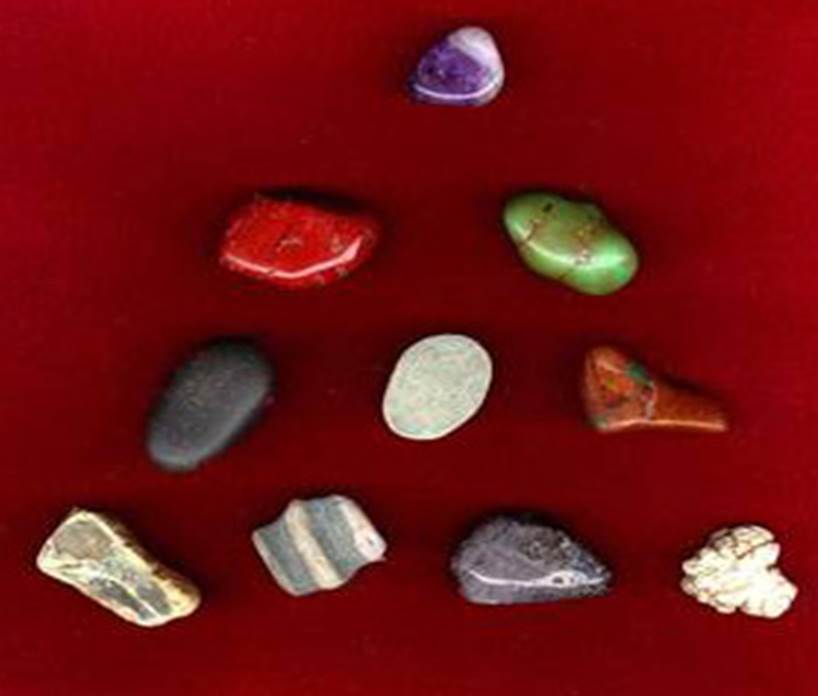
P. of Eternity, ten pebbles

By bringing light and clarity to simple forms, with beautiful illustrations, the materials presented throughout the 25 chapters convey a deep intuitive connectedness, which makes this book a joy to explore.

A surprise at the end of the book introduces 5 Starcut Glass Bead games, not featured here.

You can listen to Malcolm reading a little from Patterns of Eternity on yourtube http://www.youtube.com/watch?v=-N8QiyJU_SY

Dip into it at Amazon – PATTERNS OF ETERNITY  http://www.amazon.co.uk/Patterns-Eternity-Geometry-Starcut-Diagram/dp/0863157122/ref=cm_cr_pr_pb_i

And also look at SYMBOLS OF ETERNITY   http://www.amazon.co.uk/Symbols-Eternity-Landmarks-Soul-Journey/dp/0863158374/ref=pd_sim_b_2

19 Comments

Filed under Blog

… the mystery of thoughts …

Every child is truly switched on to the imagination. But frequently the environment belittles the imagination, and the gift can end up suppressed under the blanket of rationality. People with a strong creative drive may settle down to live in a straitjacket, and then find themselves overwhelmed by images, thoughts and associations, especially around full moon.

As a child I was intensely curious about the spaces between things, and about light. Had I not locked horns with an opinionated physics teacher I might have taken up the challenge to study sciences. Another fascination of mine was pattern repetition – how the veins in a leaf resemble the shape of a tree. And scale – how tiny bodies, big bodies, our planet, galaxies, the universe, are all reflected in each other.

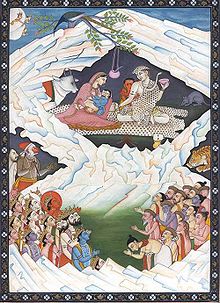
 Hindukailash, image from wikipedia.

Hindukailash, image from wikipedia.

Like Indra’s net of pearls in Vedic mythology, where the surface of each pearl mirrors all other pearls, a metaphor for the interconnected networks of mutual relationships between parts and systems. Mount Kailash is depicted here as the timeless and motionless centre of this net, housing Shiva’s family.

Not only visible structures are held together by interactive nets, our social systems, political systems, spiritual systems and the internet operate within a network. We can observe that the invisible psyche (mind) functions not only through logic, but also through aesthetics, independent of space/time, and is held by another kind of coherence – a net of meaning. And what is generated from this net of meaning is a finer kind of energy, not evidenced by present scientific methods – namely intelligence.

We knew it all along – research established that our emotional experiences leave an imprint in the cells of our body, that the brain is more than the squishy mass under our skull but a medium spread throughout the body via a network of neurotransmitters. There have been hair-splitting arguments for and against the idea that the recipient of an organ can experience personality traits of the donor, based on the speculation that each cell carries a hologram of the whole body and its memory.

Feelings and thoughts arising in my consciousness are filtered through my body’s memory. They also depend on my state of anxiety or calm, my interest, attitude and other variables, such as the weather, my relationship with the elements, with people, the collective mood, solar flares, or the constellation of planets. On some days, maybe after a meaningful dream, or a spell of mantras, thoughts are forming clearly on the breath, like reflections in a still pond, on other days, thoughts rush in on water rapids threatening to drown me, or they plod in like turtles, slow and guarded.

Objective reality is not the only game there is – what in the universe has not interacted at some point in time, irrespective of distance? Everything is linked up. Einstein called it the ‘spooky action.’

The motherboard for this wonderful instrument we call the brain, which comprises our whole body, is formed in the womb. I believe the intelligence involved in creating any specific body must lay in more than known DNA codes, must include the indeterminable non-local DNA of a spirit world. Our body foremost operates like a receiver and transmitter for as many wavelengths our radio station in time attracts or is able to tune into.

From this station, stabilized by repetition, I sort clusters of sensations and feelings, and process thoughts and ideas attracted to me from the collective psyche, a vast sea, which the individual mind must learn to navigate. Images and signifiers are coloured by whatever I consciously or unconsciously mirror and relate to.

No matter how much information we absorb, through our senses, through language and concepts, through comparing patterns, reasoning and calculation, everything, comprehended or not, will be filtered through the body’s motherboard that keeps adjusting to experiences and expanding fields of perception, fields that extend way beyond personal memory. All this information is continuously re-shuffled, as is the meaning we assign to it.

Our body is a motherboard – planet earth is a motherboard – the whole cosmos is a motherboard for a spirit we cannot comprehend, an invisible hand that touches us like a breeze, made visible through what it animates.

All we know is that images, thoughts and ideas are reflected in us. They travel via synapses in the neurons of our body, they travel on the air between minds, they travel among stars, they echo from under the sea, waving to us as plankton, they speak to us from every creature, from every blade of grass, from every stone, and they beep from within our bodies through tweaks of pleasure or pain. All matter, all people and objects we interact with store the memory of that interaction, including interactions with things we hate or nurture, and with places we live in.

We don’t invent anything, we re-discover, re-connect and re-create from the vast storehouse of knowledge and information provided to us by nature, and by the spirit between matter that makes up the cosmos, an embodied being that is becoming conscious of itself.

We are on the air, sent, programmed, radioed and broadcast, identified with all manner of things, ideas and beliefs. Yet if we look deep inside our emptiness, we know, the non-material aspects of us can potentially detach and be free, maybe enjoy tea with Shiva’s family and witness the world turn on its axis – a state some people experience spontaneously or through meditation. A state of pure consciousness not identified with this or that. In the meantime, we could at least be kind to ourselves …

‘Thoughts are beings that generate … One thought of kindness gathers a thousand beings of love and kindness around one.’            Hazrat Inayat Khan

I don’t know if a singular mind/psyche, the incredible art of a lifetime, survives the physical death of the body. Maybe a coherent individuated mind leaves a dent, an influence within the collective psyche. Like the organ of the heart, over time, achieved its definite function. But does it matter? Nothing is lost. All information is continuously re-shuffled into new forms and constellations.

Digital storage provides a metaphor – information exists and roams freely in the wind of the collective psyche (unconscious) until it is embodied and gathered towards a purpose. Every event has a consequence. Nature is exacting, but also generous, what has been repressed in the flow of evolution will always return in one form or another.

Everything alive speaks to us, and all such relationships are processed in the stories we share, stories being containers of the richest kind of information. 

*    *    *

You can source other posts on the theme of reflection in the tag cloud on the right of this page. Like this sequenc of posts: https://courseofmirrors.wordpress.com/tag/hazrat-inayat-khan/

And you might want to check out posts under the tag ‘psychology,’ especially the one on ‘awareness,’ where I share R. Assagioli’s 10 psychological laws – how the body affects the mind and the mind affects the body. https://courseofmirrors.wordpress.com/tag/psychology/

*     *    *

This post also appeared at  Third Sunday Blog Carnival: September 2013 | Third Sunday Blog Carnival

17 Comments

Filed under Blog

… mother tongue & other tongue …

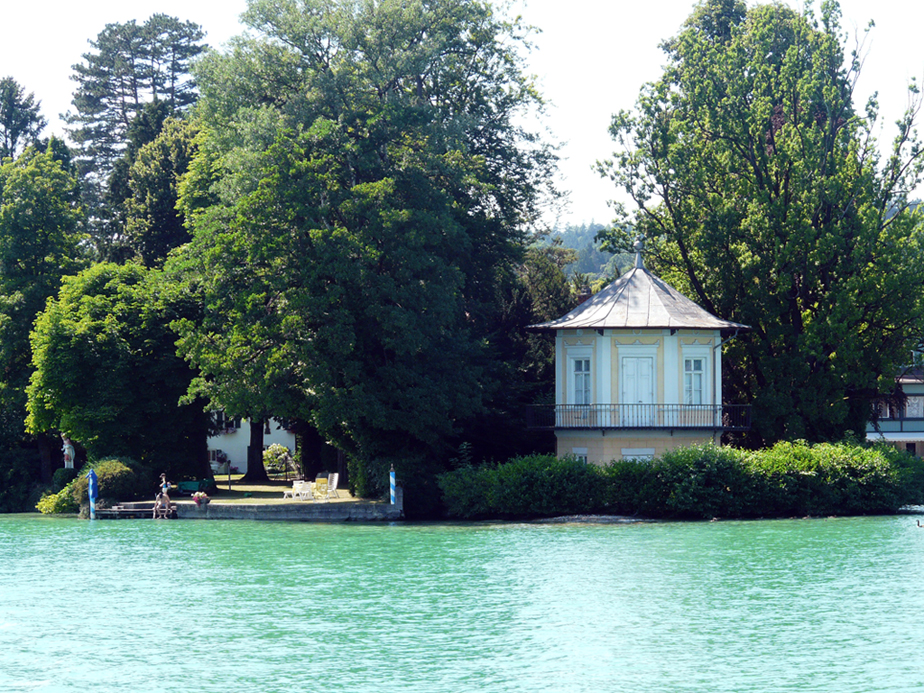
Starnbergersee

Starnbergersee


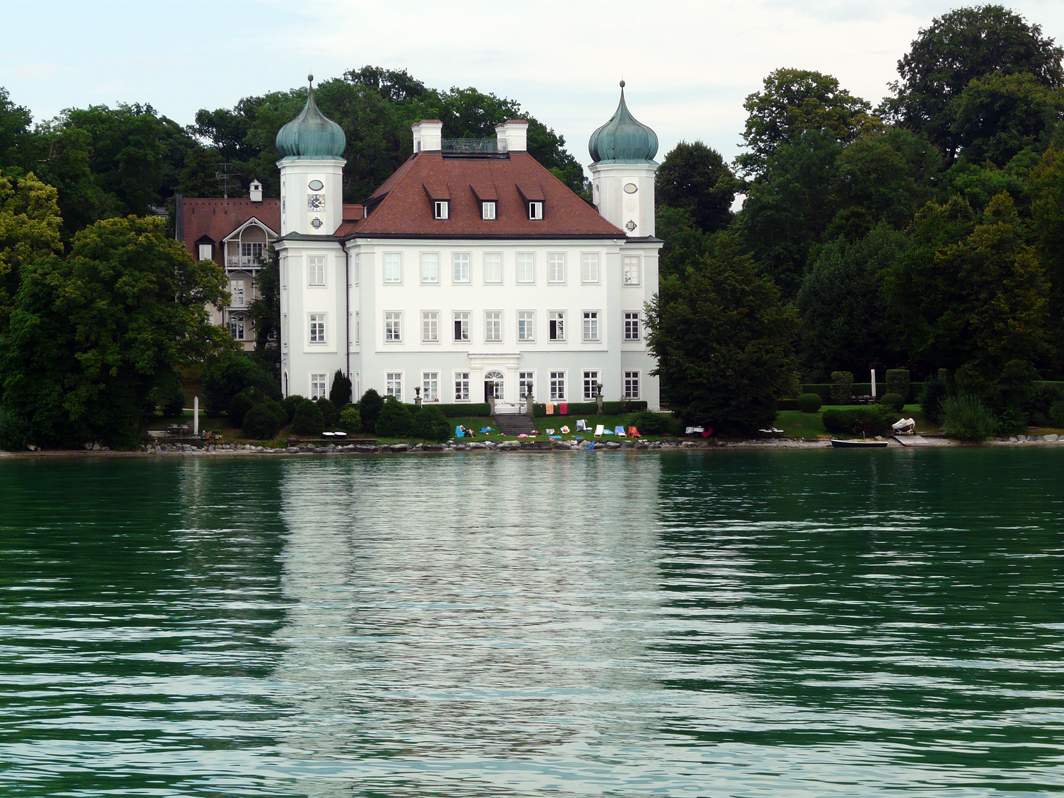
Two languages, two rhythms, two patterns, two spheres, two perceptions … last week I attended a re-union of my primary school class in Bavaria. Around 20 of us turned up.  The event included a ship ride on the lake that marks the geography of my childhood – Starnbergersee – whose shores are garlanded with castles and grand villas. Once I’ve won the lottery I’ll snap up one of these dream places and invite all my readers to a prolonged party with performances of magic theatre. Yeah!


Das Vogelhäuserl

Das Vogelhäuserl


The tour added a refreshing breeze to the sweltering heat. Later in the day a smaller group gathered at a lakeside restaurant, the same spot where, as a child, I turned up in summer holidays, at sunrise, to assist the local fishermen bringing in their full nets, in return for the free use of a small sailing boat during afternoons.

A re-union

A re-union

The encounter with classmates I hadn’t seen for over half a century unfolded like a surreal dream as we cooled down with beer and wine and gossiped time away into the evening. I’m still trying to fit names to faces and places, and make sense of stories that cast stray beams on my memories of the village I grew up in, a village close to the Alps, set in landscapes whose ambiance morphed into the beginning of my first novel.


Schloss Berg

Schloss Berg


Among my class mates were a few women I quickly chimed with, not surprisingly, we were close friends during those early years, though we lost touch when we moved on to different schools. It’s deep and wondrous – the mystery of this precious resonance called friendship.


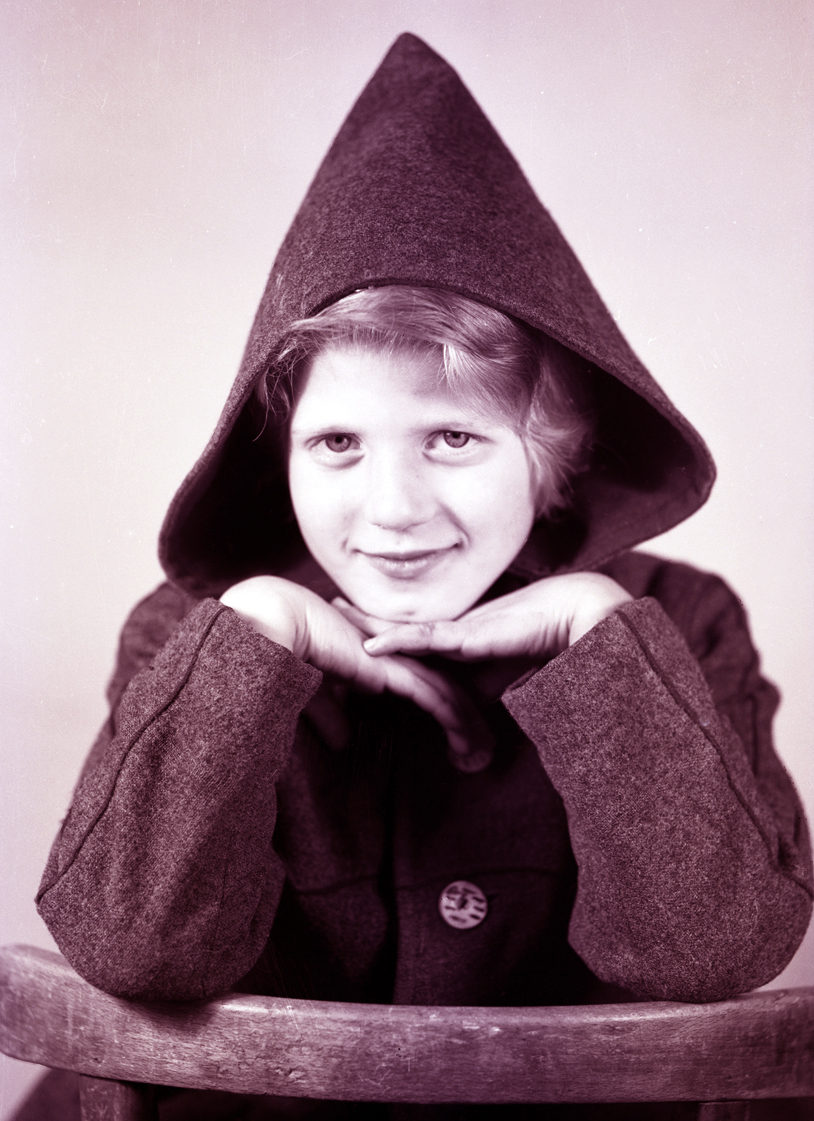
This is me, aged 6, on my first school day. I was a single child.

Erster Schultag

Erster Schultag

And I well remember the excitement. The Zuckertüte, the upside down magician’s hat filled with bonbons, chocolates and presents to sweeten the transition into the big world seems to grace my head in the photo my dad took. I can’t find the image right now, but I did receive a proper Zuckertüte on the day, filled to the rim.

My favourite teacher (in the group photo with the village poem post, link below) turned up at the re-union, slow on his legs but sharp witted. His eyes lit up when he recognised me, which gave me a warm feeling all over.

Living in England since several decades, I visit Germany periodically to see my grumpy late-artist-dad, and dear German friends, made during my later Sturm und Drang phase. What struck me about the school re-union was how the primary sensation of my childhood was brought to life through words tossed into the conversations, keywords from my mother-tongue, embedded in local dialect. My mother, who came from Berlin, never picked up the Bavarian dialect, neither did I, however, the term mother tongue incorporates for me my early environment, the village. https://courseofmirrors.wordpress.com/2012/08/31/village-poem/

For the greater part of my life I thought by and spoke in the other tongue, which I first learned at school. Aged 18, unsure of my path, I spent a cultural year with a family friend in London. She cherished me. Our relationship was a healing experience for both of us, given her loss of friends and family members in the Holocaust, and my inherited burden of the atrocities having taken place in my country. Later, studying in Munich, English was the language connecting a multicultural student population. When 9 years on I married a Dutch man and we moved to England together, my German vocabulary gathered dust during further studies. The distance from my mother tongue freed up a wider perception. It also helped me overcome an encoded traumatic experience. At secondary school I had written an essay, freely based on a painting of my choice by Spitzweg – writing was then a blissful creative process. The teacher read the essay aloud, praising its brilliance, after which she informed the whole class that I could not have composed this myself – a screaming insult! And yet, I thank the stupid woman, it changed the course of my studies. I initially used photography to express myself, resuming poetry and imaginative writing later, finding that English allowed me the necessary wings.

Who knows what the dusted off layer of my mother tongue will bring round. Writing in the other language helped me to transcend the mere facts of my life to essential themes, universal metaphors. The divided kingdom of parents, the psychology of the single child, her assumed bridging function between patterns of seeing, like the rational and imaginative perception, the distorted mirrors of relationships, betrayals, the search for the real, and the meeting of soul families. Essential themes lifted like green islands from dark waters during my protagonist’s river journey west.

Course of Mirrors is a gripping adventure story, as well as a psycho mythical opus. In its sequel the teller of the story is revealed as the visionary myth-maker overtaken by her myth – in the way that we can re-arrange the past and postulate possible futures, explore different time-zones, and expand expectations.

I must leave it to my readers to judge the results of my experiment. The first book, Course of Mirrors, will be published next year, by a small but devoted publisher.


Are you a writer/artist who processes experience through two or more languages?


38 Comments

Filed under Blog

… precious hopes …

The buzz of web-traffic can be exhilarating, a universe of stimulation, stories, advice, facts and know-hows. We put our name out there, mingle with travellers, seek adventure, share our thoughts, fulfil a task, meet like minds, exchange or sell something, and hopefully find synchronicity, resonance – yet at times …

P1090901 - Copy

Nasrudin rode the train to work every day. One day, as usual, the train conductor came and asked him for his ticket. He begun fumbling around in his coat pockets, and his pant pockets, and then in other people’s pockets. He looked in his briefcase, in his bags, and then in other people’s bags.

Finally the train conductor said, ‘Nasrudin, I’m sure you have a ticket. Why don’t you look for it in your breast pocket? That is where most men keep it.’

‘Oh no,’ said Nadrudin, ‘I can’t look there. Why, if it wasn’t there, I would have no hope.’

*     *     *

‘Why, if it wasn’t there, I would have no hope.’ What spooked the legendary fool’s mind that day? What do you make of the story? What does the ticket symbolise/represent for you? A hope can be so deeply meaningful to us that we keep it hidden at times, even from ourselves. Then we look for affirmation elsewhere because we couldn’t stand having our faith dashed.

Yes, I have such days. Where is the ticket to your hopes and dreams to be found? Are you keeping it close to your heart, holding it there, to remind yourself of inspirational instances when grace happened in your life, so when grace visits again you can seize the moment?

pink rose - black&white

*    *    *

I chose the particular version of this wisdom tale from a lovely book edited by Elisa Davy Pearmain, Doorways to the Soul. She calls the story The Lost Ticket. You find a link to Elisa’s website in my blog roll.

A classic collection of wisdom tales I treasure is in Caravan of Dreams, by Idris Shah.

13 Comments

Filed under Blog

… when did you last smile? …

When did you last smile? The question started us going. I belong to a bunch of friends, 10 to 20, who meet monthly. We rotate the facilitation of sessions. People propose themes worthy of engagement. Our April session had the theme of Positive Psychology. The term, coined by Martin Seligman, has been called unoriginal and evokes ongoing controversies, not least because basic theories promoting well-being have been around for a long time, for centuries. Overall, the disputes are creative.

P1110122

P1110124

The off-the-track cottage and studio we hire for our monthly meetings has a delightful atmosphere. We love it, though its structure is gradually falling apart. The custodians of the property have more pressing concerns, and so have we. After a unique international creative centre was lost to us eight years ago, this liminal space offered itself. Here we challenge and cherish each other, explore ideas and welcome guests.

As to the initial question of the day – when did you last smile? – Of late, I frequently smile at my quirky thoughts. That day however, I recalled waking early and passing a vase brimming with pale double daffodils, splayed open to full perfection in the morning sun. No matter how fleeting an instant of wholeness, it tends to ravish me into my veiled wholeness. The exquisite flowers invigorated every cell in my body and set the tone for my day. It was a moment of transcendence, of grace.

We explored scientific findings as to what goes on in different parts of our brain when we experience emotions. There is evidence, for example, that prolonged stress weakens the immune system. Stress may be real or imagined. It can be maintained by resentment, anxiety, learned helplessness and the anticipation of negative outcomes, often based on scary experiences (even in the womb) that informed expectations, like the world is unsafe and we have no control over events. Neurobiology is fascinating, though I wonder if it can ever explain existential questions about phenomenology. Some of us bring along a lucky or unlucky disposition, but a great deal of what we become seems to depend on the interpretation and meaning we give to what is happening to us.

Bang head here

Which begs the question, can optimism be learned through challenging negative self-talk, the kind that rubs it in, like – here we go again, I should’ve know, stupid me, no matter what I do –  and so on. For some people prolonged attention to self-talk works. Many brilliant techniques have been developed to overlay fixed habits. Extensive research has gone into the mastery of happiness, especially in the US. This said – Martin Seligman, the father of Positive Psychology, acknowledges that negativity is part of the human condition. As such, I see negativity having a compelling function in social systems that first make us ill and then sell us pills, a larger story…

I tend to huff when a generic psychological approach is wrapped up as a brand and turned into an industry, and Positive Psychology has become a successful industry during the last decade. Then again, there were a great many innovators since Abraham Maslow, who, inspired by ancient wisdom traditions was the first to challenge Psychology’s focus on pathology at the time, by researching what motivates people up the hierarchy of needs, and by defining the qualities of achievers. The work of Seligman and his colleagues seeks to encourage functionality, resilience and well-being. It provides further valuable applications and insights regarding human potential that are worth studying.

I personally lean towards the subtle wisdom regained during my training with Psychosynthesis in the 1980s. We may reach peak states of awareness as our consciousness expands, bliss even, yet each higher view calls for a journey down, into denser spheres. C G Jung put it well … As far as we can discern, the sole purpose of human existence is to kindle a light of meaning in the darkness of mere being.’

P1110127

Our group is an irreverent lot. We had fun, warm and lively discussions, and we engaged with personal questions. From a set of 24 cards we chose our 5 dominant signature strengths. Humour trumped several times, followed by creativity, perseverance, appreciation, fairness and perspective. Oddly, there was one card I ignored but which jumped to the top when I did a test on-line – Appreciation of Beauty and Excellence. I later figured out why I had held back from picking up the card. This appreciation, which I have to a high degree, is also the source of lingering sadness, because Beauty and Excellence touch me deeply, are glimpsed rarely, and are hard to live up to and shine with. Then again, moments of grace, a sudden seeing that stops time, like the daffodils of that morning, carry me through periods of melancholy and questioning. The theme of the day stayed with me, and after some reflection I came to this conclusion:

I would not be happy being happy all the time. For better or worse I walk the tightrope of contradiction.

*      *      *

The cards we used are available at:  http://mindspring.uk.com/shop/strength-cards/

Here is a site with a questionnaire that measures your character strengths http://www.viacharacter.org/www/ It’s free, unless you want a longer report.

The photo of the Stress Reduction Kit poster is by Programwitch, found on Flickr.

13 Comments

Filed under Blog