… delights of peek-a-boo …

In ways we project ourselves into our surroundings, as children we delight in the appearance, vanishing and re-appearance of a loved object or person.

Georgios Jakobides - 1895

Georgios Jakobides – 1895

To observe something reappear is as thrilling as green shoots returning in spring, as inexplicable as birth itself. Hide and seek or peek-a-boo are games said to adjust toddlers to ‘object permanence,’ an illusion we embrace, yet these games are also the prelude to a lifelong quest for the mystery of existence. Children, unless talked down to and belittled, ask deep questions – where do I come from, where did the candle-flame go, where has grandpa gone, how long is time, how come I see things with my eyes closed?  The same questions spurn lifelong passion in scientists.

Growing social, we slip into collective rituals of seeing, feeling, thinking and doing. We obey, ignore or defy rules meant to serve cultural cohesion, rules promising acceptance and success in life. We respond or react according to circumstance and temperament. Some of us have a need to belong, feel safe, protected, others may venture into the unknown, become spiritual warriors on a warpath with obstacles, often rituals, blocking individual potential.

I’m a warrior learning from obstacles, one of which I like to share.

You may recall commands, often subtle and inferred, by early significant persons, communicated via responses, to you, to life, based on generational ideals. These commands worm themselves into the psyche and settle around an inner critic. While well-meaning in aiding conscience and integrity, this critic can also become strident and counter-productive.

In my case – the critic periodically berates me for not keeping my own promises … stay on top of things, complete tasks,  respond to request without delay, call on friends, de-clutter, prepare accounts, fix the warped front-door, only so many roll-ups a day, only two glasses of wine … the tick-off list is … ah well … endless …

Good objectives aside – the more the opinionated critic berates my shortcomings, the more I need to release the tension by transgressing self-imposed rules – otherwise the noise of my inner battle drives away the bird of intuition, the unexpected and the wonder of each day.

I listen, but won’t bow to the critic, obey in fear and cage the bird. In my book, this sums up the making of tyrants.

More and more often I remember to soften the demands. Instead of berating I praise myself for small promises kept, for what has gone well, small steps in overcoming this stealthy ritual that does not benefit my aims. It’s my idiosyncratic strategy: no fighting, no surrendering. Try it – humour the critic into humanness and adjust your rules of engagement with the elegant phenomenon of now.

P1050813 - lowres You may ask – how does my strategy relate to hide and seek and peek-a-poo?

It’s the play with reality by the child in us – the delight in re-discovering being.

*    *    *

This little bird cheered me, it arrived flattened in a Christmas card. Instructions read: Stand me up on my feet.

Blessings to my friends for 2014 – may the bird of intuition frequently visit you.

19 Comments

Filed under Blog

… emitting the real …

nothing beats the spiral

nothing beats the spiral

In the spaces between

Harmony and chaos

Wisdom voids the mind

To expose veins of

Hidden avoidances

Where – omniabsent –

Omnivalent in our longing

We exist inverted –

Give in receiving

Receive in giving

While surfing across the deep

To simulate worlds

Sift signals

Endure ironies

For evermore becoming

And emitting realities

Fleeing the ground

Of being …

*    *    *

Dear readers, I hope you stick around, while I’m immersed in writing scenes  for my second book, Shapers – the continuation of an epic search for the real.

10 Comments

Filed under Blog

… a november poem …

NOBLE EXIT

P1050746 -low threshold

white plumes of mist rise

from a dripping branch – swept clean

but for nine that cling

lit by the last ray

they call out with gilded tongues

from the garden’s shade

translucent spearheads

uncaring of their fate they aim

at the hungry ground

Ashen

P1050746 -low and contr

13 Comments

Filed under Blog

… months of writing – 1st feedback from a beta-reader …

Two weeks ago I sent 20 chapters of a novel in progress (sequel to Course of Mirrors) to a friend. A long train journey from Brighton to Penzance (Radio Cornwall recorded her poetry) meant she could get stuck into reading. This morning I received an enthusiastic response from her, and demands for more chapters. Waiting for the first feedback from a sophisticated beta-reader engenders a period of nerve-wrecking suspense, so I was truly cheered.

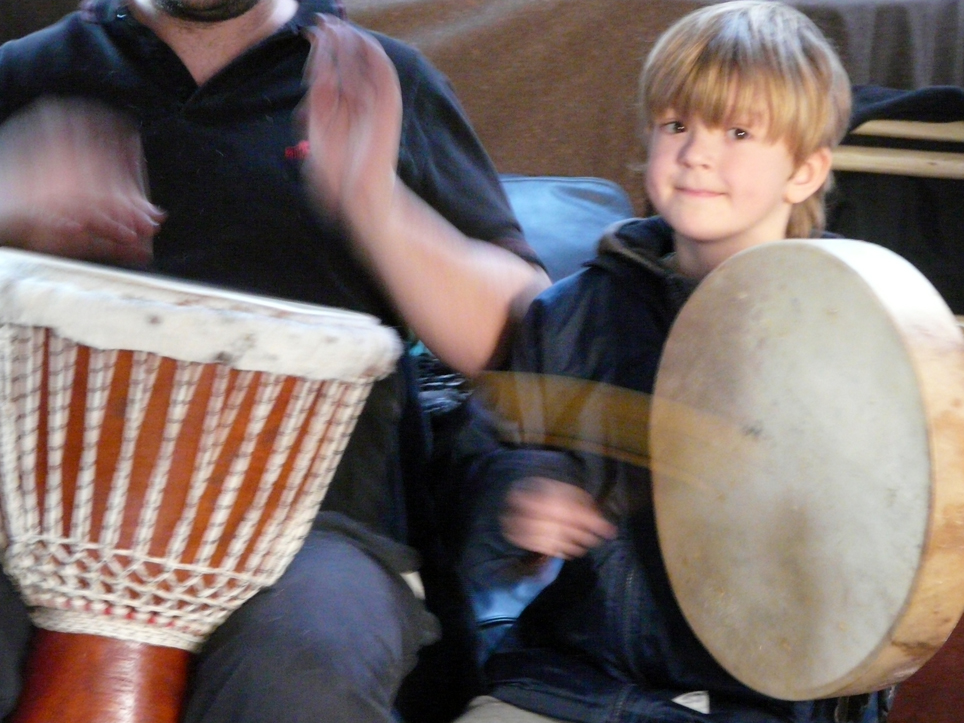
And it was a great start for today’s Shaman-drumming soirée, organised by my dear friends. Drumming clears the air and opens channels to other worlds, while grounding us in our present reality. And meeting up with 11 real bodies :) nourished this lonesome writer.

Drumming J. J. junior

Drumming J. J. junior

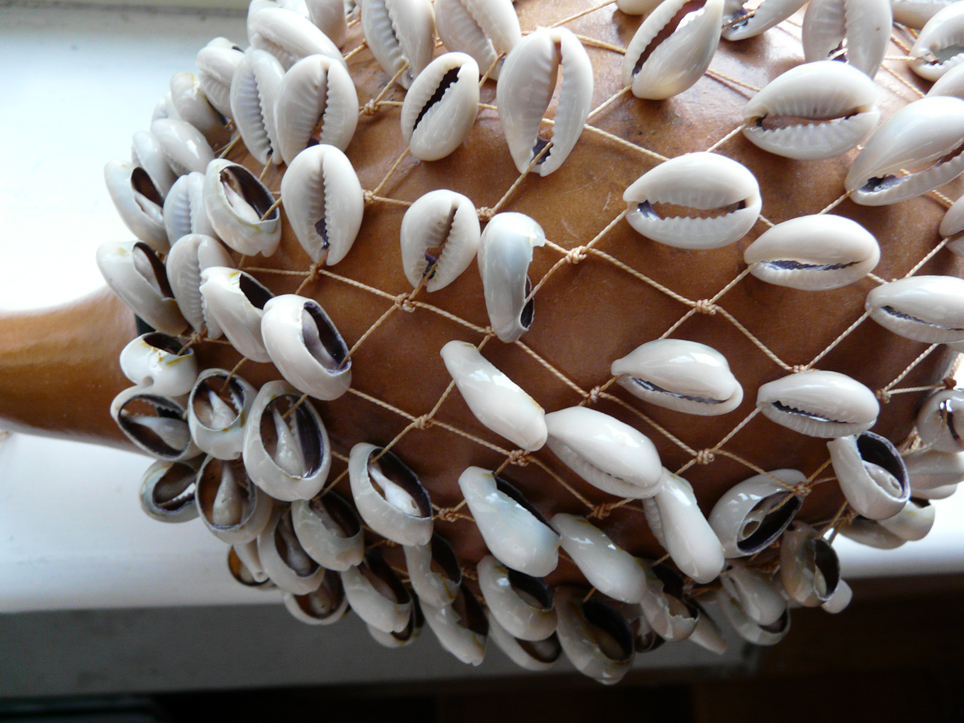
Seashell Rattle

Seashell Rattle


And I love those tiny shells. Imagine them washing up from the deep sea and rattling against the shore. When netted around a hollow gourd they make a most magical sound.


I’m looking forward to the publication of ‘Course of Mirror’ next year. http://www.armadillocentral.com/index.php?option=com_content&view=article&id=134:new-author-ashen-venema&catid=1:general&Itemid=1

And after my beta reader’s feedback, I feel encouraged, and have confidence that the sequel to my mythical and speculative novel will enchant readers no less, and that the series will acquire a fan fellowship. The idea for a third book in the series is taking shape.  

During periods of being intensely immersed in writing (my process demands solitude) I invariably neglect my Twitter and Facebook friends, and you, dear readers of my blog. I hope you nevertheless enjoy my occasional posts and bear with me.

9 Comments

Filed under Blog

… she discovered her language …

Expelled from the womb as a bundle of around 100 trillion cells, our tiny body brings along a generous genetic tome of ingredients for traits that dance together in a myriad of potential formations – depending on chance and circumstance. The process of sequencing and mapping the tome of an organism is immeasurably more complex and unpredictable than sensational media articles tend to suggest. http://en.wikipedia.org/wiki/Common_misunderstandings_of_genetics

Add inherited family models and cultural traditions – blessings and curses – this bundle of potential is compelled to fit into a given coat that eventually becomes too tight, or the colour is off, the material too heavy, and most likely the design clashes with our sensibilities. In short, the coat can conceal our potential and our essence, even to us.

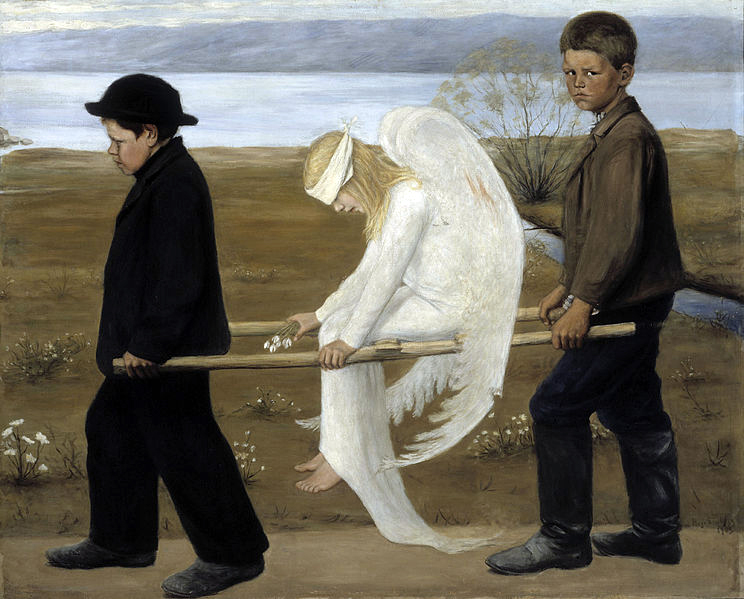
The Wounded Angel - Hugo Simberg

The Wounded Angel – Hugo Simberg

The challenge lies between two extremes: to squeeze into the coat or to alter it – and therein lies beauty – the full scale of our different stories unfolding.  We want to engage with the world, find a medium that communicates our unique myth – through being, play, work, service, music, dance, images, words, creating or dismantling ideas and objects. We crave for the ‘aha,’ the recognition, for symbolic understanding, and purpose.

The worst trials often sculpt the deepest processes. We deprive ourselves when judging those who don’t fit the norm, as demonstrated in this video about the Outsider artist, Judith Scott. Her works are exhibited in The Museum of Everything. When late in life she was welcomed in a creative space, Judith discovered a language for her inner history, her myth, and prayer. She devoted herself to wrapping up things, protecting things, keeping them safe and secure. Like many artists through whose very personal process shines the universal, she made psychological and spiritual sense of her genome.

<p>Video from <a href=”http://www.karmatube.org”>KarmaTube</a></p&gt;

In case the embedded video won’t show – it’s a great site:   http://www.karmatube.org/videos.php?id=3563&utm_content=buffer59550&utm_source=buffer&utm_medium=twitter&utm_campaign=Buffer

We’re all artists. Becoming a unique human being is a phenomenal creative achievement. In a culture that measures people against a uniform blueprint of perfection we easily lose sight of the unique perfections arising from within individuals, from within us.

*    *    *

The story of Judith Scott reminded me of a few lines from a Sufi prayer by Hazrat Inayat Khan

… Oh thou – life eternal –

we seek thy loving enfoldment …

15 Comments

Filed under Blog

… apples, flu, altered states, wedding plans …

This autumn is drunk with colours and fruit. Red-blushed, in their own sweet time, apples have been falling with soft thuds onto the dewy lawn for weeks. Each morning they blink at me, and shout – help, pick me up, the slugs are coming. They’re good for something, but did you know that slugs and snails are hermaphrodite, and lay up to 500 eggs a season? Re: fruit, after last year’s poor crop, this year’s harvest is a tad overwhelming. The scale by which nature balances excesses evades rational comprehension.

autumn colours

autumn colours

Too much of a good thing brings obligations. Eaters taste best when fresh, so I’m urged to act fast. Slug-nibbled and bruised fruit lands on the compost heap. The bulk of apples, several kilos a day, I wash, dry, box and put out on the road for passers-by, mainly kids on their way home from school. This time-consuming and noble deed has left me exhausted, and with numerous bumps on my head. Here’s the apple saint, drop now. For lack of a resident family to boss into cider-making, I’m left with ‘waste not’ ringing in my ears. If you remember scarcity, you’ll co-suffer the enforced hypocrisy of a  twenty-first-century system that thrives on waste.

I could blame the nagging ‘waste-not‘ guilt for frustrating the flow of my writing. I could blame three early morning trips to London on crowded trains, or  alien dust settling on my skin … whatever …  my body succumbed to the annual purge of flu. So a week ago I sneezed and coughed through fever and chills. Sweaty nights occasioned surreal dreams and visions, and there were days when I lost faith in my invulnerability, reminded that I need to clarify some matters in my Will. I survived – with tons of lemons. You’ve guessed by now that I’m shy of conventional medics, a story I won’t regale you with. The last official need for a doctor’s visit to my home was benign, and over three decades ago,  after I’d given birth to a healthy baby in deepest rural Somerset.

So last Sunday, following a week of altered states, I ventured out to put petrol in my car. I support small enterprises for their human idiosyncrasies. The cashier gazed absent-mindedly over the forecourt and across the street towards a line of taxies, while automatically debiting my Visa and, at my want, pressing another button to produce a tax receipt. Sensing a process at work, I said, ‘You’re bored.’

His head moved independently from his neck. You may remember the craze of bubble-head mascots:  http://en.wikipedia.org/wiki/Bobblehead that’s exactly how his head moved while his eyes rolled in their sockets to take note of my witnessing. His mouth then rounded and huffed before emitting a speech he must have rehearsed all morning. Slow, precise thoughts poured out, including snippets of existential dialogues he had had with taxi drivers from across the road. Written down, it could have edged itself towards some literary prize. His exposition ended with : ‘Nothing to be done. I’m bored stiff.’ Reminiscent of Beckett. Promises, waiting … in tune with my dull-witted flu-states. Missing most words, I was captivated by the man’s brilliant and spooky slaying of meaning. Another customer entered the cubicle. On leaving, some wise-crack in me I’ve no control over, said, ‘You’re reading …’ thinking, you’re observing life  from a distance, co-creating  its absurdities and joys. It’s what writers do.

 ‘Boredom is the dream bird that hatches the egg of experience. A rustling in the leaves drives him away.’   –  Walter Benjamin. 

*    *    *

This post was meant to be short and about my son and his partner, to brag a little.

Yeshen with baby croc, photo by Natasha, Aug. 2013

Yeshen with baby croc – there’s a story

Yeshen and Natasha

Yeshen and Natasha

They were engaged this year and their August journey to Australia had been a reconnaissance for their wedding plans next July, organised by Natasha’s family, who live in Darwin and Perth.

I asked if I could share a few images from their trip. Yesh and Tash have featured on my blog before, indirectly. You’ll find them, for example, under ‘Inspiration’ or ‘Story of an Animation.’ They’re self-employed and work extremely hard, like many young people in super-expensive London, to make a living. They’re lucky being able to do creative and fulfilling work.


I’ve not been to Australia, and am now looking forward to this journey – you can see why.  

Australia's west coast

Australia’s west coast

17 Comments

Filed under Blog

… patterns of eternity humbly opens your mind …

I want to tell you about a friend and writer – Malcolm Stewart – Initially a priest, Malcolm’s life sparkles with many roles – poet, singer-songwriter, editor, book jacket designer, cartoonist, BBC and ITV producer, UN project coordinator, NGO relief-aid and refugee organiser, artist, stained glass designer, lecturer and writer, friend, husband and father to 5 children … He is now in his 70s and lives with his wife, Nora, in Surrey. The Maze below is one of his many designs waiting to be collated and shared.

Maze design by Malcolm Stewart

Maze design by Malcolm Stewart

Having published Patterns of Eternity, of which more later, Malcolm wrote a second book, Symbols of Eternity. In the process of delivering the manuscript to his publisher, Floris Books, in March 2011, Malcolm suffered a stroke, which deeply shocked his family and friends.

He consequently lingered in a coma – drifting in and out of consciousness over a period of 5 weeks. Helped by the extraordinary determination of his wife, Nora, intense rehabilitation, the healing skills of friends, and the prayers of many, Malcolm gradually recovered speech and movement. During 2012/13 he improved in leaps and bounds. He now walks several miles a day, is his old delightful conversationalist, and has made friends with his computer again. He is working on another book, Light of Eternity (landmarks of a soul’s journey) and, in addition, is completing a novel he had kept hidden in drawers for years – Dictionary of Amazement.

Malcolm and Nora Stewart, photo by Peter Langford

Malcolm and Nora Stewart, photo by Peter Langford

We met up last week, and I asked him to sum up Dictionary of Amazement in a single sentence (a question I dread when it comes to my own novels.) His face lit up – A Tall Story – he said. It was one of those moments when you can hear the angels clapping. He read me the first chapter from the screen of his computer, and I can’t wait to read more.

Malcolm’s work inspires me. Even as a child I was in awe of music, forms and patterns in nature, proportions in art and architecture, the cosmos … and though I remained shy of mathematics, I recall my joy on discovering that all these manifestations could be based on mathematical principles of numbers made visible through geometric shapes, revealing a golden mean that pervades all systems. As I see it, evolution is the adventure of discovering the intersections from which new forms forever develop. Or, to re-appropriate the line of a poem by John Masefield I came across the other day (through Brain Pickings) … the mind re-members the beauty of fire from the beauty of embers

Patterns of Eternity - by Malcolm Stewart

At intervals to writing this, I was dashing into the kitchen to check on the setting point of my Damson jam, which requires a fine knack of proportions – fruit, sugar, lemon, a little water. We’re all born with a knack for proportions – though this tends to get obscured by an education that tips the scale of balance by valuing quantity over quality.

While much has been written on sacred geometry, Malcolm’s book is unusual. Not only does it welcome lay persons, like me, and entertain with rare, charming stories, and sumptuous illustrations, it also presents a simple device of great significance, the Starcut Diagram.

John Martineau writes in his review about Patterns of Eternity … the single most important addition to the body of sacred geometry to re-emerge in a decade …

Look up the book   Patters of Eternity (first time I try to do an ‘elegant’ link :)

An excerpt of my review: … The Star Cut Diagram introduced by Malcolm Stewart is an eye-opener in that it sheds light on one of the simplest and earliest geometric construction known, which he suspects pre-dates Euclid by thousands of years, a mnemonic device, and the template of many significant patterns throughout history and across the world … in architecture, art, rituals … a way of seeing and connecting things up.

Here a few themes from the book …

Chapter 8, The Hidden Geometry of The Divine Raphael. This chapter made me realise why Raphael’s paintings are so appealing. Malcolm first noticed the geometry in his painting The Transformation, which perfectly fitted the boundary rectangle of two circles interlocking as a Vesica Piscis, a ration that is also the perfect 5th harmony in music, like the notes C and G played together, or in sequence. The simple 2:3 ratio, root of all this, is as harmonious to the eye as to the ear or to the mind. What fascinates is how the directional gaze of the characters in the painting brings meaning to the theme.

Raphael - The School of Athens

Raphael – The School of Athens

The chapter also explores Raphael’s fresco set in a semicircle, The School of Athens. In the ceiling medallion (not visible here) it says Causarum Cognito (Knowledge of Causes.) The female figure of philosophy in the medallion holds two books, one vertically, which is titled ‘Morals,’ the other horizontally, titled ‘Nature,’ resonating with the two central philosophers – where Plato points to heaven and Aristotle gestures to the earth. All the well-known philosophical figures in this stage-like painting also represent ideas, and Malcolm expands on their connections in detail, adding inspired meaning by overlaying the diagram of the Starcut.

Chapter 21, The Lyre of Apollo, applies the Starcut diagram to architectural spaces and relates to vibrations and resonances. Images show samples of standing waves created by sound within different elements. And the tonal vibrations of the human voice are discussed, like Psalm singing, the reciting of Indian puja, Sufi Zikhr, Buddhist sutra chanting or mantra. Practising this kind of tuning in groups (as I experienced) powerfully tunes mind and body. The chapter goes on to elaborate on the length, tension and ratio of musical strings, using once more the Starcut diagram to show the consistent harmony of numbers, and the hidden one that remains quiet.

P. of Eternity, ten pebbles

By bringing light and clarity to simple forms, with beautiful illustrations, the materials presented throughout the 25 chapters convey a deep intuitive connectedness, which makes this book a joy to explore.

A surprise at the end of the book introduces 5 Starcut Glass Bead games, not featured here.

You can listen to Malcolm reading a little from Patterns of Eternity on yourtube http://www.youtube.com/watch?v=-N8QiyJU_SY

Dip into it at Amazon – PATTERNS OF ETERNITY  http://www.amazon.co.uk/Patterns-Eternity-Geometry-Starcut-Diagram/dp/0863157122/ref=cm_cr_pr_pb_i

And also look at SYMBOLS OF ETERNITY   http://www.amazon.co.uk/Symbols-Eternity-Landmarks-Soul-Journey/dp/0863158374/ref=pd_sim_b_2

19 Comments

Filed under Blog

… interludes – and poetry by W S Graham …

I’ve neglected you, my reader friends, immersed in writing the sequel to ‘Course of Mirrors’ and a few interludes. Like, my writing fixation was pleasantly disrupted last week through meeting my son at Covent Garden, and later attending the launch of ‘The Inflatable Buddha’ by András Kepes at the Hungarian Cultural Centre in London.

Armadillo Central launches 'The Inflatable Buddha.'

Armadillo Central launches ‘The Inflatable Buddha.’


It is the newest project of my to-be publisher http://www.armadillocentral.com/  András’s novel offers a more subtle perspective than officially recorded history, showing the fictional lives and wits of three ordinary, idiosyncratic Hungarians during the twentieth century. The sample readings enticed me, and I’m now looking  forward to reading the book. The well-attended, grand launch event also gave me a taste of what is to come – being exposed to questions about my own epic .


Then came a traumatic interlude to my writing …

I mourn the shimmer and music of its leaves.

I mourn the shimmer and music of its leaves.

During the last two days, to the grinding noise of chainsaws and a shredder, I mourned the loss of a beautiful poplar/aspen tree in my neighbourhood, which has grown too high for its owner. The now mutilated tree (the image shows a third of its size) will be gone completely next week. I’ll miss the shimmer and the watery music of its leaves, produced by the slightest breeze, and the golden hearts trailing into my garden come autumn. I picked a few early leaves to treasure, pressed to dry in my dictionary.

Today a most pleasant surprise … a poetry book arrived unexpectedly in the post, sent by a Scottish friend/poet, who is at this moment working with a visual artist on a project about Tin-mining in St Ives. Due to blank spots in my education I rely on stumbling upon poets less publicised, and was delighted to receive this gift of an expertly edited ‘New Collected Poems’ by W S Graham. So I thought I’ll share excerpts from his poems – on themes that will chime with fellow writers .

W. S. Graham (1918-1986) grew up in Clydeside, Scotland, and initially followed the footsteps of his father, who was a structural engineer in the ship-building trade. However, a year studying philosophy and literature at an adult education centre outside Edinburgh set him on the path of writing poetry for the rest of his life, irrespective of meagre financial rewards. He travelled to London and New York City, but later lived with his wife in Cornwall.

W S Graham, image by Sally Fear

W S Graham, image by Sally Fear

I was delving into the book this morning. Here some facets, unconnected lines, the first from THE NIGHTFISHING    (1955) – a melodic composition, speaking to the seen and unseen,  from a night in a herring boat out on the North Sea.

… Gently the quay bell

Strikes the held air …

Strikes the held air like

Opening a door

So that all the dead

Brought to harmony

Speak out on silence …

I am befriended by

This sea which utters me …

… Far out calls

The continual sea.

Now within the dead

Of night and the dead

Of all my life I go.

I’m one ahead of them

Turned in below

I’m borne in their eyes

Through the staring world.

The present opens its arms …

… Each word is but a longing

Set out to break from a difficult home. Yet in

It’s meaning I am …

… The bow wakes hardly a spark at the black hull.

The night and day both change their flesh about

In merging levels …

The iron sea engraved to our faintest breath

The spray fretted and fixed at a high temper,

A script of light …

… The streaming morning in its tensile light

Leans to us and looks over on the sea.

It’s time to haul. The air stirs its faint pressures

A slat of wind …

… The white net flashing under the watched water,

The near net dragging back with the full belly

Of a good take certain …


Some of the last lines of – THE NIGHT CITY – a turning point … I found Eliot and he said yes … T S Eliot was then with Faber and Faber. He became Graham’s publisher.

… Midnight. I hear the moon

Light chiming on St Paul’s

The City is empty. Night

Watchmen are drinking their tea …

Between the big buildings

I sat like a flea crouched

In the stopped works of a watch.


From IMPLEMENTS IN THEIR PLACES (1977) I picked a refrain from WHAT IS LANGUAGE USING US FOR ?

… What is the language using us for?

It uses us all and in its dark

Of dark actions selections differ …


And last – AIMED AT NOBODY – Poems from Notebooks (1993)

PROEM

It does not matter who you are,

It does not matter who I am.

This book has not been purposely

made for any reason.

It has made itself by circumstances

It is aimed at nobody at all.

It is now left just as an object by me

to be encountered by somebody else.


*    *    *

This may well be how it feels for most writers who simply can’t help sculpting experiences into words. What do you think?

6 Comments

Filed under Blog

… how to re-frame the ‘click’ mantra …

Try saying ‘click’ aloud a few times in front of a mirror – you’ll look like a grinning monster. 

I’ve a love/hate relationship with the internet. To navigate the jungle for meaningful contact I repeatedly click to open or close doors, and the ‘clicking’ does something to my brain, it leaves a deep impression. 

click, click, click, click, click, click, click, click, click, click, click, click, click, click, click, click, click, click, click, click, click, click, click, click, click, click, click, click, click, click, click, click, click, click, click, click, click, click, click, click, click, click, click, click, click, click, click, click, click, click, click, click, click, click, click, click, click, click, click, click, click, click, click, click, click, click, click, click, click, click, click, click, click, click, click, click, click, click, click, click, click, click, click, click, click, click, click, click, click, click, click, click, click, click, click, click, click, click, click, click, click, click, click, click, click, click, click, click, click, click, click, click, click, click, click, click, click, click, click, click, click, click, click, click, click, click, click, click, click, click, click, click, click, click, click, click, click, click, click, click, click, click, click, click, click, click, click, click, click, click, click, click, click, click, click, click, click, click, click, click, click, click, click, click, click, click, click, click, click, click, click, click, click, click, click, click, click, click, click, click, click, click, click, click, click, click, click, click, click, click, click, click, click, click, click, click, click, click, click, click, click, click, click, click, click, click, click, click, click, click, click, click, click, click, click, click, click, click, click, click, click, click, click, click, click … 

From now on I’ll take charge of this repetitive action – with each click I’ll say or think ROSE – transforming the impression into my kind of mantra. It’s re-wiring the brain. NLP calls it re-framing. It’s an ancient technique.

Autumn Rose

https://courseofmirrors.wordpress.com/2012/12/15/the-rose-trick/


11 Comments

Filed under Blog

… the mystery of thoughts …

Every child is truly switched on to the imagination. But frequently the environment belittles the imagination, and the gift can end up suppressed under the blanket of rationality. People with a strong creative drive may settle down to live in a straitjacket, and then find themselves overwhelmed by images, thoughts and associations, especially around full moon.

As a child I was intensely curious about the spaces between things, and about light. Had I not locked horns with an opinionated physics teacher I might have taken up the challenge to study sciences. Another fascination of mine was pattern repetition – how the veins in a leaf resemble the shape of a tree. And scale – how tiny bodies, big bodies, our planet, galaxies, the universe, are all reflected in each other.

 Hindukailash, image from wikipedia.

Hindukailash, image from wikipedia.

Like Indra’s net of pearls in Vedic mythology, where the surface of each pearl mirrors all other pearls, a metaphor for the interconnected networks of mutual relationships between parts and systems. Mount Kailash is depicted here as the timeless and motionless centre of this net, housing Shiva’s family.

Not only visible structures are held together by interactive nets, our social systems, political systems, spiritual systems and the internet operate within a network. We can observe that the invisible psyche (mind) functions not only through logic, but also through aesthetics, independent of space/time, and is held by another kind of coherence – a net of meaning. And what is generated from this net of meaning is a finer kind of energy, not evidenced by present scientific methods – namely intelligence.

We knew it all along – research established that our emotional experiences leave an imprint in the cells of our body, that the brain is more than the squishy mass under our skull but a medium spread throughout the body via a network of neurotransmitters. There have been hair-splitting arguments for and against the idea that the recipient of an organ can experience personality traits of the donor, based on the speculation that each cell carries a hologram of the whole body and its memory.

Feelings and thoughts arising in my consciousness are filtered through my body’s memory. They also depend on my state of anxiety or calm, my interest, attitude and other variables, such as the weather, my relationship with the elements, with people, the collective mood, solar flares, or the constellation of planets. On some days, maybe after a meaningful dream, or a spell of mantras, thoughts are forming clearly on the breath, like reflections in a still pond, on other days, thoughts rush in on water rapids threatening to drown me, or they plod in like turtles, slow and guarded.

Objective reality is not the only game there is – what in the universe has not interacted at some point in time, irrespective of distance? Everything is linked up. Einstein called it the ‘spooky action.’

The motherboard for this wonderful instrument we call the brain, which comprises our whole body, is formed in the womb. I believe the intelligence involved in creating any specific body must lay in more than known DNA codes, must include the indeterminable non-local DNA of a spirit world. Our body foremost operates like a receiver and transmitter for as many wavelengths our radio station in time attracts or is able to tune into.

From this station, stabilized by repetition, I sort clusters of sensations and feelings, and process thoughts and ideas attracted to me from the collective psyche, a vast sea, which the individual mind must learn to navigate. Images and signifiers are coloured by whatever I consciously or unconsciously mirror and relate to.

No matter how much information we absorb, through our senses, through language and concepts, through comparing patterns, reasoning and calculation, everything, comprehended or not, will be filtered through the body’s motherboard that keeps adjusting to experiences and expanding fields of perception, fields that extend way beyond personal memory. All this information is continuously re-shuffled, as is the meaning we assign to it.

Our body is a motherboard – planet earth is a motherboard – the whole cosmos is a motherboard for a spirit we cannot comprehend, an invisible hand that touches us like a breeze, made visible through what it animates.

All we know is that images, thoughts and ideas are reflected in us. They travel via synapses in the neurons of our body, they travel on the air between minds, they travel among stars, they echo from under the sea, waving to us as plankton, they speak to us from every creature, from every blade of grass, from every stone, and they beep from within our bodies through tweaks of pleasure or pain. All matter, all people and objects we interact with store the memory of that interaction, including interactions with things we hate or nurture, and with places we live in.

We don’t invent anything, we re-discover, re-connect and re-create from the vast storehouse of knowledge and information provided to us by nature, and by the spirit between matter that makes up the cosmos, an embodied being that is becoming conscious of itself.

We are on the air, sent, programmed, radioed and broadcast, identified with all manner of things, ideas and beliefs. Yet if we look deep inside our emptiness, we know, the non-material aspects of us can potentially detach and be free, maybe enjoy tea with Shiva’s family and witness the world turn on its axis – a state some people experience spontaneously or through meditation. A state of pure consciousness not identified with this or that. In the meantime, we could at least be kind to ourselves …

‘Thoughts are beings that generate … One thought of kindness gathers a thousand beings of love and kindness around one.’            Hazrat Inayat Khan

I don’t know if a singular mind/psyche, the incredible art of a lifetime, survives the physical death of the body. Maybe a coherent individuated mind leaves a dent, an influence within the collective psyche. Like the organ of the heart, over time, achieved its definite function. But does it matter? Nothing is lost. All information is continuously re-shuffled into new forms and constellations.

Digital storage provides a metaphor – information exists and roams freely in the wind of the collective psyche (unconscious) until it is embodied and gathered towards a purpose. Every event has a consequence. Nature is exacting, but also generous, what has been repressed in the flow of evolution will always return in one form or another.

Everything alive speaks to us, and all such relationships are processed in the stories we share, stories being containers of the richest kind of information. 

*    *    *

You can source other posts on the theme of reflection in the tag cloud on the right of this page. Like this sequenc of posts: https://courseofmirrors.wordpress.com/tag/hazrat-inayat-khan/

And you might want to check out posts under the tag ‘psychology,’ especially the one on ‘awareness,’ where I share R. Assagioli’s 10 psychological laws – how the body affects the mind and the mind affects the body. https://courseofmirrors.wordpress.com/tag/psychology/

*     *    *

This post also appeared at  Third Sunday Blog Carnival: September 2013 | Third Sunday Blog Carnival

17 Comments

Filed under Blog