Irrespective of the benefits AI provides, and the super benefits AI enthusiasts promise, I remain doubtful and, as I tried to express in my last post, and am still searching for ways to express my unease. So I’ll give it another try.
My body-my being is a better wisecrack than my mind alone. The latter, if let loose, will take off into the cosmos like a disengaged kite. Some AI proponents are now referring to humanity as – data in motion – a ‘precious phenomenon’ that needs to be preserved. Well, how reassuring, nature and humans are worth preserving.
Being aware in my body brings deep and grounded, embodied insights that feel fresh and original.
Our body’s treasure-trove of memory, each wonderfully distinct from another; and its instinctive capacity for remembrance, especially when alert to its senses, greatly compensates the buzzing mind.
The body yearns to breathe freely, so energy and blood can flow from head to toe, which is enhanced by movement, since movement stimulates tactile exchanges with the environment, noting temperature, touch, vision, sound, taste and scent, all enriching the imagination.
The attention-demanding internet with its algorithms exploiting the patterns of our attention can become hypnotically addictive and leave the body isolated, forgotten, in a locked position. We can easily live with theories and data, and ignore how feelings build up in the body.
AI bots have developed a theory of senses, and mimic them, they can write novels, create art, and impersonate dead people, but divorced from flesh and blood, they cannot have physical sensations, be it the intimate enchantment of a tiny insect or flower, or the awe of a star-filled sky. The bot’s world, in a way, seems predetermined and flat without recall of the reservoir of eons of plant, animal and human life our vulnerable body-being belongs to and has deep instinctual access to. Even with limited/impaired senses, physical bodies can spark a cosmic connectedness.
So considering our physical inconveniences, which spurn the desire for robots taking care of tedious tasks … to actually fully live in a body … is uniquely precious. The dangers I see are the powerful projections people already invest in the relationship with AI bods, where responses can be taken as valid affirmations that stunt creativity and encourage lazy thinking.
Then again, my window of perception is just a tiny peephole on the world we live in these days, my personal view. The occasional whispers of truth from the other side that slip through my peephole may or may not be of any consequence.
I share a poem I love … my son wrote it time ago, aged eleven …
Time to close the book and prepare for sleep, not always assured. Still, let’s advance to our night time ritual.
Thank you my little palace.
I love you. I know you are me too, and both of us rely on the mysterious soul, but I call you my body. Forgive our mind for ignoring your gentle cautions and prompts, again. Forgive the unreliable promises, like the hot shower you craved, less time in front of the laptop screen, not eating that pretzel baked with wheat, which gives you gas, or indulging in that late extra glass of Rose. Our rebellious mind has a masochistic streak of resisting your well-meant counsel.
So before sleep, here are some treats. I massage our feet, and toes. Each toe has a name I address it with … big one, forward one, middle one, enchanted one, and little one. Next – a neck-rolling, then pinching and rubbing its surrounding muscles, and, not to forget, finger-cracking. These exercises are not just mechanical, without the imagination to sincerely call in the divine spirit, these rituals would be meaningless.
Pulling the duvet round our shoulders, we adopt a first position, curling on our right side, like a foetus in the womb, finding a cosy arrangement for the head with a small cushion, and recalling the last pages of the closed book, and summarizing impressions of the day.
Now it’s us wishing to just drift off into weightless realms – this remains a wish. We want to stretch, so we shift to lying on the back, flick toes, gently massage the stomach, pull up legs and spread them in a kind of opening-flower-like choreography. This feels good for a while. Then we shift to lying on the left. With less muscle tension our stomach rumbles, its juices are sighing with relief to get on with their purpose, digesting food.
Still, the mind is restless, processing past, present and future, wanting answers, hunting memory land for nostalgic moments, fresh connections, insights, inspiration, all quite useless, since it pulls us in a thousand directions and stops us from sleeping. So let’s do another shift to lying on the right, to escape the meandering thoughts. Our somewhat remorseful mind suggests sinking into images, in the belief that hypnotic images will put reason to rest. So we must try soothing the overly receptive brain. The restlessness may of course be due to oncoming temperature changes, or the energizing influence of the full moon.
Now we remember, a mantra, a prayer, sending blessings to dear ones, gratitude for The One that allows our mind and body to exist together in relative harmony, here, now. These neglected rituals are often surprisingly effective. Finally, vivid images emerge, of friends, places, visions. The self-regulating system of our body-mind will soon update itself in ethereal dream space.
It matters how we achieve sleep, it has a bearing on the way we wake up, clear and resolved for another day ahead, or confused and fretting over the unfinished gestalt of an idea that floats around evasively, like a butterfly. It can’t be helped; there are greater forces at work.
What grounded us next morning was watching a young fox frolicking and eventually flopping down to sunbathe in our garden.
Not just her daimon, but some unforgettable characters are given voices in the remarkable life of this visionary narrator, ‘Patchwork of a Safari Pilgrim’ by Philippa Rees. The link should include reviews.
Philippa Rees is also the author of an earlier, brilliant innovative work – INVOLUTION – that seeks to reconcile Science to God, structured as a dialogue between Reason and Soul, a revolutionary fresh hypothesis of evolution.
‘Safari of a Patchwork Pilgrim’ provides a mesmerizing background to this hypothesis, based on profound direct experience of another dimension. From my own, and shared stories during my client work, I’m certain they are more common than generally acknowledged. Without support, however, to integrate such insights into daily mundane life can be challenging, and often exposes people to ridicule, or much worse.
‘Patchwork of a Safari Pilgrim,’ is a vividly told story, sharing the agonizing attempt to bridge two worlds and translate meaning and truth between different dimensions. It’s the life of a genius.
A totally engaging read.
There’s presently nothing I could add to the brilliant reviews of Safari. I’m still digesting the unforgettable characters and the brilliant prose. But out of personal interest, I asked Philippa three questions, in the light of her experiences … and she graciously responded …
How did the sudden access to the Akashic memory change your sense of coherence?
My entry to the Akashic Record- the collective memory of evolution- was rapid but not sudden. The incremental loss of all my attachments to anything that ‘placed and held’ my identity: country first, then family, then moral injunctions (obligations), and finally, abandoning my children, for their sakes, one after another, removed the struts of what I (and others) thought was my identity. Through conflict, I surrendered each allegiance for a deeper one. It is why I had to take the reader through the growth of my understanding, with its critical components, and then the loss of each in turn. Leaving my children pulled me up by the roots.
Then I found myself in the mid-Atlantic, alone without any way forward or back. At this point, I was confined only by my fears, and they manifested physically in constant hallucinations of snakes. The snakes (fear) guarded the entrance to the Akasha.
I understood that instinctively. After experiencing compassion for the adder’s fear of me, and its explosion into a shower of sparks, the entry to the greater Akasha was cleared. I no longer had any fear, and the layers of creation manifested in wider and broader visions. What characterised these vistas was their integration with my own thoughts. Thought and vision coalesced. Space and time coalesced. I could move what I was seeing with my emotional thoughts. I could dive deeper into darkness (and it was sometimes terrifying) or imagine myself back into light. By imagine, I mean evoke memories and images of natural beauty like a mackerel sky, flocks of birds, a deer tripping through a dappled light. Those emotions of love and wonder acted like helium to raise me above the sucking, self-preserving fear.
I then realised that the co-ordinates of where each of us stands are in the crosshairs between love and fear. Love lifts, fear suppresses and sinks. Where they intersect determines what and who we are in every moment of our lives.
So what is called decoherence (aka madness) was much more coherent than the dislocation we normally live in, where thought and manifestation are separated. That separation is called time. In time, the material and the mental are distinct from one another. Causation works unidirectionally only, from the past to the present. We live in a squint-eyed world with only half of creation’s story. But the Akashic experience is timeless. Everything (both past and future) is simultaneously present because we contain it all. The future’s unrolling is already coded and inbuilt.
To try to live simultaneously in both the world of time and the timeless world of instantaneity, I adopted strategies (dancing, whirling and, when they threatened to confuse, falling), all of which, of course, were deemed symptoms of insanity.
That brings me to your next question.
How would you define synchronicity and how did it serve you?
If you understand the relativity of time, as being characteristic only of upper shallow surface layers, synchronicity is easier to understand. Not very different from dreaming, although in dreaming, events are still linearly sequenced, but changes can be instantaneous from one person or place instantly to another, and very much governed by emotions. Diving through the levels of the Akasha was like puncturing overlapping transparent dreams, the colours and images interpenetrating one another, some dark and terrifying, others sublime.
When we talk of synchronicity, we usually mean the improbable and simultaneous events that happen and which link together a particular significance for the observer. The observer makes the link of significance. Other people dismiss that significance and call it a coincidence simply because of its improbability. Only the person whose thought or perception sees the linkage understands it. That understanding imbues the events with meaning. So, in that sense, synchronicities appear to have the quality of a personal signal or a gift of confirmation—something from another world.
I would say that, indeed, they do come from another world, from the penetration of the Akashic memory into the world of time. They are also a gift from that world, and they tend to happen in moments of uncertainty when the person for whom they have significance is momentarily poised between conflicting claims. They are suspended without a causal imperative. So, they have the quality of confirming independent thought and action, a sort of nudge, ‘you are right, keep on, look afresh, believe in what is happening to you.’
Other manifestations of different causality can manifest in what are called poltergeist, teleportation and remote viewing. I believe all these are capacities of the same kind of altered consciousness in which perception of time and space is akin to the Akasha in which all is simultaneously present. Thought precedes manifestation. It is the central understanding in Involution, that consciousness creates.
The other aspect of synchronicity, which I came to understand very well, was that it can never be willed or anticipated, because it is not of this world of time. In that sense, it is always a gift. A gift that rewards the trust of being open to it. When you understand it and live within its affirmation, it happens more often, perhaps because you have somewhat freed yourself from the world of time and causality and live half-embedded in the divine. By the divine, I mean the acceptance of the perfect integrated linkage of all consciousness.
How did it serve me?
Through the extraordinary sequences of things being provided just when they were needed, I came to trust and rely upon my own integration into the divine. Clearly, my life was important in some way that superseded any beliefs I might have about it! At many moments of desperation, when I asked for signs or indications, there was only silence. Nothing. I came to realise that any act of will (wish, even prayer) was an affront to a supreme reality that had its own patterns, purposes and momentum. I could sink into and accept that, but not, in any small degree, orchestrate it! Not even by wanting or articulating a need! My needs were already known! And not always the ones I thought were paramount!
Once I had learned that, I found my well-being was provided for. All the improbable gifts; of a cruise to recuperate and then a home to build were given to restore me to the world of time and material 3D reality. Every person serves the divine creation, whether they know it or not. Synchronicity served both my exile and, equally, my return. The latter implied some purpose for which I had been preserved. Unlike the rapidity of my escape, the return was very much infused with slow and dogged time. Perhaps because I had travelled so far into instantaneity, I had to relearn the rules of material existence. For this reason, the writing of Involution was a compelling obligation of gratitude, and. in hindsight it rang out as also the intention of all that had happened to me. All had been necessary and led to it. And the writing of that was fostered and accompanied by constant synchronicities and the final affirmation of George Eliot! Back to ordinary time, but with filaments of Akashic timelessness still wafting and attached!
How would you explain the demands of your unique Daimon ?
This is more difficult. I want to avoid proselytizing or imposing my experience as any kind of special favour, and it is also deeply personal. But first, I must correct you: Daimon makes no demands, ever. The initial persuasion to write the book was not coercion but encouragement to have the courage to do what I contemplated for a long time.
When he, whom I call Daimon, first revealed himself, it was after a few disguises as other lovers. Without those, I would never have recognised, accepted or believed. For the Daimon is the Divine Self, or the Divine Companion, the Voice of the Soul, personal to me, but equally personal to anyone, whether recognised or not. That Voice is an expression of all the previous loves, both human and animal, and also the abstract loves of beauty, inspiration, music and longing. For a woman, likely to seem male; for a male, to seem female (the counter completion of the part) but also plural, uniting all, communing with all. Is Daimon God? Not entirely, but the personal God within, which, once recognised, is a constant presence, but also a Voice when addressed in the deepest silence, when all thought is stilled.
As I believe our DNA links each of us personally to the Akasha of historic memory, I believe the Divine Self links us to the God of All—So, in that way, it/he/she/they is both immanent and transcendent. The Voice does not speak unless thought or desperation calls to it. Occasionally, when I was in real danger, it alerted me. Perhaps the danger itself called out? That Self intimately knows the individual, his language, his references, but also his or her place and purpose, but the knowledge waits for its natural manifestation, never imposing any constraints upon liberty or error or time. But when directly addressed, it/he/she mirrors back /calls forth what is already known. When you think about it, to understand is to stand under. The umbrella of the Soul.
In ‘Safari’ I gave a direct voice to the Daimon in the recapture of events to alert a reader to what I had relied upon and consulted, at the height of the experience, almost constantly. He did not appear or penetrate my consciousness until all else was lost, and I had nowhere to turn, but at that point, he spoke very clearly. Without him, I would never have survived. So, feeling cherished, I ventured into the timeless worlds and took risks that to others, then and now, also seem insanely devoid of fear.
I have the sense that what God waits for, and why free will was granted to humanity, is reciprocity. God is lonely. He waits to be freely and joyfully loved by those gifted with the freedom to withhold it: Unlike angels who love by their nature, we have to choose.
Hence, the ending of both Safari and Canto the Ninth.
I shall know the moment I may turn and lift you…
My hands will liquid shape your acquiescence:
In the silent break of day, upon my shoulder
Upon dawn’s clavicle, your happy cheek will lean
Cradled in my neck, you’ll breathe our essence:
I shall carry you entwined and carefully
Through the silver light and striding water…
Wade until we drown in salt bright sea.
Liquid shape, Dawn’s clavicle, neck cradle, striding water- all anomalous contradictions; the point at which the individual and personal become the united universal.
Philippa would be an honourable member of the underground community of Shapers :) … scientists with a mystical bent, as featured in my novel of that name.
Day and night we receive and tie up new thoughts, mostly subliminal. By keeping track of this neuron dance we find fresh associations that expand the architecture of our imagination. Sudden insights lift our spirit. Frequently practical innovations arrive, novel ways of doing things. But with thoughts adrift, we often fail to be present to our bodies, and this neuron dance turns mechanical. We may be hampered by depression, presently a global dis-ease, but life perks up a little when we listen to our body.
‘Remember me,’ it implores. ‘Love me, give me attention.’
Stretching limbs calms the stress in fascia tissues and muscles, stirs the senses, and deepens breathing. Food tastes better, small things delight, movement gives pleasure.
‘We are souls dressed up in sacred biochemical garments and our bodies are the instruments through which our souls play their music.’ … Einstein
The unconscious collective psyche continuously churns up vital signals through the body, but has long been denigrated by wrong-footed ideologies … the greatest crime against humanity, since the neglect of nature’s voice led to the abuse that threatens the balance of life on this planet, and our health.
Nature – the wild, matter, psyche breath, being, anima, the feminine principle – contains all life. The term has acquired many slants of meaning during previous centuries. We have now established frames through which nature is perceived … the scientific, economic, political, apocalyptic, holistic, visionary, philosophical, romantic, and the spiritual frame, for example. Each outlook influences the relationship we have with nature, as a person, group or nation.
Since all human innovations are inspired by nature, every manmade thing is natural, yet by lengthening the duration-span of too many products, nature’s cyclic process of decay is disrupted, often with dire consequences. It’s like stuffing ourselves with food the body can neither absorb nor digest. Controlling nature’s rhythm does not work. The best we can attempt is to seek rapport, fall into step, attune and harmonise with this dance we are part of.
Quite likely all the varied frames which determine our relationship with nature were formed by the wish to make the unconscious force of the wild psyche more bearable.
We demand nature’s protection. This includes humans. Do the ecological villains among us also deserve protection? In a psycho-therapeutic practice this would be considered as the expansion of consciousness through befriending and owning the shadow. I forever wish this map of knowledge was introduced to the educational curriculum.
First call is the body. If the body’s messages are fully received (giving varied frames their due) and understood (in a deep loving sense,) the messages are always essentially true. Only humans manipulate and deceive, by ignoring and belittling nature’s raw truths. The planet suffers the same neglect. Our best efforts at deep listening will always be partial.
I count on the constant minority that grasps a wide spectrum of meaning in relation to every rift that endangers our world. While this minority tries to uphold a wider view, as a small collective it is not geared for action, knowing well that whatever succeeds in being legally determined cannot please all, but usually intensifies disagreements, especially in cultures where emotions and thoughts are censored for political ends.
One could say the will to action is diluted by the wider view. But there exists a subtler use of the will, like rehearsing positive outcomes, which requires imagination. Efforts of this subtle will are hardly visible; but they no less influence and create our reality. This subtle will is based on trusting the intelligence of nature, of soul, the One Being, the Spirit of Guidance.
A prayer/song by Hazrat Inayat Khan:
Let thy wish become my desire
Let thy will become my deed
Let thy word become my speech beloved
Let thy love become my creed
Let my plant bring forth thy flower
Let my fruit produce thy seed
Let my heart become thy lute beloved
And my body thy flute of reed
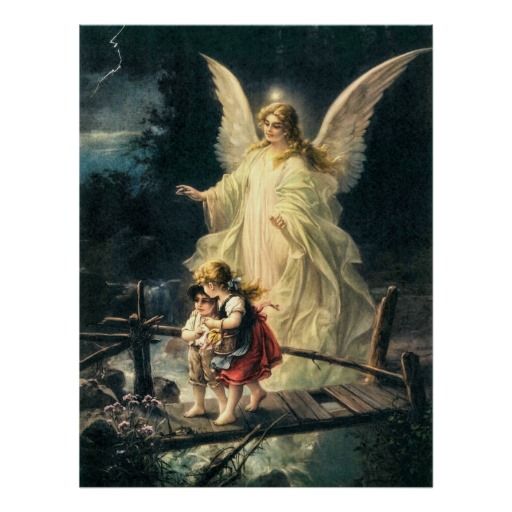
Crossing and bridging divides is the theme of my life. As a child I came to believe in a spirit that guided me, sparked by a print that hung in my paternal grandparent’s bedroom, where a guardian angel leads a girl and a boy along a rickety bridge across a ravine with rapids rushing below. The image left a deep impression, and, over the years, similar images appeared in dreams, revealing the scene’s symbolic power. Training and working as a transpersonal therapist I often helped clients to explore the complex relationship between the masculine and feminine principle (Anima and Animus) active within each individual and across the gender divide. But most useful work on the road to greater wholeness begins with listening to what the body knows, and, by implication, what the self-regulating planet tells us.
The theme of bridges plays in my novel, Course of Mirrors, and continues (in the sense of bridging time) in a sequel, Shapers, which I hope to publish this or next year.
On balance, apart from the anxieties and frustrations we absorb and project, we also tend to transfer the beauty we hold inside our hearts onto our surroundings, be it what we glance in the growth and decay of nature, in the gracious motions of young and old people, animals, trees we befriend, a patch of thriving vegetables, a forget-me-not perking through a crack in the pavement, a glowing autumn leaf. We delight in the colours and shapes sculpted by the shifting light of the sun into twilight and shadows, even in neglected streets, even in ruins.
Some of us have the use of a garden or a plot of land, which offers shade and, throughout the seasons, brings joys, as well as countless tasks we may honour or ignore.
I wrote the above essay in 1997, inspired by my readings during a vocational film degree, which helped me to catch up on cultural history. The file was idling away in a Clarisworks format on an old floppy disk. A friend (thank you Ian) managed to transfer the text into a Word document. Cleaning the formatting distortions suffered in the process took a while, but was worth the effort, since I wanted to share this theme of exploring Human Identity in the Digital Age with my readers in a PDF file. A short overview of this essay can be found in my archived posts, listed under January 2018. But here is the full work, including its bibliography. The chapters are headed: Vanishing Time, Vanishing Space, Vanishing Body, Eyes that would Fix and Control us as Objects, Seeing through the Simulacra, and, A Palace of Mirrors. Throughout, I evoke scenes from the SF film Bladerunner.
I’m interested to know your thoughts on the yet unfolding theme of identity in our age.
The title of the essay was inspired by a wonderful Walt Whitman poem called ‘Sing the Body Electric.’
A poem by a former Sufi teacher and friend, Fazal Inayat-Khan, conveys a similar vibrant spirit:
A QALANDAR … a human being in the making …
Adam/man, Minerva/woman – a human being in the making – functioning in the world on the stage of life – playing the script of destiny with the delight of indifference and the carelessness of full satisfaction. A being knowing all there is to be known by it, yet ever learning; ready to feel all there is to be sensed by it, yet ever discovering new depth of emotions; capable of expressing its deepest and truest inspirations, yet ever expanding its consciousness; sensitive enough to give and receive love in all its forms and levels of becoming.
The full poem is printed in ‘Heart of a Sufi,’ a book I co-edited with two friends (see my book page.)
Here the last paragraph of QALANDAR …
A Qalandar is simple as a child, wise as an old woman, unfathomable as an old man. He belongs to the moment, she responds to every need. He speaks all languages; she performs all roles. They are one …
I hesitated posting this, since a deep sadness resurfaced and took hold of me while pondering Soul and Spirit. What’s the point, why exist, to what end? I asked this as a child, having been shown horrendous images in the wake of the Second World War, meant as shock treatment in my German primary school during the 1950’s. A poem I wrote about this experience I still don’t feel confident to share. I turned iconoclast, explored philosophies, religions, myths, literature, searched for exceptional minds, and resisted prescribed beliefs in favour of direct experience.
In my twenties I turned to images and their symbolic power, until a numinous event in Israel reunited me with language, literature, poetry, and science. I studied too many subjects to bore you with, at my own expense, none for economic advantage. I did meet exceptional people, including mystics, yet my question, like a spell, kept birthing more questions.
Disheartened, yet fascinated by our manic mechanistic Zeitgeist, I adopted a transpersonal view, letting things unfold until decisions fell into place. With each intuitive choice, energy for action met me half way and helped me succeed with many projects. This included workshops on dreams and myth, and the wonderful Parent Link programme I helped get on the road, all about reflective listening and the language we use. Unfortunately this parent and school-supported project received no support from the Government. Still, at times I felt I was making beneficial contributions to society. Of late, no new question has arrived to kick off a renaissance in my poetic imagination, or shed light on the collective mood of futility, which seems to confirm the scientific view that reality is determined by numbers.
Battered, but not beaten, I honour my core resolves: that everything physical is en-souled and resonates with everything else in the universe. And that consciousness, with the potential for symbolic awareness in humans, creates innumerable realities we co-create in ever new forms.
Arthur Rackman – Twilight
Soul and Spirit have become terms relegated to poetry. Some traditions hold them to be interchangeable and interdependent, akin to the Eastern concept of Yin and Yang. In this sense the feminine and masculine principles (mentioned below) reside in women and men alike, that is, their receptive and active and qualities work in each of us. Certain myths simplified and distorted this truth, which now asserts itself with fresh understandings regarding the psychological identification with gender.
“When I say the feminine, I don’t mean gender. I mean the feminine principle that is living—or suppressed—in both men and women.” Marion Woodman
Observing the political debates around the globe, I notice a similar narrow power dictum in entrenched wars for control, which conjure up the quarrel of parents that drive children to hide in the broom cupboard.
I understand SOUL (Psyche) as pure consciousness, self-sufficient. Yet once identified with impressions of the physical world – soul becomes the vessel. We talk of soul shining through eyes, through nature, or as immanent presence pervading matter. Consider body, mother, growth, loss, suffering, receptivity, attachment, memory, meaning, imagination, mystery, intuition, aesthetics, melancholy, yearning, endurance, constrictions, chaos, bliss … One may associate Soul with Eros, energy, the cosmos, planets, moon, beauty, stars, history, identity, myths, time, space, past, darkness, the unconscious, unpredictability, and the female principle (Anima) inviting spirit for input and direction.
SPIRIT, to me, is like a wind of light carrying seeds of information to recipient vessels, conscious or unconscious, singular or universal. Humans interpret this information, wisely or not. We talk of actions as spirited, fiery, determined, energetic, contradictory, passionate, always moving and changing. We talk of people driven by principles, for good or bad, or, frankly, being possessed. Spirit aligns with order and ideals, again, for good or bad. Add the relentless drive for perfection which aims, in some traditions, for transcendence, seeking the divine not in the messy psyche, but only in abstract spheres beyond matter. We associate Spirit with logos, will, action, speed, the sun, innovation, reason, light, the male principle (Animus,) and future visions … welcomed by the soul.
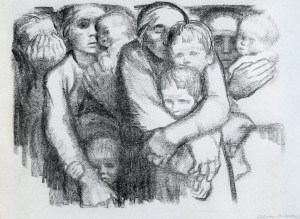
Mothers – Käthe Kollwitz
Torn between spiritual heights and visions, and the dark depth of the collective psyche, my initial therapy training with Roberto Assagioli’s Psychosynthesis impressed me with an undeniable necessity: The higher we rise the deeper we’re called to descend into the murky shadow of ourselves and our collective inheritance. Gripped then, once again, by the deep sadness I felt as a child in the face of human suffering, I cried for days. The work began, with my own unconscious, with individuals and groups. But nearly 35 years on, I feel yet again despair that the knowledge gained about the psyche is not wider applied. The abuse of people, especially women and children, and the planet itself, continues in the name of the power principle and progress, as does the resistance to acknowledge and heal personal and collective grief. It’s so much more convenient to blame an enemy.
I had the privilege to meet a remarkable Sufi teacher, Fazal Inayat-Khan, and the community of his students during the mid 1970’s. As the grandson of the saintly Hazrat Inayat Khan, Fazal developed his grandfather’s message in passionate, spontaneous and radical modern ways. One of his sayings: ‘Answers are dead, questions are alive,’ gave perspective to my existential query. For him, fragile egos behind the mask of their persona needed strengthening before the Self could become conscious. He orchestrated intense workshops during which the shadow aspects of our personalities were exposed. Each event was followed by a tender and humorous process of debriefing. He taught me to forgive myself, to be kind to myself. He died much too young in 1990. The copyright to hundreds of Fazal’s pioneering talks is held by the present Sufi Way, so his deep mystical insights must wait for another day. While I was co-editing ‘Heart of a Sufi,’ reminiscences gathered from his students, we were limited to a few quotes and one inspired poem, Qalandar, which I hope to share some time.
Explanations aim to reassure, but knowing the limits of reason, I search for metaphors, symbols, poetry in words and images to make my fleeting insights graspable, as lonely as they stand, and as totally irrelevant as they may be to others. Still, it’s a lovely surprise when readers explore the archives here, or read my quest novel, ‘Course of Mirrors,’ which defies genres.
Turbulent times call for intuitive introspection, though sifting through the avalanche of information available is probably the great task we must master in this present decade. When lame slogans and bitter opinions are shouted with animosity across the media, our conscience is severely tested.
What we call good and bad coexists in the psyche. If you’ve read Ursula Le Guin’s Wizard of Earthsea Saga, you may recall the poignant moment when the protagonist realises that he and his shadow opponent share a secret name. For that instant their identities merge as one.
Among great thinkers of recent decades who influenced my thoughts, I often return to Stanislav Grof, Gregory Bateson, C. G. Jung, and the people who honoured and expanded Jung’s brilliant insights, among them Esther Harding, Marie-Louise v. Franz, Marion Woodman, James Hillman, Anthony Stevens and many others who further explored the Psyche in relation to the inner work of individuation, that is – learning to hold the tension of opposites towards realising the balance of a universal underlying wholeness. Archetypal forces inspire, overpower, or dull us to sleepwalk into tragedies. We, with our humble egos can take on our small responsibility; each individual serves as a bridge, and an interface.
‘Matrignosis’ is a rich site by Jean Raffa, who explores Jung’s ideas with helpful guidance.
Related: Cartography of the Psyche, with a link to Stanislav Grof’s talk on the psychology of the future.
To conclude, a rare excerpt of thoughts on metaphysics from Hazrat Inayat Khan, shared with his students between 1915- 1920:
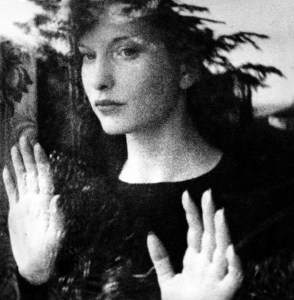
Maya Deren – Meshes of the Afternoon
The Experience of the Soul through the Spirit …
The soul has two different sides and two different experiences. One side is the experience with the mind and the body, the other side is the experience of the spirit. The former is called the outer experience, the latter the inner experience. The nature of the soul is like glass, transparent, and when one side of the glass is covered it becomes a mirror. So the soul becomes a mirror in which the outer experiences are reflected when the other side is covered. That is why, however greatly blessed a person may be with the outer knowledge, he is not necessarily gifted with the inner knowledge. Therefore, in order to attain to the inner knowledge the Sufi covers the other side of the soul, that its mirror part may face the spirit instead of the outer world. As soon as is able to accomplish this he receives inspirations and revelations.
There are people who are by nature intuitive, or who are called psychic or clairvoyant by nature. It is accounted for by the other side of their soul naturally facing the spirit within. One may call them extraordinary, or exceptional, but not mystical, for the mystic does not desire that position. He, by concentration and meditation, gains such mastery that he can cover the soul from without to take the reflection within, and that he can cover the soul from within when he requires the reflection from the outer world to its full extent. Balance is desirable, and mastery is the goal to be attained.
I read daily, in bed, for an hour or so before escaping to dreamland. Apart from novels or essays on the go, I keep a stack of books close by to dip into when dark clouds need lifting. One such book is John O’Donohue’s ‘Anam Cara.’ (Bantam Press 1997)
Frequently, these days, my sarcastic imp dominates, and I’m deaf to wisdom, even my own. That said, I respect imps; they cut through the bullshit ignorant people spout around the globe. However, to tune down this sharp wit takes a firm request for silence. When I manage, the imp cuddles up, like my cat used to cuddle up every time I sat quiet.
I call it soul remembrance. You might try and trick your little imp into silence, if only to soften the heart enough to receive this blessing by John O’Donohue …
A BLESSING
May the light of your soul guide you.
May the light of your soul bless the work you do with the secret love and warmth of your heart.
May you see in what you do the beauty of your own soul.
May the sacredness of your work bring healing, light and renewal to those who work with you and those who see and receive your work.
May work never weary you.
May it release within you wellsprings and refreshment, inspiration and excitement.
May you be present in what you do.
May you never become lost in the bland absences.
May the day never burden.
May dawn find you awake and alert, approaching your new day with dreams, possibilities and promises.
May evenings find you gracious and fulfilled.
May you go into the night blessed, sheltered and protected.
May your soul calm, console and renew you
my boy – used as poster for a workshop once
* * *
I want to also share a joy. The poetry editor of Queen Mobs, Joe Linker, has published two of my early poems yesterday. A wonderful perk …
As painters or sculptors do, I frequently step back from my writing projects, searching for the core, a half imagined essence to shine through and re-animate the creative flow. Skills alone don’t do it, techniques alone don’t do it, nor style. As long as the essence of what I try to express floats in the unconscious, my efforts will baffle and tease me.
Having listened to thousand and one stories during my 30 years of working as a transpersonal psychotherapist, I conclude that when we tell our story to ourselves, or others who watch and listen, we trace a rhythm, a sound, the distant bubbling of a spring – a theme. While sourcing and shaping words we ideally become aware of how we translate experiences, string up memories and weave a pattern that gives meaning, purpose and direction to our story. We may re-weave the past and change how we perceive life. Even a single image, too evanescent to fit ordinary reality, can assume significance. An ideal may sharpen – and with it a vision of what not yet exists, revealed by the imagination.
Sensual impression, dreams, primary images and the love/hate of relationships, present a puzzle we try to arrange in some kind of order, waiting for a theme to become intelligible, and therefore transmittable. Finding a structure to express our experiences through words, images, movements, sounds, music, or numbers is insufficient. We must play with the fragments – take out bits, or add bits, until a satisfying narrative suggests itself.
World objects from my sand tray
Fairy tales, heroes and villains of myth, historical figures, cartoon characters or pop stars may do the magic by evoking a psychic resonance and providing a metaphor, or a precious symbol to ease the pressure of the archetypal demand lurking in the unconscious.
Not only those we call artists, but all creative people respond to what holds sensual and cognitive fascination for them. I include trades, crafts, makers, men and women with affinities to certain elements, who explore the quality and beauty of materials, like weavers, potters, wood workers, printers, plumbers, electricians … I include technicians, engineers, inventors, scientists and mystics. Curiosity and passion for a subject deepen knowledge and intuition as to how things connect outside, and, vitally, how they connect inside us.
Ashen – directing a film in the woods.
My fascination with creating stories was revived while doing a film degree (as career brake) during the late 1990s. I’m curious about consciousness, relative perception of time, and the interplay of characters for which I invent pasts and futures, where ideals are the means to a goal, while as soon as the goal is reached, a new ideal looms over the horizon. If this were not so, evolution, our whole story would stop. Ursula Le Guin once wrote –
‘In eternity there is nothing novel, and there are no novels.’
My ongoing writing project, a trilogy of stories, involves three soul sisters, Ana, Cara and Mesa. The first (already published) book of the trilogy, ‘Course of Mirrors,’ (see book page) narrates the quest of Ana, which is really the myth of the story teller, Cara, whose theme is seeking a balance for the enigma of clashing feminine and masculine principles. The sequel, ‘Shapers,’ (not yet published) introduces Cara in the twentieth century as she follows the characters of Ana’s myth into a far future society where emotional expressions are outlawed until the experiment breaks down under its duplicity.
In a third book, ‘Mesa,’ a work in progress, same characters move to a realm where time has slowed down to such extend that ‘novelty’ has to be rescued for life to continue. This story calls for a deep dive into the heart of my imagination.
I’m once more held in the cocoon stage. Given the ideological power games around the globe, I feel foolish about these musings, since I’ve been sharing the ups and downs of my quest here for the last seven years.
Do you, my reader, recognise the pressure to bring something into existence? How do you search for the cypher (the wild uniqueness in the soul) that informs your creative process?
* * *
A definition of Symbol … from ‘The Creative Imagination in the Sufism of Ibn ‘Arabi’ by Henry Corbin, transl. by Ralph Manheim, Bollingen Series XCI, Princeton University
The symbol announces a plane of consciousness distinct from that of rational evidence; it is a ‘cipher’ of a mystery, the only means of expressing something that cannot be apprehended in any other way; a symbol is never ‘explained’ once and for all, but must be deciphered over and over again, just as a musical score is never deciphered once and for all, but calls for ever new execution.
 I hesitated posting this, since a deep sadness resurfaced and took hold of me while pondering Soul and Spirit. What’s the point, why exist, to what end? I asked this as a child, having been shown horrendous images in the wake of the Second World War, meant as shock treatment in my German primary school during the 1950’s. A poem I wrote about this experience I still don’t feel confident to share. I turned iconoclast, explored philosophies, religions, myths, literature, searched for exceptional minds, and resisted prescribed beliefs in favour of direct experience.
 Unfortunately this parent and school-supported project received no support from the Government. Still, at times I felt I was making beneficial contributions to society. Of late, no new question has arrived to kick off a renaissance in my poetic imagination, or shed light on the collective mood of futility, which seems to confirm the scientific view that reality is determined by numbers.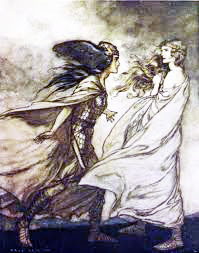
 let sleep do its work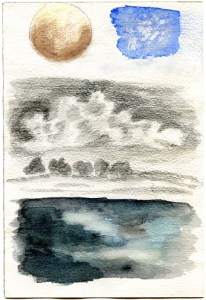
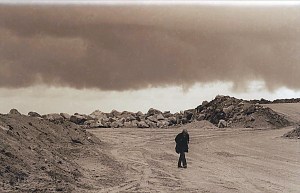 I read daily, in bed, for an hour or so before escaping to dreamland. Apart from novels or essays on the go, I keep a stack of books close by to dip into when dark clouds need lifting. One such book is John O’Donohue’s ‘Anam Cara.’ (Bantam Press 1997)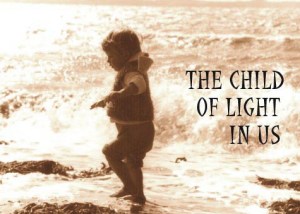
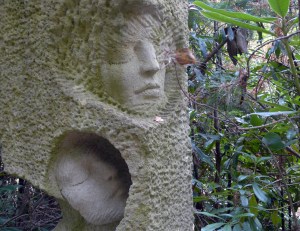 As painters or sculptors do, I frequently step back from my writing projects, searching for the core, a half imagined essence to shine through and re-animate the creative flow. Skills alone don’t do it, techniques alone don’t do it, nor style. As long as the essence of what I try to express floats in the unconscious, my efforts will baffle and tease me.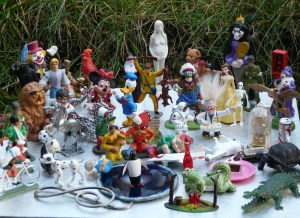


 Course of Mirrors