Tag Archives: meaning

… framing our impressions …

Last week a friend visited, and I took her to a local Sculpture Park set within ten acres of heath and woodland, a place where meandering pathways lead you into a deep dream-scape of rare plants, springs, streams and ponds, and where artworks face you at every turn.

The evening before, over a meal in my garden, we shared stories – about ageing and loosing people, about war-damaged fathers, about writing workshops in prisons. Our discussions often home in on the suppressed feminine in both men and women. So it’s not surprising that while we wandered through the park our two pairs of eyes were resting longer on artworks expressing aspects of the feminine, and our observations mingled.

P1060122 lowres

I thought I share a few photos of sculptures that caught our attention.

P1060123 lowres


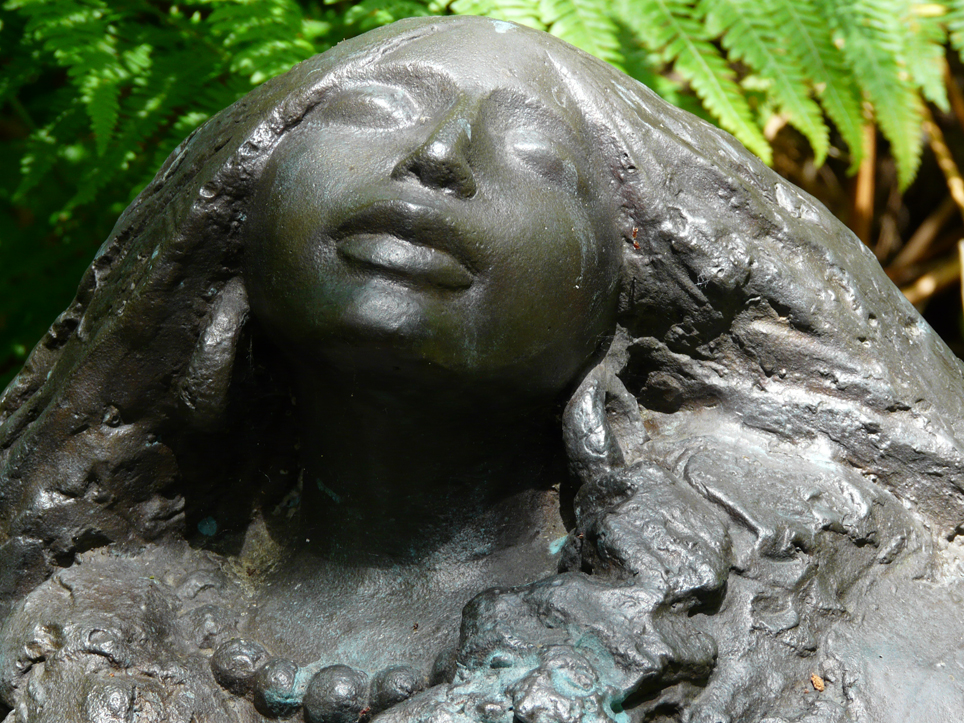
This bronze figure of an earth mother and warrior combined in one impressed. Her solid stance, yet also her surrender to something other. I took a picture and looked again, moved to touch her rough coat. There were her feet, standing firmly on the ground, a tool or weapon hanging from her belt, the little fists, speaking of determination, and there was her smooth, yielding face turned upwards in ecstasy towards a transcending spirit.

P1060116 lowres

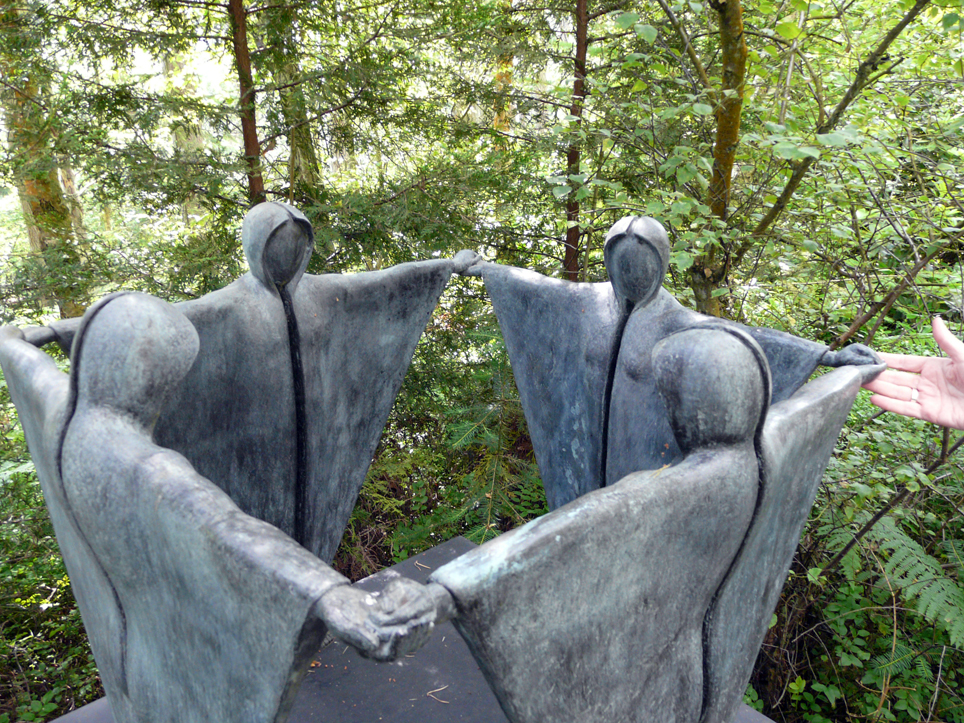
The endearing foursome forming a protective square made us linger.

My friend reached out to add her hand to the interlocking hands.

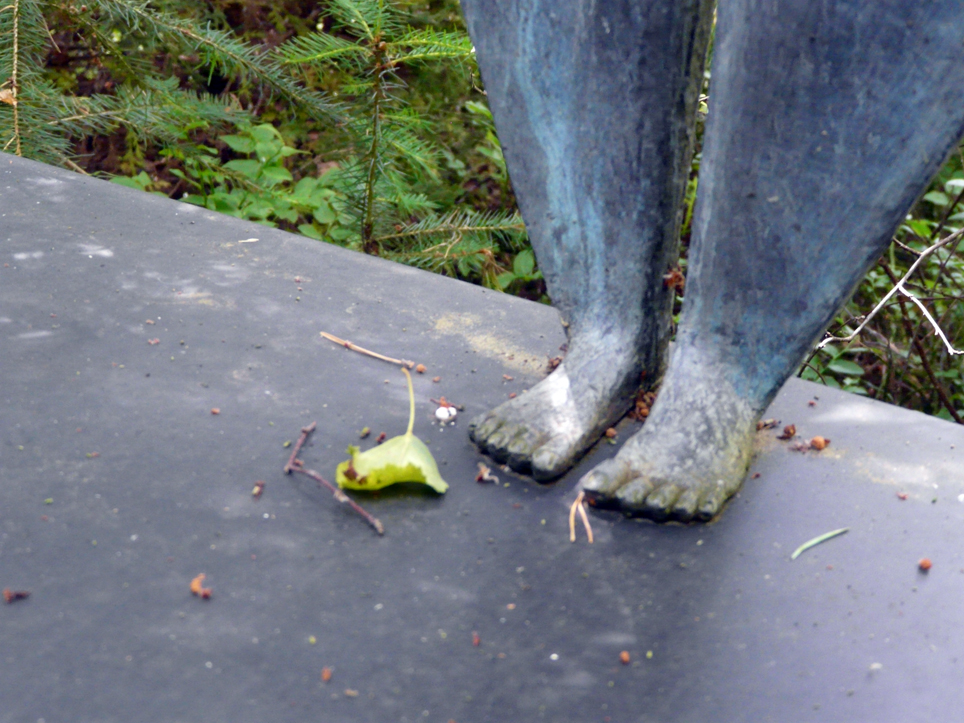
P1060117 lowresAnd we loved the little feet …

P1060118 lowres
P1060120 lowres


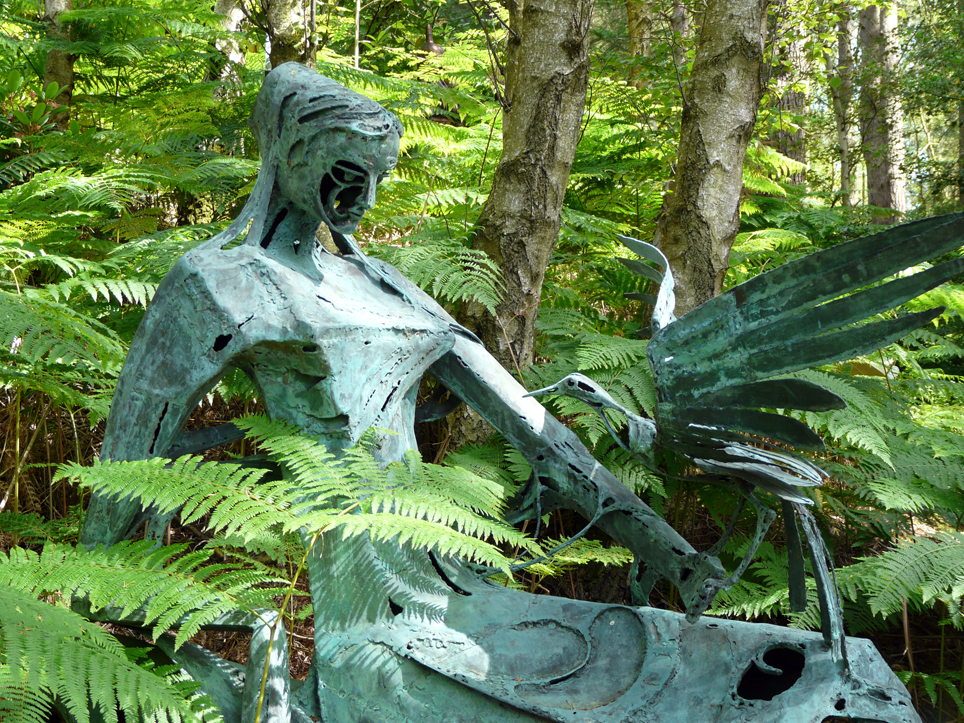
I felt a natural affinity with this bird woman, again taking a closer frame, to highlight her relationship to the bird.

It’s talons rest gently in her outstretched hand, bringing a greeting, and maybe a message.

The woman keeps a respectful space between her and the bird, a space filled with wonder, in which to savour the special meeting with her core nature.


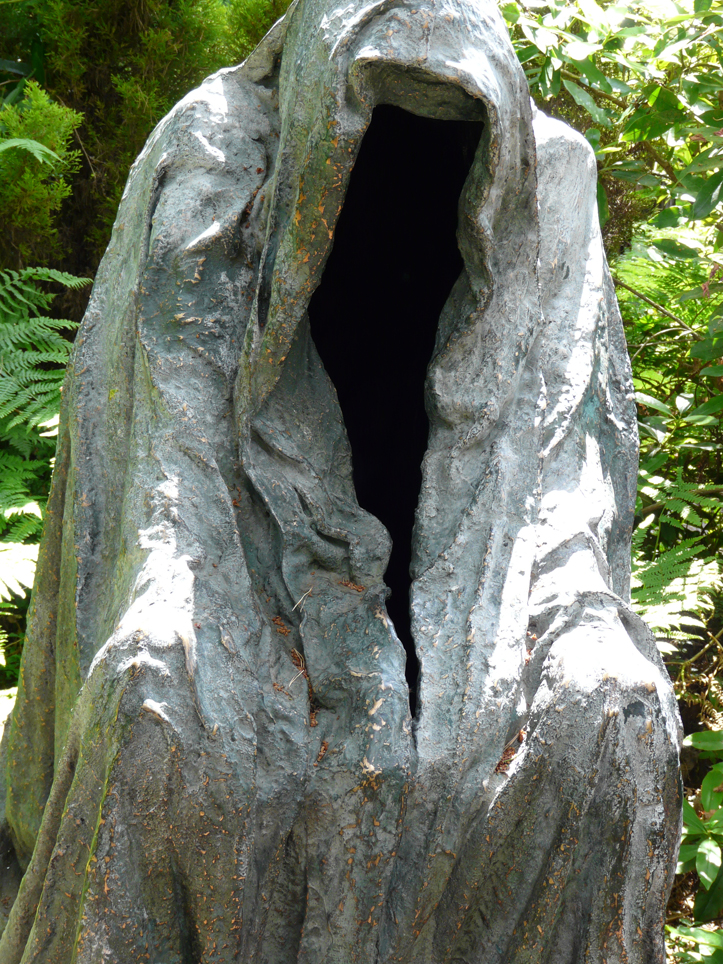
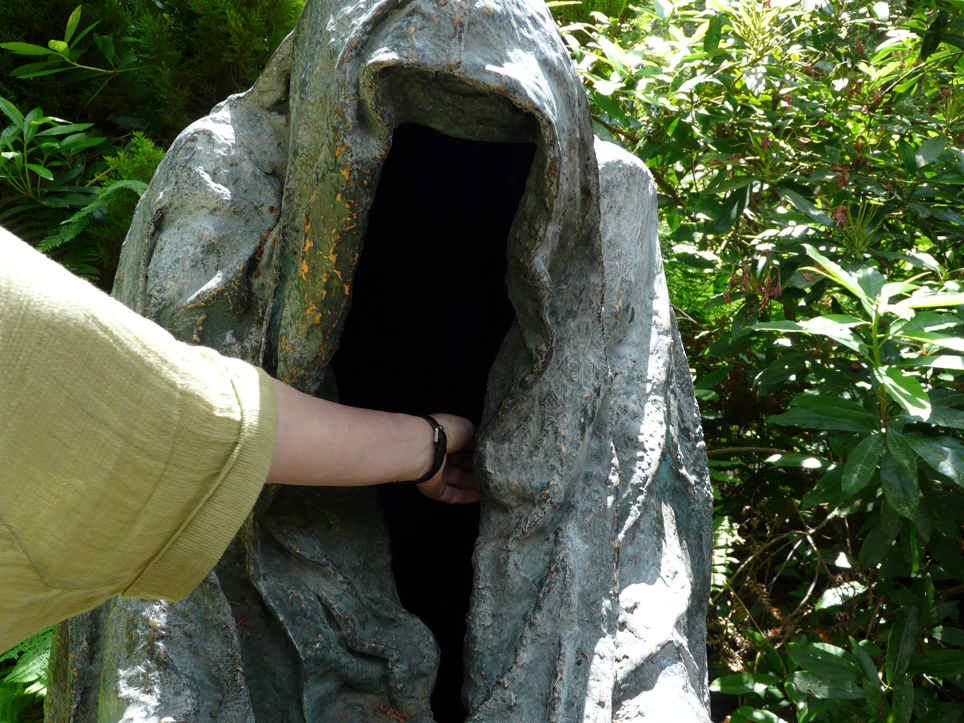
A most haunting sculpture was this shell of a person. My friend reached into the dark emptiness. I called ‘Hello’ into the hollow and the sound was swallowed up without returning an affirming resonance.

P1060112 lowresP1060111 lowres


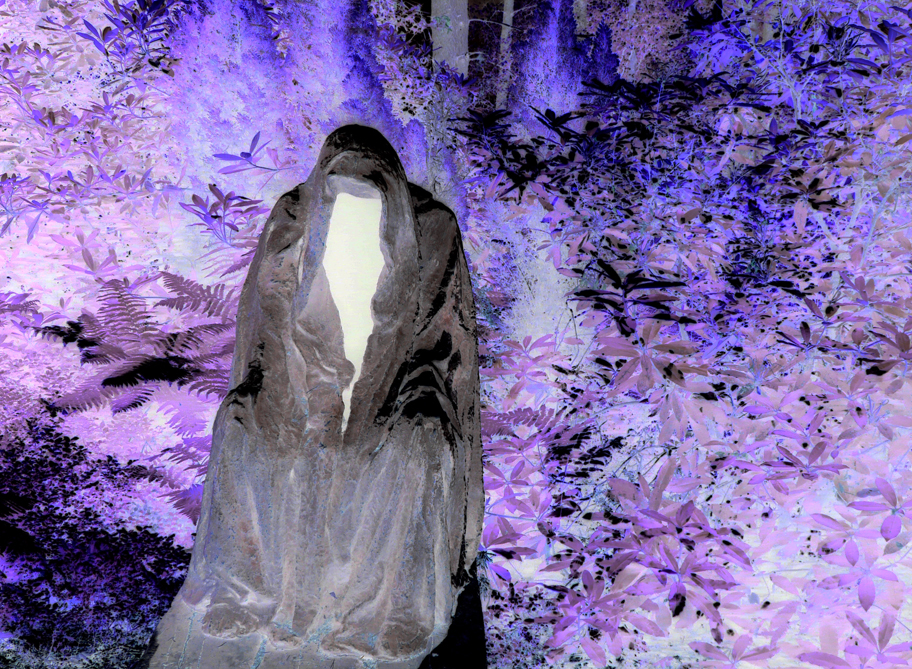
Later, with the help of Photoshop, I turned the image into a negative, and there you have it – the essence of what we are, light, often hidden.

P1060110 inverse lowres

Day in day out we absorb a continuous hyper stream of phenomena. What makes us stop and observe more closely and choose a meaningful frame to digest our experience?

Is it an emotion, a sound, a movement, a desire to touch, an association, a memory, a pattern recognition, an inner seeing, the intuition of an essence, a context that resonates with our lives, an interesting angle, a certain light …?

For creatively inclined minds, these processes fuse and culminate in an urge to compose and share the impression of an experience by placing a frame round an image … a story.

A symbolic understanding arrives and signals once more  into the unknown, framed anew.

*    *    *

LINKS:  http://thesculpturepark.com/

https://courseofmirrors.wordpress.com/2011/10/18/sculpture-park/ post from a former visit

https://courseofmirrors.wordpress.com/2012/12/31/the-inner-silence-of-henri-cartier-bresson/  master framer

https://courseofmirrors.wordpress.com/2011/06/28/what-makes-a-photograph-arresting/ a knack for composition

https://courseofmirrors.wordpress.com/inspiration/ young people observing and being creative


15 Comments

Filed under Blog

… the mystery of thoughts …

Every child is truly switched on to the imagination. But frequently the environment belittles the imagination, and the gift can end up suppressed under the blanket of rationality. People with a strong creative drive may settle down to live in a straitjacket, and then find themselves overwhelmed by images, thoughts and associations, especially around full moon.

As a child I was intensely curious about the spaces between things, and about light. Had I not locked horns with an opinionated physics teacher I might have taken up the challenge to study sciences. Another fascination of mine was pattern repetition – how the veins in a leaf resemble the shape of a tree. And scale – how tiny bodies, big bodies, our planet, galaxies, the universe, are all reflected in each other.

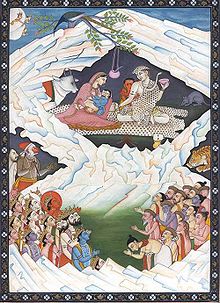
 Hindukailash, image from wikipedia.

Hindukailash, image from wikipedia.

Like Indra’s net of pearls in Vedic mythology, where the surface of each pearl mirrors all other pearls, a metaphor for the interconnected networks of mutual relationships between parts and systems. Mount Kailash is depicted here as the timeless and motionless centre of this net, housing Shiva’s family.

Not only visible structures are held together by interactive nets, our social systems, political systems, spiritual systems and the internet operate within a network. We can observe that the invisible psyche (mind) functions not only through logic, but also through aesthetics, independent of space/time, and is held by another kind of coherence – a net of meaning. And what is generated from this net of meaning is a finer kind of energy, not evidenced by present scientific methods – namely intelligence.

We knew it all along – research established that our emotional experiences leave an imprint in the cells of our body, that the brain is more than the squishy mass under our skull but a medium spread throughout the body via a network of neurotransmitters. There have been hair-splitting arguments for and against the idea that the recipient of an organ can experience personality traits of the donor, based on the speculation that each cell carries a hologram of the whole body and its memory.

Feelings and thoughts arising in my consciousness are filtered through my body’s memory. They also depend on my state of anxiety or calm, my interest, attitude and other variables, such as the weather, my relationship with the elements, with people, the collective mood, solar flares, or the constellation of planets. On some days, maybe after a meaningful dream, or a spell of mantras, thoughts are forming clearly on the breath, like reflections in a still pond, on other days, thoughts rush in on water rapids threatening to drown me, or they plod in like turtles, slow and guarded.

Objective reality is not the only game there is – what in the universe has not interacted at some point in time, irrespective of distance? Everything is linked up. Einstein called it the ‘spooky action.’

The motherboard for this wonderful instrument we call the brain, which comprises our whole body, is formed in the womb. I believe the intelligence involved in creating any specific body must lay in more than known DNA codes, must include the indeterminable non-local DNA of a spirit world. Our body foremost operates like a receiver and transmitter for as many wavelengths our radio station in time attracts or is able to tune into.

From this station, stabilized by repetition, I sort clusters of sensations and feelings, and process thoughts and ideas attracted to me from the collective psyche, a vast sea, which the individual mind must learn to navigate. Images and signifiers are coloured by whatever I consciously or unconsciously mirror and relate to.

No matter how much information we absorb, through our senses, through language and concepts, through comparing patterns, reasoning and calculation, everything, comprehended or not, will be filtered through the body’s motherboard that keeps adjusting to experiences and expanding fields of perception, fields that extend way beyond personal memory. All this information is continuously re-shuffled, as is the meaning we assign to it.

Our body is a motherboard – planet earth is a motherboard – the whole cosmos is a motherboard for a spirit we cannot comprehend, an invisible hand that touches us like a breeze, made visible through what it animates.

All we know is that images, thoughts and ideas are reflected in us. They travel via synapses in the neurons of our body, they travel on the air between minds, they travel among stars, they echo from under the sea, waving to us as plankton, they speak to us from every creature, from every blade of grass, from every stone, and they beep from within our bodies through tweaks of pleasure or pain. All matter, all people and objects we interact with store the memory of that interaction, including interactions with things we hate or nurture, and with places we live in.

We don’t invent anything, we re-discover, re-connect and re-create from the vast storehouse of knowledge and information provided to us by nature, and by the spirit between matter that makes up the cosmos, an embodied being that is becoming conscious of itself.

We are on the air, sent, programmed, radioed and broadcast, identified with all manner of things, ideas and beliefs. Yet if we look deep inside our emptiness, we know, the non-material aspects of us can potentially detach and be free, maybe enjoy tea with Shiva’s family and witness the world turn on its axis – a state some people experience spontaneously or through meditation. A state of pure consciousness not identified with this or that. In the meantime, we could at least be kind to ourselves …

‘Thoughts are beings that generate … One thought of kindness gathers a thousand beings of love and kindness around one.’            Hazrat Inayat Khan

I don’t know if a singular mind/psyche, the incredible art of a lifetime, survives the physical death of the body. Maybe a coherent individuated mind leaves a dent, an influence within the collective psyche. Like the organ of the heart, over time, achieved its definite function. But does it matter? Nothing is lost. All information is continuously re-shuffled into new forms and constellations.

Digital storage provides a metaphor – information exists and roams freely in the wind of the collective psyche (unconscious) until it is embodied and gathered towards a purpose. Every event has a consequence. Nature is exacting, but also generous, what has been repressed in the flow of evolution will always return in one form or another.

Everything alive speaks to us, and all such relationships are processed in the stories we share, stories being containers of the richest kind of information. 

*    *    *

You can source other posts on the theme of reflection in the tag cloud on the right of this page. Like this sequenc of posts: https://courseofmirrors.wordpress.com/tag/hazrat-inayat-khan/

And you might want to check out posts under the tag ‘psychology,’ especially the one on ‘awareness,’ where I share R. Assagioli’s 10 psychological laws – how the body affects the mind and the mind affects the body. https://courseofmirrors.wordpress.com/tag/psychology/

*     *    *

This post also appeared at  Third Sunday Blog Carnival: September 2013 | Third Sunday Blog Carnival

17 Comments

Filed under Blog

one raindrop – ten raindrops – what’s the difference?

Before I went to bed last night I asked for a dream, as I do when I want guidance from my unconscious. After all, the greater part of our psyche is out of sight, submerged, with only the top in view, which is why Freud used the image of an iceberg to depict the psyche, the submerged part having deeper connections with the sea of the collective unconscious in which we all swim.

Iceberg - Ri han - Shutterstock

Iceberg – Ri han – Shutterstock

My question was related to the global web, and what’s rising to the surface like long drowned skeletons bobbing along the electric rapids of information, memories re-shuffled, all with a kind of speed only fearless surfers can negotiate. And how every link you and I click is traced, analysed and fed back to the media, politicians, businesses, twitter-birds, face bookers, bloggers and so on. At times it seems like a kind of vivisection in a shiny mirror looking back at us, surreal.

I’m seasoned. There was no TV in my early childhood, it astounds me what I’ve adapted to over the years, but the present tech-apps-avant-garde makes me feel like I’m missing a boat, along with, let’s take a breath, at least sixty-one-percent of the world population (that’s the kind of people with no internet at all.) And because I tend to reflect on cultural trends, searching for wider purpose, meaning and metaphors, I put this to my unconscious: please give me some insight.

On waking, the first thing I gazed at was the raindrops netting my skylight. A phrase came:

                 … one raindrop – ten raindrops – what’s the difference? …

It stuck. I stopped myself diving into associations, about raindrops, the number one, about the history of zero – as symbol for something that doesn’t exist but has become a place-holder. I stopped myself from quoting Rumi, too.

The phrase I received is enigmatic and feels creative. Does it come down to postulation, the everything-and-nothing-matters kind of power we have to envision and re-assemble stories, the delicious freedom to speculate without limits …?

Maybe purpose and meaning are becoming old hats and I’m missing the point entirely. What do you make of the phrase … either with your knowledge of maths and physics, or with your imagination? Even with the phrase or image of a dream ☼


19 Comments

Filed under Blog

… inner time – writing – rant …

Beyond my window, robins, wrens, blue tits and blackbirds are nest-building, with bursts of passion. Dipping in and out of view, they settle shortly on a deck chair, branch or flowerpot, balancing lavish bouquets of fluff, moss, twigs and leaves, before darting off towards the next promising material. The birds winging through my garden make me happy.

Yesh

My thoughts wing in similar fashion dedicated to another passion, no less preparing for a new round of birth – in my case the writing of the next chapter of a novel. I anticipate with joy each few hours of unstructured time that allows me to visit my garden of recollections, a space where myths re-weave themselves from the fluff, moss, twigs and leaves of memories. Like the visions I brought into this world, ambivalent responses to my existence, altered states, affinity with elements, genetic markers, epigenetic quirks … my bundle of life that fell into a mould and was conditioned by socially convenient patterns of time.

Dividing reality into past, present and future time, measured by clocks and dated events, called facts, is a fairly modern idea that made Science the grail of knowledge. The best of science deepens our understanding of the cosmos and improves the quality of our lives, but its method is limited, not suited to go to court on another reality dimension, inner time, infinite, immeasurable, where our experiences assume meaning. We may walk through life like snapshots of ourselves, collecting capture after capture of evidence for our existence, while longing for a dimension within, the bridge to a spiritual presence hidden between each breath, a truth impossible to evaluate? Some religions banked divine capital in heaven. Science too, in its present phase, projects a kind of heavenly capital, hijacked by corporates selling us the future, a Promised Land of artificial intelligences catering to our every need, uncannily resembling the Matrix or Plato’s cave.

My rhythm of life changed when I dropped out – the second time in my life – taking the financial risk to work from home and make time to write, which I had failed to combine with careers, family and social obligations. The experiences were vital, up to a point. Now I relax about clocks and tend to my inner worlds. I crave unstructured time. Not everyone does.

Recently a friend reflected humorously on her frustration at finding herself with one hour to spare, having miscalculated her travel time. She would have been happy had she brought a book to read. Instead, she endured a dragging hour of unplanned, wasted time. Intrigued, we reflected on this sense of loss when there is unexpectedly nothing in particular to attend to.

Is there merit in unstructured time … what do you think? Is it only for children, is it a luxury, a waste, or an opportunity to shift perspectives, discover your passion, break the mould and loosen up your ideas of reality? I don’t see unstructured time being much encouraged, or its lovely randomness being valued. I was burdened by the message that my imagination is fanciful, a kind of debility. It took me decades to claim the time for my passion, writing …

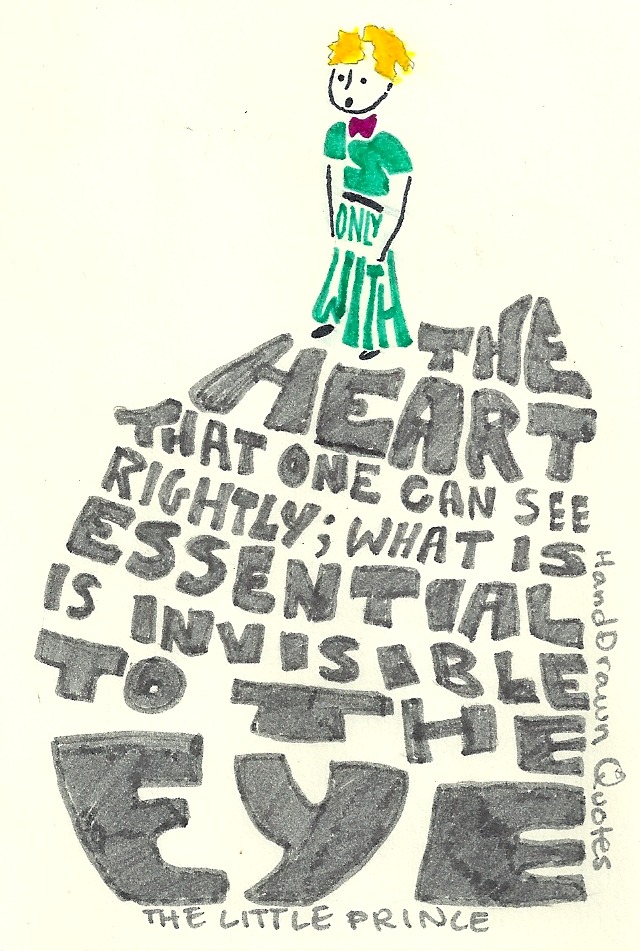
Little Prince

This seems the place to share a personal rant, blaming no one in particular, since, from where I look the rift between head and heart that is tearing apart the fabric of western societies may yet need to become wider before the peril is addressed. If the media is anything to go by, meaningful purpose, visions, let alone joie de vivre, are overshadowed by collective gloom. Feel free to disagree with my take on this. Straining under the pressure to change, I see our systems are attempting to cement a shaky launch pad towards a logarithmic future, with good intentions, though the consequences are dire. Every aspect of our lives is in danger of becoming: over-calculated, over-regulated, over-efficient, over-specialised, over-mechanised, over-prescriptive, over-secured, over-insured, over-compartmentalised, over-conglomerated, and over-economised.

On a more cheerful note, young people in their 30s, at least the ones I know, are asking sharp questions, and are finding ingenious ways to play with, while not getting sucked mindlessly into programmes that abuse data, spoon feed illusions, appeal to personal anxieties, invade privacy, and insult the intelligence of creative individuals.

Back to the birds winging through my garden …

*     *     *

To see a world in a grain of sand

And Heaven in a wild flower

Hold infinity in the palm of your hand

And eternity in an hour … W. Blake, from Auguries of Innocence


12 Comments

Filed under Blog

… global vision & synchronicity …

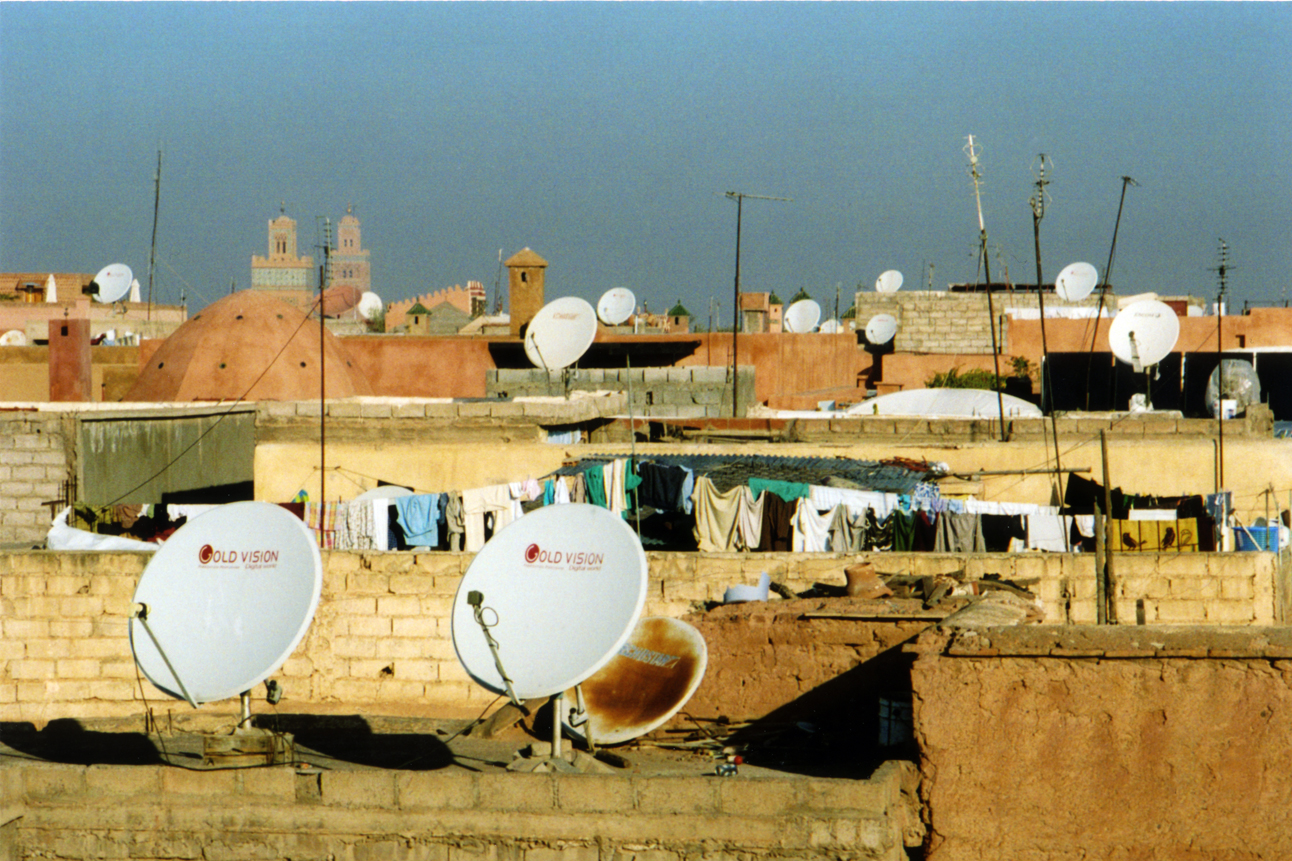
Moroc, Marrakech Riad roof, golden vision - low     Less than 80 years ago, across the world, only about 200 televisions sets were in use. Today, a simulated reality confronts us with our collective mind. A click away, we sample the zeitgeist and witness some disturbing trends, like the continuous robbery of world resources.

How do we filter the mass of information? Do we shout treason when we see the failure of economic systems that allow 1 % of the population to own 40 % of global wealth, or when we discover that certain corporations privatise water –  even rainwater  –  in underdeveloped countries? Traversing from one patch of light to another, do we make connections that apply to our scope of action? Or, lacking a meaningful context, are we hypnotised by this enlarged mega-screen, the global vision of a world that can mirror our inner fragmented states  –  a world where every viewpoint exists simultaneously, that over-exposes so-called reality and blinds us? Are we ourselves living inside the screen-myth, as extras, freed into bits, a reservoir of data?

As writers, what in-forms us, what material do we disseminate? And what is it that makes choices, switches from one networks of influence to another? What guides us through the data jungle? Are there perceptions beyond our wilful personalities that determine, agencies that operate through us from beyond time and space? I’m weary of the term God. For me this agency is a consciousness composed of past, present and future intelligences, a light-wave that echoes different signals according to the receptivity and needs of each animated vessel. Humans can be dense, but a calm mind recognises clear signals of this wave, since they chime with a joyous feeling of connectedness, a larger symphony, maybe even the sense of a destined purpose.

In my experience, this consciousness operates through synchronicity. There exist conceptual similarities between the behaviour of sub-atomic particles and archetypal images, (C G Jung and Wolfgang Pauli discussed such similarities in the context of synchronicity), a striking link between mind and matter that has been largely ignored. It implies that mind and matter connect, relate, mirror each other, and reciprocate. The process is given life in the realm of the psyche as imagination, not structured by time and space, but through layers of meaning illuminated by consciousness. Psyche is the changing room between cosmos and pneuma.

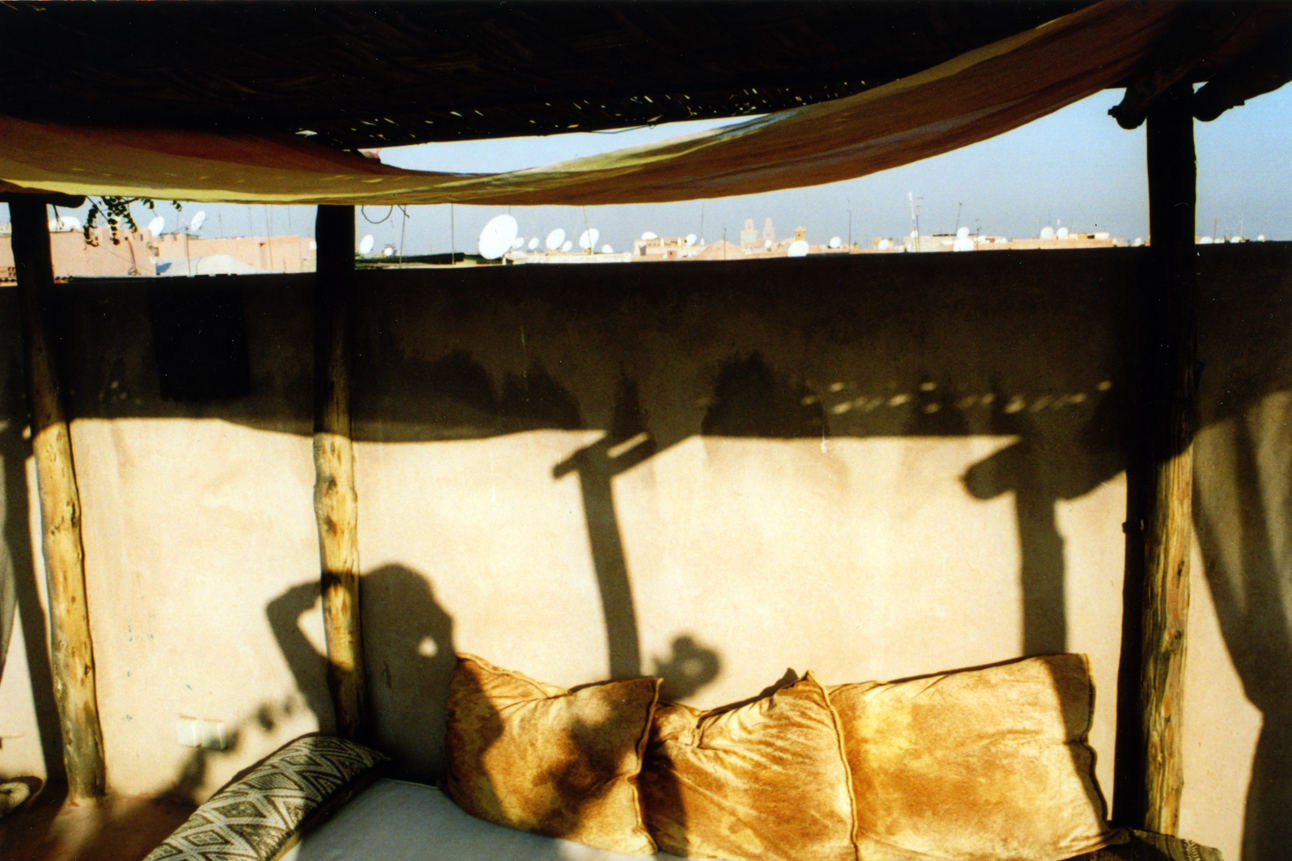
Moroc, Marrakech, Riad roof, shadow - lowJung thought of archetypes not as fixed, but as changing predispositions, universal patterns inherent in the human psyche, images that comprise our collective past and future unconscious. A pattern stirred into activity by an emotionally charged event in our lives, brings home related experiences, often through meaningful coincidences in a non-linear and a-causal way.

Such synchronicities draw on a deeper life-sap, as if an eternal intelligence were at work.

David Bohm proposed that subatomic particles remain in contact with one another regardless of the distance separating them, and that their separateness is an illusion. Here a facet of his thinking – a short first part of a 5 part series  http://www.youtube.com/watch?v=oGyDVF8GrLk                                                                                              A great and humble man I greatly admire. He has beautiful hands  🙂

A dream, for example, can attract an outer event, a meaningful coincidence, that powerfully substantiates a message from the unconscious, often accompanied by a numinous quality. In my own life, synchronistic events have challenged my narrow reasoning at certain crossroads towards seemingly irrational decisions. Exploring a hunch, while not attaching to the outcome, often clarifies a situation for me. Consequently, I respect the unconscious, and heed my intuitions.

‘The universe does not exist, out there, independent of all acts of observation. Instead, it is in some strange sense a participatory universe.’ – John Wheeler

Just as scientist are branching out from traditional imperatives that divide the world into subjects and objects, so we all, presented with a global vision, must modify some of the archetypal imperatives, images and ideas that have outlived their use, and look for symbols that carry a fresh mystery.

Moroc, Plage Blanche sunset - low

While sun and moon are forever formative and feed our imagination, they are no more our only lights.

With new associations from science come fresh symbols and exciting probabilities, in that we can question assumptions about time and progress, about the relationship between matter and mind, about our view of social units, and even the meaning we give to gender.

‘It’s a poor sort of memory that only works backwards’. The White Queen says to Alice.

*    *    *

Many of my posts here touch upon similar themes, but maybe pattern-which-connect in particular: https://courseofmirrors.wordpress.com/2012/05/25/pattern-which-connects/

6 Comments

Filed under Blog

… pattern which connects …

For a recent book-sharing with a group of irreverent friends (archventures), I had the wish to share so many books that I instinctively reached more or less blindly into one of my shelves. Books in my home, I must add, are in a muddle. The only order to speak of is their relationship to each other through time. I picked Alice in Wonderland and Mind and Nature. During our afternoon of reading there was not enough time to do honour to the latter, Gregory Bateson’s work. So I said I’d write up something. Oh dear. After pages and pages, I finally recalled this was supposed to be a blog-post, not a novel .

I first came upon Gregory Bateson books, ‘Steps to an Ecology of Mind’ and ‘Mind and Nature,’ during the early 1980’s, after his death. The clarity of his notion that biological forms arrange themselves through relationships struck a deep chord. What totally resonated with me was his thought that the structure of nature and the structure of mind are reflections of each other.  He had a broad perspective for a Biologist, and wanted to build a bridge between the facts of life and behaviour, and what we know of the nature of pattern and order. He was active in, and connected up many different fields of study – anthropology, psychiatry, biological evolution and genetics and the new epistemology which comes out of system-theory and ecology. He challenged basic assumptions and methods of scientific investigations, pointing to the processes beneath structures. He quoted Goethe …

A stem is what bears leaves

A leaf is that which has a bud in its angle

A stem is what was once a bud in that position …

And he provoked new thinking: ‘What pattern connects the crab to the lobster and the orchid to the primrose and all four of them to me. And me to you?’ 
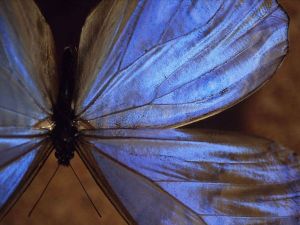
His interest in morphology, the study of structure and form of organisms, involved context, meaning and communication. He distrusted reductive models of cause and effect, the scientific approach that lines up parts and classifies them, focussing on quantity.

Comparing systems, one to another, he perceived the mind as an ecological system. And he used the analogy that ideas, like seeds, can only take root and flourish according to the nature of the system receiving them. This thought alone deserves deep contemplation.

He had a way with stories … ‘There was a man who had a powerful computer, and he wanted to know whether computers could ever think. So he asked it – Will you ever be able to think like a human being? – The computer clicked and rattled and blinked, and finally it printed out its answer on a piece of paper, as these machines do. The man ran to pick up the printout, and there, neatly typed, read the following words: ‘That reminds me of a story.’ 
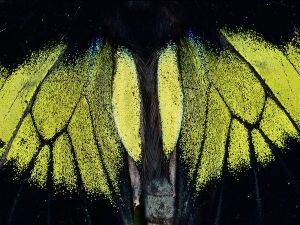
Concerned about the decimation of aboriginal populations (he did field-work with Margaret Mead), the degradation of ecological systems, economic oppression, and senseless wars and arms races, he took these ominous signs of contemporary life to be manifestations of deeper disorders, which he defined in terms of cybernetic systems of communication and meaning that comprise life, mind, and society. In his view, consciousness dominated by purposeful thought has a linear structure that establishes goals and ways for attaining them without being necessarily sensitive to the circular network of cause and effect that orders the systems.

Looking at human consciousness as an adaptive system, he thought the cure for its inadequacies, evidenced by the negative side-effects of purposive rationality, was not to reject it in favour of a passionate non- rationality, as in the extreme romantic position, but to augment and complete it by engaging with non-discursive, pattern-comprehending and emotional processes. He advocated the befriending of the unconscious aspects of the mind through utilising images and metaphors.

In a civilization which separates mind from body, mythologies about the survival of a transcendent mind are often meant to soften the idea of death, or even deny death as part of life. For Bateson, who saw the mind as being immanent not only in pathways of information which are located inside the body but also in external pathways, death took on a different aspect. ‘The individual nexus of pathways which I call ‘me’ is no longer so precious because that nexus is only part of a larger mind. The ideas which seemed to be me can also become immanent in you. May they survive, if true.’  (Afterword to a collection of celebratory essays, 1972)

Yet there are scientists that can no more perceive the language of nature, and politicians who feel beleaguered by sections of society that seek balance and a fresh context towards ‘an ecology of mind.’  The extreme factions of believers, for what else are they, should look again at the bridge  Bateson prepared.


This lovely video gives a taste of what it is all about :

Update … I discovered recently, in 2019, that some the links in this post don’t seem to work anymore. Here , however, is his daughter’s great documentary on Vimeo, unfortunately not free, apart from the trailer.  https://vimeo.com/ondemand/bateson

Looking at the structure of nature and the structure of mind being reflections of each other, it becomes obvious that not only does nature mirror our habit of thinking, but our thinking also mirrors the state of nature. Ecology and psychology must therefore both engage in listening, and seeing, and working ceaselessly towards the integration of knowledge and the re-adjustment of a dynamic balance.

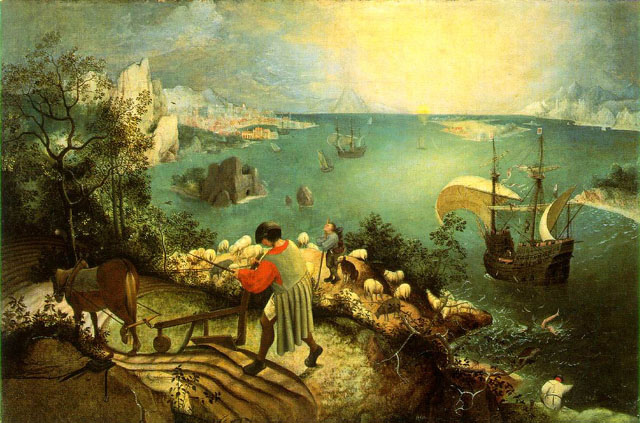
I could go on, but want to bring in a famous painting of Icarus by Brueghel.                                                             Anthony Stevens, a brilliant expositor of Jung’s thought, used the painting as cover for the first hard-cover edition (1995) of his book Private Myths.

http://www.anthonystevens.co.uk/index.html



Stevens quotes from a poem by Wystan Auden:

In Brueghel’s Icarus, for instance: how everything turns away

Quite leisurely from the disaster; the ploughman may

Have heard the splash, the forsaken cry,

But for him it was not an important failure; the sun shone

As it had to on the white legs disappearing into the green

Water; and the expensive delicate ship that must have seen

Something amazing, a boy falling out of the sky,

Had somewhere to get to and sailed calmly on.

What goes up must come down. Who knows how many Big Bangs there were before the one we so ardently explore? There is an organising intelligence behind life’s cycles, while consciousness forever expands. Thinking in metaphors we can perceive similar patterns, forms in nature and mind, cosmos and psyche, mirroring each other across scale and time. In other words, life teems with realities we can tune into, as long as we assign context and meaning.

Check out Gregory Bateson’s books ‘Steps to an Ecology of Mind’ and ‘Mind and Nature.

His family continue his work: His daughter Nora and his wife – Mary Catherine Bateson:   http://www.interculturalstudies.org/main.html

Peripheral Vision

 http://www.amazon.com/exec/obidos/tg/detail/-/0060926309/mead2001centenni

Free chapters of Angels Fear:  http://www.oikos.org/angelsfear.htm

Nora Bateson, recently created a film:

http://www.anecologyofmind.com/

Last not least, the themes:  pattern which connects, mirroring and bridging, are subjects of my novels.
25 Comments

Filed under Blog

… solitude …

Weather-defying, I had my first Pimms with ice cubes this year, imagining warmth, sun, swinging in my hammock under apple blossoms, listening to birds, walking barefoot and having friends round to watch the sun go down and the moon come up. The Brits are fed up with the rain. More than darkening the sun, clouds also obstruct the brighter aspects of the mind. Signals from the noosphere get muffled, or so it seems. There remains solitude, a tranquil space where questions arise, and thoughts have space to dream and play without being overstimulated. Allow your children periods of solitude and they will come to value it later in life.

I mulled over a question these last days, not for the first time. And an answer came, an angel whispered it into my ear while I slept – if all incarnated beings living on this planet were enlightened at the same time, the whole developmental cycle of the psyche would collapse, and consciousness would expand into a new matrix all over again. I’m making no claim to truth, angels can’t always be trusted. But the message seems to be – all is well-tuned as it is.

This is what solitude does to me – I get answers that beg more questions, like, what about multiverses? My body lives in this house in England that is at times difficult to maintain, but my mind also has another house, an interior house, free from mundane pressures, a house that exists in a dimension invisible to the physical eye … built from bricks of meaning rather than clay.

Here to the Noosphere, an interesting concept:  http://en.wikipedia.org/wiki/Noosphere

7 Comments

Filed under Blog