Tag Archives: insight

… when the soul speaks …

Not just her daimon, but some unforgettable characters are given voices in the remarkable life of this visionary narrator, ‘Patchwork of a Safari Pilgrim’ by Philippa Rees. The link should include reviews.

Philippa Rees is also the author of an earlier, brilliant innovative work – INVOLUTION – that seeks to reconcile Science to God, structured as a dialogue between Reason and Soul, a revolutionary fresh hypothesis of evolution. 

‘Safari of a Patchwork Pilgrim’ provides a mesmerizing background to this hypothesis, based on profound direct experience of another dimension. From my own, and shared stories during my client work, I’m certain they are more common than generally acknowledged. Without support, however, to integrate such insights into daily mundane life can be challenging, and often exposes people to ridicule, or much worse.

‘Patchwork of a Safari Pilgrim,’ is a vividly told story, sharing the agonizing attempt to bridge two worlds and translate meaning and truth between different dimensions. It’s the life of a genius.

A totally engaging read.                

There’s presently nothing I could add to the brilliant reviews of Safari. I’m still digesting the unforgettable characters and the brilliant prose. But out of personal interest, I asked Philippa three questions, in the light of her experiences … and she graciously responded …

How did the sudden access to the Akashic memory change your sense of coherence?

My entry to the Akashic Record- the collective memory of evolution- was rapid but not sudden. The incremental loss of all my attachments to anything that ‘placed and held’ my identity: country first, then family, then moral injunctions (obligations), and finally, abandoning my children, for their sakes, one after another, removed the struts of what I (and others) thought was my identity. Through conflict, I surrendered each allegiance for a deeper one. It is why I had to take the reader through the growth of my understanding, with its critical components, and then the loss of each in turn. Leaving my children pulled me up by the roots.

Then I found myself in the mid-Atlantic, alone without any way forward or back. At this point, I was confined only by my fears, and they manifested physically in constant hallucinations of snakes. The snakes (fear) guarded the entrance to the Akasha.

I understood that instinctively. After experiencing compassion for the adder’s fear of me, and its explosion into a shower of sparks, the entry to the greater Akasha was cleared. I no longer had any fear, and the layers of creation manifested in wider and broader visions. What characterised these vistas was their integration with my own thoughts. Thought and vision coalesced. Space and time coalesced. I could move what I was seeing with my emotional thoughts. I could dive deeper into darkness (and it was sometimes terrifying) or imagine myself back into light. By imagine, I mean evoke memories and images of natural beauty like a mackerel sky, flocks of birds, a deer tripping through a dappled light. Those emotions of love and wonder acted like helium to raise me above the sucking, self-preserving fear.

I then realised that the co-ordinates of where each of us stands are in the crosshairs between love and fear. Love lifts, fear suppresses and sinks. Where they intersect determines what and who we are in every moment of our lives.

So what is called decoherence (aka madness) was much more coherent than the dislocation we normally live in, where thought and manifestation are separated. That separation is called time. In time, the material and the mental are distinct from one another. Causation works unidirectionally only, from the past to the present. We live in a squint-eyed world with only half of creation’s story. But the Akashic experience is timeless. Everything (both past and future) is simultaneously present because we contain it all. The future’s unrolling is already coded and inbuilt.

To try to live simultaneously in both the world of time and the timeless world of instantaneity, I adopted strategies (dancing, whirling and, when they threatened to confuse, falling), all of which, of course, were deemed symptoms of insanity.

That brings me to your next question.

How would you define synchronicity and how did it serve you?

If you understand the relativity of time, as being characteristic only of upper shallow surface layers, synchronicity is easier to understand. Not very different from dreaming, although in dreaming, events are still linearly sequenced, but changes can be instantaneous from one person or place instantly to another, and very much governed by emotions. Diving through the levels of the Akasha was like puncturing overlapping transparent dreams, the colours and images interpenetrating one another, some dark and terrifying, others sublime.

 When we talk of synchronicity, we usually mean the improbable and simultaneous events that happen and which link together a particular significance for the observer. The observer makes the link of significance. Other people dismiss that significance and call it a coincidence simply because of its improbability. Only the person whose thought or perception sees the linkage understands it. That understanding imbues the events with meaning. So, in that sense, synchronicities appear to have the quality of a personal signal or a gift of confirmation—something from another world.

I would say that, indeed, they do come from another world, from the penetration of the Akashic memory into the world of time. They are also a gift from that world, and they tend to happen in moments of uncertainty when the person for whom they have significance is momentarily poised between conflicting claims. They are suspended without a causal imperative. So, they have the quality of confirming independent thought and action, a sort of nudge, ‘you are right, keep on, look afresh, believe in what is happening to you.’

Other manifestations of different causality can manifest in what are called poltergeist, teleportation and remote viewing. I believe all these are capacities of the same kind of altered consciousness in which perception of time and space is akin to the Akasha in which all is simultaneously present. Thought precedes manifestation. It is the central understanding in Involution, that consciousness creates.

The other aspect of synchronicity, which I came to understand very well, was that it can never be willed or anticipated, because it is not of this world of time. In that sense, it is always a gift. A gift that rewards the trust of being open to it. When you understand it and live within its affirmation, it happens more often, perhaps because you have somewhat freed yourself from the world of time and causality and live half-embedded in the divine. By the divine, I mean the acceptance of the perfect integrated linkage of all consciousness.

How did it serve me?

Through the extraordinary sequences of things being provided just when they were needed, I came to trust and rely upon my own integration into the divine. Clearly, my life was important in some way that superseded any beliefs I might have about it! At many moments of desperation, when I asked for signs or indications, there was only silence. Nothing. I came to realise that any act of will (wish, even prayer) was an affront to a supreme reality that had its own patterns, purposes and momentum. I could sink into and accept that, but not, in any small degree, orchestrate it! Not even by wanting or articulating a need! My needs were already known! And not always the ones I thought were paramount!

Once I had learned that, I found my well-being was provided for. All the improbable gifts; of a cruise to recuperate and then a home to build were given to restore me to the world of time and material 3D reality. Every person serves the divine creation, whether they know it or not. Synchronicity served both my exile and, equally, my return. The latter implied some purpose for which I had been preserved. Unlike the rapidity of my escape, the return was very much infused with slow and dogged time. Perhaps because I had travelled so far into instantaneity, I had to relearn the rules of material existence.  For this reason, the writing of Involution was a compelling obligation of gratitude, and. in hindsight it rang out as also the intention of all that had happened to me.  All had been necessary and led to it. And the writing of that was fostered and accompanied by constant synchronicities and the final affirmation of George Eliot! Back to ordinary time, but with filaments of Akashic timelessness still wafting and attached!

How would you explain the demands of your unique Daimon ?

This is more difficult. I want to avoid proselytizing or imposing my experience as any kind of special favour, and it is also deeply personal. But first, I must correct you: Daimon makes no demands, ever. The initial persuasion to write the book was not coercion but encouragement to have the courage to do what I contemplated for a long time.

When he, whom I call Daimon, first revealed himself, it was after a few disguises as other lovers. Without those, I would never have recognised, accepted or believed. For the Daimon is the Divine Self, or the Divine Companion, the Voice of the Soul, personal to me, but equally personal to anyone, whether recognised or not. That Voice is an expression of all the previous loves, both human and animal, and also the abstract loves of beauty, inspiration, music and longing. For a woman, likely to seem male; for a male, to seem female (the counter completion of the part) but also plural, uniting all, communing with all. Is Daimon God? Not entirely, but the personal God within, which, once recognised, is a constant presence, but also a Voice when addressed in the deepest silence, when all thought is stilled.

As I believe our DNA links each of us personally to the Akasha of historic memory, I believe the Divine Self links us to the God of All—So, in that way, it/he/she/they is both immanent and transcendent. The Voice does not speak unless thought or desperation calls to it. Occasionally, when I was in real danger, it alerted me. Perhaps the danger itself called out? That Self intimately knows the individual, his language, his references, but also his or her place and purpose, but the knowledge waits for its natural manifestation, never imposing any constraints upon liberty or error or time. But when directly addressed, it/he/she mirrors back /calls forth what is already known. When you think about it, to understand is to stand under. The umbrella of the Soul.

In ‘Safari’ I gave a direct voice to the Daimon in the recapture of events to alert a reader to what I had relied upon and consulted, at the height of the experience, almost constantly. He did not appear or penetrate my consciousness until all else was lost, and I had nowhere to turn, but at that point, he spoke very clearly. Without him, I would never have survived. So, feeling cherished, I ventured into the timeless worlds and took risks that to others, then and now, also seem insanely devoid of fear.

I have the sense that what God waits for, and why free will was granted to humanity, is reciprocity. God is lonely. He waits to be freely and joyfully loved by those gifted with the freedom to withhold it: Unlike angels who love by their nature, we have to choose.

Hence, the ending of both Safari and Canto the Ninth.

I shall know the moment I may turn and lift you…

My hands will liquid shape your acquiescence:

In the silent break of day, upon my shoulder

Upon dawn’s clavicle, your happy cheek will lean

Cradled in my neck, you’ll breathe our essence:

I shall carry you entwined and carefully

Through the silver light and striding water…

Wade until we drown in salt bright sea.

Liquid shape, Dawn’s clavicle, neck cradle, striding water- all anomalous contradictions; the point at which the individual and personal become the united universal.

————————-

You may want to follow Philippa on Sub stack: https://philipparees.substack.com/p/perfection-in-the-commonplace

Philippa would be an honourable member of the underground community of Shapers 🙂 …  scientists with a mystical bent, as featured in my novel of that name.
4 Comments

Filed under Blog

… Trump – a prologue asking for the proper story …

       The seed -painting by Silvia Pastore

Stories inform, entertain, inspire. They make us think, dream, identify, or divert us from reflecting about what is going on inside us or in our present situation. Images and story lines reinforce each other. If we can’t detect the symbols images hold for us, be they evoked in paintings, literature, in the frame by frame images in cinema, or in the media, a story may grip with sensational elements, but remain otherwise flat. Feedback can vary, to use comic extremes, from, ‘What a thrilling yarn’ to, ‘What the hell was that all about?’ Stories that hang in the middle might satisfy both contemplatives and the sensationalist, and occasionally become best sellers.

A story well told acts like a seed in the psyche, is subtle and opens cracks in the unconscious with contradictions to ponder upon. A story well told is often mysterious, far from obvious at first impression. A story well told takes deep questions into our dreams. Then, out of the blue, we’re struck by an insight, and a door to the imagination opens.

I’ve been wondering about the Trump story. How many of you have had an inner voice saying, ‘You can’t make this up. It can’t be, how does he get away with it?’ even while chapter after chapter the public across the world was spun into a nightmarish trance. The surreal and sensational element the Trump protagonist brought to the world stage has wrought continuous fascination and cravings for the next cliff-hanger. ‘Wow, he says it like it is … a kind of superman who gives a fuck about good manners or political correctness.’

No Aha moment, no insight, no transformation, just point by point affirmations for the disenchanted, the frustrated, to let it all hang out, a continuous clowning spectacle, embodying, well, possessed by the archetype of the sulking child whose gratification is denied, the Id with its breath-taking rages. No contradiction here. No subtle narrative, more like an attention-demanding prologue. The meanwhile addicted public won’t take kindly to the sobering. Where does it go from here?

For this prologue to develop from a catalytic incident into a worthwhile story begs the questions, and not just from ungratified Americans, but from ungratified people all over the world … and though I could dare answers, they’d only resonate with a few psychologically aware, the already converted.  So I include myself as curious as to where those vital questions will find ground to grow:

What is denied, and by whom?

16 Comments

Filed under Blog

… a dream of being in the dark …

How to reconcile moments of pure beauty and light our restless world offers, with the heavy darkness of human ignorance? How is it the guiding spirit that is shining through everything so often escapes the unseeing eye? Is it our wounded hearts, or our anxious busy thoughts that prevent spontaneous being?  Many of us like twilight, the dawn, the dusk, mist, where darkness and light do not negate but enhance each other. They mingle. As friends do, or lovers.  Twilight is poetry in motion.

And what, you may ask, does she mean by the guiding spirit that shines through everything. It’s a core in me that connects to the one soul-being I belong to, the only self I really know. And while I’m not enlightened, I do experience timeless moments, glimpses into the sixth dimension, nodal points around which the fiction of my existence is woven.

The other day, my long-ridiculed romantic fool tossed out these lines:

like tiny cherubs

white butterflies loop across

green teeming canvas

thou – sweet silent mystery

do you sense me sigh

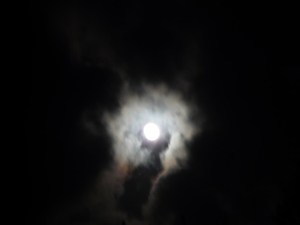
when the cold moon-rock rises

as luminous globe – hello dear ones lost in time – your intense living – is forever part of me

‘Long live the dead because we live in them.’  …  Clarice Lispector, A Breath of Life

When there is no other near to share such paradoxical quickening with, I may call on those who enriched my life but are no longer present. I adore the moon, the ancient chunk of earth, reflecting and making tolerable the blinding beams of the sun, granting us poetry and symbolic language.
That night I had a dream and remembered its last facet … I’m floating through a soft, vibrant darkness. A small voice says, ‘You’re the light, look again.’ Sure enough, I spot the outline of a building and bright points, like glittering stars. A series of scenes unfolds, which brings clarity to a puzzling questions. Darkness holds memories, visions and vital knowledge, though it requires trust in the guiding spirit as a mode of orientation. Insights are shy; they wait to be found.

Nature, being energy manifested in slow motion, breathes life into countless rhythms and tunes from the recorded symphonic sounds of the universe – to continuously re-animate the one being of eternal life. Yet we humans, who pride ourselves in aiding this process with heightened consciousness, are increasingly busy destroying the homeostasis life depends on. Can a virus offer a long enough pause for the powers in charge to acknowledge this self-destructive madness? Below anger, I feel the deep sadness, the spiritual starvation, an unfulfilled longing for meaning, for being worthwhile, accepted and loved.

I sense a change of mood in the collective mind, a call for change. Upfront are manic voices using the language of warfare against the invisible enemy – let’s control it – defeat I – kill it – get on top of it. I feel this kind of rhetoric misses the point entirely.

In Sept. 2012 I did a blog post on the unseen stuff.

We must see things fresh, not through tired ideas our establishments bank on, that destroy nature’s homeostasis and spill imbalances into cultures too poor to afford resistance. I say – let our children and young people decide what’s worth living for?

 ‘A day, whether six or seven years ago or whether six thousand years ago, is just as near to the present as yesterday. Why?  Because all time is contained in now.’   – Meister Eckhart

10 Comments

Filed under Blog

… dazzling journalism through this dark moon phase …

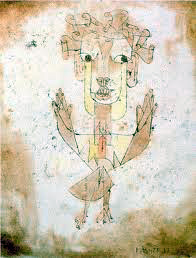
Angelus Novus, Klee

We’ve been living through metaphorical dark moon years, with debris stirred up from deep, and yet, when brave souls explore the confusion in such times, sharp beams break through cracks in the mud.

Wars fought over territories and resources have become wars over ideologies and identity. The internet intensifies clashing ideas, and where free speech is allowed, arguments find air. Whose side to take, where to place oneself –  left, right, center, past, present, future? Peace- loving citizens are challenged. Does one go numb, angry, self-righteous, or suffer confusion? Are they defensive reactions to the cacophony of voices struggling for attention? Some shout, some play clever games, some share information, true or false, and others offer sharp insights, be it through anguish, sincerity, passion or irony.

Marina Hyde from the Guardian does the latter, with anguish, sincerity, passion and, most of all, irony. Conflict inspires the search for her truth. Like a martial artist, she uses words that dance without hesitation, in swift, spirited and glittering moves. The new moon a few days ago brought a dazzling peace of her journalism, a laser glance at recent politics. Marina’s dark irony brightened my confused and deflated mood – because she speaks to the truth.

Marina Hyde – her bit on Dominic Cummings

… using words my mother would never have …

cathartic therapy, Sufi style

It’s of course useless, and mostly counterproductive, to blame or dispense anger about ideologies on particular people or nations.

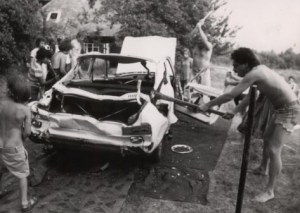
Far better to release the rage by smashing up old cars, as my former Sufi teacher, Fazal Inayat-Khan, encouraged us to do. But who has such novel opportunity? For now, we’re in this storm blowing from paradise together.

Nationalism is the pathology of modern developmental history as inevitable as neurosis in the individual.   – Tom Nairn, The Break-Up of Britain

Relevant, my post on nationalism from April 2012 … here is everywhere

4 Comments

Filed under Blog

… moans from an unruly writer …

Installation by Frederick Franck

Installation by Frederick Franck

While I write, wrestle with style, query words battling for attention and set out sequences to string ideas together, anyone watching me might assume I’m a nervous wreck. My body, perfectly able to string an arrow to a bow and hit a target, has a wild notion of focus when it comes to writing. It shifts and wriggles, gets up pretending I need a coffee, ends up cleaning the sink, checks the porch for post and so on, all the while allowing my word sculpting to continue until, bingo …. I rely on intuition, which slips into little silences, opens a crack in the surface of things and reveals a hidden layer, and, occasionally offers a glimpse into the infinity of now. A tiny glimpse is all it takes to relax, sharpen senses and spark a creative dialogue between my inner voices that often quarrel and fool around like the average family.

I respect moderate conflict, it stirs up mud but clears the air, and even when the inner crowd gets fed-up with listening – grace, solitude, or a good night’s sleep bring additional insights, bridge divides and re-establish a tolerable rhythm of chaos and peace.

Am I fooling myself? Is my knack for intuition just guesswork. Is it inborn? Does it evolve with experience, as a kind of deeper listening skill humanity moves towards? Can it be learned? Is it worth defending? Or is it the relic of a go-with-the-flow philosophy that avoids closer analysis of my thought processes and behaviour? I seem to struggle with two kinds of temperaments, one looking for the particle and the other for the wave, stretched between rational and irrational numbers. The two temperaments compete but need each other.

Pilgrim Fool by Celcil Collins

Pilgrim Fool by Celcil Collins

Scientists and statisticians tend to approach the unknown rationally, and seem set to eradicate human incompetence and messiness. Some frenzied rational prophets go as far as knocking anything that can’t be quantified and evidenced. I value logic, what annoys me is the attitude that scoffs at people who hold hands with the fool.

There are more reliable methods than the vagaries of intuition, shown in a New York Times piece by Gary Wolf ‘The Data Driven Life’ from April 2010,  a long but brilliant article that received many pages of diverse comments. Not everyone is keen on the Quantified Self.

I resist being monitored and quantified by data, fixed as particle, ticked off for my risk-taking folly, my random cross-referencing. The geeks and outliers the article describes have fun recording their every move. And I grant that someone suffering from high blood pressure or apnoea benefits from being nudged by a gadget to take a deep breath. I remember being excited and applauding the first biofeedback devices that affirmed how thoughts affect our physiology and vice versa. When it comes to data dependency, I have a hunch it will starve emotional intelligence, which I strongly believe develops through mastery of language.

Working a few years for Social Services, we used to write narrative assessments until a computer programme with tick boxes was introduced. We hated it. Conveying observations in writing was shoved aside as time-consuming, subjective and vague, while quantitative recording was hailed as reliable, though its data hinges no less on interpretation and application.

Recently I skimmed an article suggesting future novels will be written by computers. My cynic leapt from its slumber and argued that a machine hasn’t got 100 Billion neurons and can’t be intimate with nature, is immune to changing metabolisms and moods – hour by hour, night and day. Immune to what comes on the breath, with wind, dust, rain and radio waves that travel through the cosmos, nor is a machine influenced by dreams, synchronicities, diets, layers of revolving memories, kind gestures, general anxieties, rejection, loss of control, loss of a loved one, global news … the unpredictable influx of thoughts and emotions that our mind continuously sifts, evaluates and re-interprets.

Irrational humans can’t be quantified and controlled, which may be why since ancient times there has been an ambition to create artificial beings.  Here a bit of fun from Turing and his colleague Strachey – a reasoned-out love letter, achieved through programming a 1951 computer to make sentences via algorithms, having been fed on love synonyms from a Thesaurus:

Honey Dear – My sympathetic affection beautifully attracts your affectionate enthusiasm. You are my loving adoration: my breathless adoration. My fellow feeling breathlessly hopes for your dear eagerness. My lovesick adoration cherishes your avid ardour.

Yours wistfully, M.U.C. (Manchester University Computer)

…. M. U. C. is eager, if a little verbose and breathless 🙂

Since then, artificial intelligence is even more breathless with numbers, but operates highly sophisticated technology that improved the quality of our lives. I admit I’m fascinated by the concept of cyborgs, but don’t want to get plucked into the human network protocol .

Our privacy is at stake. And our relationship with nature? … its record of life and the human experience, the treasure house of the collective unconscious, translated and re-membered through DNA, invisible spheres and the very light we breathe. Anything alive changes from moment to moment. And our experiences, insights and expectations have a vital part in the changing.

Nature is the book I grew up with, it taught me stuff:                                                                                                       About growing … put a seed into earth, tend to its needs and its story flowers.                                                        About resilience … a seedling lost in a dark corner will grow towards any spot of light, no matter how it must bend and curl its stalk around obstacles.                                                                                                                                       About connections … the dynamic geometry of the tiniest plants and vast galaxies are reflected in each other.

Enough samples to show the obvious – nature teaches through metaphors. My theme is resilience. I take risks and accept that struggling makes me inventive, expands my consciousness, polishes my heart and challenges me to think for myself.

My moan extends to the growing practice of enticing people to emulate machines in service of progress and economic efficiency, in jobs that dull the senses and dull the mind.

Meanwhile I cheer the unruly folk, including fools, dreamers, innovators, artists, poets and writers with an ear towards the hidden – who translate past and future newly into the present – the open-minded, who can tolerate conflict, value intuitive signals that chime in the heart, and who can occasionally endure being suspended like a leaf on a gossamer thread.

What do you, my reader, think?

26 Comments

Filed under Blog

one raindrop – ten raindrops – what’s the difference?

Before I went to bed last night I asked for a dream, as I do when I want guidance from my unconscious. After all, the greater part of our psyche is out of sight, submerged, with only the top in view, which is why Freud used the image of an iceberg to depict the psyche, the submerged part having deeper connections with the sea of the collective unconscious in which we all swim.

Iceberg - Ri han - Shutterstock

Iceberg – Ri han – Shutterstock

My question was related to the global web, and what’s rising to the surface like long drowned skeletons bobbing along the electric rapids of information, memories re-shuffled, all with a kind of speed only fearless surfers can negotiate. And how every link you and I click is traced, analysed and fed back to the media, politicians, businesses, twitter-birds, face bookers, bloggers and so on. At times it seems like a kind of vivisection in a shiny mirror looking back at us, surreal.

I’m seasoned. There was no TV in my early childhood, it astounds me what I’ve adapted to over the years, but the present tech-apps-avant-garde makes me feel like I’m missing a boat, along with, let’s take a breath, at least sixty-one-percent of the world population (that’s the kind of people with no internet at all.) And because I tend to reflect on cultural trends, searching for wider purpose, meaning and metaphors, I put this to my unconscious: please give me some insight.

On waking, the first thing I gazed at was the raindrops netting my skylight. A phrase came:

                 … one raindrop – ten raindrops – what’s the difference? …

It stuck. I stopped myself diving into associations, about raindrops, the number one, about the history of zero – as symbol for something that doesn’t exist but has become a place-holder. I stopped myself from quoting Rumi, too.

The phrase I received is enigmatic and feels creative. Does it come down to postulation, the everything-and-nothing-matters kind of power we have to envision and re-assemble stories, the delicious freedom to speculate without limits …?

Maybe purpose and meaning are becoming old hats and I’m missing the point entirely. What do you make of the phrase … either with your knowledge of maths and physics, or with your imagination? Even with the phrase or image of a dream ☼


19 Comments

Filed under Blog

… layers of perception …

Lately, fully into the process of writing again – the sequel to my first novel – I sometimes wake up with phrases. Yesterday it was: Outsight is the dream, insight is reality. Aha, not just a nice wordplay, I thought, but a fitting indication for what happens in the creative, intuitive process. Insight is new comprehension, often through a shift of focus revealing deeper layers, new connections in the matrix that awaken and surprise, fresh meaning, and adjust the outsight, the old noise caught in a time warp. It’s like having new sight through what the Celts called Thin Places, actual or virtual, where our senses are transcended and spheres intermingle.

If you are a creative person, you may listen to the system talking to itself, as it does day and night, even during dreams. Some of us like to branch into the unknown for dimensions beneath surface impressions, probe into the vast reservoir of the personal and collective psyche,  normally filtered out from our conscious awareness when we must attend to the practical matters of daily living.

Often a creative process is sparked by sensing in-betweens. This applies to all arts, including writing. Different layers of experience and association diverge and merge anew when we de-focus. In a visual sense, for example, try looking at a tree in twilight, squeeze your eyes and concentrate on the in-between spaces. There is a moment when the shapes reverse and the background becomes the foreground. And who hasn’t looked at clouds or landscapes in a particular light and seen magical beings?

In this optical illusion you only need to tilt your head. 

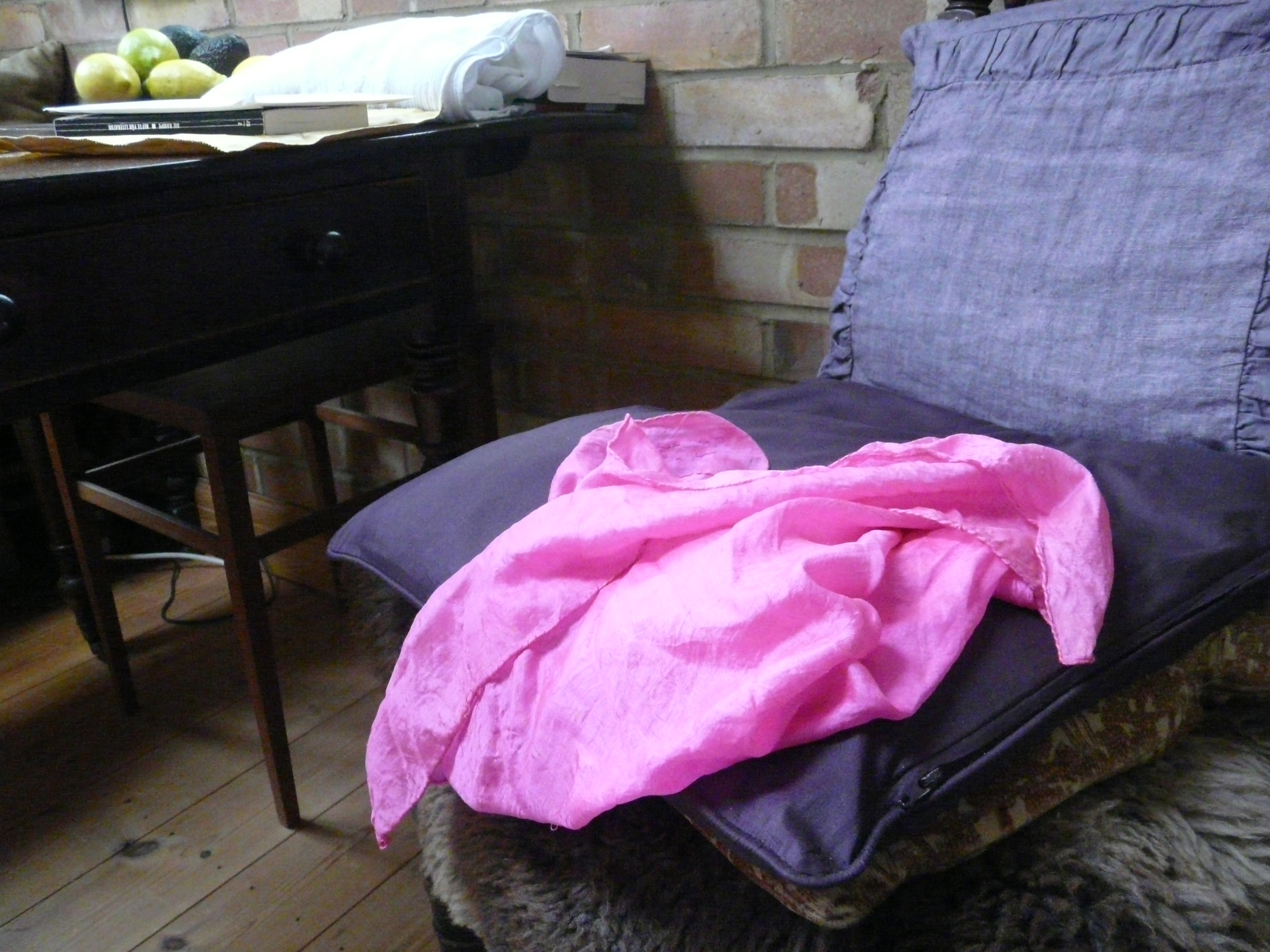
And there is the meandering mind, receptive to intuition. Like yesterday I popped to the corner shop to get a paper. An unintended detour got me talking to Annie, who does house clearances. Amongst her cornucopia of stuff a spot of bright magenta caught my eye. I instantly thought of my friend, Rahima, presently in hospital. She is a painter. She loves colours. The vibrant patch of silk, I thought, will make her smile. 

Artists tend to tune out of fashion, out of mass projections, to let the muse take them along random paths into deeper strata of perception and cognition – of shapes, colours, sounds and movements – to re-arrange personal experience, bringing them into a new, universal context.

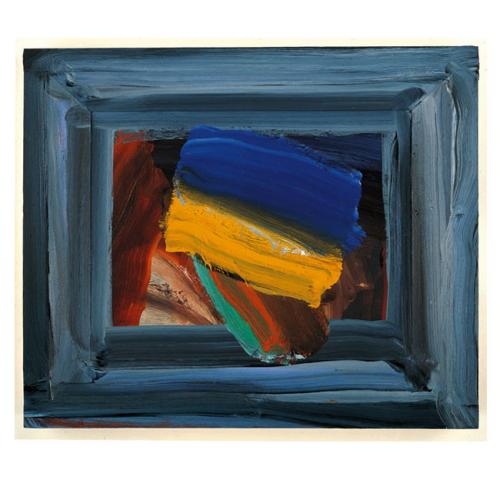
A good example of this process is shown in a documentary of the painter Howard Hodgkin by Alan Yentob, from the IMAGINE series.

Howard Hodgkin has a current exhibition at the Alan Christea Gallery, London.  http://www.alancristea.com/  in celebration of his 80th birthday,

A Robert Frost poem – Acquainted with the night – was chosen as the title for the exhibition.

De-focussing is magical – it brings new layers of perception …

Ask what makes you come alive, and go do it. Because what the world needs are people who have come alive.’ – Howard Thurman

18 Comments

Filed under Blog