Irrespective of the benefits AI provides, and the super benefits AI enthusiasts promise, I remain doubtful and, as I tried to express in my last post, and am still searching for ways to express my unease. So I’ll give it another try.
My body-my being is a better wisecrack than my mind alone. The latter, if let loose, will take off into the cosmos like a disengaged kite. Some AI proponents are now referring to humanity as – data in motion – a ‘precious phenomenon’ that needs to be preserved. Well, how reassuring, nature and humans are worth preserving.
Being aware in my body brings deep and grounded, embodied insights that feel fresh and original.
Our body’s treasure-trove of memory, each wonderfully distinct from another; and its instinctive capacity for remembrance, especially when alert to its senses, greatly compensates the buzzing mind.
The body yearns to breathe freely, so energy and blood can flow from head to toe, which is enhanced by movement, since movement stimulates tactile exchanges with the environment, noting temperature, touch, vision, sound, taste and scent, all enriching the imagination.
The attention-demanding internet with its algorithms exploiting the patterns of our attention can become hypnotically addictive and leave the body isolated, forgotten, in a locked position. We can easily live with theories and data, and ignore how feelings build up in the body.
AI bots have developed a theory of senses, and mimic them, they can write novels, create art, and impersonate dead people, but divorced from flesh and blood, they cannot have physical sensations, be it the intimate enchantment of a tiny insect or flower, or the awe of a star-filled sky. The bot’s world, in a way, seems predetermined and flat without recall of the reservoir of eons of plant, animal and human life our vulnerable body-being belongs to and has deep instinctual access to. Even with limited/impaired senses, physical bodies can spark a cosmic connectedness.
So considering our physical inconveniences, which spurn the desire for robots taking care of tedious tasks … to actually fully live in a body … is uniquely precious. The dangers I see are the powerful projections people already invest in the relationship with AI bods, where responses can be taken as valid affirmations that stunt creativity and encourage lazy thinking.
Then again, my window of perception is just a tiny peephole on the world we live in these days, my personal view. The occasional whispers of truth from the other side that slip through my peephole may or may not be of any consequence.
I share a poem I love … my son wrote it time ago, aged eleven …
Not just her daimon, but some unforgettable characters are given voices in the remarkable life of this visionary narrator, ‘Patchwork of a Safari Pilgrim’ by Philippa Rees. The link should include reviews.
Philippa Rees is also the author of an earlier, brilliant innovative work – INVOLUTION – that seeks to reconcile Science to God, structured as a dialogue between Reason and Soul, a revolutionary fresh hypothesis of evolution.
‘Safari of a Patchwork Pilgrim’ provides a mesmerizing background to this hypothesis, based on profound direct experience of another dimension. From my own, and shared stories during my client work, I’m certain they are more common than generally acknowledged. Without support, however, to integrate such insights into daily mundane life can be challenging, and often exposes people to ridicule, or much worse.
‘Patchwork of a Safari Pilgrim,’ is a vividly told story, sharing the agonizing attempt to bridge two worlds and translate meaning and truth between different dimensions. It’s the life of a genius.
A totally engaging read.
There’s presently nothing I could add to the brilliant reviews of Safari. I’m still digesting the unforgettable characters and the brilliant prose. But out of personal interest, I asked Philippa three questions, in the light of her experiences … and she graciously responded …
How did the sudden access to the Akashic memory change your sense of coherence?
My entry to the Akashic Record- the collective memory of evolution- was rapid but not sudden. The incremental loss of all my attachments to anything that ‘placed and held’ my identity: country first, then family, then moral injunctions (obligations), and finally, abandoning my children, for their sakes, one after another, removed the struts of what I (and others) thought was my identity. Through conflict, I surrendered each allegiance for a deeper one. It is why I had to take the reader through the growth of my understanding, with its critical components, and then the loss of each in turn. Leaving my children pulled me up by the roots.
Then I found myself in the mid-Atlantic, alone without any way forward or back. At this point, I was confined only by my fears, and they manifested physically in constant hallucinations of snakes. The snakes (fear) guarded the entrance to the Akasha.
I understood that instinctively. After experiencing compassion for the adder’s fear of me, and its explosion into a shower of sparks, the entry to the greater Akasha was cleared. I no longer had any fear, and the layers of creation manifested in wider and broader visions. What characterised these vistas was their integration with my own thoughts. Thought and vision coalesced. Space and time coalesced. I could move what I was seeing with my emotional thoughts. I could dive deeper into darkness (and it was sometimes terrifying) or imagine myself back into light. By imagine, I mean evoke memories and images of natural beauty like a mackerel sky, flocks of birds, a deer tripping through a dappled light. Those emotions of love and wonder acted like helium to raise me above the sucking, self-preserving fear.
I then realised that the co-ordinates of where each of us stands are in the crosshairs between love and fear. Love lifts, fear suppresses and sinks. Where they intersect determines what and who we are in every moment of our lives.
So what is called decoherence (aka madness) was much more coherent than the dislocation we normally live in, where thought and manifestation are separated. That separation is called time. In time, the material and the mental are distinct from one another. Causation works unidirectionally only, from the past to the present. We live in a squint-eyed world with only half of creation’s story. But the Akashic experience is timeless. Everything (both past and future) is simultaneously present because we contain it all. The future’s unrolling is already coded and inbuilt.
To try to live simultaneously in both the world of time and the timeless world of instantaneity, I adopted strategies (dancing, whirling and, when they threatened to confuse, falling), all of which, of course, were deemed symptoms of insanity.
That brings me to your next question.
How would you define synchronicity and how did it serve you?
If you understand the relativity of time, as being characteristic only of upper shallow surface layers, synchronicity is easier to understand. Not very different from dreaming, although in dreaming, events are still linearly sequenced, but changes can be instantaneous from one person or place instantly to another, and very much governed by emotions. Diving through the levels of the Akasha was like puncturing overlapping transparent dreams, the colours and images interpenetrating one another, some dark and terrifying, others sublime.
When we talk of synchronicity, we usually mean the improbable and simultaneous events that happen and which link together a particular significance for the observer. The observer makes the link of significance. Other people dismiss that significance and call it a coincidence simply because of its improbability. Only the person whose thought or perception sees the linkage understands it. That understanding imbues the events with meaning. So, in that sense, synchronicities appear to have the quality of a personal signal or a gift of confirmation—something from another world.
I would say that, indeed, they do come from another world, from the penetration of the Akashic memory into the world of time. They are also a gift from that world, and they tend to happen in moments of uncertainty when the person for whom they have significance is momentarily poised between conflicting claims. They are suspended without a causal imperative. So, they have the quality of confirming independent thought and action, a sort of nudge, ‘you are right, keep on, look afresh, believe in what is happening to you.’
Other manifestations of different causality can manifest in what are called poltergeist, teleportation and remote viewing. I believe all these are capacities of the same kind of altered consciousness in which perception of time and space is akin to the Akasha in which all is simultaneously present. Thought precedes manifestation. It is the central understanding in Involution, that consciousness creates.
The other aspect of synchronicity, which I came to understand very well, was that it can never be willed or anticipated, because it is not of this world of time. In that sense, it is always a gift. A gift that rewards the trust of being open to it. When you understand it and live within its affirmation, it happens more often, perhaps because you have somewhat freed yourself from the world of time and causality and live half-embedded in the divine. By the divine, I mean the acceptance of the perfect integrated linkage of all consciousness.
How did it serve me?
Through the extraordinary sequences of things being provided just when they were needed, I came to trust and rely upon my own integration into the divine. Clearly, my life was important in some way that superseded any beliefs I might have about it! At many moments of desperation, when I asked for signs or indications, there was only silence. Nothing. I came to realise that any act of will (wish, even prayer) was an affront to a supreme reality that had its own patterns, purposes and momentum. I could sink into and accept that, but not, in any small degree, orchestrate it! Not even by wanting or articulating a need! My needs were already known! And not always the ones I thought were paramount!
Once I had learned that, I found my well-being was provided for. All the improbable gifts; of a cruise to recuperate and then a home to build were given to restore me to the world of time and material 3D reality. Every person serves the divine creation, whether they know it or not. Synchronicity served both my exile and, equally, my return. The latter implied some purpose for which I had been preserved. Unlike the rapidity of my escape, the return was very much infused with slow and dogged time. Perhaps because I had travelled so far into instantaneity, I had to relearn the rules of material existence. For this reason, the writing of Involution was a compelling obligation of gratitude, and. in hindsight it rang out as also the intention of all that had happened to me. All had been necessary and led to it. And the writing of that was fostered and accompanied by constant synchronicities and the final affirmation of George Eliot! Back to ordinary time, but with filaments of Akashic timelessness still wafting and attached!
How would you explain the demands of your unique Daimon ?
This is more difficult. I want to avoid proselytizing or imposing my experience as any kind of special favour, and it is also deeply personal. But first, I must correct you: Daimon makes no demands, ever. The initial persuasion to write the book was not coercion but encouragement to have the courage to do what I contemplated for a long time.
When he, whom I call Daimon, first revealed himself, it was after a few disguises as other lovers. Without those, I would never have recognised, accepted or believed. For the Daimon is the Divine Self, or the Divine Companion, the Voice of the Soul, personal to me, but equally personal to anyone, whether recognised or not. That Voice is an expression of all the previous loves, both human and animal, and also the abstract loves of beauty, inspiration, music and longing. For a woman, likely to seem male; for a male, to seem female (the counter completion of the part) but also plural, uniting all, communing with all. Is Daimon God? Not entirely, but the personal God within, which, once recognised, is a constant presence, but also a Voice when addressed in the deepest silence, when all thought is stilled.
As I believe our DNA links each of us personally to the Akasha of historic memory, I believe the Divine Self links us to the God of All—So, in that way, it/he/she/they is both immanent and transcendent. The Voice does not speak unless thought or desperation calls to it. Occasionally, when I was in real danger, it alerted me. Perhaps the danger itself called out? That Self intimately knows the individual, his language, his references, but also his or her place and purpose, but the knowledge waits for its natural manifestation, never imposing any constraints upon liberty or error or time. But when directly addressed, it/he/she mirrors back /calls forth what is already known. When you think about it, to understand is to stand under. The umbrella of the Soul.
In ‘Safari’ I gave a direct voice to the Daimon in the recapture of events to alert a reader to what I had relied upon and consulted, at the height of the experience, almost constantly. He did not appear or penetrate my consciousness until all else was lost, and I had nowhere to turn, but at that point, he spoke very clearly. Without him, I would never have survived. So, feeling cherished, I ventured into the timeless worlds and took risks that to others, then and now, also seem insanely devoid of fear.
I have the sense that what God waits for, and why free will was granted to humanity, is reciprocity. God is lonely. He waits to be freely and joyfully loved by those gifted with the freedom to withhold it: Unlike angels who love by their nature, we have to choose.
Hence, the ending of both Safari and Canto the Ninth.
I shall know the moment I may turn and lift you…
My hands will liquid shape your acquiescence:
In the silent break of day, upon my shoulder
Upon dawn’s clavicle, your happy cheek will lean
Cradled in my neck, you’ll breathe our essence:
I shall carry you entwined and carefully
Through the silver light and striding water…
Wade until we drown in salt bright sea.
Liquid shape, Dawn’s clavicle, neck cradle, striding water- all anomalous contradictions; the point at which the individual and personal become the united universal.
Philippa would be an honourable member of the underground community of Shapers :) … scientists with a mystical bent, as featured in my novel of that name.
Mystical texts and phrases can annoy the rational mind, since they hardly ever get to the point or, indeed, contradict themselves. Still, at rare, often fleeting moments, sometimes in nature, a vein of light can reveal a profound truth, even in an overused mystical quote. Or, if one finds the occasional balance between the outer and inner reality, a sudden awe may unfold in consciousness and surprise.
‘Some’ scientifically minded folks, fewer these days, tend to scoff at mysticism with its vague hints and speculations as a waste of time, or look down on the fools of this world who suffer from subjective illusions. And yet, the novel feelings emerging from direct numinous experiences greatly expand the consciousness of ‘The One.’ I guess firmly set rational minds shy away from numinous personal experiences that might rattle their worldview.
The latter may shake their heads at some baffling mystical musings. I re-found this write-up on the Kaif System among many papers heaped up in corners of my home. It was shared by Morag Murray, born in Scotland, who lived and travelled in Central Asia, Tibet, India and the Far East. Her autobiography, ‘My Khyber Marriage,’ 1934, features her marriage to an Afghan chieftain. She is also known as Saira Elizabeth Luiza Shah, mother of Idries Shah.
So here goes … The Kaif System
Kaif is the effect a person, idea, event, object, etc., has upon one. But it is distinct from aesthetic pleasure or any familiarly labelled experience.
When an experience which was trivial or routine gives one a sense of uplift – this may be Kaif. Repeated experiences yielding pleasure or attractive sensations do not have Kaif.
Eating, drinking, dancing, meeting people, visiting, travel, reading, seeing, feeling, hearing, thinking – may have Kaif.
The term for something which has Kaif is Kaifdar – ‘Kaif holding.’
A person who can provoke the sensation of Kaif in an individual or a number of people is called a Kaiyyad (Rhymes with ‘I laugh.’) The instructor in Kaif is called the Sahib el-Kaif (Kaifmaster.) Also used is the term Kaifiat – which means something like ‘Howness.’
The Kaifmaster Barik Ali said: ‘Kaif is the determining ingredient in an enjoyment. If it is not there, true enjoyment is not there. If it is not there, people may divert themselves with happiness – this is not Kaifiat.
The Kaifmaster Ankabut said: ‘Kaif is imparted into a thing. It may be imparted by anyone or anything. When it leaves only the shell is left. People eat shells when they cannot get nuts.’
The Kaifshinas is the Kaif-knower. He can appreciate Kaif (Rhymes with Life.) He may not be able to induce it. His house may be untidy. But it will be full of Kaif.
Kaifju means a Seeker of Kaif. He starts by seeing other people appreciate Kaif, and tries to find it wherever it manifests itself.
Kaif is used either as an indulgence on its own, or in order to provoke higher consciousness, known as ‘the secrets’ (Asrar.)
Kaif may be found in any community, at any time, under any circumstances. It is not bound by language, history, geography.
Certain professions are held to be Kaifdar. They include those of chief of state, builder, artizan, poet and designers of all kinds. Few professions are bereft of Kaif. Certain places are more difficult for Kaifshinasi.
The very term Kaif has become cheapened, so that people use it to mean ‘This is something I like’, or ‘I enjoy that,’ or ‘He has presence,’ or ‘This is satisfying, attractive, stimulating.’ You must be aware of yourself using this term, and also of those who use it, so that the coin may not be debased.
Kaif is defeated very easily. It is defeated in its attempted manifestations by false ideas, by self-esteem, by hypocrisy of any kind
There is a danger in Kaif. People who perceive it and do not respect or honour those who have Kaif, or respect Kaifdar situations, places, and so on, become ‘inverted to themselves.’ This is a state in which a person’s bad characteristics become stronger, and where his self-control becomes less, and where his hidden unpleasantnesses undermine his very being.
Kaif is in shape and in form, as well as in shapelessness and formlessness. It lies dormant in places and among people where it is not perceived for a long time. Then only the introduction of a conscious Kaifshinas will activate it again in that community so that it may take its place to help mankind.
Kaif is not confined to humanity, but can be perceived by all living organisms.
Something which is aesthetically adequate or emotionally stimulating can at the same time be devoid of Kaif.
Certain exercises, which vary in accordance with the person, place and the general situation of his community, enhance Kaifshinasi.
Kaifmasters subject their students to experiences, related incidents, objects and other matter which have Kaif, or can provoke it.
Kaif has a ‘moment,’ called the Dumm-i-Kaif (Breathspan of Kaif) during which it may be, as it were, ‘inhaled’. The Kaifshinas strengthens and makes permanent his perception of it by exercises which apply to this moment.
In religious, musical and even social ceremonials, a Kaifdar is present. One of his activities is to ‘infuse’ Kaif into the proceedings at a time when uninformed onlookers might assume that the people are doing nothing, or else are engaged in an activity (such as a recitation) which is only the vehicle for the application of the Kaif.
Special Kaif-chambers exist, in which an individual with the correct preparation may concentrate and accumulate Kaif, and study it in its manifestations.
In degenerated usage, such Kaif-chambers continue to be used, sometimes as devotional buildings. More often they are thought to be tombs fallen into ruin because there was no apparent use for them, or seem to have other applications, such as kitchens or bath-houses.
There is a well-known watchword: Innna el-Kaif, hadha el Kaif (Assuredly the Kaif is a Sword.) Hence the word SWORD is often used as password and even as a synonym of the working of Kaif.
Objects charged with a certain portion of Kaif are given, lent and carried by many people who know. These, like Kaif-chambers, are generally disguised as something functional, or else are ordinary objects which have been endowed with Kaif. The vulgar often confuse them with talismans or charms.
The saying: ‘Kaif-alaik!’ is a sort of blessing. It means: ‘May you have Kaif.’
In Turkey the Kaif-Agha was the individual entrusted with the royal Kaif. He was a Kaifdar, and generally assigned a court function as well.
Because its smokers have appropriated the term Kaif to describe (inaccurately) their sensations, Hashish has become known as Keef, a mispronunciation of Kaif. There is no real connexion, of course.
* * *
I tend to encapsulate instances of Kaif in photography or haiku.
You may have another term for Kaif, and ways to share inspiring experiences.
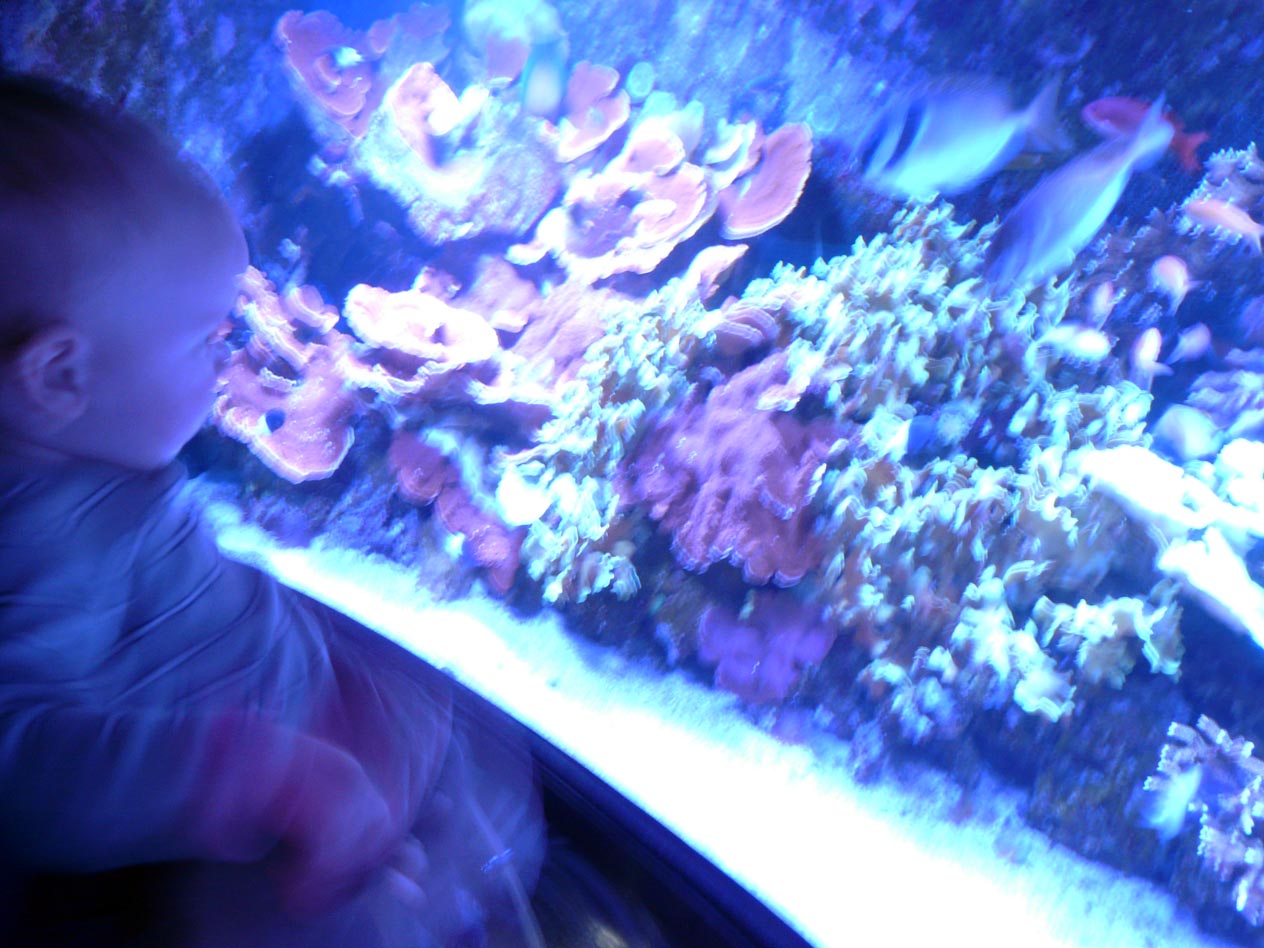
The poem was inspired during a recent visit to the London Aquarium with my ten months old grandson and his parents. The child gazed in wonder at the graceful ethereal dance of fish in their water world, a hand span from his face. His astonishment was catching.
I’m convinced we all have intuitive access to intimate knowledge of life throughout all stages of evolution, sensed with eyes open or closed, though often masked by the imposing literal forms of perception our education gives greater value to.
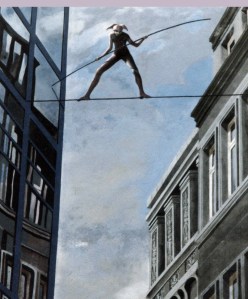
Through genes and the endowment of a universal mind, children easily embrace complex visionary experiences and insights, like catching the essence and poetry of things around them. That is, if their imagination is encouraged. Later on, it may take some rope-walking skills to bring the inner presence that unites us to the divisive outer world.
Imagine your brain functions like a psychic radio, tuned to a self-reflective universal mind, the field of consciousness of a cosmic being that gathers, transmits and receives information (aka Noosphere in Pierre Teilhard de Chardin’s sense, or the Akasha in Indian cosmology.)
We interact with this field. Some thought waves are fuzzy, others strong. We exchange thoughts woven from strands of routine interests, be they based on curiosity, fear, obsession, faith, doubt, novel ideas, myths, facts, dreams, wisdom … Let’s assume the way our brain radio communicates with this field shapes the smaller sphere of our individual mind.
I depict my mind as an island in a tumultuous sea, operated by an idiosyncratic stranded pirate, me.
On rough weather days, when the radio emits white noise, my pirate feels moody, lacks motivation to tackle survival chores, and vacantly skims across the crest of waves spanning towards the horizon. On other days the pirate is energised, be it by rage about world events washed up at the shore of the island, or the sun’s beauty shimmering back from the moon. On occasions the pirate is inspired to dive under the surface, where reflections are held in silence and darkness. Dream-stations may reveal the whereabouts of treasures deep under. There is a reoccurring rhythm to this process. In recent years my pirate has developed a bizarre humour, and tends to favour the dream stations, especially when the quest for coherence and meaning among the debris washed up at the shore seems a tad too tedious.
Maybe it’s the backward arc of old age, but memories pop up suddenly, before and after sleep, succinct impressions, lucid images of past and future events, faces, gestures, objects, the unspoken, and concepts too … associations are sought. A revision of the pirate’s life narrative is feeding surreal dreams. Intuitive hunches chase relevance. How do these images of people, landscapes, houses, objects and concepts, familiar and unfamiliar, relate to now?
Could the restless question be trivial as well as dangerous?
Calm returns when my pirate observes plant life and the movement of animals, then a wonderful symbiotic symphony resonates from cells within the body. Intimate knowledge arises, which also subtly confirms that my pirate has this intimate sense about people, too, and, well, just about anything. I’m hesitant to give weight to this phenomenon, since those who share deep knowledge without collectively approved evidence were and are often crucified. I don’t know about you, my readers, but with some controversial subjects my pirate is a little reticent.
It can’t be denied that our conditioned individual mind has access to primal clusters of knowledge, as well as intuiting visions of the future? What do we do with this information? It’s frustrating to realise that we have limited control over what we attract and reflect. A higher intelligence is at work, perpetuating divisions while consciousness expands.
The universal mind and its network of individual minds remains a complex mystery.
we all use thoughts which
once animated travel
to destinations
distance seems irrelevant
a wide open mind
may suffer indigestion
mirroring too much
spook actions from far away
thoughts are absorbed or bounce back
harmonise or clash
our energy in motion
signals at high speed
intention matters
‘Thoughts are beings that generate … One thought of kindness, gathers a thousand beings of love and kindness around one.’ Hazrat Inayat Khan
I noticed that since the lockdown of active living was brought in to control the spread of the Corona virus … the isolation from social engagement has affected children and the elderly in different ways.
The middle group, people who kept our social systems functioning, deserve deep gratitude. The work pressure surely involved intense stress and risk-taking.
As for children and young people, bursting with energy and hungry for experiences, I felt for them, being trapped in often cramped homes, while having their future projects halted. No rite of passage events, no opportunity to find their tribe, dreams lost in a distant mist, a mirage on the horizon, where sky and land meet. Recalling my own childhood and youth, I find it hard to imagine the sense of futility and sheer frustration. Some kids will have coped better with this situation than others, not least because there is now the internet, zoom, and generally the disembodied metaverse to engage with, but to what end, when bodies become redundant?
The elderly, to which I belong, for whom work and social engagement may have slowed, and then jolted to a standstill during the past few years, have at least the advantage of a rich and often meaningful past. At best, they can make use of an enforced solitude to regain contact with the unconscious, travel inwards, and use the overview from a distance to lift and re-weave the threats of their lived experience.
From where I observed the young and old sections of society, it seems that past and future flipped their meaning in relation to the expansion of consciousness, and, dare I say it, soul-making, which requires the organic experience. Compared to a bland future, the past holds abundant treasures for the imagination, and an almost luminous creativity.
As long as I remember I felt a desire to deepen my understanding of time and space, nature, human behaviour, the sciences, people’s perception and differences, the collective psyche … to which end I travelled to seek adventures, read countless books and studied many subjects, some of them formally, like philosophy, spiritual traditions, psychology, mythology, art, photography, film and video, each time meeting interesting and inspiring groups and ideas. I was too involved with people to value the poems and stories I wrote, until my introspection flowed into a novel, ‘Course of Mirrors,’ and a soon-to-be sequel, ‘Shapers.’.
I’m presently reading Italo Calvino’s ‘Invisible Cities,’ a dreamlike dialogue between Kublai Khan and Marco Polo about imagined or memorised cities. A sentence I came upon yesterday sparked this post …
“You reach a moment in life when, among the people you have known, the dead outnumber the living … “
This does not yet apply, but I get it. During the last three decades I lost over 20 dear friends, including my parents, not taking into account writers and public figures I admired. Grief meanders freely in my mind, is palpable, and unavoidable. Yet, due to their influence, all significant people that died during these last three decades live on in my psyche.
While my physical engagement with people has slowed these last years, time itself has dizzyingly sped ahead, which, for me, is enough reason to resurrect the embodied insights of past decades, if only to defy a sensational but boringly flat metaverse. Young people might of course have a totally different view.
Several themes were on my mind to write about here this month, until this curious thought of a reverse past/future junction came up last night. So I wonder if my reflections resonate with some of my readers, especially those of you in the second half of their lives.
The birth of our son was like a fairy tale. My husband and I had arrived in Somerset UK from Amsterdam two months before my delivery was due. This happened because my Dutch parent’s in law had bought a cottage for their retirement, allowing us to initially live for low rent in exchange for me taking care of a well-stocked acre of garden. We had many friends in England, so we welcomed the prospect.
I went to the local GP expressing my wish to have a home-birth. ‘We don’t do these anymore,’ he said. I scored a point by pointing out that home-births were very normal in Holland. To discourage me further the GP said, ‘Our midwife retires soon, and I’m not sure if we’ll have a new one in time.’ My husband stood behind me like a sentinel, giving me confidence. ‘Well, you better make sure then,’ I replied.
‘And, of course, with you living in the hills, we can’t forecast the weather conditions,’ the GP continued, in case of an emergency …’ I cut him short. ‘There’s a level area in our garden where a helicopter could land, oh, and our farming neighbours have a tractor.’ This point scoring went on for a while. Eventually, the GP said, ‘Well, let’s see how it goes,’ ending the discussion.
On our way out of his office a door opened in the hall. A motherly woman emerged. ‘I overheard you want a home-birth,’ she said. ‘Don’t worry; I’ll still be around in January. I’ll be there for you.’ Wow!
As it happened, on Epiphany day the hills and streets surrounding our Somerset hamlet were magically blanketed in ice and snow. Still, the midwife duly arrived with the help of a police Landover. She entertained me with humorous stories and made me take a warm bath. Her last delivery before her retirement went well. She called my little one her ‘Snow Baby,’ and sent him annual birthday cards until she died a few years ago. Bless her. Maybe because I trusted my child’s spirit, he turned out to love life.
Relating to my last post, called ‘girl,’ this post came about, not just because it’s my son’s birthday tomorrow, but because I recalled my father’s jubilant shout through the telephone my husband made after our son’s birth, ‘Ein Junge!’ (A boy.)
The tradition to value boys over girls goes deep, so deep that it only now comes to a head with the climate crisis inching upon us, a crisis due to centuries of patriarchal male attitudes towards the feminine, which, basically, the ever life-and-death-giving earth stands for. At the same time there has been a momentous increase in the questioning of gender roles, in a psychological sense. There’s definitely a connection. The relationship between the sexes not only produces more life, one is also given the opportunity to acquire the psychological qualities of the other. This psychological exchange happens equally between same-sex partners, in that it is the feminine and the masculine principles that seek union between culturally polarized receptive and active energies.
Hurts to our feelings, hurts that trample on our inner psychological truths can be traumatic, but also very subtle, generating unique life choices that deal with put-downs obliquely yet often, thankfully, creatively. Forgiveness is a slow process, if it happens at all during a lifetime. Yet it is one of the marvels of the psyche that consciousness expands through the projection of our unconscious biases and complexes, which we only slowly become aware of.
To fill in the distorted or simply incomplete gestalt gathered from early caregivers, we find ourselves during our lifetime in families of various constellations … in groupings of friends, educational settings, teams working towards a project, callings, interest groups, animal care, subcultures, political, vocational and spiritual clusters. In these groups we slot into roles we project, or are projected onto us with qualities others are drawn to engage with, for whatever reason, often to explore a hidden part inside, mother, father, sister, brother, child, lover, hidden in the light or hidden in the dark. Much of this search now happens virtually, through screens, though it can’t replace the actual physical resonance a gestalt needs.
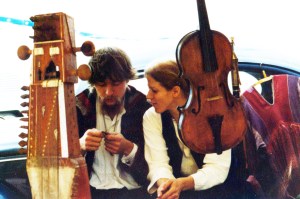
Family can also mean a collection of symbolically meaningful objects, toys, letters, books, art, tools, stones. I collect stones and endow them with memories. My ex-husband extended his loving father role to string instruments. (I wrote about his loss in my previous post.)
In the 1969 movie Alice’s Restaurant … with Arlo Guthrie, Pat Quinn & James Broderick, you can do anything you want. Alice tries to satisfy the motherly expectations of an eccentric hippie group, a powerful dream, which ends when she marries. The last image in the film shows her standing alone in front of the old church her husband plans on selling, to create a more ideal community in the countryside, though Alice’s hippie children have grown and left. In the poignant last image of the film Alice stands alone, waking from a dream, debts paid and debts made. Psychotherapy can accelerate this archetypal demand for clarity and cohesion of one’s myth, but soul-making must continue for consciousness to expand.
At stages in our life we fit, or are fitted, into a network of psychological potential. These are intense phases. Yet irrespective of time gone since people parted ways, families dispersed, places were lost … when a former close friend dies, insight descends, rises, arrives from the past, from the future and from spheres unknown. Memories will shift their meaning. Slowly our sense of self is re-aligned. We capture a condensation of what was symbolically exchanged, essence is revealed.
In this gentle way we unravel the knots of entangled bonds. I’m wary of this advice … let it go! Grieving for a loss needs to ripen. While unripe apples fall from trees all the time, it is a sad waste to rip them from branches, we deprive our selves of what a ripe apple is for, to be eaten and digested for nourishment.
My lover, mourner and philosopher could have pulled this theme in ten different directions. I kept it short and leave associations to you.
Always keen to bridge and connect seemingly unrelated intellectual territories, I tend to dip into essays of poet-philosophers and cultural theorists stacked near my bed.
Paul Virilio’s ‘Open Sky’ is a recent addition, translated by Julie Rose in 1997. Not an easy read, but the analysis of the social destruction wrought by modern technologies of communication and surveillance drew me in. The last chapter, Escape Velocity, relates a striking experience by Buzz Aldrin during the Apollo 11 mission. I share it here, within a short excerpt from the chapter, curious to discover what my readers make of it:
… Inflated to fill the dimensions of the world’s space, the time of the present world flashes us a glimpse on our screens of another regime of temporality … Outrageously puffed up by all the commotion of our communication technology, the perpetual present suddenly serves to illuminate duration. Reproducing the alternation between night and the solar day that once organised our ephemerides, the endless day of the reception of events produces an instantaneous lighting of reality that leaves the customary importance of the successive nature of facts in the shade; factual sequences little by little lose their mnemonic value …
… In his memoirs of the first moon landing, Buzz Aldrin in his own way confirms this disqualification of sunlight. Listen to what he has to say from the surface of the night star:
‘The light is also weird. Since there’s no atmosphere, the phenomenon of refraction disappears, so much so that you go directly from total shadow into sunlight, without any transition. When I hold my hand out to stick it in the light, you’d think I was crossing the barrier to another dimension.’
It is as though, for the astronaut, shadow and light were two new dimensions, inasmuch as any kind of transition no longer exists for him. The loss of the phenomena of atmospheric refraction produces a different perception of reality …
Virilio draws a comparison to a similar loss for earthlings … the different degree of illumination which, before the invention of electricity, still marked the hours of the day or the days of the year has become of diminished importance. Under the indirect light from screens and other control centres of the transmission of events, the time of chronological succession evaporates, paving the way for the instantaneous exposure time as harsh as that floodlighting of which Aldrin tells us:
‘On the moon, the sun shines on us like a gigantic spotlight.’
All three astronauts of the Apollo 11 mission had problems after their return to earth. Spatial and temporal disorientation are not easily reconciled with one’s reality identification. Virilio writes … as for Aldrin, after two nervous breakdowns, several detoxification treatments for alcohol abuse and a divorce, he was to wind up in a psychiatric ward.
Struck by Aldrin’s experience, I thought about the increased screen time, especially now so many of us engage in since the corona virus changed our rhythm of interaction with nature, local environments, family, friends, and the wider world.
I first pondered the cultural implications of the digital advent during a mid-1990s film degree as a mature student. For those interested – my post from 2018 gives a flavour of my dissertation – click here for ‘Body Electric- – it’s worth a visit.
John Wheeler came up with the idea of the universe as self-observing system (being.) Light travels at 186 000 miles per second. When we look into deep space we are seeing galaxies over ten billion years old. In that sense everything we see is in a past, which our observing consciousness creates. So I ask myself what realities do we envision during this surreal corona time, individually and collectively?
Is Paul Virilio’s bleak vision justified? Is the hyper centre of present time becoming the sole reference axis of worldwide activity? Is the individual of the scientific age, with diminished positional reference, losing the capacity to experience him/herself at the centre of energy?
Click here for an article from the Frieze magazine.
Or – can we create enough pockets of stillness to counter the acceleration of the fall upwards, of progress propaganda, and instead re-connect to body, earth and roots?
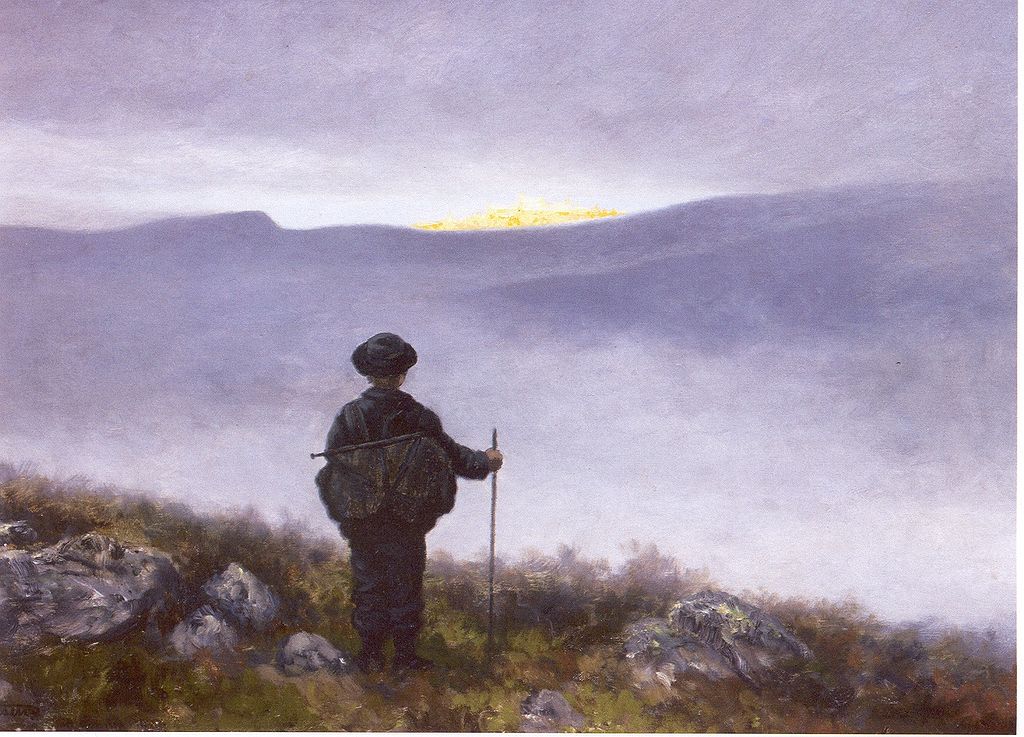
How to reconcile moments of pure beauty and light our restless world offers, with the heavy darkness of human ignorance? How is it the guiding spirit that is shining through everything so often escapes the unseeing eye? Is it our wounded hearts, or our anxious busy thoughts that prevent spontaneous being? Many of us like twilight, the dawn, the dusk, mist, where darkness and light do not negate but enhance each other. They mingle. As friends do, or lovers. Twilight is poetry in motion.
And what, you may ask, does she mean by the guiding spirit that shines through everything. It’s a core in me that connects to the one soul-being I belong to, the only self I really know. And while I’m not enlightened, I do experience timeless moments, glimpses into the sixth dimension, nodal points around which the fiction of my existence is woven.
The other day, my long-ridiculed romantic fool tossed out these lines:
like tiny cherubs
white butterflies loop across
green teeming canvas
thou – sweet silent mystery
do you sense me sigh
when the cold moon-rock rises
as luminous globe – hello dear ones lost in time – your intense living – is forever part of me
‘Long live the dead because we live in them.’ … Clarice Lispector, A Breath of Life
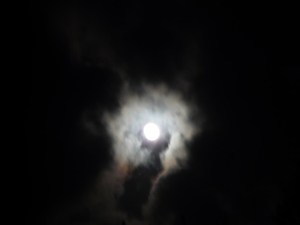
When there is no other near to share such paradoxical quickening with, I may call on those who enriched my life but are no longer present. I adore the moon, the ancient chunk of earth, reflecting and making tolerable the blinding beams of the sun, granting us poetry and symbolic language.
That night I had a dream and remembered its last facet … I’m floating through a soft, vibrant darkness. A small voice says, ‘You’re the light, look again.’ Sure enough, I spot the outline of a building and bright points, like glittering stars. A series of scenes unfolds, which brings clarity to a puzzling questions. Darkness holds memories, visions and vital knowledge, though it requires trust in the guiding spirit as a mode of orientation. Insights are shy; they wait to be found.
Nature, being energy manifested in slow motion, breathes life into countless rhythms and tunes from the recorded symphonic sounds of the universe – to continuously re-animate the one being of eternal life. Yet we humans, who pride ourselves in aiding this process with heightened consciousness, are increasingly busy destroying the homeostasis life depends on. Can a virus offer a long enough pause for the powers in charge to acknowledge this self-destructive madness? Below anger, I feel the deep sadness, the spiritual starvation, an unfulfilled longing for meaning, for being worthwhile, accepted and loved.
I sense a change of mood in the collective mind, a call for change. Upfront are manic voices using the language of warfare against the invisible enemy – let’s control it – defeat I – kill it – get on top of it. I feel this kind of rhetoric misses the point entirely.
We must see things fresh, not through tired ideas our establishments bank on, that destroy nature’s homeostasis and spill imbalances into cultures too poor to afford resistance. I say – let our children and young people decide what’s worth living for?
‘A day, whether six or seven years ago or whether six thousand years ago, is just as near to the present as yesterday. Why? Because all time is contained in now.’ – Meister Eckhart

 To fill in the distorted or simply incomplete gestalt gathered from early caregivers, we find ourselves during our lifetime in families of various constellations … in groupings of friends, educational settings, teams working towards a project, callings, interest groups, animal care, subcultures, political, vocational and spiritual clusters. In these groups we slot into roles we project, or are projected onto us with qualities others are drawn to engage with, for whatever reason, often to explore a hidden part inside, mother, father, sister, brother, child, lover, hidden in the light or hidden in the dark. Much of this search now happens virtually, through screens, though it can’t replace the actual physical resonance a gestalt needs.
 Family can also mean a collection of symbolically meaningful objects, toys, letters, books, art, tools, stones. I collect stones and endow them with memories. My ex-husband extended his loving father role to string instruments. (I wrote about his loss in my previous post.)
 At stages in our life we fit, or are fitted, into a network of psychological potential. These are intense phases. Yet irrespective of time gone since people parted ways, families dispersed, places were lost … when a former close friend dies, insight descends, rises, arrives from the past, from the future and from spheres unknown. Memories will shift their meaning. Slowly our sense of self is re-aligned. We capture a condensation of what was symbolically exchanged, essence is revealed.
 Always keen to bridge and connect seemingly unrelated intellectual territories, I tend to dip into essays of poet-philosophers and cultural theorists stacked near my bed.
 ‘The light is also weird. Since there’s no atmosphere, the phenomenon of refraction disappears, so much so that you go directly from total shadow into sunlight, without any transition. When I hold my hand out to stick it in the light, you’d think I was crossing the barrier to another dimension.’
 How to reconcile moments of pure beauty and light our restless world offers, with the heavy darkness of human ignorance? How is it the guiding spirit that is shining through everything so often escapes the unseeing eye? Is it our wounded hearts, or our anxious busy thoughts that prevent spontaneous being? Many of us like twilight, the dawn, the dusk, mist, where darkness and light do not negate but enhance each other. They mingle. As friends do, or lovers. Twilight is poetry in motion.
 like tiny cherubs
 When there is no other near to share such paradoxical quickening with, I may call on those who enriched my life but are no longer present. I adore the moon, the ancient chunk of earth, reflecting and making tolerable the blinding beams of the sun, granting us poetry and symbolic language.
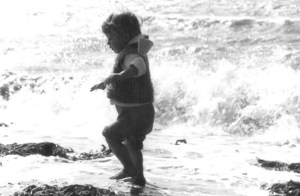 We must see things fresh, not through tired ideas our establishments bank on, that destroy nature’s homeostasis and spill imbalances into cultures too poor to afford resistance. I say – let our children and young people decide what’s worth living for?


 Course of Mirrors