 We mostly think through conventional forms and givens, for practical reasons, while another way of thinking embraces invisible and unknown dynamics via intuition – like the seeming particle/wave paradox in quantum mechanics, where a local particle also exists as a non-local wave. The two perceptions can potentially mingle creatively, but, notably in times of social uncertainty, they clash, and fewer people maintain the ability to tolerate negative capability.
The way autocratic opinions over divisive issues are sensationalised by some tabloids, sends my thoughts flitting through the mutable and nuanced zones of shadow lands. I write the glut of absurdities off my chest, only to delete the drafts, not having the talent or guts for the iconoclastic fun Marina Hyde pours into her articles for the Guardian.
The tit for tat race of opposing interest groups that blame, attack and counter attack each other eludes any balanced comprehension of events. Opportunists, generously funded, like to whip up the chaos for their own benefit. Fertile ground for tyrants. This will go on until the churning oceans calm and offer deeper reflections.
My early education was unremarkable, but I fondly recall a few teachers who made space for ambivalence, encouraging us to question everything and value respectful, if inconclusive, debates. Glib opinions and self-righteousness were mocked and laughed at.
In the early seventies, doing a short apprenticeship with a small Dutch advertising firm in London, we had weekly meetings, where ideas, no matter how crazy, were explored. Every person working in the building was asked to the table, including caterers and cleaners. This inspirational seedbed sparked successful projects and maintained a motivated team.
Decades later, during a part time stretch at Social Services, policy makers introduced a new computer programme for tick-box client assessments, a software developed without involving the people who were meant to use it – us. Sparing you the specifics of this nonsensical scheme, the nightmare in its wake resulted in multiple nervous breakdowns by employees. Since I had a private psychotherapy practice I escaped the hell and resigned.
A relentless trend towards greater efficiency continued despite loud social backlash. Over and over I listened to the stories of my stressed clients suffering from the overbearing changes in public institutions and private companies. The forced procedures insulted the intelligence of workers, who felt the stupidity and pain of it all in their guts, as did I. The harmful effect on mental health, family life, education, small traders and community venues … is ongoing.
Recently I re-read a 1970s lecture by my Sufi teacher, Fazal Inayat Khan – Old Thinking, New Thinking – also used as title of a small collection of his controversial talks, published in 1979 by Harper & Row. Some of Fazal’s students insisted on this publication. He reluctantly agreed. I’ll share here a few notions that struck me form the lecture, Old Thinking, New Thinking:
The end of real is false, while the greatest false is real.
The real is about form, the false (non-evidenced) is about essence. Fazal addressed two qualitative different ways of thinking, both beneficial if used in the right time and context. Those supporting form and tradition set out to protect stability, whereas those who seek essence knock over the stable towards the freedom of the unknown. Imaginative people, including scientists and artists, tend to overshoot crumbling realities.
The sad logic of power driven politicians is to manipulate social anxieties by promising simple fixes to allay feelings of uncertainty. In such times people tends to grope towards old thinking, to what can be predicted and depended upon, thus moving away from the immeasurable independence of anything beyond facts.
Old thinking relies on valid knowledge; however, to apply this knowledge intelligently requires new thinking, so essence can find expression once more.
Old thinking will bring achievement, notwithstanding that without new thinking it will have achieved nothing. Traditions wedded to established forms exemplify old thinking. Yet for a tradition to remain sincere and dynamic new thinking is required.
In other words, only what changes stays functional. Much as we dislike it, life could not continue if it were not for the transient growth and death phases of nature. The same applies to cycles that call for the expansion of consciousness.
How is one to value both form and essence in complex times and stay sane? No way around it, we must suffer the anguish of holding the tension between static knowledge and intuition in our hearts. Not easy. Perhaps because I experienced the 1960s new thinking surge, any leaps of goodwill from young people still brings tears to my eyes. I’m interested in everything. I’m interested in bridging divides. I even occasionally delight being in the spirit zone, with the effortless flow of things. (A Zen concept)
Deep, maybe very deep down, every one of us knows the bliss of being in the zone.
… Old thinking is a sorting process – new thinking is a melting process …
… Old thinking is a claim – new thinking is an aim … Fazal Inayat Khan
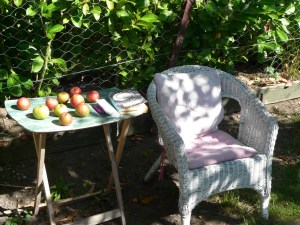 Embodying the perfect autumn warmth, a divine stillness, devoid of mental chatter, other than a faint hum of the river of cars flowing along the town’s bypass, and the gentlest sound of a disintegrating wood chime in my cherry tree, whatever else happens in the world is another dream.
 as this wet August
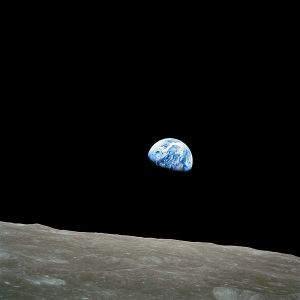
 I was in Prague. My then companion, for his birthday celebration, had organised a small group of friends to spend a weekend in this beautiful city, coinciding with the moon landing. We could afford a 5 star hotel, due to a bargain currency exchange rate in the wake of the short-lived
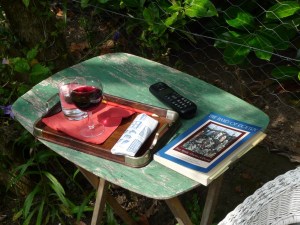 This time of year I like reading in the garden. Last week I forgot to take a book inside – ‘The Hand of Poetry,’ collected poems from Sanai, Attar, Rumi, Saadi and Hafiz, translated by Coleman/Barks, with introductions taken from talks by Inayat Khan. During a short but heavy shower that night, the book greedily feasted on rain. I found it blown up, like a balloon, to double its size.
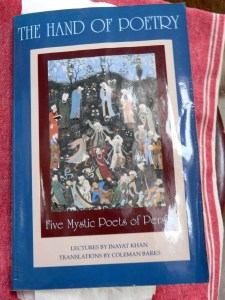 and three times over. On the third day I hung the book by its spine on the washing line. Once dry, I managed to press the volume with a heavy vintage iron into reasonable shape again. The ordeal required my undivided attention. The re-read pages during those hours lodged themselves with refreshed presence in my heart.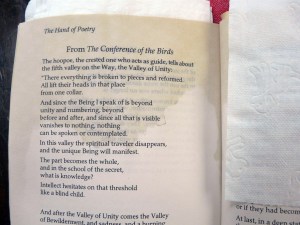
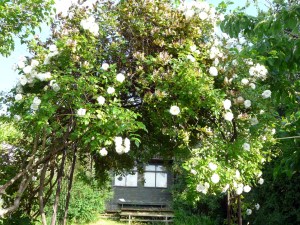 Meanwhile I enjoy some treasures close by …
 let sleep do its work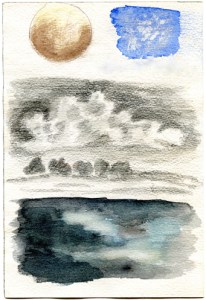
 I read daily, in bed, for an hour or so before escaping to dreamland. Apart from novels or essays on the go, I keep a stack of books close by to dip into when dark clouds need lifting. One such book is John O’Donohue’s ‘Anam Cara.’ (Bantam Press 1997)
 a dried-up vessel
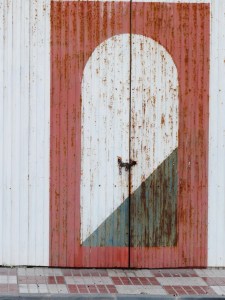
 Writers and readers have their unique (often indirect) discernment of text and image; a fluid perception spots moods in the sky, or envisages what’might be happening behind doors.