Tag Archives: wisdom

… treasure hunt with my grandchild … 

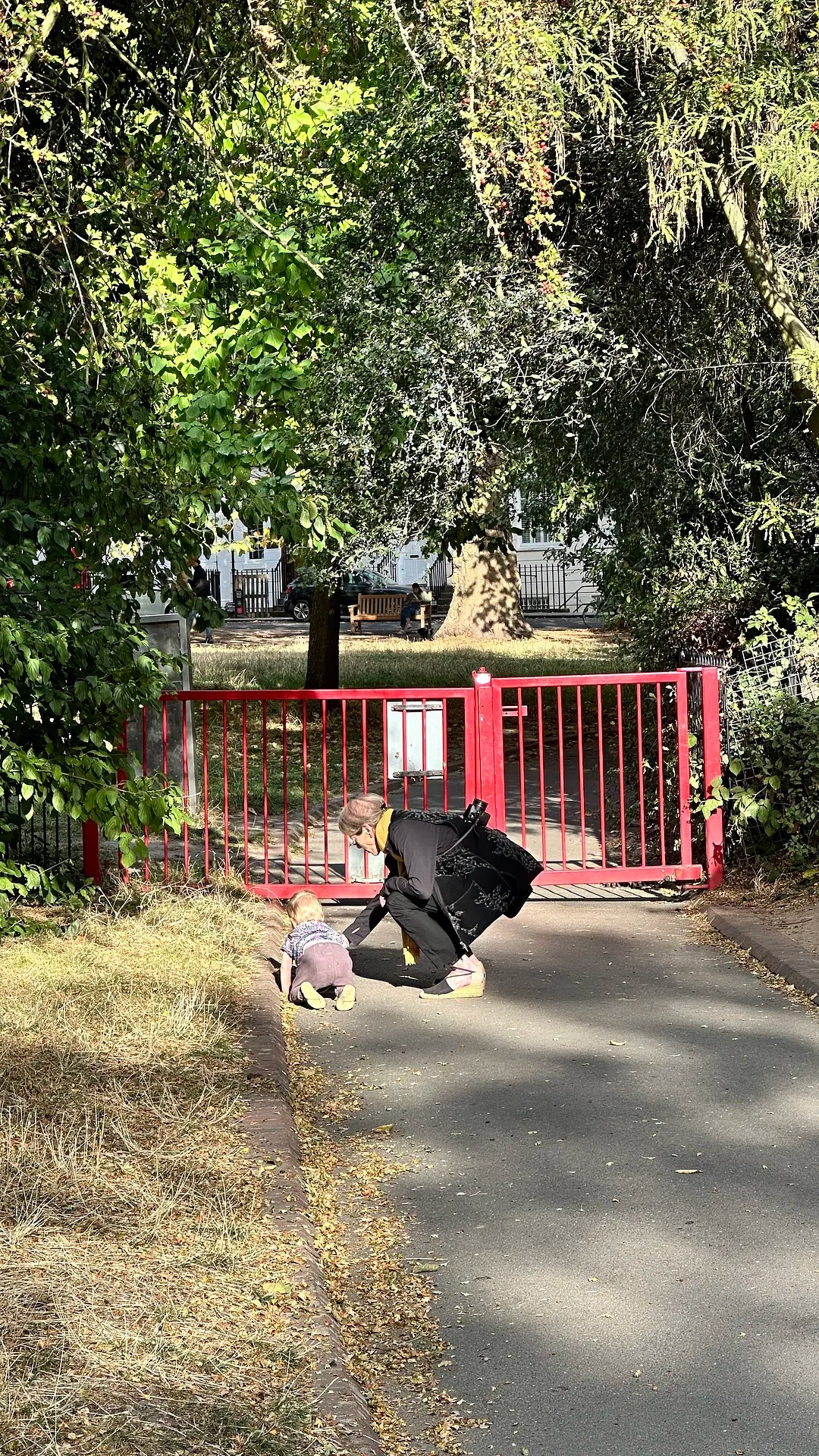
I happily slow down and follow his lead along the curb of the path. I join his seeing, peering down and examining the ground. He pushes dry leaves ahead; occasionally he lifts one to show me, adding a sound. I nod, repeat, and may add a word. He attends to shapes, curled or straight, to weight, to colours and their shades in the light, he tests textures, hard, soft … a stone, a twig, a feather, an empty snail shell, an acorn.

I witness and share the adventure.

He has learned to resist putting objects in his mouth. Yogurt tastes better. It’s now all about touching with fingertips, sensing, and smelling, moving things, sounding, sorting, weighing, comparing new impression with recent ones, rearranging his comprehension, moment by moment, of how things are connected. His imagination soars. I observe his world expanding.

These discoveries will resurface in picture books, turn into stories and create stories.

He aims ahead, crawling towards the red playground-gate with parallel bars. Arrived, he shakes the bars for a good rattle. Having recently achieved walking, gates will soon cease to be obstacles. And he’ll look less down and increasingly more up.

Dear heart, I enjoy the wisdom-gathering fun to be present at your early treasure hunts.

2 Comments

Filed under Blog

… the psyche’s tectonic plates …

Do you find yourself staring vacantly into space after scrolling through daily headlines?

Just like ocean waters rise during an earthquake, information can dumbfound us when unconscious content is shifting, erupting, and sudden bursts of awareness surface, which is the psyche’s attempt to seek balance.

We are stirred by the rough storms of fervent feelings that emanate from the collective mind spectrum. I may feel safe from natural disasters and human brutalities shaking our planet, but am, like most people, bombarded by the alarming images that land on my laptop screen. I consider it a duty to witness what goes on around the world. But how does one face the magnified realities of injustice, suffering and death?

Those inclined to psychotic violence tend to crave emotional catharsis as a way to deal with paranoia, anger and resentment, spurred on by sensational or false reports that frequently spout blame, hypocrisy and sarcasm.

Ensuing are toxic environments that employ punishing control. A sensitive and too tenderly attuned individual may sink into a trance of inner turmoil and depression, or renounce their moral dignity and engage in violence themselves, often self-harming.

Beyond strength, it takes subtlety to stay awake, present to suffering, and centred, when the functional energy balance of the cosmic psyche wobbles.

There seems nothing useful this helpless me can do. Or is there?

My body complains when muscles cramp up with stored emotional tension, restricting its spontaneous movements, its fluid dance. So I’m forced to listen and allow offered solutions. One example is: to stomp the ground with heels, like in Indian Kathak, Spanish Flamenco, Irish or other dance moves … it’s freeing to ground and rebirth intense energy.

I appreciate the body’s wisdom, true and real in that its physical form is mortal. And I like to believe that the energy state of each of us influences the environment – near and far away. Also, thankfully, our metabolism allows sleep, where impressions are processed via dreams. My dreams are fairly wild these days.

What is your experience of trying for a balanced state of mind within these mad times?

Do share if you like.

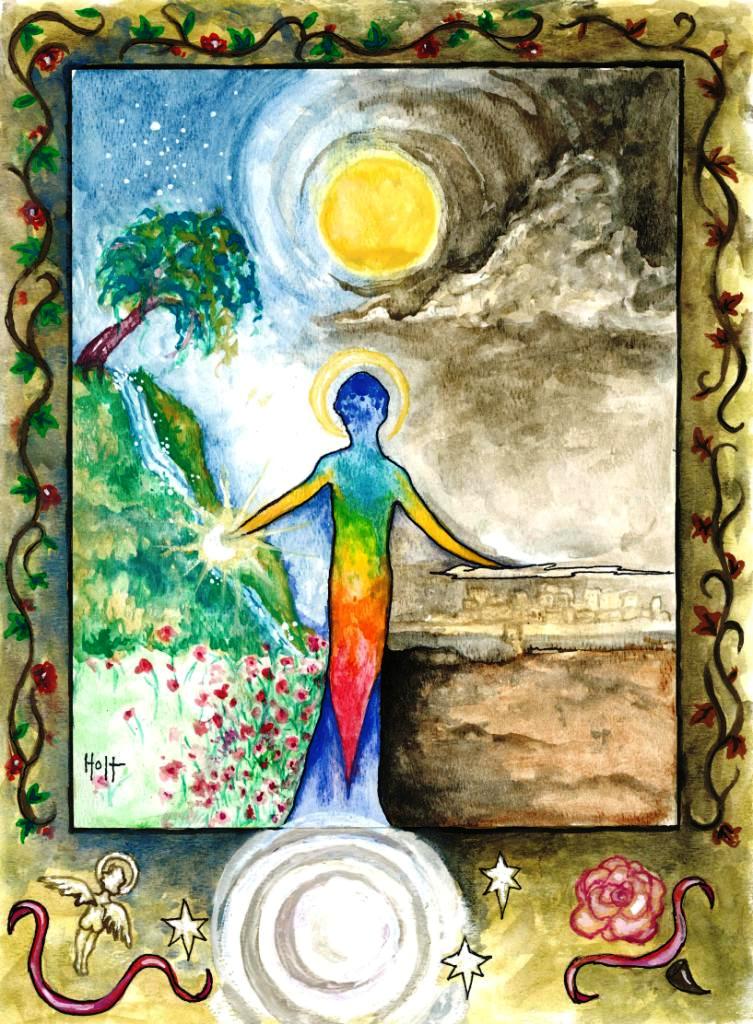
The above image was created by Cynthia Holt, inspired by my poems.

1 Comment

Filed under Blog

… using – or being used by algorithms …

The morose question of whether to be or not to be has moved on to whether to appear or not to appear. Appearances can deceive according to context. Or as my spiritual friend, Fazal Inayat Khan used to say, ‘Form is a relic of eternal potential.’ Things that have lost their former function have joined the archive of icons, metaphors.

Could the function of our individuality become no more than a statistical entity during our lifetime?

Today’s institutions and corporations share knowledge, advice, wisdom, stipulate laws, or instill fear via alerts. Ultimately, they accumulate information but are not necessarily held accountable for how this information is used. Priests used to claim this power in the name of God, as well as sorcerers and witches, who made it their business to converse with spirits. Many people project power onto an all-knowing agency, though today’s most consequential agency has moved on into the next clan of power holders – those who collect and control data … our data, our location, movements, activities, political leaning, looks, habits, likes and dislikes.

Our existence is being whittled down into digits that tumble about in a sea of algorithms, and wherever they perk up in statistics they could fix our fate, since temporal data can be adjusted to any setting a bureaucracy chooses as being predictive. This, mainly unchecked, development is running into problems, with the recent U.K exam result fiasco only being the latest example. Bless our young people for revolting.

Power of information equals control, for your own good, maybe, depending, of course, on who is in charge. Distorting and withholding knowledge, be it intentionally, through ignorance or through expediency, endangers democracy when used unchallenged as manipulation tools by governments. At worst, it enables profit seekers to accelerate the exploitation of earth’s resources, maintaining poverty around the globe.

Those involved in research, students, scientist, and writes, know the challenges of filing and stacking information. My own filing mirrors the ad hoc workings of my brain. To find stuff again is a matter of focus, luck and intuition. While occasionally frustrating, I trust my larger self and the collective unconscious. It is my oracular method, circumventing any too strict measurements promoted as our new saviour, algorithms. I value rationality, just not when it discounts spontaneous human creativity, heart felt compassion, and the inspiring moods of nature.

Belonging has never been easier – not belonging has never been more difficult. How does one evade the pressure of countless unfair impositions our systems prescribe via algorithms? In Walt Whitman style one could say … every ‘digit’ belonging to me as good belongs to you …  But wait, there is vast space in the One, space between atoms, between digits, between the many of us, where one can belong and be eccentric and separate at the same time.

Where do algorithms lead? How do they influence our values? Yuval Noah Harari in his book Homo Deus, describes ‘dataism’ as a new religion, a potential digital dictatorship that could shape our reality. Who would aspire to such a stagnant future?

I was fascinated and encouraged by a recent discussion between Yuval Noah Harari and Taiwan’s digital minister, Audrey Tang. (click here for the YouTube video coming up on a separate page)

They discuss code, including, at the start, the issue of non-polarized gender, going on to the negatives and positives of human hacking and the democratic fairness that can potentially happen when transparent data sharing and plural viewpoints are allowed.

Audrey Tang says,

‘Technology should be utilised to promote freedom, democracy & human rights.’

In Taiwan, this hugely influential young trans woman is making this happen.

16 Comments

Filed under Blog

When the Waters Were Changed

Once upon a time Khidr, the Teacher of Moses, called upon mankind with a warning. At a certain date, he said, all the water in the world which had not been specially hoarded would disappear. It would then be renewed, with different water, which would drive men mad.

Only one man listened to the meaning of this advice. He collected water and went to a secure place where he stored it, and waited for the water to change its character

On the appointed date the streams stopped running, the wells went dry and the man who had listened, seeing this happening, went to his retreat and drank his preserved water.

When he saw, from his security, the waterfalls again beginning to flow, this man descended among the other sons of men. He found that they were thinking and talking in an entirely different way from before; yet they had no memory of what had happened, nor of having been warned. When he tried to talk to them, he realized that they thought that he was mad, and they showed hostility or compassion, not understanding.

At first he drank none of the new water, but went back to his concealment, to draw on his supplies, every day. Finally, however, he took the decision to drink the new water because he could not bear the loneliness of living, behaving and thinking in a different way from everyone else. He drank the new water, and his fellows began to look upon him as a madman who had miraculously been restored to sanity.

From ‘Tales of the Dervishes’ by Idris Shah

(This version of the story is attributed to Sayed Sabir Ali-Shah, a saint of the Chisti Order, who died in 1818)

9 Comments

Filed under Blog

… taming …

Everything alive is curious, humans excel in this trait. When meeting up with something we haven’t come across we ask … is it worth knowing: is it important, useful, is it friend or foe? Getting to know something is a kind of taming. We energise what we tame, and attempt to exert control over it, be it elements, animals, people, or ideas. Then again, when for innumerable reasons, which include changing priorities or attitudes, interest fades; we withdraw our energy from what we tamed.

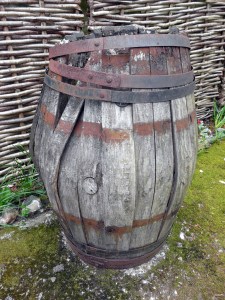
Take this vat. Not having held water for some time – its wood shriveled.

a dried-up vessel

lacking its soulful function

becomes an icon

an exquisite memory

or inspiration

where in beauty of decay

new dreams incubate

as nature’s purpose rotates


Getting older sparks such contemplation, and the reassurance that a formidable self-regulating force is in charge of life – nature and its cycles of birth, death and rebirth.

Despite every greedy effort to control nature, there is ample proof it will only work for life if we honour the spirit behind the delicate interdependencies of its cyclic system, which in its wisdom continuously expands the consciousness of the one and only being.

‘Stop acting so small. You are the universe in ecstatic motion.’ Jalāl ad-Dīn Muhammad Rūmī

16 Comments

Filed under Blog

…Brexit – the exhausted old man …

Last week I had visitors, Fred, Kit and Mirre, dear friends from Holland. Their invigorating presence took me away from my mordant addiction to the UK Brexit drama, for a while, anyway.

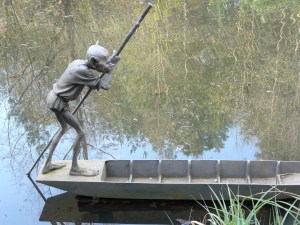
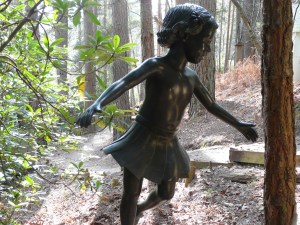
We went to a nearby Sculpture Park.

    seen in Churt Sculpture Park

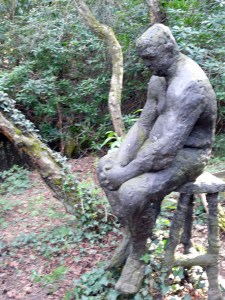
The particular sculpture on the right was pointed out to me by Fred, or I might have missed it. The body of the old man impressed and his image lingered on. It conveys interiority, a bowing down towards earth, in memory of its elements.

The old man sits still, listening to the hidden part of the soul below the surface of busy things. He may contemplate regrets, feel clichés evaporate and the linear progress of his life fade, together with familiarities of the past. For me, the sculpture also encapsulates a phase when ideals are crumbling during a homecoming to mystery, and hopefully a guidance from the spirit of ‘the one being’ we are part of.

The shape also evokes my father, who died almost a year ago, having nearly reached a century of existence. The most touching thing he said during the last years in a dreamlike moment was … ‘I want to be where you are’ … which took me by surprise, since he disapproved of my choices in life. I can only assume it was a slip of the tongue, or a desire to shed his history for an expanded imagination and another future.

as seen in Churt Sculpture Park

Bless my dad, he’s moved on …

Transformation happens unseen, much like in this present dark moon phase all of us experience within and without – sensing deep down that the eternal is ever now, and there’ll emerge another healing well, another spring of joy and renewal … the wildness of the unknown.

I deeply thank natural cycles, mirrored in seasons, world affairs and the lifespan of creatures.


Were it not so, humans would have no chance for reflection, redemption, renewal, and a fresh dance of love.

        seen in Churt Sculpture Park

‘We are the mirror as well as the face in it.                       We are tasting the taste this minute of eternity.            We are pain and what cures pain. We are                        the sweet, cold water and the jar that pours.’

Versions of Rumi from Open Secrets (transl. by John  Moyne and Coleman Barks.

15 Comments

Filed under Blog

… two of my heroes in the UK parliament …

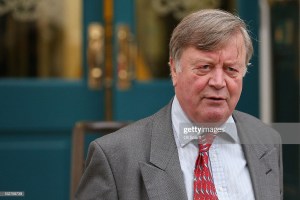
Ken Clarke – Getty image

This is an unusual post, for me, living as a European in the UK since many decades, loving the idiosyncratic country, yet having no political affiliation. That said, I want to express my thanks to the people who offer lightness and intelligence through these crazy Brexit times. Here – mainly to the politicians, men and women from various UK parties I respect and admire for their passion, sincerity, common sense and wit. In fairness, I should also name a number of politicians from the other side of the House of Commons, especially some amazing  women …

But I’ll limit myself to highlight two men whose passion, sincerity, wit, wisdom and imagination I value:

Kenneth Clarke – the Father of the house. Below, he typically clarifies his point of view in the House of Commons in … his speech from January 31st 2017

And here Kenneth Clarke on 13th July 2018 in an interview on Channel 4 re: the Brexit chaos.

Ken has been a Member of Parliament for almost five decades. As the longest serving MP, he talks to Krishnan about why Brexit is in such chaos, his long-standing Conservative views and why he thinks it’s important politicians talk honestly to the media.  Recorded: 4 July 2018.

John Bercow in session

The other person lightening up my days is …

John Bercow – chair of proceedings at Westminster MP – a British politician who has been the Speaker of the House of Commons since June 2009. Most famous for calling the house to ORDER.
In addition to the qualities of common sense and wit, he also provides comic relief and excellent entertainment value during these turbulent times.
In this video from recent procedures the Speaker takes points of order for one hour and seven minutes. A pivotal point in the play of powers, one might say. It’s clear that he absolutely loves his job. This session is well worth watching to the end.

Here John Bercow is sharing the passion for his job with students, the Speaker gives a talk to the Oxford Union

21 Comments

Filed under Blog

… when the waters were changed …

Water

Once upon a time Khidr, the Teacher of Moses, called upon mankind with a warning. At a certain date, he said, all water in the world which had not been specially horded, would disappear. It would then be renewed, with different water, which would drive men mad.

Only one man listened to the meaning of this advice. He collected water and went to a secure place where he stored it, and waited for the water to change its character.

On the appointed date the streams stopped running, the wells went dry, and the man who had listened, seeing this happening, went to his retreat and drank his preserved water.

When he saw, from his security, the waterfalls again beginning to flow, this man descended among the other sons of men. He found that they were thinking and talking in a different way from before; yet they had no memory of what had happened, nor of having been warned. When he tried to talk to them, he realised that they thought that he was mad, and they showed hostility or compassion, not understanding.

At first he drank none of the new water, but went back to his concealment, to draw on his supplies, every day. Finally, however, he took the decision to drink the new water because he could not bear the loneliness of living, behaving and thinking in a different way from everyone else. He drank the new water, and became like the rest. Then he forgot all about his own store of special water, and his fellows began to look upon him as a madman who had miraculously been restored to sanity.

*    *    *

A Sufi story is from ‘Tales of Dervishes’ by Idries Shah. First published in 1967 by Jonathan Cape Ltd.

The above version is from a 1973 edition published by Panther Books Ltd and is attributed to Sayed Sabir Ali-Shah, a saint of the Chisti Order, who died in 1818 …  though like most Sufi stories, it is much older.

6 Comments

Filed under Blog

… resurrected treasures – fables …

Kalila and Dimna – Selected Fables of Bidpai – Tales of Friendship and Betrayal – by Ramsay Wood.

Fables can shock and surprise us, irrespective of their antiquity. Various collections, like Aesop’s, derived from versions of beast fables originating from the oral traditions of cultures that existed thousands of years ago. It must be the profound exposition of human nature revealed in this deep sea of tales that made them show up in all corners of the earth. The punchiness of these tales remains relevant to this day, in that their wisdom cuts through our neurotic habit of jumping to conclusions.
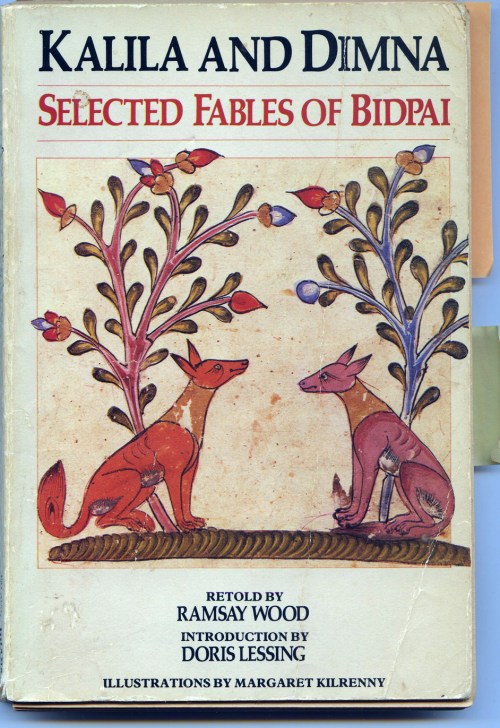
Ramsay Wood’s passion and labours of love has given us the humorous and delightful retellings of Kalila and Dimna – Selected Fables of Bidpai, with vibrant attention to detail. His research includes the famous Panchatantra, and a Persian version of the same, translated into Arabic.

In the first volume it says upfront: This book is dedicated to the many midwives of the book, including al-Kashifi, who in the preface to his fifteenth-century Persian version of this story described himself as ‘this contemptible atom of but small intellectual store.’

My 1982 Granada edition is among a bunch of books I’ve loved to bits – with pages falling apart. One of its tales within tales, ‘The Cormorant and the Star,’ depicts how appearances deceive, as all surfaces do. A line from Socrates appears in the margin, ‘Living starts when you start doubting everything that comes before you.’ Given the mirage of opinions floating across our electric screens, if this sensible advice were to catch on, the creativity released would be phenomenal.

Ramsay Wood kindly allowed me to use the little tale of  The Cormorant and the Star in my novel, Course of Mirrors.

Volume 1 of Kalila and Dimna has an introduction by Doris Lessing. She writes: ‘The claim has been made for this book that it has travelled more widely than the Bible, for it has been translated through the centuries everywhere from Ethiopia to China… It is hard to say where the beginning was… One progenitor was the Buddhist cycle of Birth Tales (or Jātaka Stories) where Buddha appears as a monkey, dear, lion, and so on… Sir Richard Burton, who like all the other orientalists of the nineteenth century was involved with Bidpai, suggested that man’s use of beast-fables commemorates our instinctive knowledge of how we emerged from the animal kingdom, on two legs but still with claws and fangs.’

Our inherited animal traits go a long way to explain the variations of our conflicting human dispositions and idiosyncrasies. I wrote a post last year about the perception of difference.

Ramsay Wood presents us with Dr. Bidpai, an incorruptible Indian sage living under the reign of King Dabschelim. The king is a stargazer, blissfully blind to the sufferings of his subjects. In desperation, Bidpai resolves to offer him his wisdom. The reader gets to know the good man through his own voice, sharing how his nervous and skittish wife fusses over his robe before the royal appointment, expressing her apprehension. Bidpai, though terrified of confronting the king, feigns complete confidence. His wife’s instincts were entirely correct, but he knew that his male arrogance would give her the blind strength of anger and that, at least, was better than the helplessness of fear. In truth, jails were full of men and women who had merely irritated The King.

Alas, no matter how delicately and tactfully Bidpai expresses his concerns to King Dabschelim, employing his words as both narcotic and as a scalpel; his audacity lands him in the dungeon. That is, until the king witnesses a shooting star, followed by a prophetic dream, leading him to a buried treasure. When he finds the treasure, it comes with a letter of admonitions from the long dead King Houschenk, addressed to the future King Dabschelim in person. The letter mentions Bidpai as a storehouse of fables that will illustrate the cautions.  Suddenly the sage’s counsel is most urgently required. From there on Bidpai’s wisdom unfolds in the form of stories within stories (think of 1001 Nights,) one tale branching to another, like the roots of a tree that also mirror the branches and tendrils reaching for the sky. The same method of telling can sometimes be found in the visual arts of painting, photography, collage, installations – images within images that convey truths in a dreamlike and surreal fashion. Artists note – fables provide endless inspirations and connections.

Here some links to click on, which will lead to Ramsay Wood’s books of fables:

Kalaila and Dimna Vol 1– introduced by Doris Lessing, illustrated by Margaret Kilrenny.   See also a present Giveaway on Goodreads.  

Kalila and Dimna Vol 2 – introduced by Michael Wood, illustrated by G M Whitworth

In a review for the second volume, Aubrey Davies, another wonderful story teller, writes: Wood concludes the book with two masterful essays. The first outlines the history of the tale and how this treasure trove of sophisticated teaching-stories posing as humble fables has so easily slipped over borders and been embraced by so many cultures.
The final essay was prompted by a challenge from a NASA Director to prove that story is a more effective medium for science outreach than technical writing. It details our limited conceptions of story together with an extended concept of its nature and value.

Highly recommended.

Clicking on any links in this text will open a separate page without losing this post.

4 Comments

Filed under Blog

… so we stumble along …

Drawing by Claire Finaz

Siva and Shakti, the Divine Couple in Hinduism, are in their heavenly abode watching over the earth. They are touched by the challenges of human life, the complexity of human reactions, and the ever-present place of suffering in the human experience. As they watch, Shakti spies a miserable poor old man walking down the road. His clothes are shabby and his sandals are tied together with rope. Her heart is wrung with compassion, touched by his goodness and his struggle. Shakti turns to her divine husband and begs him to give this man some gold. Siva looks at the man for long moment. ‘My dearest Wife,’ ‘I cannot do that.’

Shakti is astounded. ‘Why, what do you mean, Husband?’ You are Lord of the Universe. Why can’t you do this simple thing?

‘I cannot give this to him because he is not yet ready to receive it,’ Siva replies.

Shakti becomes angry. ‘Do you mean to say you cannot drop a bag of gold in his path?’

‘Surely I can,’ Siva replies, ‘but that is quite another thing.’

‘Please, Husband,’ says Shakti.

And so Siva drops a bag of gold in the man’s path.

The man meanwhile walks along talking to himself, ‘I wonder if I will find dinner tonight – or shall I go hungry again?’ Turning a bend in the road, he sees something on the path in his way. ‘Aha,’ he says. ‘Look there, a large rock. How fortunate that I have seen it. I might have torn these poor sandals of mine further.’ And carefully stepping over the bag of gold, he goes his way.

*    *    *

‘The Bag of Gold,’ like many wisdom tales, has layers of meanings, one being: within each stumbling block is also a treasure. Gold, of old, is associated with the inner sun.

The above version of the story is shared by Elisa Pearmain in ‘Doorways to the Soul.’ See the link in my blogroll at the right. One page on her site features publications. 

To the above story she adds: … Before going to sleep each night, think about all the gold encountered during the day. You may feel quite rich …

The longing remains, expressed in this song by Neil Young:    … I want to live, I want to give. I’ve been a miner for a heart of gold …

One of my New Year resolutions is to practice tunes on my G Blues Harp – a magical instrument that fits into my pocket –  however bad things get, a little breath and a harmonica can cheer people.

The drawing is by a friend – Claire Finaz – on a Christmas Card many years back. It depicts the inner sun very well.

19 Comments

Filed under Blog