Tag Archives: stories

… World News – by Mulla – Allum …

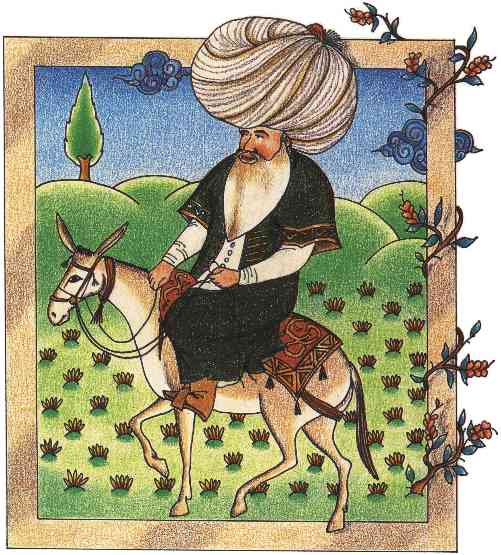
Nasreddin - 17th century miniature - Tokapi Palace Museum

In my world, Mulla Nasreddin, the famous wise fool from the East, could not possibly be stuck in one place or one time. I call my inversion of him ‘Allum.’ Warning: He always has the last word. If you have a problem with this then just add another word, for your pleasure.

I hope to occasionally post more of Allum, should his voice come through the white noise surrounding our planet.

(The image of Nasreddin  is from a 17th century miniature – in Tokapi Palace Museum)

World News

Allum is seated on his favourite bench from where he overlooks the town.

A kid, making sure that none of his peers is nearby, sneaks up to Allum.

‘You’re known as a wisecrack. Tell me – why are grown-ups so obsessed with World News?’

Allum shudders. ‘World News has become a mega-mirror to humanity. People are mesmerised by the comical clashes of ideas. Factions are stretched on the cross between being and becoming, that is, final answers and dynamic change. It’s a conflict most humanely and economically fought inside each of us.’

The boy looks puzzled. ‘Aren’t there final answers?’

Allum sighs. ‘I hope not in my lifetime. If that was so the illusionary charm of reality would evaporate. Life would have no meaning. There’d have to be another big bang.

*    *    *

Bang head hereFor those stressed over solutions to the divide between being and becoming, here an academic exploration from Stanford  academia. To shorten the  tortuous exploration: … We are not inertial observers …

I figure we have plenty of potential to develop in ourselves, and there is always more we can contribute to the world.

My Sufi teacher, Fazal Inayat Khan, summed up being and becoming eloquently:

   ‘Being is death. Becoming is life.’

Here some of my former posts that are related …

https://courseofmirrors.wordpress.com/2014/11/06/not-now-later/#comments

https://courseofmirrors.wordpress.com/2013/02/18/global-vision-synchronicity/

https://courseofmirrors.wordpress.com/2013/02/06/why-spin-tales

10 Comments

Filed under Blog

How do I read?

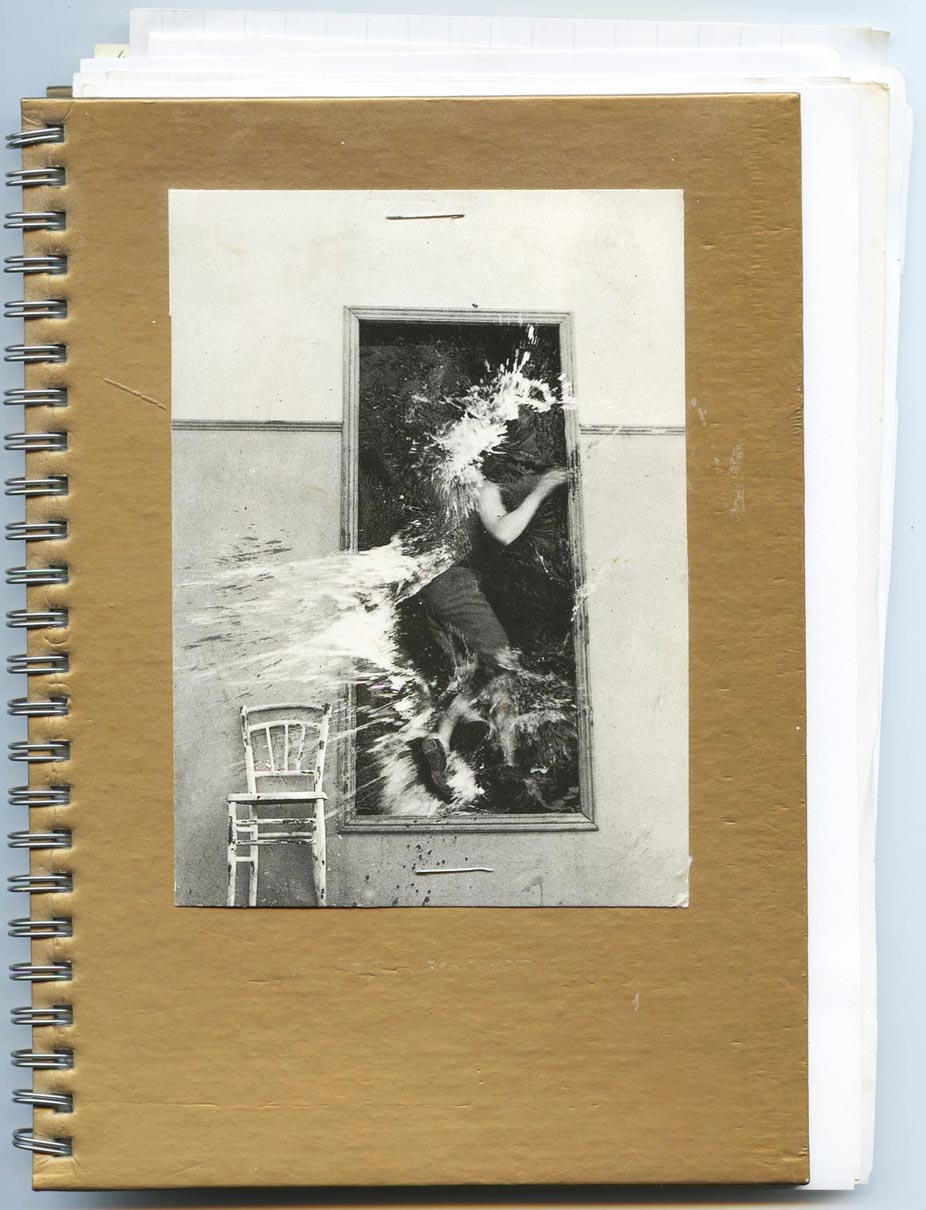
one of my notebooks

one of my notebooks

I jotted this question in my notebook a while ago. How do I read, in the widest sense? There is plenty of observation and advice on the art of writing, composing music, painting, photography, film. Less is said about on the art of reading, perceiving, interpreting, or how we reject or embrace what is expressed by others, and ourselves, even how we read our dreams.

I conclude there’s no difference between, let’s say writing, and reading, other than visibility, since any creative composition derives from an inner process of reading, the picking and shuffling of impressions into our frame of reference in relation to the larger myth of reality.

One could say the secret of being read lies in one’s talent and ability to read one’s inner psychic world, even when filtered through one’s most personal and eccentric imagination.

Long before communication was easily reproducible and reached greater audiences, people were reading the world, though only a tiny fraction of inspirations and inventions was circulated. Today’s media channels swamp us with communications. It’s confusing. We must choose.

In reading novels, I follow my intuition. The gimmick of an instant attention grabbing action scene puts me off. A proposal may be impossibly fantastic, but if I detect an authentic voice, rhythm and movement, I travel along. Invited into a mind, an atmosphere, a time, a place, I want to be absorbed in this other world and experience myself anew in a conflict between light and shadow from within the heart of another consciousness.

Whether meaning is intended or not, I read my own meaning into what has been imagined by another mind. An insight, a memory may surprise. Some books I treasure for one or two illuminating sentences, so I guess reading for me is a bit of a treasure hunt, which begs a question. What am I hunting for?

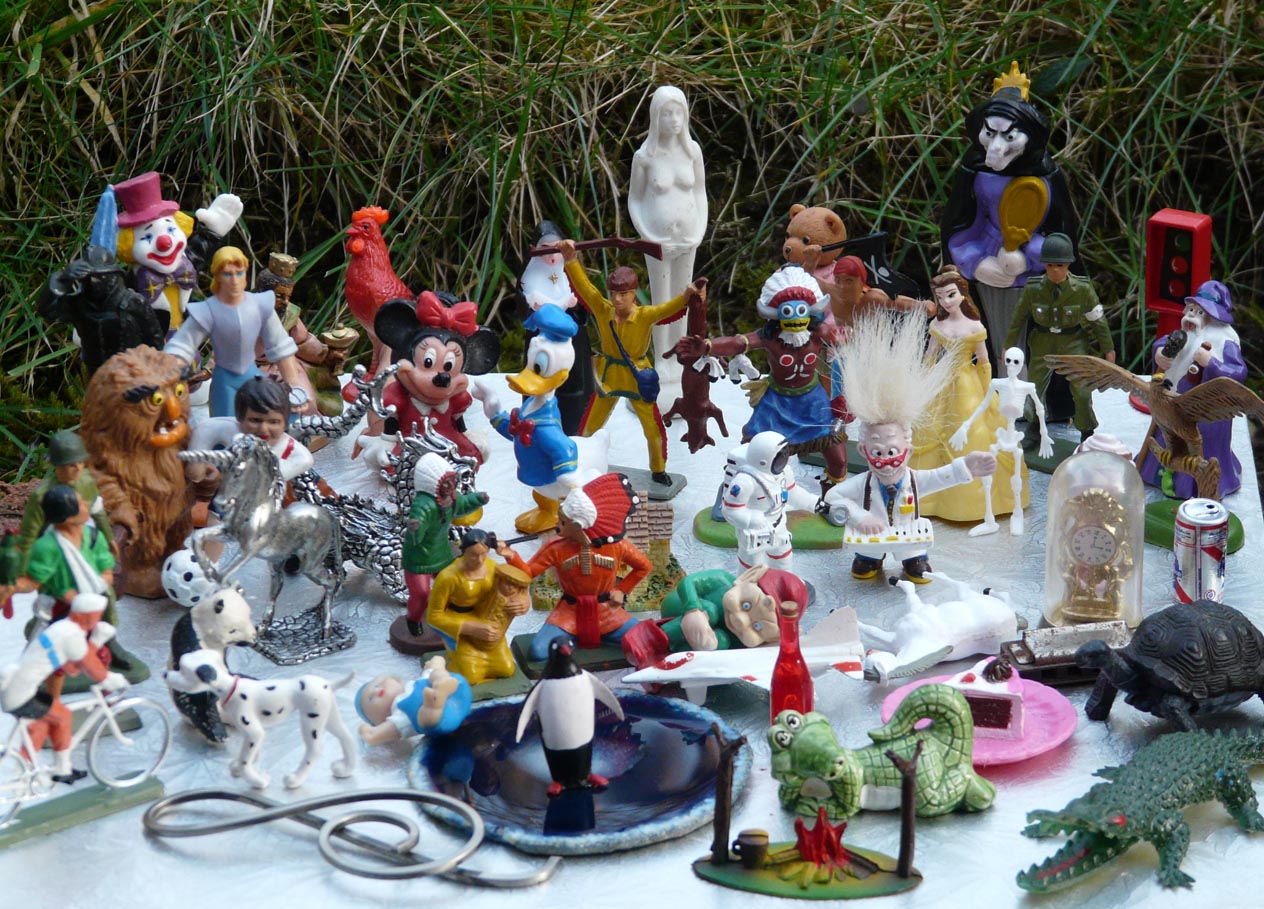
world objects for sandtray work

world objects for sandtray work

My interest is fleeting when events are contrived, plucked from the air. Characters convince me when they are embodied and grow around obstacles, reaching towards the light, while spreading roots and producing seeds (new thoughts,) even when they come from mythical creatures, kings and slaves of the past, or explorers of distant futures. As long as events happen in a believable psychological setting, I engage.

Then again, I’ve been convinced by writing that made no sense at all, until, with a little patience, I discovered a new comprehension shining through an abstract form. It’s a wonderful feeling, and important feedback for writers, who may be surprised by what is evoked in readers. Once I finished my present project, I intent to spend more time on reviewing – a most giving art of reading.

Stories for stories sake can be dull, while stories in which nothing much happens outwardly can be riveting when they resonate with the human condition, where, quite often, what seems true becomes false, and what seems false becomes true.

It is said we write the books we want to read. When writing, I search to combine words that convince intellectually and emotionally, until something true is mirrored back. Maybe what I’m hunting for in my reading and writing are fitting metaphors for the miracle of existence.

I always delight in discovering neglected writers, like Marlene Haushofer,  or the poet W S Graham, whom I wrote about here as part of a post in Sept 2013.  And beyond new works, there are innumerable old favourites, including H G Wells. The link connects to a post I did about one of his lesser known stories.

Thinking about photography, my other passionate reading, I was inspired by Henri Cartier Bresson – the link leads to my post about him.  And here the archive of the street photography of Andre Kertesz – enjoy.  I’ll leave film alone, that’s a whole other story.

What are your reflections on reading?


Some related blogposts:

Storytelling and the primary world.

Mother-tongue and other tongue.

Memory and Place.

11 Comments

Filed under Blog

… other worlds … 

Writers that inspire and make me think are like a family of heart and mind. Luis Borges belongs. His imaginary worlds shine from beyond time and space, and delight with paradox.

‘The universe (which others call the Library) is composed of any indefinite and perhaps infinite number of hexagonal galleries, with vast air shafts between … The Library is a sphere whose exact centre is any one of its hexagons and whose circumference is inaccessible … For every sensible line of straightforward statement, there are leagues of senseless cacophonies, verbal jumbles and incoherences … it suffices that a book be possible for it to exist …’   The Library of Babel, by Jorge Luis Borges

Between each breath, comma, pause, number, node, and each period, we string symbols towards stories. Some make sense to some, others make sense to none, and yet others inspire more stories. Ideas that resonate have an ongoing life, they tag on each other.

In his extensive readings, Borges must have come upon the ‘many worlds’ theme recorded in various cultures over the centuries, long before quantum physics was challenged to struggle with this probability.

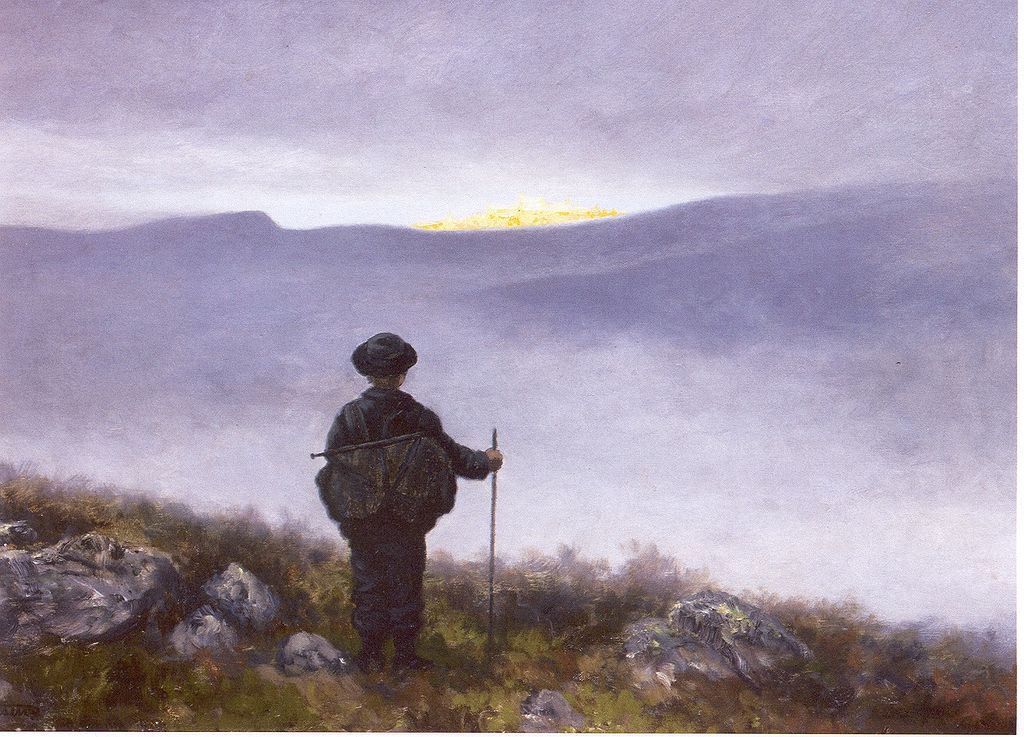
Theodor Kittelsen 1857 - 1914

Theodor Kittelsen 1857 – 1914

Even as a child I experienced shifts in reality, vivid moments that expanded my imagination and have come to play a part in my novels. Since nothing about particle behaviour under observation is certain, everyone of us is abundantly free to speculate about memory, time, and parallel worlds. Though dreamlike, these other dimensions leave signs, like unseen winds show in swaying branches, jittering leaves, and rippling waters that gather momentum to become waves upon waves.

The general definition of wave is a disturbance travelling from one location to another through whatever medium or vacuum presents itself. Do bits of information travel with resonating particles? Is the medium itself the message transmitting pattern recognition? After all, even far galaxies mirror the branching of trees and leaves on earth, or, for that matter, the neuron system in our bodies. Everything scales up or down ad infinitum. Here’s how Jonathan Swift put it in 1773

The vermin only teaze and pinch                                                                                                                                               Their foes superior by an inch.                                                                                                                                                    So, naturalists observe, a flea                                                                                                                                                    Has smaller fleas that on him prey                                                                                                                                              And these have smaller still to bite ‘em,                                                                                                                                      And so proceed ad infinitum.

It seems incomprehensible that parallel worlds could exist and influence our reality and vice versa. How could there be many collective and personal histories? How could there be other versions of us and everything? How would it work?

Given the fickleness of our feelings and thoughts, strange dreams, synchronicities, and the constant dissolution of ordered energy fields, we are exposed to streams of oscillating and interrelating signals, unless we fine-tune through the white noise, or completely relax. Occasionally we have a sensation of order, like a blossom unfolding. All is right and beautiful – we don’t feel separate, but in symphony with all dimensions, here and now.

At other times, when under pressure, and crucified having to make a decision, we sample memories, search pasts, postulate futures, until we surrender to a compromise, or the universe decides for us, or  … a resonance occurs.

‘All time is contained in now.’ – Meister Eckhart

A sudden resonance, if deep, could explain many paranormal phenomena that vex and hex people, especially scientists. Mystics are fond of saying the ‘self’ is an illusion, trapped in the body, though which self is a matter of perspective.  Since quantum physics, particles stopped being things in themselves, but function as waves also.  This is where it gets slippery, because no explanation has come forward for the wave-function- collapse when the measuring of the particle is attempted.

Time is nature’s way of stopping everything from happening at once.’

Graffiti in a Texas Washroom

The ‘many worlds’ concept gets round this problem by suggesting myriad of copies of our reality, where everything conceivable can happen. As a writer, this is my license to create. The invented characters in my novels happen to me. They are tangible, psychologically coherent, yet also suspended between worlds, like, I think, we all are.

‘… the library is infinite and cyclical … If an eternal traveller were to cross it in any direction, after centuries he would see that the same volumes were repeated in the same disorder (which, such repeated, would be an order: the Order). My solitude is gladdened by the elegant hope.’ Jorge Luis Borges

Here the Wikipedia entry on The Library of Babel.

The image is by Theodor Kittelsen, master of vision, trolls and wit.

14 Comments

Filed under Blog

… the mystery of thoughts …

Every child is truly switched on to the imagination. But frequently the environment belittles the imagination, and the gift can end up suppressed under the blanket of rationality. People with a strong creative drive may settle down to live in a straitjacket, and then find themselves overwhelmed by images, thoughts and associations, especially around full moon.

As a child I was intensely curious about the spaces between things, and about light. Had I not locked horns with an opinionated physics teacher I might have taken up the challenge to study sciences. Another fascination of mine was pattern repetition – how the veins in a leaf resemble the shape of a tree. And scale – how tiny bodies, big bodies, our planet, galaxies, the universe, are all reflected in each other.

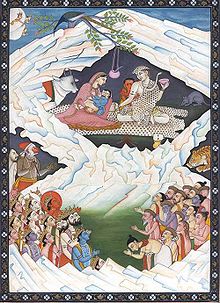
 Hindukailash, image from wikipedia.

Hindukailash, image from wikipedia.

Like Indra’s net of pearls in Vedic mythology, where the surface of each pearl mirrors all other pearls, a metaphor for the interconnected networks of mutual relationships between parts and systems. Mount Kailash is depicted here as the timeless and motionless centre of this net, housing Shiva’s family.

Not only visible structures are held together by interactive nets, our social systems, political systems, spiritual systems and the internet operate within a network. We can observe that the invisible psyche (mind) functions not only through logic, but also through aesthetics, independent of space/time, and is held by another kind of coherence – a net of meaning. And what is generated from this net of meaning is a finer kind of energy, not evidenced by present scientific methods – namely intelligence.

We knew it all along – research established that our emotional experiences leave an imprint in the cells of our body, that the brain is more than the squishy mass under our skull but a medium spread throughout the body via a network of neurotransmitters. There have been hair-splitting arguments for and against the idea that the recipient of an organ can experience personality traits of the donor, based on the speculation that each cell carries a hologram of the whole body and its memory.

Feelings and thoughts arising in my consciousness are filtered through my body’s memory. They also depend on my state of anxiety or calm, my interest, attitude and other variables, such as the weather, my relationship with the elements, with people, the collective mood, solar flares, or the constellation of planets. On some days, maybe after a meaningful dream, or a spell of mantras, thoughts are forming clearly on the breath, like reflections in a still pond, on other days, thoughts rush in on water rapids threatening to drown me, or they plod in like turtles, slow and guarded.

Objective reality is not the only game there is – what in the universe has not interacted at some point in time, irrespective of distance? Everything is linked up. Einstein called it the ‘spooky action.’

The motherboard for this wonderful instrument we call the brain, which comprises our whole body, is formed in the womb. I believe the intelligence involved in creating any specific body must lay in more than known DNA codes, must include the indeterminable non-local DNA of a spirit world. Our body foremost operates like a receiver and transmitter for as many wavelengths our radio station in time attracts or is able to tune into.

From this station, stabilized by repetition, I sort clusters of sensations and feelings, and process thoughts and ideas attracted to me from the collective psyche, a vast sea, which the individual mind must learn to navigate. Images and signifiers are coloured by whatever I consciously or unconsciously mirror and relate to.

No matter how much information we absorb, through our senses, through language and concepts, through comparing patterns, reasoning and calculation, everything, comprehended or not, will be filtered through the body’s motherboard that keeps adjusting to experiences and expanding fields of perception, fields that extend way beyond personal memory. All this information is continuously re-shuffled, as is the meaning we assign to it.

Our body is a motherboard – planet earth is a motherboard – the whole cosmos is a motherboard for a spirit we cannot comprehend, an invisible hand that touches us like a breeze, made visible through what it animates.

All we know is that images, thoughts and ideas are reflected in us. They travel via synapses in the neurons of our body, they travel on the air between minds, they travel among stars, they echo from under the sea, waving to us as plankton, they speak to us from every creature, from every blade of grass, from every stone, and they beep from within our bodies through tweaks of pleasure or pain. All matter, all people and objects we interact with store the memory of that interaction, including interactions with things we hate or nurture, and with places we live in.

We don’t invent anything, we re-discover, re-connect and re-create from the vast storehouse of knowledge and information provided to us by nature, and by the spirit between matter that makes up the cosmos, an embodied being that is becoming conscious of itself.

We are on the air, sent, programmed, radioed and broadcast, identified with all manner of things, ideas and beliefs. Yet if we look deep inside our emptiness, we know, the non-material aspects of us can potentially detach and be free, maybe enjoy tea with Shiva’s family and witness the world turn on its axis – a state some people experience spontaneously or through meditation. A state of pure consciousness not identified with this or that. In the meantime, we could at least be kind to ourselves …

‘Thoughts are beings that generate … One thought of kindness gathers a thousand beings of love and kindness around one.’            Hazrat Inayat Khan

I don’t know if a singular mind/psyche, the incredible art of a lifetime, survives the physical death of the body. Maybe a coherent individuated mind leaves a dent, an influence within the collective psyche. Like the organ of the heart, over time, achieved its definite function. But does it matter? Nothing is lost. All information is continuously re-shuffled into new forms and constellations.

Digital storage provides a metaphor – information exists and roams freely in the wind of the collective psyche (unconscious) until it is embodied and gathered towards a purpose. Every event has a consequence. Nature is exacting, but also generous, what has been repressed in the flow of evolution will always return in one form or another.

Everything alive speaks to us, and all such relationships are processed in the stories we share, stories being containers of the richest kind of information. 

*    *    *

You can source other posts on the theme of reflection in the tag cloud on the right of this page. Like this sequenc of posts: https://courseofmirrors.wordpress.com/tag/hazrat-inayat-khan/

And you might want to check out posts under the tag ‘psychology,’ especially the one on ‘awareness,’ where I share R. Assagioli’s 10 psychological laws – how the body affects the mind and the mind affects the body. https://courseofmirrors.wordpress.com/tag/psychology/

*     *    *

This post also appeared at  Third Sunday Blog Carnival: September 2013 | Third Sunday Blog Carnival

17 Comments

Filed under Blog

one raindrop – ten raindrops – what’s the difference?

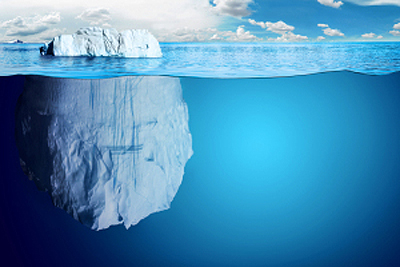
Before I went to bed last night I asked for a dream, as I do when I want guidance from my unconscious. After all, the greater part of our psyche is out of sight, submerged, with only the top in view, which is why Freud used the image of an iceberg to depict the psyche, the submerged part having deeper connections with the sea of the collective unconscious in which we all swim.

Iceberg - Ri han - Shutterstock

Iceberg – Ri han – Shutterstock

My question was related to the global web, and what’s rising to the surface like long drowned skeletons bobbing along the electric rapids of information, memories re-shuffled, all with a kind of speed only fearless surfers can negotiate. And how every link you and I click is traced, analysed and fed back to the media, politicians, businesses, twitter-birds, face bookers, bloggers and so on. At times it seems like a kind of vivisection in a shiny mirror looking back at us, surreal.

I’m seasoned. There was no TV in my early childhood, it astounds me what I’ve adapted to over the years, but the present tech-apps-avant-garde makes me feel like I’m missing a boat, along with, let’s take a breath, at least sixty-one-percent of the world population (that’s the kind of people with no internet at all.) And because I tend to reflect on cultural trends, searching for wider purpose, meaning and metaphors, I put this to my unconscious: please give me some insight.

On waking, the first thing I gazed at was the raindrops netting my skylight. A phrase came:

                 … one raindrop – ten raindrops – what’s the difference? …

It stuck. I stopped myself diving into associations, about raindrops, the number one, about the history of zero – as symbol for something that doesn’t exist but has become a place-holder. I stopped myself from quoting Rumi, too.

The phrase I received is enigmatic and feels creative. Does it come down to postulation, the everything-and-nothing-matters kind of power we have to envision and re-assemble stories, the delicious freedom to speculate without limits …?

Maybe purpose and meaning are becoming old hats and I’m missing the point entirely. What do you make of the phrase … either with your knowledge of maths and physics, or with your imagination? Even with the phrase or image of a dream ☼


19 Comments

Filed under Blog

… consciousness – the mystery …

People who engage in therapeutic work with me often ask – why dig up my past, it holds pain, why look at attachment patterns, why explore the theme (myth) of my life? What a waste of time. I only want to get rid of my symptoms.

We all, without exception, suffered injuries. The creative question to ask is – how has the injury shaped my life, and what purpose does it serve? Many years ago, during a group dialogue following the inspirational talk of my Sufi teacher, we discussed three basic kinds of injuries. I connect my own experience to the third injury.

1        Having experienced physical injury can result in fight and flight behaviour – it brings a heightened sensitivity and develops a sharpening of the senses.

2        Having experienced sexual, sensual and emotional injury can result in escape from one’s self into others, estrangement from self, lack of differentiation and boundaries – the great challenge is to accept one’s self, differentiate as an individual from the tribe and take responsibility for one’s unique potential.

3        Having experienced injury on a cognitive level accelerates individuation – the escape is into deeper realities, a search for authenticity and truth and the development of symbolic reality – universal reality.

My novel, Course of Mirrors, is the fictionalised account of an aspect of my personal myth made universal – in the sense that memories of events don’t have to be real for a story to be true.

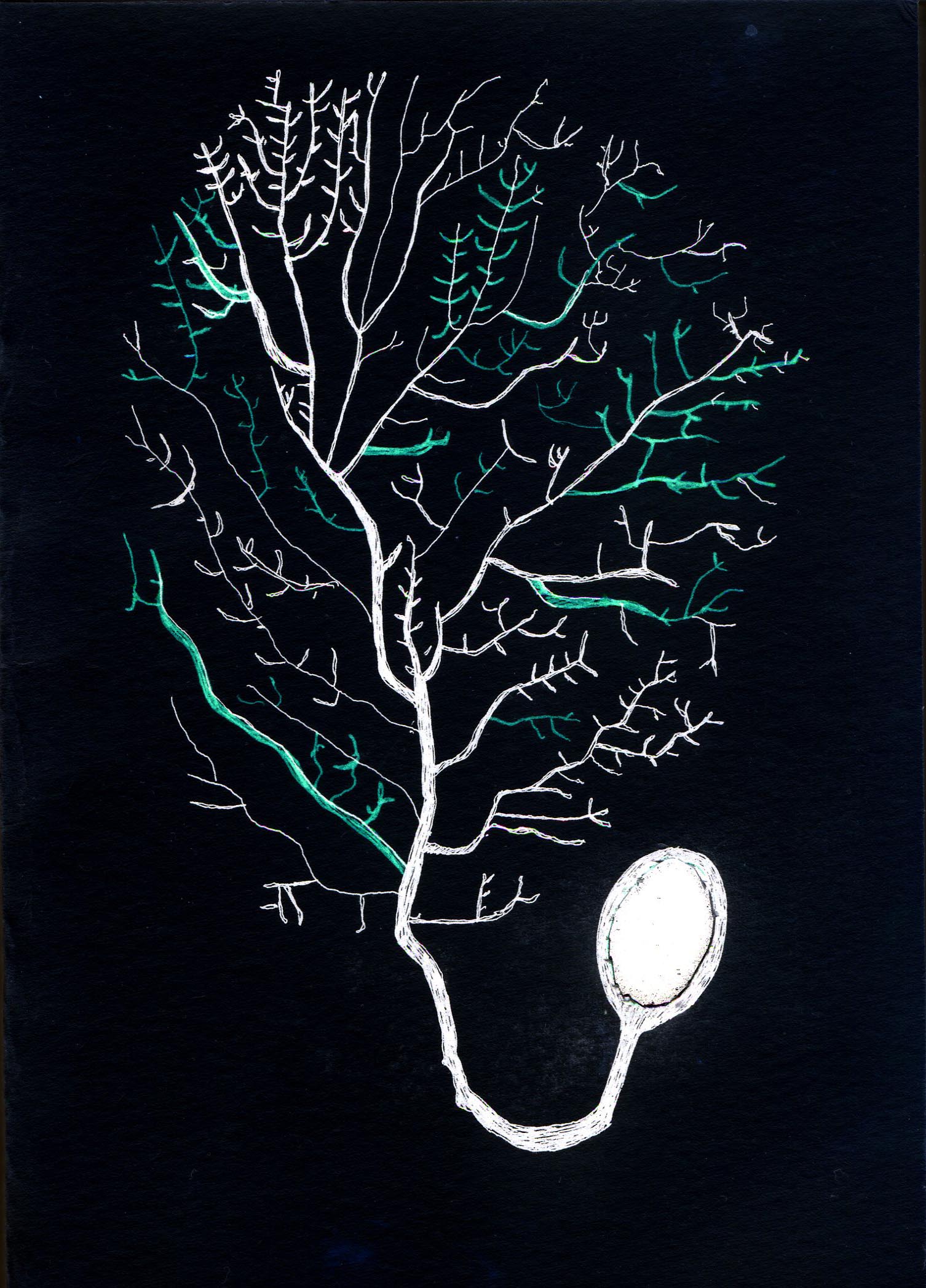
@ Natasha Tonkin

@ Natasha Tonkin

Even the most die-hard materialists among us grok that life is animated and guided by an all-pervading spirit? We are vessels, psychic switchboards for the spirit that animates and records all life.

An ungraspable phenomenon we try to name in vain.

Mental states pass through us. We call in and then process thoughts and feelings, seeking coherence, and – given we assign meaning to what happens to us – are gaining wider perspectives and deeper insights. With every new connection made and every little light brought to what is forgotten and unknown – collective consciousness grows.

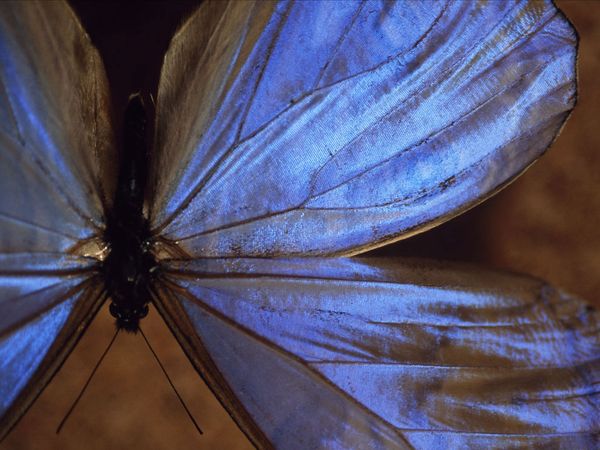
Our body knows, if we care to notice, what stirs in our psyche, what wants to unfold and emerge. When energy flows freely through us our essential nature is uplifted, and our desire is aligned with the potential in us that seeks actualisation – in the way a cocoon reveals the butterfly. Our life has many cocoon and wing stages. The proverbial flutter that causes a stir in all spheres of the universe is like yet another love-transcended aspect of us emerging from yet another cocoon.

Presence, responding to situations, accepting differences and contradictions, frees energy that is ghosted and stagnant. While blocked energy creates frustrations and often painful symptoms, it is totally inevitable, since every organism evolves through condensed experiences. Life enhancing and life destroying events subject us to a pattern of repetition in time until we embrace change.

‘A truth outgrown crushes you under its weight.’   Fazal Inayat-Khan

To bring a repeating pattern to a higher level of flow requires a kind of quantum leap of consciousness. Small leaps occur frequently, especially when we befriend the unconscious and allow fresh symbols into awareness. The released light/energy brings new meaning and allows the self-actualisation of new potential.

‘It is obvious that the percolation of a timeless NOW is penetrating everything!’  –  Philippa Rees

*      *      *

The image above is by Natasha Tonkin, my son’s partner. It was done two years ago as Christmas card and gift idea towards illustrating my novel, to help bring it to life. I scanned and inversed the image for the mirror to appear light. Natasha’s animation website: http://pandahorse.com/

Link to a book I co-edited about the Sufi teacher I mentioned above, Fazal Inayat-Khan. http://www.amazon.co.uk/Heart-Sufi-Inayat-Khan-Reflections-ebook/dp/B00BFUO0T6/ref=sr_1_1?s=books&ie=UTF8&qid=1369084226&sr=1-1&keywords=heart+of+a+sufi

Link to ‘Involution,’ an exceptional book by a kindred spirit, Philippa Rees.                                         http://involution-odyssey.com/  her book will soon hit the market. Her site is being developed.

6 Comments

Filed under Blog

… pattern which connects …

For a recent book-sharing with a group of irreverent friends (archventures), I had the wish to share so many books that I instinctively reached more or less blindly into one of my shelves. Books in my home, I must add, are in a muddle. The only order to speak of is their relationship to each other through time. I picked Alice in Wonderland and Mind and Nature. During our afternoon of reading there was not enough time to do honour to the latter, Gregory Bateson’s work. So I said I’d write up something. Oh dear. After pages and pages, I finally recalled this was supposed to be a blog-post, not a novel .

I first came upon Gregory Bateson books, ‘Steps to an Ecology of Mind’ and ‘Mind and Nature,’ during the early 1980’s, after his death. The clarity of his notion that biological forms arrange themselves through relationships struck a deep chord. What totally resonated with me was his thought that the structure of nature and the structure of mind are reflections of each other.  He had a broad perspective for a Biologist, and wanted to build a bridge between the facts of life and behaviour, and what we know of the nature of pattern and order. He was active in, and connected up many different fields of study – anthropology, psychiatry, biological evolution and genetics and the new epistemology which comes out of system-theory and ecology. He challenged basic assumptions and methods of scientific investigations, pointing to the processes beneath structures. He quoted Goethe …

A stem is what bears leaves

A leaf is that which has a bud in its angle

A stem is what was once a bud in that position …

And he provoked new thinking: ‘What pattern connects the crab to the lobster and the orchid to the primrose and all four of them to me. And me to you?’ 
His interest in morphology, the study of structure and form of organisms, involved context, meaning and communication. He distrusted reductive models of cause and effect, the scientific approach that lines up parts and classifies them, focussing on quantity.

Comparing systems, one to another, he perceived the mind as an ecological system. And he used the analogy that ideas, like seeds, can only take root and flourish according to the nature of the system receiving them. This thought alone deserves deep contemplation.

He had a way with stories … ‘There was a man who had a powerful computer, and he wanted to know whether computers could ever think. So he asked it – Will you ever be able to think like a human being? – The computer clicked and rattled and blinked, and finally it printed out its answer on a piece of paper, as these machines do. The man ran to pick up the printout, and there, neatly typed, read the following words: ‘That reminds me of a story.’ 
Concerned about the decimation of aboriginal populations (he did field-work with Margaret Mead), the degradation of ecological systems, economic oppression, and senseless wars and arms races, he took these ominous signs of contemporary life to be manifestations of deeper disorders, which he defined in terms of cybernetic systems of communication and meaning that comprise life, mind, and society. In his view, consciousness dominated by purposeful thought has a linear structure that establishes goals and ways for attaining them without being necessarily sensitive to the circular network of cause and effect that orders the systems.

Looking at human consciousness as an adaptive system, he thought the cure for its inadequacies, evidenced by the negative side-effects of purposive rationality, was not to reject it in favour of a passionate non- rationality, as in the extreme romantic position, but to augment and complete it by engaging with non-discursive, pattern-comprehending and emotional processes. He advocated the befriending of the unconscious aspects of the mind through utilising images and metaphors.

In a civilization which separates mind from body, mythologies about the survival of a transcendent mind are often meant to soften the idea of death, or even deny death as part of life. For Bateson, who saw the mind as being immanent not only in pathways of information which are located inside the body but also in external pathways, death took on a different aspect. ‘The individual nexus of pathways which I call ‘me’ is no longer so precious because that nexus is only part of a larger mind. The ideas which seemed to be me can also become immanent in you. May they survive, if true.’  (Afterword to a collection of celebratory essays, 1972)

Yet there are scientists that can no more perceive the language of nature, and politicians who feel beleaguered by sections of society that seek balance and a fresh context towards ‘an ecology of mind.’  The extreme factions of believers, for what else are they, should look again at the bridge  Bateson prepared.


This lovely video gives a taste of what it is all about :

Update … I discovered recently, in 2019, that some the links in this post don’t seem to work anymore. Here , however, is his daughter’s great documentary on Vimeo, unfortunately not free, apart from the trailer.  https://vimeo.com/ondemand/bateson

Looking at the structure of nature and the structure of mind being reflections of each other, it becomes obvious that not only does nature mirror our habit of thinking, but our thinking also mirrors the state of nature. Ecology and psychology must therefore both engage in listening, and seeing, and working ceaselessly towards the integration of knowledge and the re-adjustment of a dynamic balance.

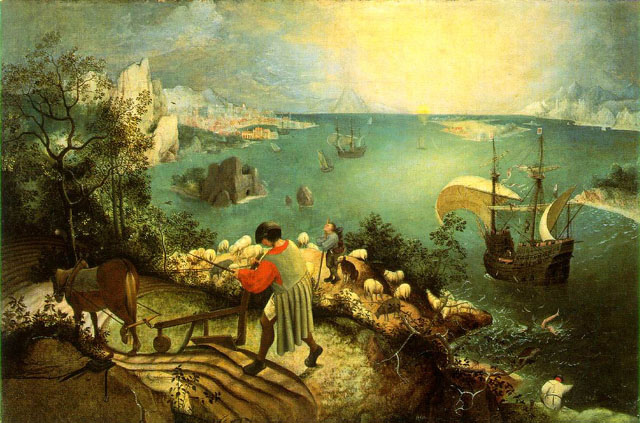
I could go on, but want to bring in a famous painting of Icarus by Brueghel.                                                             Anthony Stevens, a brilliant expositor of Jung’s thought, used the painting as cover for the first hard-cover edition (1995) of his book Private Myths.

http://www.anthonystevens.co.uk/index.html
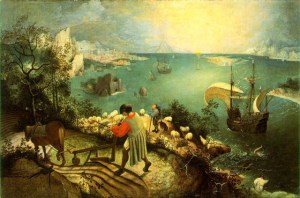


Stevens quotes from a poem by Wystan Auden:

In Brueghel’s Icarus, for instance: how everything turns away

Quite leisurely from the disaster; the ploughman may

Have heard the splash, the forsaken cry,

But for him it was not an important failure; the sun shone

As it had to on the white legs disappearing into the green

Water; and the expensive delicate ship that must have seen

Something amazing, a boy falling out of the sky,

Had somewhere to get to and sailed calmly on.

What goes up must come down. Who knows how many Big Bangs there were before the one we so ardently explore? There is an organising intelligence behind life’s cycles, while consciousness forever expands. Thinking in metaphors we can perceive similar patterns, forms in nature and mind, cosmos and psyche, mirroring each other across scale and time. In other words, life teems with realities we can tune into, as long as we assign context and meaning.

Check out Gregory Bateson’s books ‘Steps to an Ecology of Mind’ and ‘Mind and Nature.

His family continue his work: His daughter Nora and his wife – Mary Catherine Bateson:   http://www.interculturalstudies.org/main.html

Peripheral Vision

 http://www.amazon.com/exec/obidos/tg/detail/-/0060926309/mead2001centenni

Free chapters of Angels Fear:  http://www.oikos.org/angelsfear.htm

Nora Bateson, recently created a film:

http://www.anecologyofmind.com/

Last not least, the themes:  pattern which connects, mirroring and bridging, are subjects of my novels.
25 Comments

Filed under Blog