More contagious than micro-organisms are fear and hopelessness.
Long before our time, the existence of micro-organisms was presupposed, notably in Jainism, whose followers vow non-violence in thought and practice (Ahimsa) towards all living beings. The tradition is said to be older than Buddhism.  In the teachings of Mahavira (599 – 527 BEC), micro-organisms are described as unseen creatures living in earth, water, air and fire, and existing as clusters pervading every plant and tissue, not just on earth but throughout the whole universe. Jain libraries are the oldest in India.
While home-bound with a young child in rural Somerset, I did an OU course on world religions, wanting to learn about the formative ideas underlying our variety of cultures. Reading on Jainism, I was struck by its beautiful philosophy, genuine tolerance of other faiths, and the surprisingly modern belief – that the universe is self-regulated by the laws of nature. Worth exploring: see wiki-link below.
With a different mind-set, the idea of unseen creatures informed a nasty biological war fare during the Middle Ages, when diseased corpses were catapulted into enemy strongholds.
Along came artificial eyes, the telescope and the microscope, evidencing these unseen worlds. The Jesuit priest, Athanasius Kircher, and Anton van Leeuwenhoek, were among the first to spot micro-organisms through lenses in the 17th century. 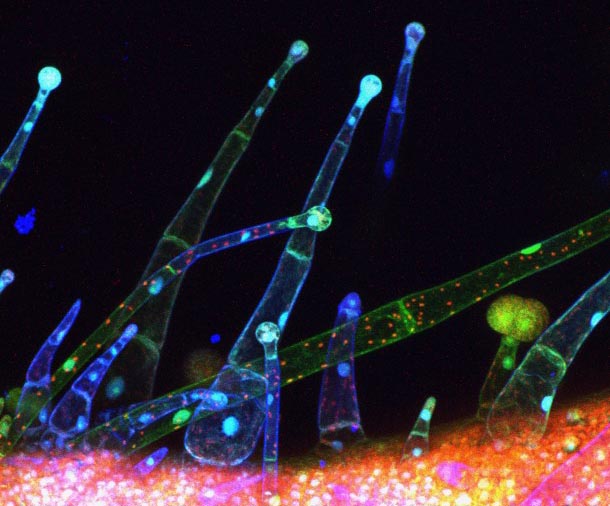 The journey took off, until Ferdinand Cohn founded the discipline of bacteriology in the 19th century, and Louis Pasteur and Robert Koch developed the study of microbiology, focussing on food preservation and vaccines. The gained knowledge helped to protect us from organisms known to spread disease, and improved the hygiene of our environment. During the late 19th century the study was expanded through the work of Martinus Beijerinck and Sergei Winogradsky into the field of general microbiology.
Today the study of micro-organisms has developed to such extend that hundreds of specialised branches of study exist serving a huge variety of applications. I’m fascinated by biology, and I greatly respect scientists who devote their days and nights to deepen our understanding of life.
What I question, as do many of my friends, which include scientists, is the unrestricted power of multinational companies. It is totally unethical that multinationals can push decisions as to how scientific evidence is used. To start with, they must be made accountable for damages caused, and next, it should be obligatory, like a tax, that a fraction of the profits these companies reap be used for interdisciplinary research, so that evidence can be established for the many undeniably wholesome methods of balancing and strengthening self-organising systems.
The over-reliance on suppressive drugs (and in the case of agriculture pesticides) in the fight against every imbalance has devastating side effects. Apart from training super-bugs, the relentless war undermines the ecosystem of our planet, and our birth right, the ingenious self-regulatory system that acquires immunity through exposure. Nature has taught us everything, nature is not the enemy. Excess use of medication could even undo the good work of vaccines, meant to help us acquire immunities. A weakened immune system may eventually fail to deal with any kind of exposure. So why do we sanction this paranoid warfare ?
What is known about micro-organisms includes the process of endosymbiosis – where symbiosis occurs between different organisms that benefit from living together. Lynn Margulis opposed the neo-Darwinian concept of competition, and proposed that evolution thrived through cooperation: ‘Symbiogenesis recognizes that every visible life-form is a combination or community of bacteria.’ (See link below) In other words, the fittest is what adapts and harmonises.
There is always more than one way to look at something. When it comes to the prevention of dis-ease, and the healing of body and mind, the soothing of stress, we have enough knowledge and wisdom to appreciate the effectiveness of: relaxation, telling one’s story and being listened to, a clear positive intention, the benefits of meditation, a calm mind, the balancing of subtle energies, the vibrations of harmonious sound, architecture, colours, symbolic understanding, the use of active creative imagination, a gentle touch, a heartfelt smile, for example.
The authenticity of a friend, a doctor, a healer or therapist, can inspire a troubled person who is seeking support to take self-responsibility. Trust, or faith in one’s healing, is a phenomenon that also throws light on the powerful physiological effects of the placebo, which is a proposed ritual that promises nothing, but puts the patient in charge. Wow!
From another tradition that respects all faiths, here is a perspective on microbes expressed by Sufi Hazrat Inayat Khan, who brought his wisdom to the west in the early 20th century:
Every day a new invention brings a new microbe. And if a new microbe is discovered every day till the end of the world there will be numberless diseases; in the end it will be difficult to find one man healthy, for there must always be some microbe; if it is not of an old disease, then of a newly discovered one …
The people of old thought that microbes were spirits, living beings, in the absence of science which today distinguishes these spirits in the form of microbes; and yet it seems that the ancient healers had a greater grip upon the illness, for the reason that they considered the microbe in its spirit. In destroying the microbe they did not only destroy the outer microbe, but the inner microbe in the form of the spirit, of the germ; and the most interesting thing is that in order to drive away that spirit which they thought had possessed the patient, they burned or they placed before him certain chemicals which are used even now, having been proved to be destructive to the germs of diseases.
With every measure that physicians may take to prevent the germs of diseases from coming, in spite of all the success that they will have there will be a greater failure; for even if the actual germ is destroyed, it exists, its family exists, somewhere. Besides, the body which has once become the abode of that particular germ has become a receptacle of the same germ. If the physician destroys the germ of disease from the body of an individual that does not mean that he destroys it from the universe. This problem, therefore, must be looked at from another point of view: that everything that exists in the objective world has its living and more important part existing in the subjective world; and that part which is in the subjective is held by the belief of the patient. As long as the patient believes that he is ill he is giving sustenance to that part of the disease which is in the subjective world. Even if the germs of the disease were destroyed, not once but a thousand times in his body, they would be created there again; because the source from which the germs spring is in his belief, not in his body, as the source of the whole creation is within, not without.

Hazrat Inayat Khan
The outer treatment of many such diseases is just like cutting the plant from its stem while the root remains in the ground. Since the root of the illness is in the subjective part of one’s being, in order to drive away that illness one must dig out the root by taking away the belief of illness even before the outer germ is destroyed. The germ of illness cannot exist without the force, the breath, which it receives from the subjective part of one’s being; and if the source of its sustenance is once destroyed, then the cure is certain.
Very few people can hold a thought, but many are held by a thought. If such a simple thing as holding a thought were mastered, the whole life would be mastered. When once a person gets into his head, ‘I am ill’, and when this is confirmed by a physician, then his belief becomes watered like a plant, then his continual reflection of it, falling upon his illness like the sun, makes the plant of illness grow; and therefore it would not be an exaggeration to say that, consciously or unconsciously, the patient is the gardener of his own illness … The root of illness is in the mind, and if that root is continuously watered by thought and feeling, illness is realized in the end.
* * *
More contagious than micro-organisms are fear and hopelessness. (my conclusion)
* * *
We are the mirror and the face in it.
We are tasting the taste this minute
of eternity. We are pain
and what cures pain. We are
the sweet, cold water and the jar that pours.
Rumi – transl. by John Moyne and Coleman Barks
* * *
Jainism: http://en.wikipedia.org/wiki/Jainism
Lynn Margulis
http://discovermagazine.com/2011/apr/16-interview-lynn-margulis-not-controversial-right
Hazrat Inayat Khan – Volume 4 – Healing and the Mind World.


 Course of Mirrors
… the wonderful visit …
I loathe most talk of angels since they became best-selling brands, but the synchronicity of Annie Lennox wearing wings and singing to an angel at the Queen’s Diamond Jubilee, and the discovery of a rare book among my shelves, brought angels up close.
H G Wells (1866-1946) has been referred to as the Father of Science Fiction. A neglected story, The Wonderful Visit, published shortly after The Time Machine, was regarded as a mocking reflection on attitudes, beliefs and the social structure of a typical English village in Victorian times. I read the social commentary as ornamentation, the comical human attempt to stay the same, round a more essential theme, the conflict that can accompany awakening.
The edition below is from 1922 and has an illustration by Conrad Heighton Leigh. The line under it is from chapter 5 – ‘He fired out of pure surprise and habit.’
A strange bird was sighted.
Ornithology being a passion of the Vicar of Siddermorton, Rev. K. Hilyer, he was going to outdo his rivals and hunt the strange bird. So it came to be that on the 4th of August 1895 he shot down an angel.
… He saw what it was, his heart was in his mouth, and he fired out of pure surprise and habit. There was a scream of superhuman agony, the wings beat the air twice, and the victim came slanting swiftly downward and struck the ground – a struggling heap of writhing body, broken wing and flying blood-stained plumes … the Vicar stood aghast, with his smoking gun in his hand. It was no bird at all, but a youth with an extremely beautiful face, clad in a robe of saffron and with iridescent wings … never had the Vicar seen such gorgeous floods of colour …
‘A man,’ said the Angel, clasping his forehead … ‘then I was not deceived, I am indeed in the Land of Dreams.’ The vicar tells him that men are real and angels are myth … ‘It almost makes one think that in some odd way there must be two worlds as it were …’
‘At least two,’ said the Vicar, and goes on pondering … he loved geometrical speculations, ‘there may be any number of three dimensional universes packed side by side, and all dimly aware of each other.’
They met half way, where reality is loosely defined, and truth has no hold. And they shared the nature of their worlds. Eat, pain, and die were among the new terms the strange visitor had to come to grips with.
‘Pain is the warp and the waft of this life,’ said the Vicar. Riddled with remorse over having maimed the Angel’s wing he decides to looks after him. But to adjust to the Vicar’s world, the Angel must eat and accept pain, and learn all manner of things very fast indeed … Starting to read, during a phase of now legendary sunshine, I settled in my garden with a glass of red, and consequently spilled the wine on my wild strawberry blossoms due to sudden bursts of laughter.
‘What a strange life!’ said the Angel.
‘Yes,’ said the Vicar. ‘What a strange life! But the thing that makes it strange to me is new. I had taken it as a matter of course until you came into my life.’
Mr Angel is nothing like the pure and white angel of popular belief, more like the angel of Italian art, polychromatic, a musical genius with the violin. Listening … the Vicar lost all sense of duration, all sense of necessity … The reactions of the villagers oscillate across a hair-thin-divide between comedy and tragedy, while the bone of the story is psychological, and spiritual. Indirectly, the Vicar encounters his anima (his inner female) through the Angel’s love for Delia, the maid servant of the house. There is no escape. Things get intense. The Angel, over the span of a short week, is tainted by the wickedness of the world, and it crushes him. And the Vicar’s awakening from his narrow prison brings him into tragic conflict with his community.
* * *
Not much has changed. The world is crowded with wounded angels seeking compassion, and since our daily vocabulary offers little more than clichés for other realities, awakening rarely convinces, unless it is embodied and conveyed through atmosphere. Look out for the artist… the musician, painter, writer, animator, filmmaker … and the children.
‘If the doors of perception were cleansed every thing would appear to man as it is, Infinite. For man has closed himself up, till he sees all things thro’ narrow chinks of his cavern.’
― William Blake, The Marriage of Heaven and Hell
The painting heading this post is by the Finnish symbolist painter Hugo Simberg.
Share this:
18 Comments
Filed under Blog
Tagged as 19th century, Angels, Anima, Annie Lennox, artists, awakening, beliefs, books, children, circular and linear time, comedy, communication, Conrad Heighton Leigh, English, fallen angel, father of science fiction, H G Wells, heaven, Hugo Bimberg, illustration, imagination, inner conflict, inspiration, lover, Marriage of Heaven and Hell, men, metaphors, morals, musical genius, other realities, pain, painting, perception, preconceptions, Queen, reality, relationship, religion, remorse, Siddermorton, social commentary, spirituality, symbolic understanding, The Queen's Diamond Jubilee, The Time Machine, The Wonderful Visit, tragedy, unique moments, Vicar, village, violin, William Blake, wisdom, wounded angels, writing