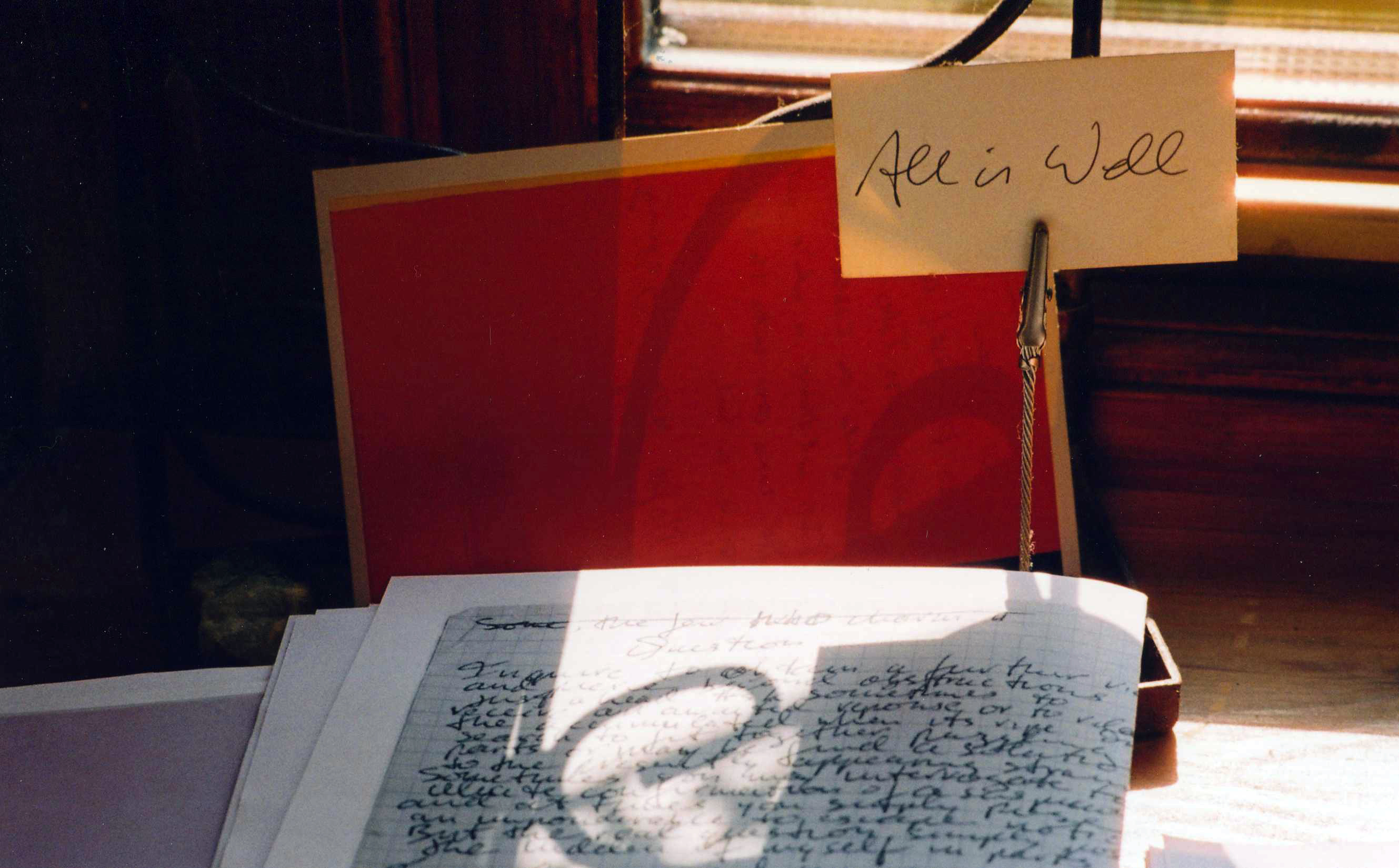
‘All is Well’ may not sound true to you, but pause for a moment, think of it as a deep state of mind, a trust in the balancing power of the psyche, a trust in human values; don’t underestimate the phenomenal power of this attitude.
Make it your manta. It’s an enabling attitude that dilutes all diversionary and sensational news.
I’m fortunate to have a small garden, the care of which grounds my overactive mind and diverts me from the increasingly surreal global politics of these days.
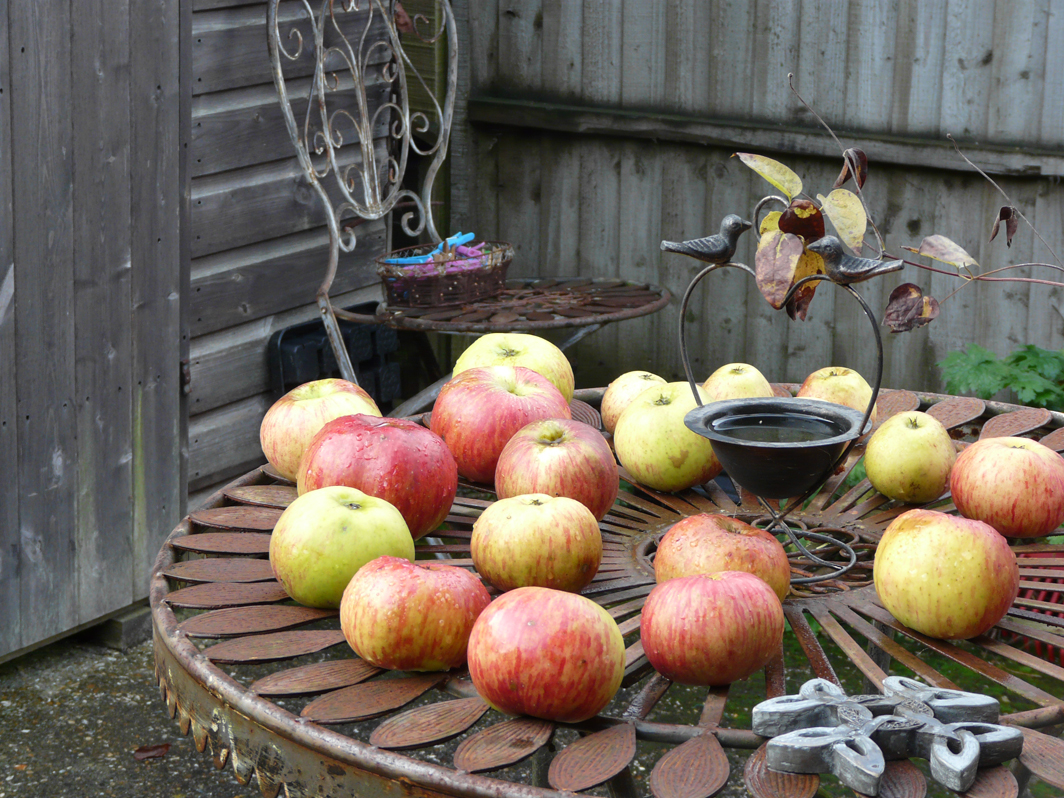
This time of year I’m challenged to deal with a glut of apples, eaters and Bramley cookers. I hear them plop daily to the ground. I can’t leave them to rot, so apart from sharing the blessings with friends, wrapping the cookers in newspaper to preserve them for a while for stir fries and curries, I’ve made a batch of applesauce today.
I don’t think I ever posted a food recipe, but was prompted by a memory of my mum’s kitchen magic. Her potato fritters, made of raw grated potatoes, mixed with flour, egg – and fried, were served with a dollop of applesauce.
The applesauce I made today, consists of 1 kg peeled Bramley apples chopped up into small chunks, the juice of a lemon, a tablespoon of maple syrup, a little castor sugar, a little cinnamon, a little rose wine, and some butter and salt … result … it tastes divine …
That’s about all the inspiration I feel able to share this month :)
AI is all the rage. It doesn’t chime, and I’m puzzled about its implementations, ChatGPT etc.
Where data is concerned; humans have access, filtered through nature, our body, DNA, our ancestry, through Gaia and the Noosphere … all providing indefinitely more useful and richer intuitive information than any AI machination based on prompts that are trained to offer flattering affirmation and resonance.
I’m only a curious bystander, yet, following reports on this controversial subject, something about AI feels like a discord in my heart, a lifeless blank spot without position or horizon, a killer of critical doubt, a wicked joke, subversion of meaning, a parsimonious harvesting of material from artists, an affront to the psyche, a false mirror … I grapple for words to express my strong concerns, though I tend to agree with Mc Gilchrist…
‘The opposite of life is not death, it’s a machine.’
A poem by Wislawa Szymborska from the 1970s chimes in an uncanny way…
Utopia …
Island where all becomes clear.
Solid ground beneath your feet.
The only roads are those that offer access.
Bushes bend beneath the weight of proofs.
The tree of Valid Supposition grows here
with branches disentangled since time immemorial.
The Tree of Understanding, dazzling straight and simple,
sprouts by the spring called Now I Get It.
The thicker the woods, the vaster the vista:
the Valley of Obviously.
If any doubts arise, the wind dispels them instantly.
Echoes stir unsummoned
and easily explain all the secrets of the worlds.
On the right a cave where Meaning lies.
On the left the lake of deep Conviction.
Truth breaks from the bottom and bobs to the surface.
Unshakable Confidence towers over the valley.
Its peak offers an excellent view of the Essence of Things.
For all its charms, the island in uninhabited,
and the faint footprint scattered on its beaches
turn without exception to the sea.
As if all you can here is leave
and plunge, never to return, into the depths.
Into unfathomable life.
As said, I’m grappling for words to express my concerns, and may lack understanding.
So I’m grateful for feedback of any kind. Thank you.
Anger is a natural human emotion. When its agressive energy accumulates as tension in the body, depending on one’s basic temperament, it can well up like a river bursting its banks and trigger a surge of destruction, or, if held inward, often can develop into depression, self-harm or illness.
We may not think of ourselves as prone to anger, but think again … loss, resentment, frustration, rigid bureaucracy, fear mongering, feeling powerless, being lied to, neglected, humiliated, threatened, manipulated, or simply witnessing daily insane politics, injustice and cruelty … tell me in all honesty you don’t regularly feel angry.
My former Sufi teacher/friend, ‘Fazal Inayat-Khan,’ embraced contradiction as a function or reality. He had a vastly dynamic, psychological and deeply intuitive way of interpreting his grandfather’s Sufi message of ‘love, harmony and beauty,’ upsetting the traditional understanding of his elders, not in essence, but in the way harmony may be restored. For example, he instigated workshops on the theme of spiritual war-games, like ‘Struggle and Conflict.’
Imagine young people could engage in this ingenious way of recycling redundant matter using the trapped energy of their unresolved feelings …
Sadly, there is a lack of opportunity, especially for young people, to safely release strong feelings, physically or symbolically. As regards the latter approach, artists and creative people have an advantage by employing their imagination to adjust the imbalance of inner turmoil, to help ease the anger out there.
Mystical texts and phrases can annoy the rational mind, since they hardly ever get to the point or, indeed, contradict themselves. Still, at rare, often fleeting moments, sometimes in nature, a vein of light can reveal a profound truth, even in an overused mystical quote. Or, if one finds the occasional balance between the outer and inner reality, a sudden awe may unfold in consciousness and surprise.
‘Some’ scientifically minded folks, fewer these days, tend to scoff at mysticism with its vague hints and speculations as a waste of time, or look down on the fools of this world who suffer from subjective illusions. And yet, the novel feelings emerging from direct numinous experiences greatly expand the consciousness of ‘The One.’ I guess firmly set rational minds shy away from numinous personal experiences that might rattle their worldview.
The latter may shake their heads at some baffling mystical musings. I re-found this write-up on the Kaif System among many papers heaped up in corners of my home. It was shared by Morag Murray, born in Scotland, who lived and travelled in Central Asia, Tibet, India and the Far East. Her autobiography, ‘My Khyber Marriage,’ 1934, features her marriage to an Afghan chieftain. She is also known as Saira Elizabeth Luiza Shah, mother of Idries Shah.
So here goes … The Kaif System
Kaif is the effect a person, idea, event, object, etc., has upon one. But it is distinct from aesthetic pleasure or any familiarly labelled experience.
When an experience which was trivial or routine gives one a sense of uplift – this may be Kaif. Repeated experiences yielding pleasure or attractive sensations do not have Kaif.
Eating, drinking, dancing, meeting people, visiting, travel, reading, seeing, feeling, hearing, thinking – may have Kaif.
The term for something which has Kaif is Kaifdar – ‘Kaif holding.’
A person who can provoke the sensation of Kaif in an individual or a number of people is called a Kaiyyad (Rhymes with ‘I laugh.’) The instructor in Kaif is called the Sahib el-Kaif (Kaifmaster.) Also used is the term Kaifiat – which means something like ‘Howness.’
The Kaifmaster Barik Ali said: ‘Kaif is the determining ingredient in an enjoyment. If it is not there, true enjoyment is not there. If it is not there, people may divert themselves with happiness – this is not Kaifiat.
The Kaifmaster Ankabut said: ‘Kaif is imparted into a thing. It may be imparted by anyone or anything. When it leaves only the shell is left. People eat shells when they cannot get nuts.’
The Kaifshinas is the Kaif-knower. He can appreciate Kaif (Rhymes with Life.) He may not be able to induce it. His house may be untidy. But it will be full of Kaif.
Kaifju means a Seeker of Kaif. He starts by seeing other people appreciate Kaif, and tries to find it wherever it manifests itself.
Kaif is used either as an indulgence on its own, or in order to provoke higher consciousness, known as ‘the secrets’ (Asrar.)
Kaif may be found in any community, at any time, under any circumstances. It is not bound by language, history, geography.
Certain professions are held to be Kaifdar. They include those of chief of state, builder, artizan, poet and designers of all kinds. Few professions are bereft of Kaif. Certain places are more difficult for Kaifshinasi.
The very term Kaif has become cheapened, so that people use it to mean ‘This is something I like’, or ‘I enjoy that,’ or ‘He has presence,’ or ‘This is satisfying, attractive, stimulating.’ You must be aware of yourself using this term, and also of those who use it, so that the coin may not be debased.
Kaif is defeated very easily. It is defeated in its attempted manifestations by false ideas, by self-esteem, by hypocrisy of any kind
There is a danger in Kaif. People who perceive it and do not respect or honour those who have Kaif, or respect Kaifdar situations, places, and so on, become ‘inverted to themselves.’ This is a state in which a person’s bad characteristics become stronger, and where his self-control becomes less, and where his hidden unpleasantnesses undermine his very being.
Kaif is in shape and in form, as well as in shapelessness and formlessness. It lies dormant in places and among people where it is not perceived for a long time. Then only the introduction of a conscious Kaifshinas will activate it again in that community so that it may take its place to help mankind.
Kaif is not confined to humanity, but can be perceived by all living organisms.
Something which is aesthetically adequate or emotionally stimulating can at the same time be devoid of Kaif.
Certain exercises, which vary in accordance with the person, place and the general situation of his community, enhance Kaifshinasi.
Kaifmasters subject their students to experiences, related incidents, objects and other matter which have Kaif, or can provoke it.
Kaif has a ‘moment,’ called the Dumm-i-Kaif (Breathspan of Kaif) during which it may be, as it were, ‘inhaled’. The Kaifshinas strengthens and makes permanent his perception of it by exercises which apply to this moment.
In religious, musical and even social ceremonials, a Kaifdar is present. One of his activities is to ‘infuse’ Kaif into the proceedings at a time when uninformed onlookers might assume that the people are doing nothing, or else are engaged in an activity (such as a recitation) which is only the vehicle for the application of the Kaif.
Special Kaif-chambers exist, in which an individual with the correct preparation may concentrate and accumulate Kaif, and study it in its manifestations.
In degenerated usage, such Kaif-chambers continue to be used, sometimes as devotional buildings. More often they are thought to be tombs fallen into ruin because there was no apparent use for them, or seem to have other applications, such as kitchens or bath-houses.
There is a well-known watchword: Innna el-Kaif, hadha el Kaif (Assuredly the Kaif is a Sword.) Hence the word SWORD is often used as password and even as a synonym of the working of Kaif.
Objects charged with a certain portion of Kaif are given, lent and carried by many people who know. These, like Kaif-chambers, are generally disguised as something functional, or else are ordinary objects which have been endowed with Kaif. The vulgar often confuse them with talismans or charms.
The saying: ‘Kaif-alaik!’ is a sort of blessing. It means: ‘May you have Kaif.’
In Turkey the Kaif-Agha was the individual entrusted with the royal Kaif. He was a Kaifdar, and generally assigned a court function as well.
Because its smokers have appropriated the term Kaif to describe (inaccurately) their sensations, Hashish has become known as Keef, a mispronunciation of Kaif. There is no real connexion, of course.
* * *
I tend to encapsulate instances of Kaif in photography or haiku.
You may have another term for Kaif, and ways to share inspiring experiences.
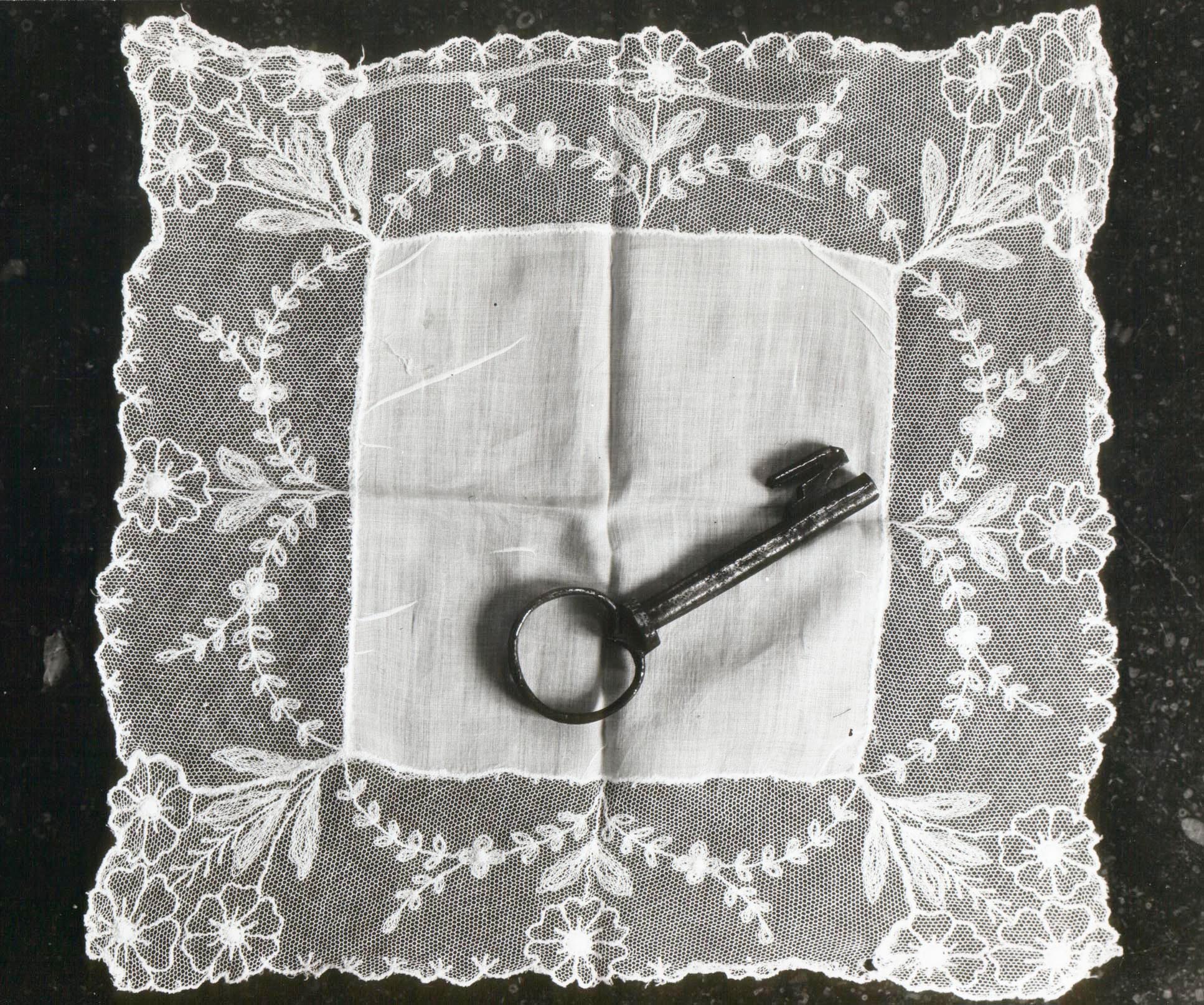
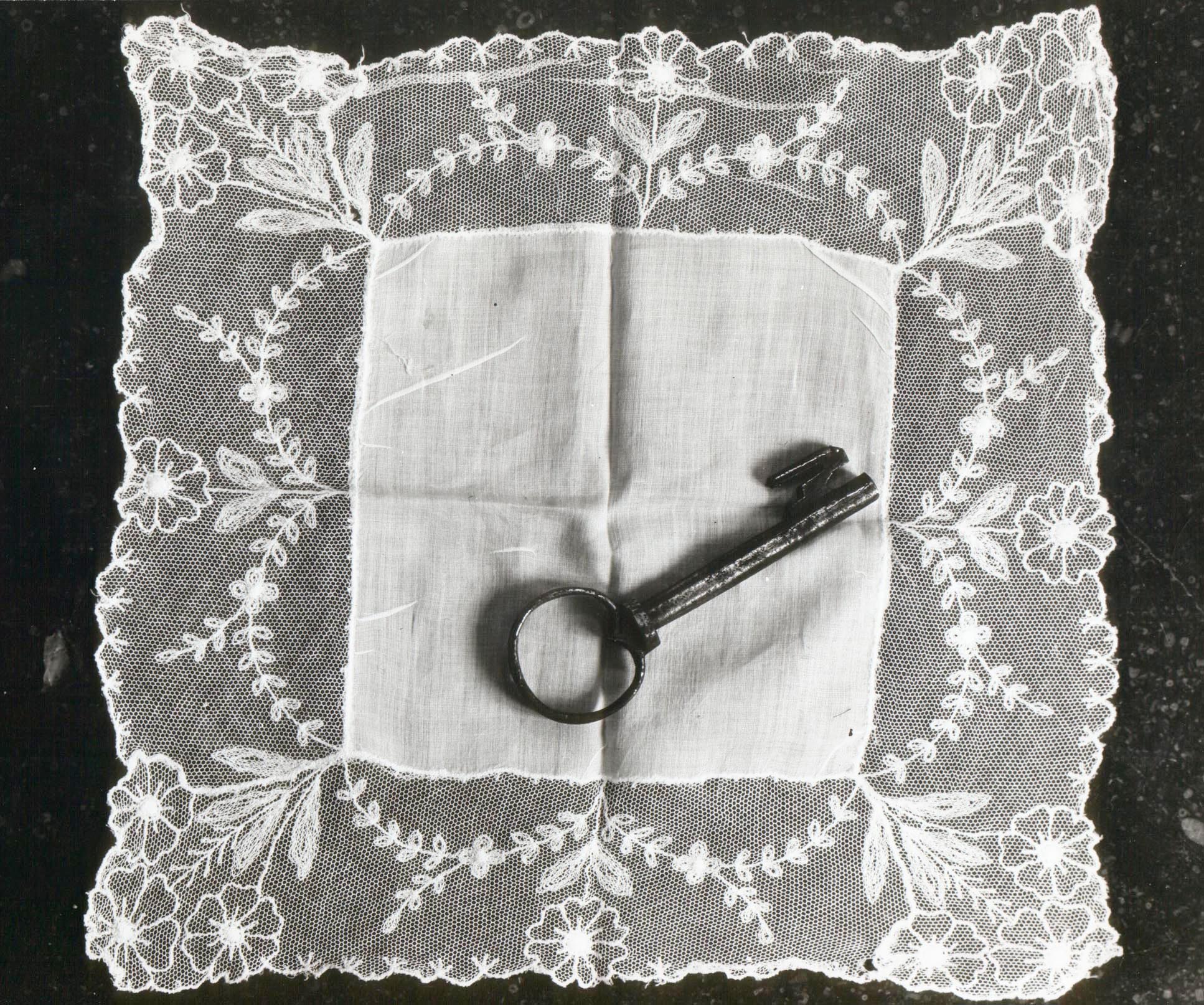
It happens to all keys, eventually, they become redundant. Whatever was safeguarded or secreted behind a lock has lost its significance, or its mystery.
I took the above photo in my early twenties … but my fascination with keys started in childhood, with fairy tales. Recently a friend on FB re-discovered ‘Woman who Run with the Wolves,’ by Clarissa Pinkola Estes.. Like Deborah, and her friends, drawn to the inner journey, I was enchanted by the book when it was first published in 1992.
I took the tattered edition from my shelf and added it to my bedside reads. The first theme I dipped into was the psychology of Bluebeard, a tale which Clarissa uses to explores the archetypal innate predator in women’s psyche, which, while bullying us into silence, also holds the key to a woman’s deep instincts and creativity. Re-reading this chapter, I had a powerful dream that showed me that the forbidding and controlling voice still lurked in me and has presently dampened my spirit, even though I naively and bravely turned many keys in my life, revealing both, threatening spells of my inner predator I managed to transform into vital energy, as well as treasures that inspired many creative adventures.
Yet of late, at this advanced stage in my life, I feel listless and stuck with the MS of the third novel in my Course of Mirrors trilogy, Mesa, which, incidentally, is set in a realm where time has slowed down and the protagonist must re-introduce conflict to empower life. In the face of this challenge, it seems that all my keys are of no use. Mystery does not call. My vital curiosity, even my desire for a meaning, dissipated, with no lock in sight. The wild spirit in me lingers in a safe garden, full of robins and butterflies. How dare I to disturb paradise by instigating conflict? Any thoughts are welcome, well, needed. Thank you ♥
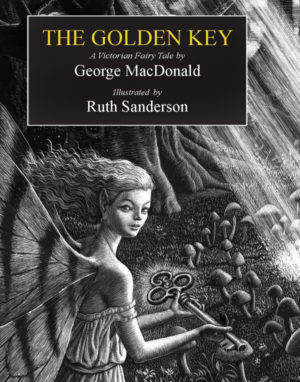
During a short exploration on google I found this lovely post by Ruth Sanderson re: George Mac Donald’s story of The Golden Key.
The image is of an enlarger, used to project, copy, or enlarge negative film images onto chemically sensitive paper, by moving the lens box up or down to achieve a variety of sizes, or to place filmstrips directly on the paper and press them down with a glass plate for contact sheets. The timed, light exposed paper is developed slowly in a chemical bath, and then fixed in another bath to stop the developing process. Next, the print is watered for a while and then dried on a hot press. Depending on the quality of the negative, it’s a delicate art to achieve the optimal gradation of light and shadow in a final print. The process happens in a darkroom with only a red light.
Much was destroyed during the Second World War, and my parents started out with nothing but their skills. My mother had trained as photographer at the Berlin Lette House (Academy,) where women were encouraged to acquire academic and industrial skills. My father, apart from being a talented artist, for whom there was no call, trained and worked as a fine mechanic. Together they moved south and started a photographic business. The enlarger in the image was built by my father during the early 1950 s.
I was not interested in the business (another story,) but eventually studied photography, and this enlarger served me through a decade of self-employment, based in Munich, including still photography for projects by directors of the then German New Wave Cinema. I could have continued working in the film scene, but instead became a hippy, a seeker, a psychotherapist, and a writer, in that order.
Five years ago I donated the enlarger to a local art college. They were very pleased. I’m still mourning.
Having been a big part of my life, I thought of posting something about my experience with analogue photography here, but was fretting because it’s a deeply emotional subject, for another day. So this post did not turn out as intended.
There are glimpses worth sharing. To explore and understand the shift from analogue to digital systems, I wrote an article about Human Identity in the Digital age: ‘Body Electric.’ You can read it as PDF, and find the link on the ‘Other’ page here. It is 20 pages plus notes and bibliography, but after all these years, I still think it is definitely worth reading.
A great book on photography and surrealism, L’Amour Fou, carries a quote by Roger Callois, which shines a light on the fading idea of an original:
‘It is with represented space that the drama becomes clear; for the living being, the organism, is no longer the origin of the coordinates, but is one point among others;; it is dispossessed of its privilege and, in the strongest sense of the term, no longer knows where to put itself.’
The analogue process provided rich metaphors to live by, while the oracular quality of the digital system has fragmented many assumptions and values we hold about human nature and reality. Thing is, I don’t think we have caught up yet. We are all a bit lost in space and time – which has become a theme of my two novels, (see my Books page.)
Yesterday I had a surreal dream, all about us, and others, being developed (in our mind) through our ongoing experience. In the process, it can happen that we, and others, become fixed into static existence through our attitude, and our need for permanence and certainty.
Being born, we bring along a smile, which, when being mirrored over time, becomes the signature of our face. Not the cheery or cheesy smile, but the unique one, always remembered by those who know us well. Why? Because something is loosened up in the face … a happy heartbeat sneaks into an authentic smile and, if only for a fleeting instant, a glimpse of heaven is revealed. Mostly, the magic lies in the spontaneity of the smile, and its short duration.
Actors in movies convey touching smiles, at times. Meryl Streep comes to mind. In a photograph or painting this can happen, though less often. There are of course many exceptions, the most famous being Leonardo da Vinci’s enigmatic portrait of Mona Lisa. Her smile seems slowed down in time and keeps resonating with one’s own internal smile … and both linger on. Apart from Da Vinci’s excellent study and understanding of anatomy, and his accomplished painting techniques, the reason why Mona Lisa’s mysterious smile seems eternally fresh, may also have been due to the deep rapport between model and painter. And, interestingly, Sigmund Freud theorized that Leonardo imparted an approving smile from his mother, Caterina, onto the Mona Lisa and other works.
Each smile tells a story, open to interpretation – the smile of intimacy, friendship, reconciliation, condolence, seduction, pity, revenge, conspiracy, the haughty ‘I told you so,’ or simply bliss. It is a long list.
Can one’s authentic smile fade? Can trauma, sadness, or despair about humanity impact the signature of one’s face? Maybe, though I think even if you’re disillusioned with life, lose your teeth, or have ill-fitting dentures that change the physiognomy of your jaw and cheeks, the essence of your smile remains somehow. Maybe in the eyes, or sometimes, irrespective of a facial expression, a person radiates a peaceful atmosphere, a loving presence, which Hazrat Inayat Khan called ‘the smiling forehead.’







 Course of Mirrors