Tag Archives: philosophy

… Kaif System – that sense of uplift … 

Mystical texts and phrases can annoy the rational mind, since they hardly ever get to the point or, indeed, contradict themselves. Still, at rare, often fleeting moments, sometimes in nature, a vein of light can reveal a profound truth, even in an overused mystical quote. Or, if one finds the occasional balance between the outer and inner reality, a sudden awe may unfold in consciousness and surprise.

‘Some’ scientifically minded folks, fewer these days, tend to scoff at mysticism with its vague hints and speculations as a waste of time, or look down on the fools of this world who suffer from subjective illusions. And yet, the novel feelings emerging from direct numinous experiences greatly expand the consciousness of ‘The One.’ I guess firmly set rational minds shy away from numinous personal experiences that might rattle their worldview.

The latter may shake their heads at some baffling mystical musings. I re-found this write-up on the Kaif System among many papers heaped up in corners of my home. It was shared by Morag Murray, born in Scotland, who lived and travelled in Central Asia, Tibet, India and the Far East. Her autobiography, ‘My Khyber Marriage,’ 1934, features her marriage to an Afghan chieftain. She is also known as Saira Elizabeth Luiza Shah, mother of Idries Shah.

So here goes … The Kaif System

Kaif is the effect a person, idea, event, object, etc., has upon one. But it is distinct from aesthetic pleasure or any familiarly labelled experience.

When an experience which was trivial or routine gives one a sense of uplift – this may be Kaif. Repeated experiences yielding pleasure or attractive sensations do not have Kaif.

Eating, drinking, dancing, meeting people, visiting, travel, reading, seeing, feeling, hearing, thinking – may have Kaif.

The term for something which has Kaif is Kaifdar – ‘Kaif holding.’

A person who can provoke the sensation of Kaif in an individual or a number of people is called a Kaiyyad (Rhymes with ‘I laugh.’) The instructor in Kaif is called the Sahib el-Kaif (Kaifmaster.) Also used is the term Kaifiat – which means something like ‘Howness.’

The Kaifmaster Barik Ali said: ‘Kaif is the determining ingredient in an enjoyment. If it is not there, true enjoyment is not there. If it is not there, people may divert themselves with happiness – this is not Kaifiat.

The Kaifmaster Ankabut said: ‘Kaif is imparted into a thing. It may be imparted by anyone or anything. When it leaves only the shell is left. People eat shells when they cannot get nuts.’

The Kaifshinas is the Kaif-knower. He can appreciate Kaif (Rhymes with Life.) He may not be able to induce it. His house may be untidy. But it will be full of Kaif.

Kaifju means a Seeker of Kaif. He starts by seeing other people appreciate Kaif, and tries to find it wherever it manifests itself.

Kaif is used either as an indulgence on its own, or in order to provoke higher consciousness, known as ‘the secrets’ (Asrar.)

Kaif may be found in any community, at any time, under any circumstances. It is not bound by language, history, geography.

Certain professions are held to be Kaifdar. They include those of chief of state, builder, artizan, poet and designers of all kinds. Few professions are bereft of Kaif. Certain places are more difficult for Kaifshinasi.

The very term Kaif has become cheapened, so that people use it to mean ‘This is something I like’, or ‘I enjoy that,’ or ‘He has presence,’ or ‘This is satisfying, attractive, stimulating.’ You must be aware of yourself using this term, and also of those who use it, so that the coin may not be debased.

Kaif is defeated very easily. It is defeated in its attempted manifestations by false ideas, by self-esteem, by hypocrisy of any kind

There is a danger in Kaif. People who perceive it and do not respect or honour those who have Kaif, or respect Kaifdar situations, places, and so on, become ‘inverted to themselves.’ This is a state in which a person’s bad characteristics become stronger, and where his self-control becomes less, and where his hidden unpleasantnesses undermine his very being.

Kaif is in shape and in form, as well as in shapelessness and formlessness. It lies dormant in places and among people where it is not perceived for a long time. Then only the introduction of a conscious Kaifshinas will activate it again in that community so that it may take its place to help mankind.

Kaif is not confined to humanity, but can be perceived by all living organisms.

Something which is aesthetically adequate or emotionally stimulating can at the same time be devoid of Kaif.

Certain exercises, which vary in accordance with the person, place and the general situation of his community, enhance Kaifshinasi.

Kaifmasters subject their students to experiences, related incidents, objects and other matter which have Kaif, or can provoke it.

Kaif has a ‘moment,’ called the Dumm-i-Kaif  (Breathspan of Kaif) during which it may be, as it were, ‘inhaled’. The Kaifshinas strengthens and makes permanent his perception of it by exercises which apply to this moment.

In religious, musical and even social ceremonials, a Kaifdar is present. One of his activities is to ‘infuse’ Kaif into the proceedings at a time when uninformed onlookers might assume that the people are doing nothing, or else are engaged in an activity (such as a recitation) which is only the vehicle for the application of the Kaif.

Special Kaif-chambers exist, in which an individual with the correct preparation may concentrate and accumulate Kaif, and study it in its manifestations.

In degenerated usage, such Kaif-chambers continue to be used, sometimes as devotional buildings. More often they are thought to be tombs fallen into ruin because there was no apparent use for them, or seem to have other applications, such as kitchens or bath-houses.

There is a well-known watchword: Innna el-Kaif, hadha el Kaif (Assuredly the Kaif is a Sword.) Hence the word SWORD is often used as password and even as a synonym of the working of Kaif.

Objects charged with a certain portion of Kaif are given, lent and carried by many people who know. These, like Kaif-chambers, are generally disguised as something functional, or else are ordinary objects which have been endowed with Kaif. The vulgar often confuse them with talismans or charms.

The saying: ‘Kaif-alaik!’ is a sort of blessing. It means: ‘May you have Kaif.’

In Turkey the Kaif-Agha was the individual entrusted with the royal Kaif. He was a Kaifdar, and generally assigned a court function as well.

Because its smokers have appropriated the term Kaif to describe (inaccurately) their sensations, Hashish has become known as Keef, a mispronunciation of Kaif. There is no real connexion, of course.   

   *   *   *

I tend to encapsulate instances of Kaif in photography or haiku.

You may have another term for Kaif, and ways to share inspiring experiences.

In any case …  May you have Kaif my friends …
1 Comment

Filed under Blog

… psychogenic secrets …

You and I have secrets so well hidden in dark corners of our psyche; the only chance of discovery is us bumping into them through some synchronistic event. Angels may be involved. Secrets keep us under a spell, just like we get needy for the absent puzzle pieces that prevent a scene from completion, which nags on our sense of cohesion. Depending on the temperament of any given day this can result in restlessness, procrastination, or apathy. The pieces exist, we know that much. But in our lives the missing pieces represent holes, patches of nothingness that beg to be filled. And some will never be filled, unless imagination enters like a grace, and offers fresh possibilities.

Beneath this yearning for cohesion chimes a faint drone. From that drone a vague theme, image or a melody we can’t place may arrive from nowhere, persisting in teasing us.

I sum this sensation up as ‘waiting.’ Waiting for the fog to clear, waiting for a connection, a response to a question, waiting for a birth, waiting for a death, waiting for the heart’s eye to light up, waiting for inspiration, waiting for a door to open, a hint … like in Samuel Beckett’s absurd play, ‘Waiting for Godot,’ where the passive Estragon and the impatient Vladimir are adrift in their minds, hoping for a meaningful sign. Some early viewers angrily left the theater. Maybe it annoyed them that the play exposes the absurd inner dialogues everyone experiences at times. Critics have voiced fascinating interpretations. For me, the philosophical variance between Aristotle and Plato comes to mind.

Years ago, my dear Sufi friend/teacher, Fazal Inayat-Khan, introduced the term ‘psychogenic secret’ during a workshop he instigated. The term could be understood as the distorted or buried memory of an incident that compels our behaviour in ways we cannot fathom. Consequently, shadowy aspects of our personality may appear in relationships, when others see us in ways we cannot comprehend. Consistency upholds our mental habits until their significance wears down. But once we discover and acknowledge a twist in our interpretation of relational events, a thread will untangle and jingle the famed ‘aha moment.’

It is tricky to share a personal experience, though an example of twisted psychology is in order here. Far back, at primary school, a triangle of girls was jealous of me for having as friend and neighbour the favourite boy in our class. He had train sets and lots of Enid Blyton books. They alleged I had been stealing stuff from their and other pupils’ desks. Their concerted accusation required me to empty my schoolbag in front of the head teacher and the whole class. The crafty girls had planted a fancy pencil, a sharpener, a metal ruler and a pop-star image between my notebooks. The items were quickly claimed by their owners. Disputing the abhorrent deed was hopeless. I felt deeply humiliated. And my parents were unable to refute the evidence. The insult sunk deep and festered.

Much later, during student years, I casually stole a chunk of butter from a shop to round up a meal for friends. Observing my lack of conscience, and the ease, even pleasure, with which I stole the butter mortified and shamed me. It took a while to process my turmoil until I drew the connection which stopped me in my track towards becoming a bank robber with supernatural powers … I realised it was my irrational comeuppance, a kind of revenge for being once wrongly blamed and shamed.

My example might spark your imagination. Intricacies as to how psychogenic secrets can operate, be they based on humiliation, small or big traumas and betrayals, frequently appear in fairy tales, stories, novels, including mine, notably in the forthcoming sequel to Course of Mirrors, ‘Shapers,’ to be released in spring.

I’ve learned to tolerate psychogenic secrets I’m ignorant of, the holes in my life, by allowing my dreamer to use the empty patches as frames for stories that humour the unknown.      


4 Comments

Filed under Blog

… speed – falling upwards into spatial & temporal bewilderment …

Always keen to bridge and connect seemingly unrelated intellectual territories, I tend to dip into essays of poet-philosophers and cultural theorists stacked near my bed.
Paul Virilio’s ‘Open Sky’ is a recent addition, translated by Julie Rose in 1997. Not an easy read, but the analysis of the social destruction wrought by modern technologies of communication and surveillance drew me in. The last chapter, Escape Velocity, relates a striking experience by Buzz Aldrin during the Apollo 11 mission. I share it here, within a short excerpt from the chapter, curious to discover what my readers make of it:

… Inflated to fill the dimensions of the world’s space, the time of the present world flashes us a glimpse on our screens of another regime of temporality … Outrageously puffed up by all the commotion of our communication technology, the perpetual present suddenly serves to illuminate duration. Reproducing the alternation between night and the solar day that once organised our ephemerides, the endless day of the reception of events produces an instantaneous lighting of reality that leaves the customary importance of the successive nature of facts in the shade; factual sequences little by little lose their mnemonic value …

… In his memoirs of the first moon landing, Buzz Aldrin in his own way confirms this disqualification of sunlight. Listen to what he has to say from the surface of the night star:

‘The light is also weird. Since there’s no atmosphere, the phenomenon of refraction disappears, so much so that you go directly from total shadow into sunlight, without any transition. When I hold my hand out to stick it in the light, you’d think I was crossing the barrier to another dimension.’
It is as though, for the astronaut, shadow and light were two new dimensions, inasmuch as any kind of transition no longer exists for him. The loss of the phenomena of atmospheric refraction produces a different perception of reality …

Virilio draws a comparison to a similar loss for earthlings … the different degree of illumination which, before the invention of electricity, still marked the hours of the day or the days of the year has become of diminished importance. Under the indirect light from screens and other control centres of the transmission of events, the time of chronological succession evaporates, paving the way for the instantaneous exposure time as harsh as that floodlighting of which Aldrin tells us:

‘On the moon, the sun shines on us like a gigantic spotlight.

All three astronauts of the Apollo 11 mission had problems after their return to earth. Spatial and temporal disorientation are not easily reconciled with one’s reality identification. Virilio writes … as for Aldrin, after two nervous breakdowns, several detoxification treatments for alcohol abuse and a divorce, he was to wind up in a psychiatric ward.

Struck by Aldrin’s experience, I thought about the increased screen time, especially now so many of us engage in since the corona virus changed our rhythm of interaction with nature, local environments, family, friends, and the wider world.

I first pondered the cultural implications of the digital advent during  a mid-1990s film degree as a mature student. For those interested – my post from 2018 gives a flavour of my dissertation – click here for ‘Body Electric- – it’s worth a visit.

John Wheeler came up with the idea of the universe as self-observing system (being.) Light travels at 186 000 miles per second. When we look into deep space we are seeing galaxies over ten billion years old. In that sense everything we see is in a past, which our observing consciousness creates. So I ask myself what realities do we envision during this surreal corona time, individually and collectively?

Is Paul Virilio’s bleak vision justified? Is the hyper centre of present time becoming the sole reference axis of worldwide activity? Is the individual of the scientific age, with diminished positional reference, losing the capacity to experience him/herself at the centre of energy?

Click here for an article from the Frieze magazine.

And if you’re brave, read this fascinating & sobering interview of Paul Virilio by Caroline Dumoucel.

Or – can we create enough pockets of stillness to counter the acceleration of the fall upwards, of progress propaganda, and instead re-connect to body, earth and roots?

P. S. All links in the post open a new window.

13 Comments

Filed under Blog

… outer and inner horizons …

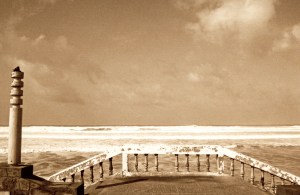
Atlantic coast, Morocco

Whatever dream is dreaming through me brings stimulation, challenge, insight, learning, or, during dark times, unlearning. The latter, with its accompanying disillusionment, has tested me for a while now. I’m not alone. The whole planet seems to be going through a dark moon phase.

I like to think beyond every effort, every hill and every sea are new horizons, outer or inner, where adventure beckons, treasures might be found.

But I tend to forget that the most relevant information is gifted by the body, and the planet. It is unsettling to accept the physical signs and their metaphors, because nature’s truth is scary. It holds a mirror of knowledge surrendered over time, with glimmers that engaged the human imagination and has given us the tools of science. As living organism and self-correcting system, nature deserves deep gratitude and respect.

The mind (psyche,) a finer and faster kind of matter, with the ability to emulate nature, plants and re-plant itself in any field of interest … outraces wisdom, seeks drama, familiar patterns, fertilises, grows, invents, designs, builds ideal dwellings, ideal systems, ideal worlds … be they citadels of power suppressing the underdog, utopias of love and liberty, or creative realms, where artists embrace and make the ordinary luminous and sacred. The mind loves myth-making, explores symbols, plays with forms and random connections, re-interprets reality and generate new meaning.

Continuously rejuvenated, mind pursues all imaginable universes across time, seeking eternity, since, even if unawares, it envisions the wholeness of its original home, where it will never be lost, but forever be enfolded by unlimited potential.

Yet when it comes to the daily business on this planet, the mind fares best when listening to the body, the living matter, the feminine principle (irrespective of gender,) and appreciates its cosmic interconnections, since all secrets arise from nature’s dark chambers. A severance from these intricate physical and mythical roots of our being can result in a devastating sense of futility, where the question, ‘What’s the point?’ brings up no action worth considering, no ideal worth following. Somber and futile looms a future that wants to fix waves into particles.

The thought brought on a Haiku last week …
 

if I were this calm

river without internal

discord – I would miss

how the waves urge particles

in random beauty

While unsettling at times, I must attend and listen to my body – learn and unlearn, flow with change, light and darkness, of dust, the chorus of wind and birds.


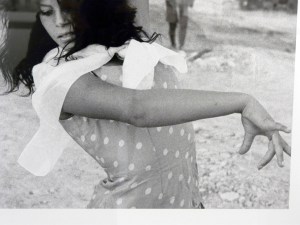
From an exhibition in Amsterdam, Dec 2014

And, hopefully, I’ll catch ever now and then a spark of Duende,’  the poetic escape. Goethe called it the spirit of the earth – a mysterious force that everyone feels and no philosophy has explained.

Follow the ‘Duende’ link above for Lorca’s talk.

Below, a related post from 2017 – Both links open new pages without losing the page of this post.

… letting go of letting go …


6 Comments

Filed under Blog