Tag Archives: inspiration

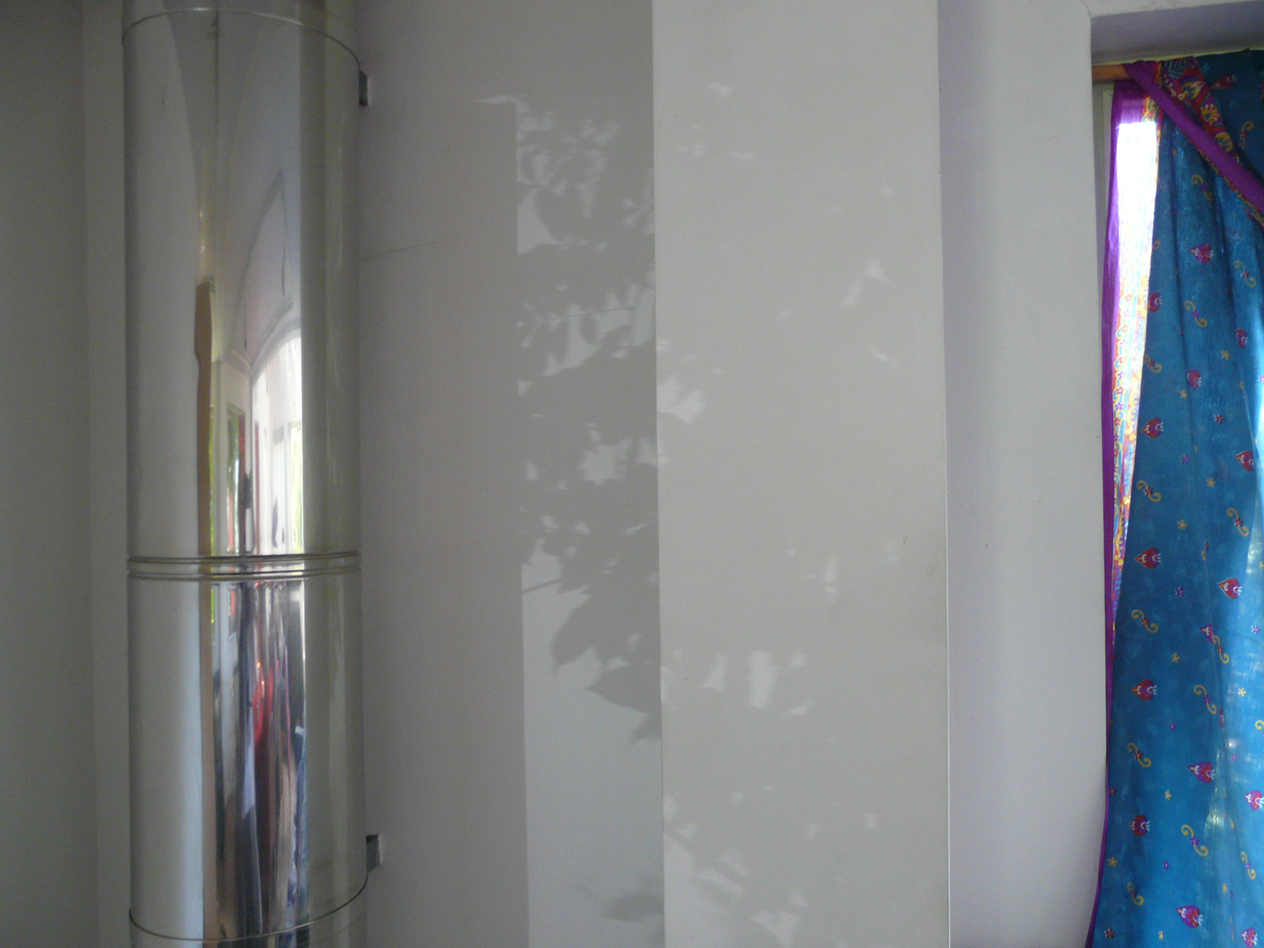
… dappled light – a vital joy …

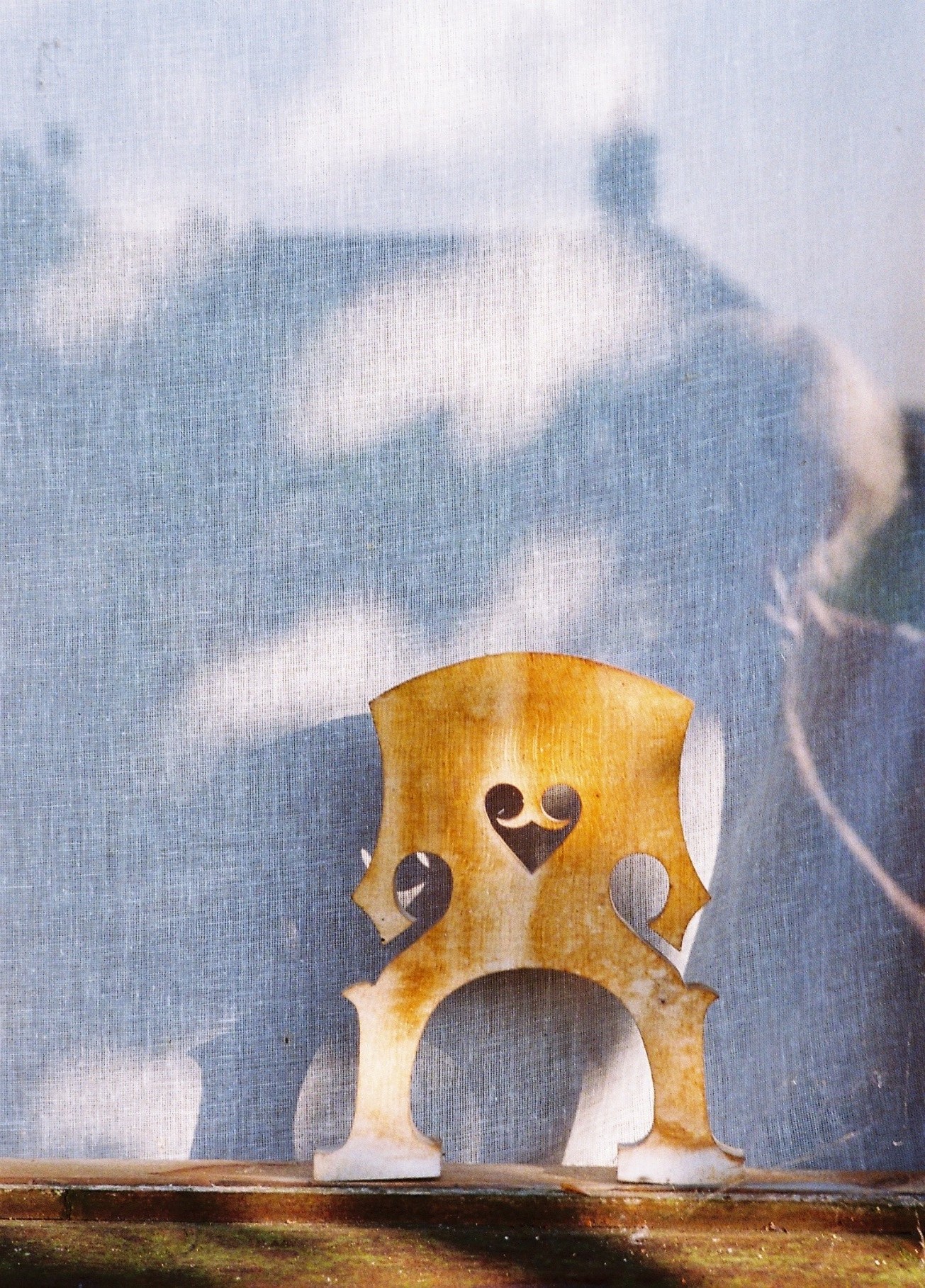
Cello bridge two orbs surge and ebb

as gold-white-silver-and-blue

flicker through the mesh

of vapour and dust

and amid clouds and branches

needle shadow lace

through myths and hollows

in dappled light on solids

… visible pointers

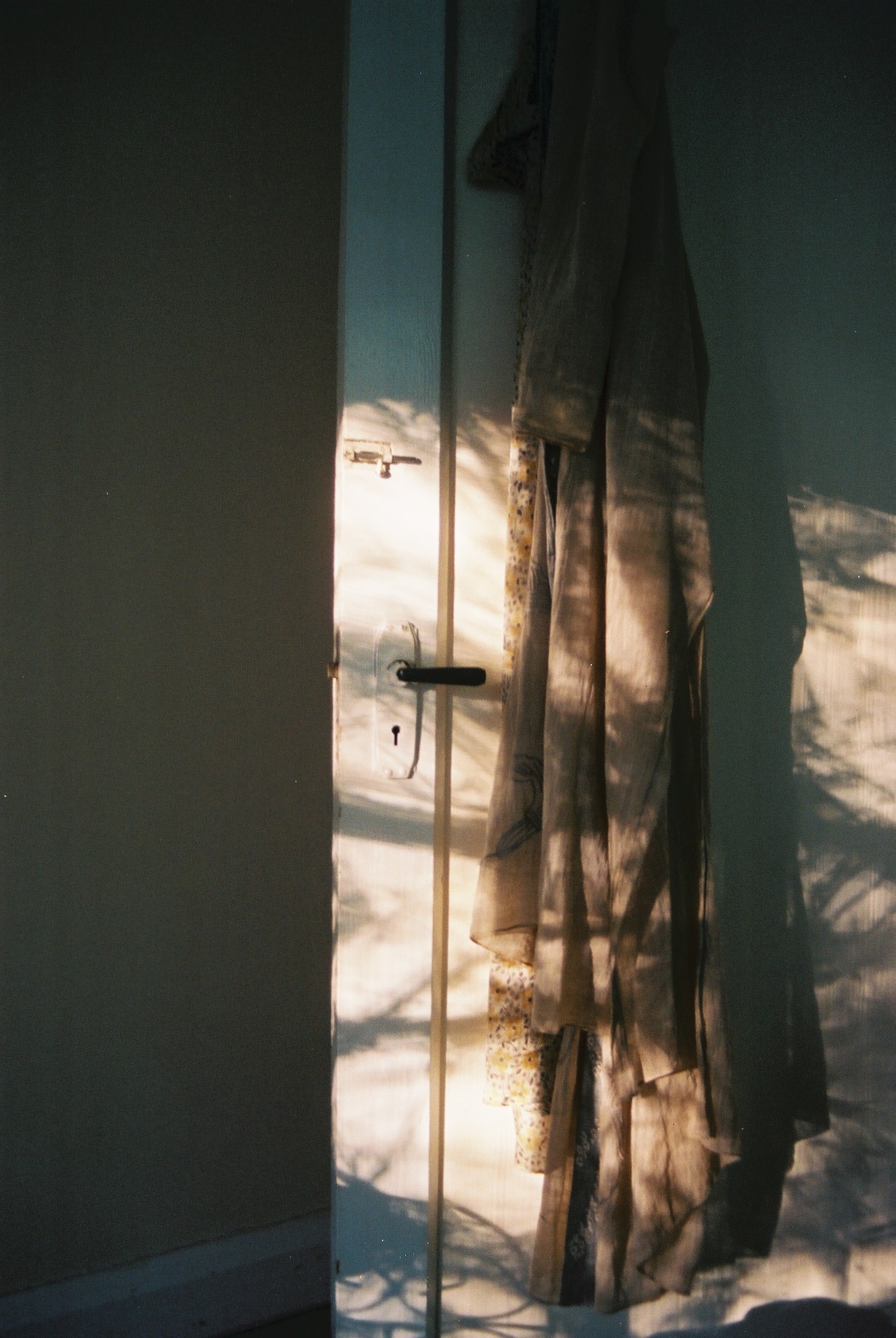
Shadow on door - Copyto deep-breathing space

within – the fulcrum from whence

unfolds everything

*    *    *

P1100852 - low

I found a poem by Gerard Manley Hopkins (1844-89) – ‘Pied Beauty’ – more musical and sophisticated than my Haiku attempt,and with sincerity of devotion I can’t muster. Enjoy …

Glory be to God for dappled things–
For skies of couple-colour as a brinded cow;
For rose-moles all in stipple upon trout that swim;
Fresh-firecoal chestnut-falls; finches’ wings;
Landscape plotted and pieced–fold, fallow, and plough;
And all trades, their gear and tackle and trim.

All things counter, original, spare, strange;
Whatever is fickle, freckled (who knows how?)
With swift, slow; sweet, sour; adazzle, dim;
He fathers-forth whose beauty is past change:
Praise Him.

*    *    *

My thoughts on dappled light are a spin-off from an exchange of comments with my on-line friend Joe Linker who asked:   ‘Framing – How much light to reveal? Shuttering – How much darkness to avoid?’

Imacon Color Scanner

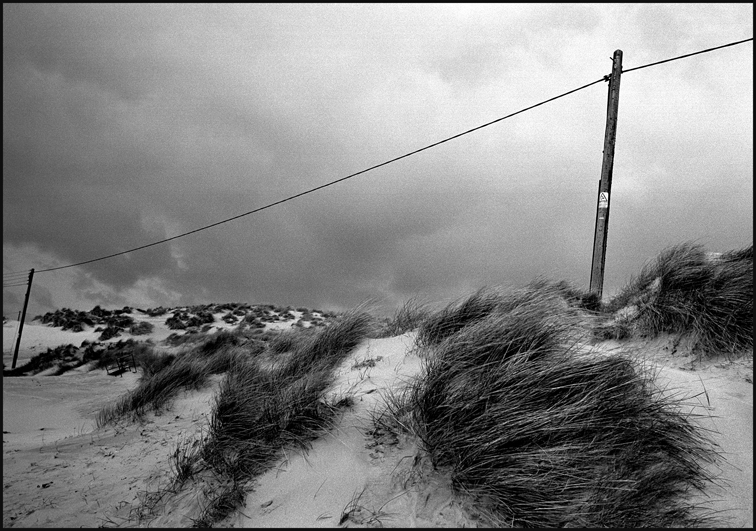
Here a scene from a stormy day in Rye with optimal exposure.

Analogue photography provides brilliant metaphors. No matter how interesting the chosen frame, shutter speed is vital. Too much light will turn the negative dense and dark, bringing bleached-out definitions to the positive print. Too little light produces a thin, transparent negative, resulting in a hard or soggy positive where subtleties of tone are lost. The amount of light is regulated by shutter speed.

In writing this is equivalent to the balance of rhythm, sound and shape of words drawing you into the frame.       I’ll keep practising :)

20 Comments

Filed under Blog

… physical books I loved to bits…

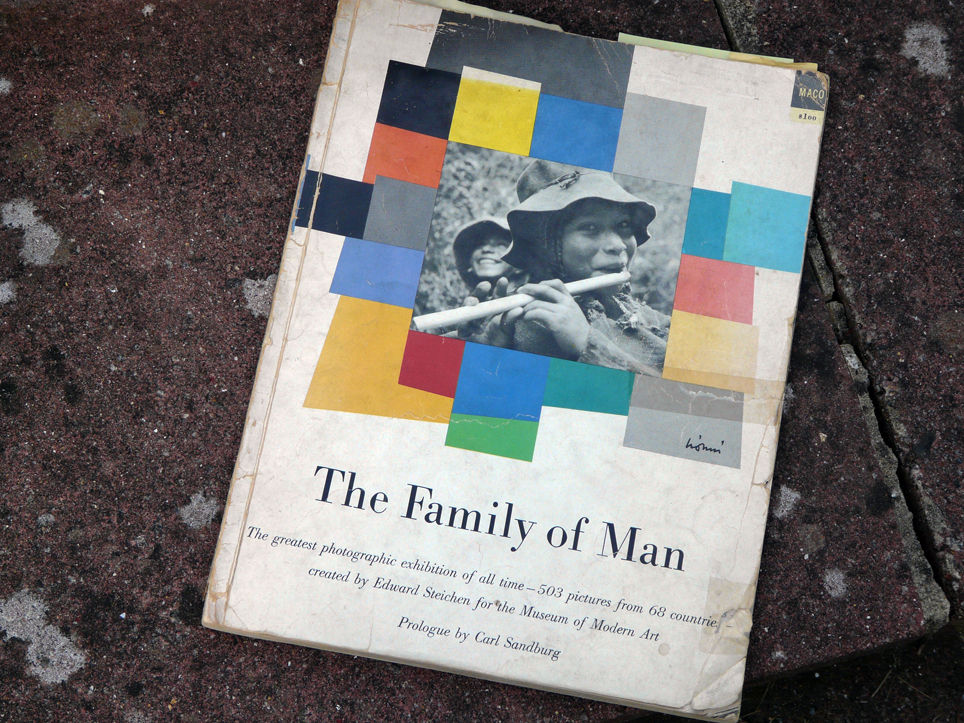
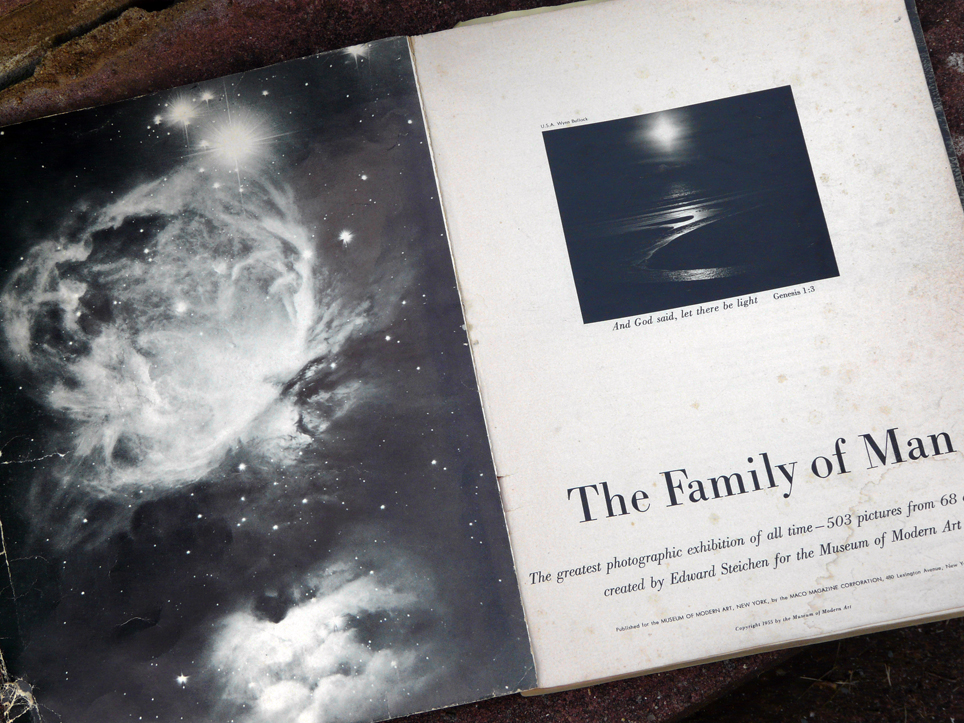
Aged eighteen, while staying with a family friend in London, I came upon the catalogue of the greatest photographic exhibition of all time – The Family of Man – a mirror to the essential oneness of mankind throughout the world.

The exhibition was assembled by Edward Steichen for the Museum of Modern Art and contained photographs from sixty-eight nations …

P1060180 smaller


There is only one man in the world

and his name is All man

There is only one woman in the world

and her name is All Woman

There is only one child in the world

and the child’s name is All Children


The inspiring collection of images decided my first career as a photographer.

P1060181 smaller

Ironic, given that my parents’ photographic business had held no interest for me. I realised my search was for what shone through reality, the essence in people and situation. I was inspired by poetry, story, light and shadow, movement, point of view and framing.

Fully embracing this passion started an active and adventurous period of my life, with opportunities to travel and mingle with groups of highly eccentric and creative people.


A decade later, at New York’s Kennedy airport, after a several momentous months in Washington DC, while waiting for a flight back to Amsterdam with my husband to be, a title on a book rack screamed for my attention … well, it jumped at me like a dream tiger.

P1060064 lowres

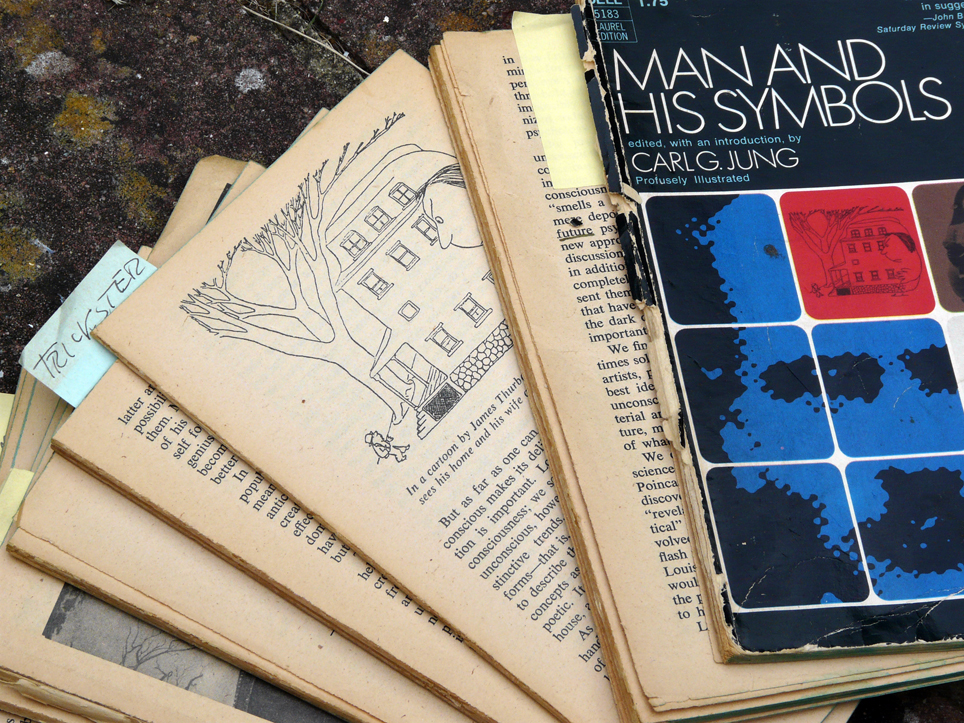
Man and his Symbols.

You couldn’t find a better window into the ideas of Carl Gustav Jung.

It was Jung’s last project, addressed to a wider public, readers who would not normally come upon the over 17 volumes of his work.

Due to its pocket size, as you can see, the yellowed pages of my copy travelled and have been well-read over the years ….

The book came about through the persistence of the remarkably diverse John Freeman: http://www.newstatesman.com/politics/politics/2013/03/john-freeman-face-face-enigma

He interviewed Jung in a Face to Face programme for TV: https:/ /www.youtube.com/watch?v=FPGMWF7kU_8

Seeing the programme, Wolfgang Foges (Aldus Books,) urged Freeman to persuade Jung to write a book for the general public. Jung firmly refused – until he had a dream. He consequently asked Freeman to act as editor and co-ordinator with the average reader in mind. So it became a collective project between Jung and four of his followers, M L von Franz, Joseph L Henderson, Aniela Jaffe and Jolande Jacoby, and was completed before Jung’s death in 1961,

In his introduction Freeman suggests the reader will find it a persuasive and profoundly absorbing journey … which, for me, was true from the start. During eight hours on the plane, with an occasional glance at my partner, the receding skyscrapers of Manhattan, and the expanse of oceans, my interest in dreams and the unconscious were powerfully validated. The book makes a convincing case for the imaginative life as the most distinctive characteristic of human beings. I totally grokked this: The unconscious is no mere repository of the past but also full of germs of future psychic situations and ideas … they grow up from the dark depths of the mind like a lotus and form a most important part of the subliminal psyche.

Two years on, having become a mother, and living for five years in rural Somerset with treasured time to study, it was C G Jung’s work that inspired me to delve into cultural and mythological research, leading on to my training in psychotherapy, and later still, to write novels.

My shelves contain many more books I loved to bits, and I wonder if digital version of these publications would have had the same lasting impact.

Frankly, I doubt it.

Only today I shared a tattered copy of Kahlil Gibran’s ‘The Prophet’ with a supervision client. She had never heard of the poet and was delighted.

Do you have books that fall apart through love and physical touch and still inspire?


17 Comments

Filed under Blog

… framing our impressions …

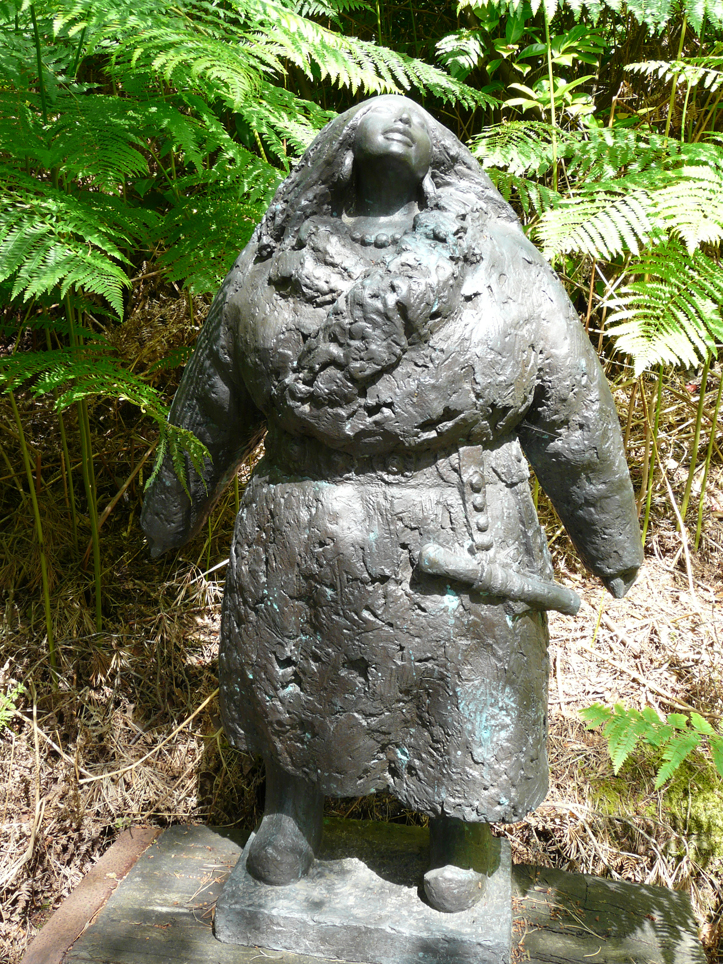
Last week a friend visited, and I took her to a local Sculpture Park set within ten acres of heath and woodland, a place where meandering pathways lead you into a deep dream-scape of rare plants, springs, streams and ponds, and where artworks face you at every turn.

The evening before, over a meal in my garden, we shared stories – about ageing and loosing people, about war-damaged fathers, about writing workshops in prisons. Our discussions often home in on the suppressed feminine in both men and women. So it’s not surprising that while we wandered through the park our two pairs of eyes were resting longer on artworks expressing aspects of the feminine, and our observations mingled.

P1060122 lowres

I thought I share a few photos of sculptures that caught our attention.

P1060123 lowres


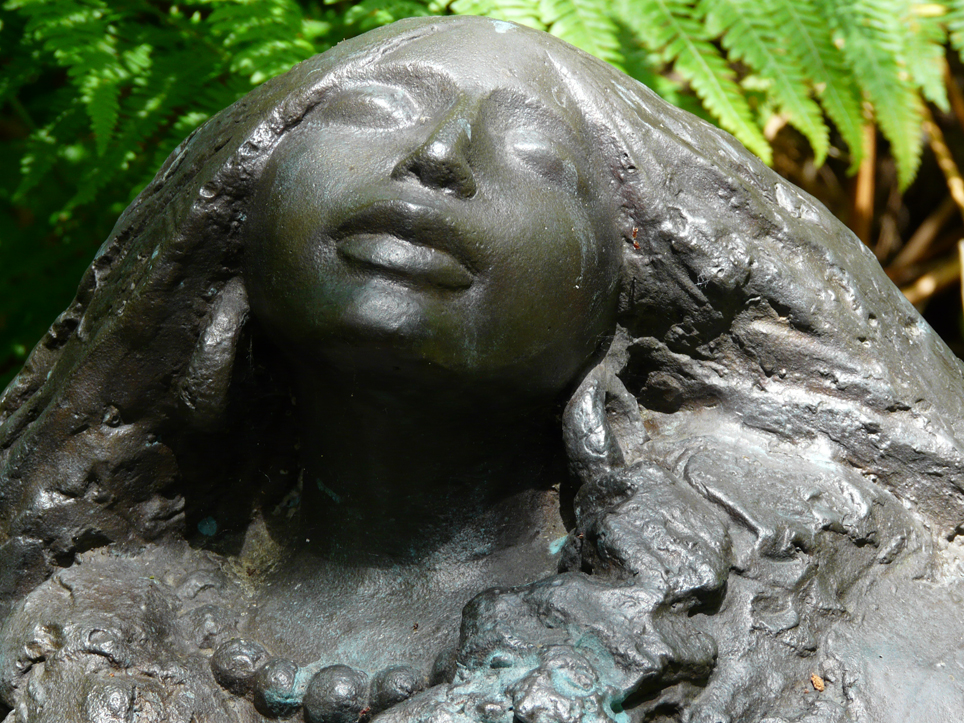
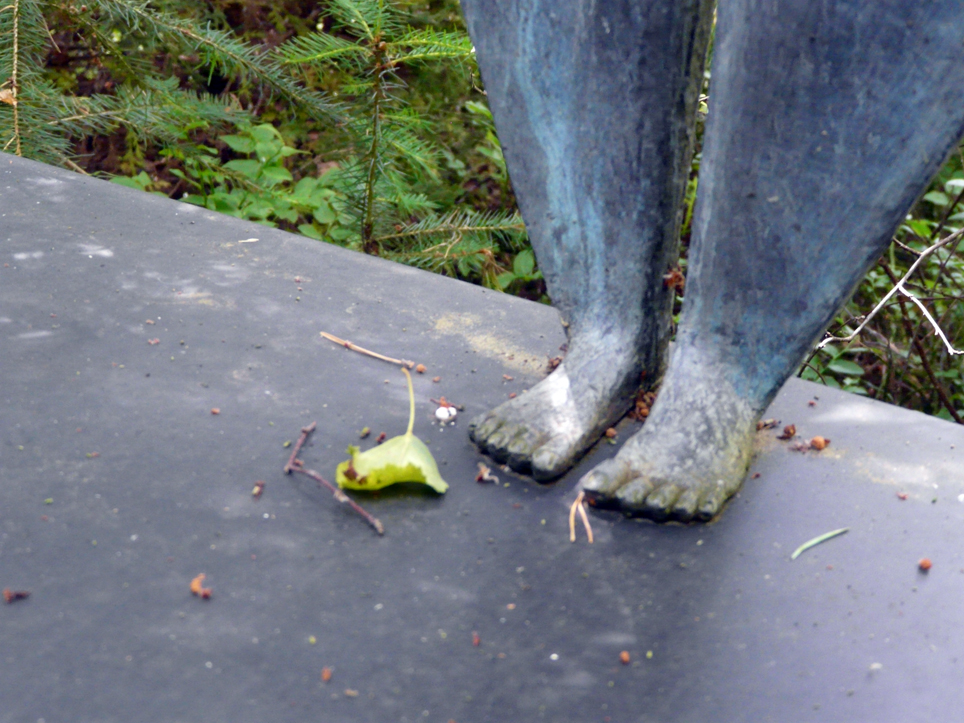
This bronze figure of an earth mother and warrior combined in one impressed. Her solid stance, yet also her surrender to something other. I took a picture and looked again, moved to touch her rough coat. There were her feet, standing firmly on the ground, a tool or weapon hanging from her belt, the little fists, speaking of determination, and there was her smooth, yielding face turned upwards in ecstasy towards a transcending spirit.

P1060116 lowres

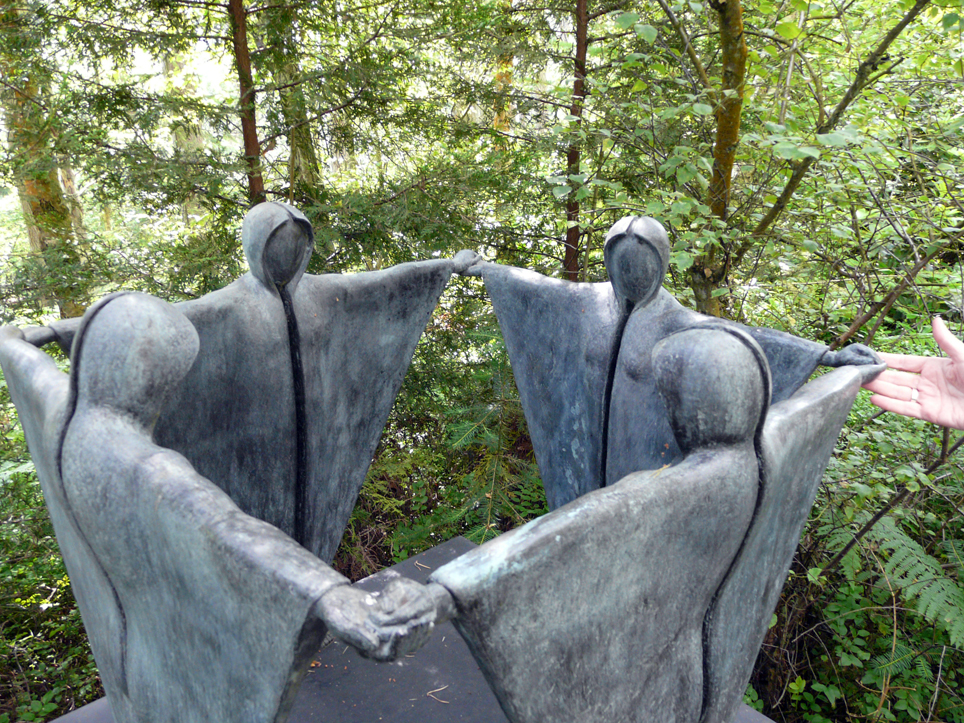
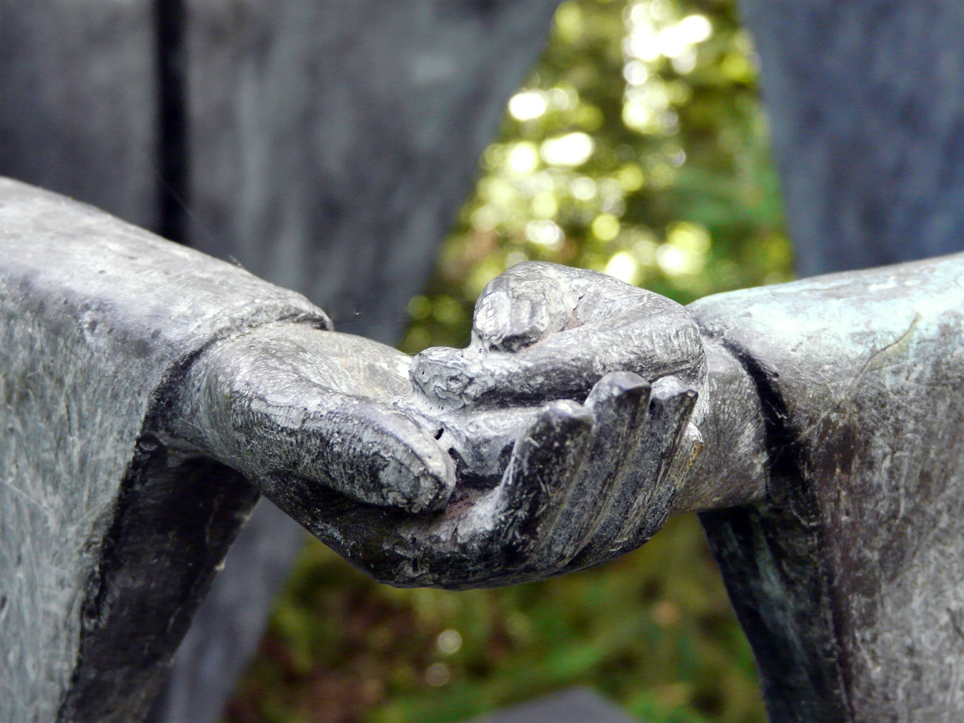
The endearing foursome forming a protective square made us linger.

My friend reached out to add her hand to the interlocking hands.

P1060117 lowresAnd we loved the little feet …

P1060118 lowres
P1060120 lowres


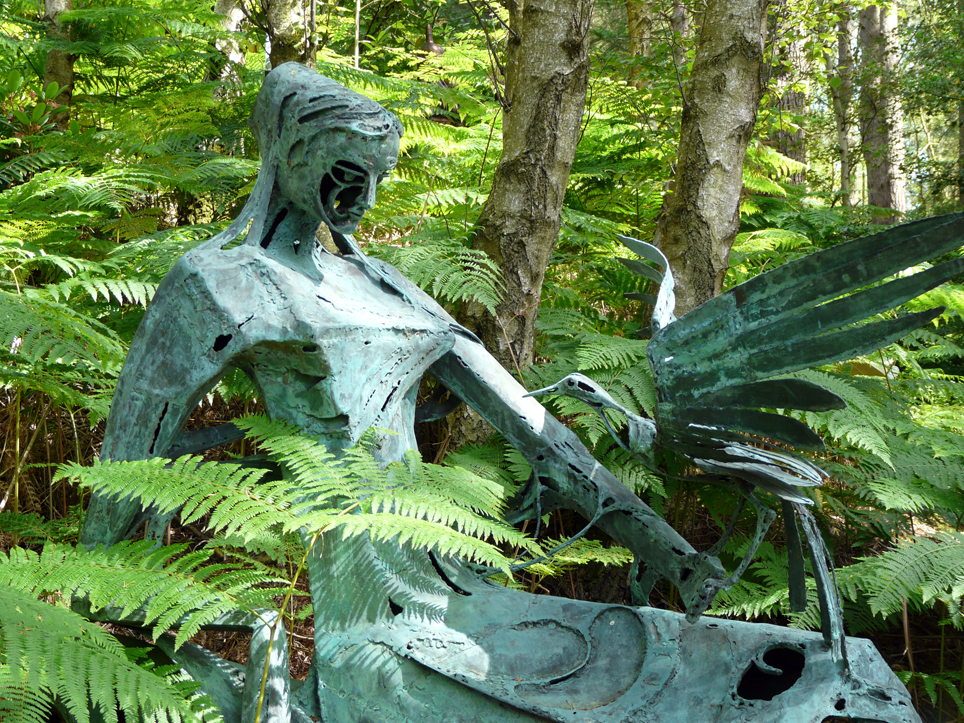
I felt a natural affinity with this bird woman, again taking a closer frame, to highlight her relationship to the bird.

It’s talons rest gently in her outstretched hand, bringing a greeting, and maybe a message.

The woman keeps a respectful space between her and the bird, a space filled with wonder, in which to savour the special meeting with her core nature.


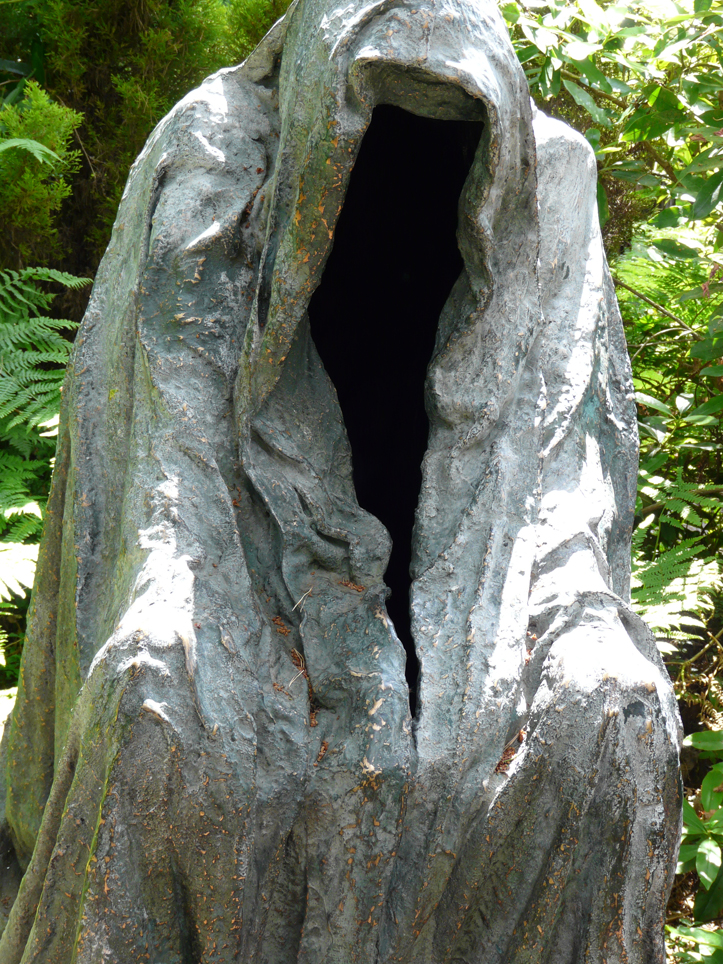
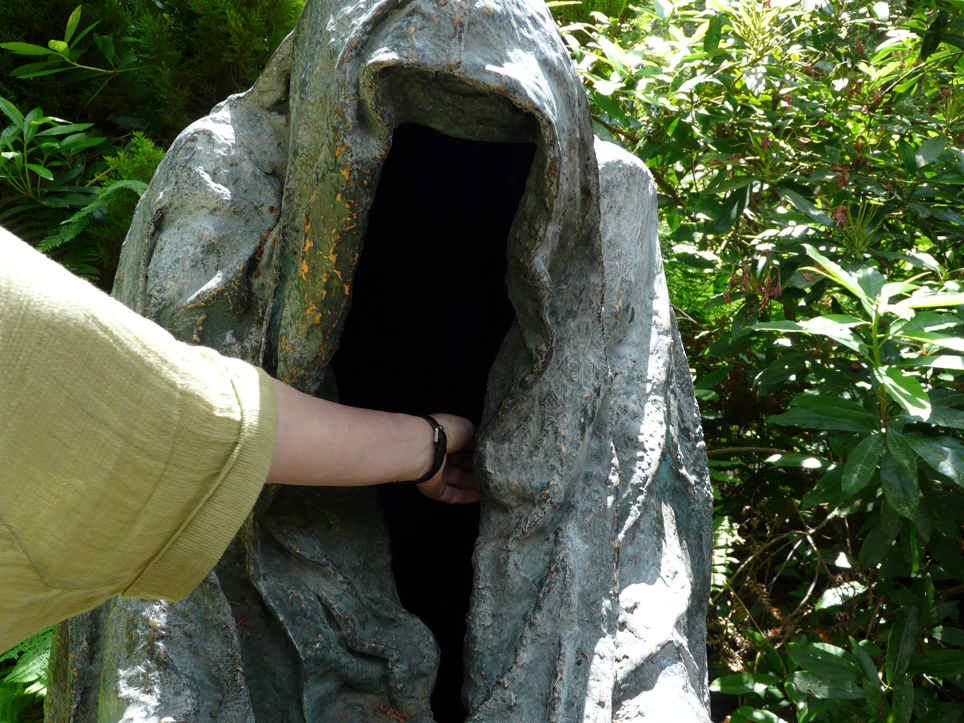
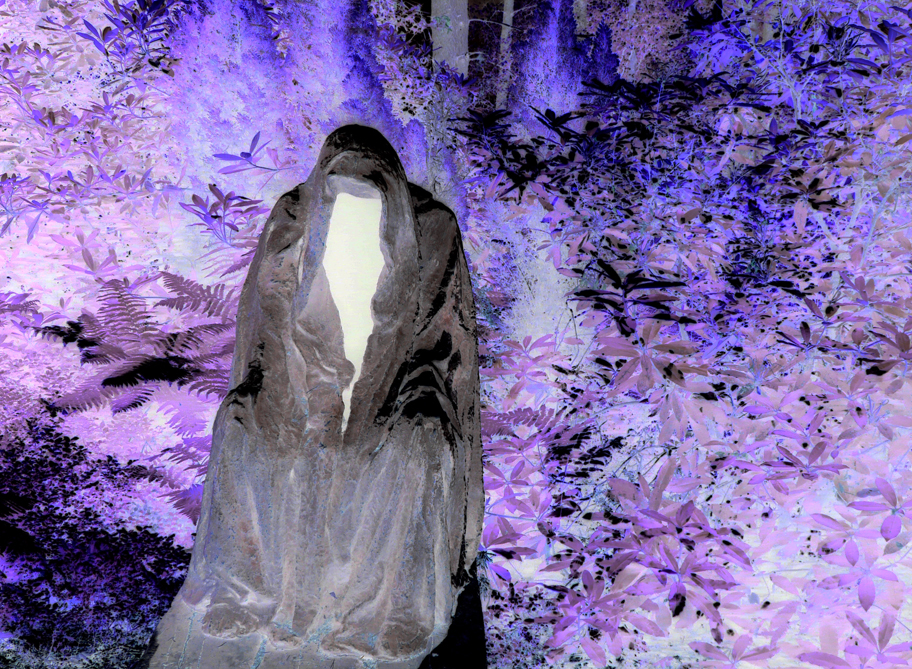
A most haunting sculpture was this shell of a person. My friend reached into the dark emptiness. I called ‘Hello’ into the hollow and the sound was swallowed up without returning an affirming resonance.

P1060112 lowresP1060111 lowres


Later, with the help of Photoshop, I turned the image into a negative, and there you have it – the essence of what we are, light, often hidden.

P1060110 inverse lowres

Day in day out we absorb a continuous hyper stream of phenomena. What makes us stop and observe more closely and choose a meaningful frame to digest our experience?

Is it an emotion, a sound, a movement, a desire to touch, an association, a memory, a pattern recognition, an inner seeing, the intuition of an essence, a context that resonates with our lives, an interesting angle, a certain light …?

For creatively inclined minds, these processes fuse and culminate in an urge to compose and share the impression of an experience by placing a frame round an image … a story.

A symbolic understanding arrives and signals once more  into the unknown, framed anew.

*    *    *

LINKS:  http://thesculpturepark.com/

https://courseofmirrors.wordpress.com/2011/10/18/sculpture-park/ post from a former visit

https://courseofmirrors.wordpress.com/2012/12/31/the-inner-silence-of-henri-cartier-bresson/  master framer

https://courseofmirrors.wordpress.com/2011/06/28/what-makes-a-photograph-arresting/ a knack for composition

https://courseofmirrors.wordpress.com/inspiration/ young people observing and being creative


15 Comments

Filed under Blog

… clouds …

Last week, during a flight to Munich, and equally this week during my return journey to London, I witnessed some spectacular cumulus scenes from above, with the moist earth being the canvas.

P1050992 SMALLER

P1050991 - SMALLER

The changing cloudscapes drifting on the wind teased my imagination. I wanted to wander into this world that words can scarce describe, be there alone with my own heartbeat, where past and future is one and present. I’m no Percy Bysshe Shelley, who gave an eloquent voice to The Cloud

… I am the daughter of Earth and Water,       P1050995 SMALLER                                                              And the nursling of the Sky …


His cloud speaks of the ‘pilot.’


… This pilot is guiding me,                                                                                                    Lured by the love of the genii that move                                                                  In the depth of the purple sea …  

Shelley’s time had no flying machines that did away with the invisible navigator. He perceived through the inner eye.

P1050990 SMALLER

P1050999 SMALLER

The first Cloud Atlas was documented in 1896.

Today’s airline pilots must know their clouds 


Like us, clouds change but keep on living. We and they are fleeting manifestations of nature – a show of impermanence ornamenting this planet. The water of oceans, lakes and rivers, the sap of life, flowing through the perspiration of plants and all living organisms, including the breath of 7 Billion people, clings and seeps into the warm earth only to be drawn up again, where its vapour compacts in cold air and spirals into fluid shapes between us and the blue dome, where all moods find expression – wild charcoal formations with dove grey wisps parading at the horizon, luminous coloured tendrils and satin sheets in slanting sunlight at dawn and dusk, or dewy porcelain veils.

P1050993 SMALLERClouds are moisture made visible. Who knows what information is inscribed and carried in droplets from one place to another? It takes about one million cloud droplets to form one raindrop.

What rises also falls. There is a wonderful Sufi story about this cycle of transformation, serving as a metaphor for identity, the form we must inevitably relinquish to change into another form while maintaining our essence … here told by Terence Stamp: The Tale of the Sands

There is ongoing research of water as an agent – receiving impressions and holding patterns of information. Water can be vitalised, for example, which explains things we know the results of but not the reason. Such findings, while presently called pseudo-science, may yet confirm many of our intuitions. Water is alive, and living things form a centre and have intelligence.

15 Comments

Filed under Blog

… the frottage of life …

Aged 14, my confidence and love for writing was shattered by a teacher. She praised a brilliant essay – mine – based on a painting of our choice. The romantic image of a Carl Spitzweg painting I picked had freed my imagination. After reading my essay out in front of the class, the teacher stated it was unlikely the pupil had written this herself and she therefore had to disqualify the work. I was pushed off a flying carpet, too speechless and humiliated to protest. My creative writing went underground. I wrote poetry, in secret.

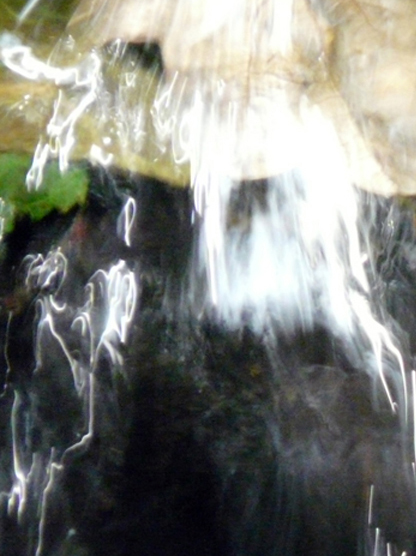
Water

Water

Images inspire me, they tell stories. Photography came to my rescue, not so much in the sense of recording concrete reality, but more in the sense of sub-creating it. Light attracted as liquid poetry that fell through shadows and sculpted fleeting life. I discovered my knack for framing the essence of a story.  And in the spaces between things I looked for something transient emanating from other spheres. There were moments in my life when finding words for these other dimensions became imperative, like, for example, when working as still photographer on a film-set at the shore of the Red Sea. In poems like ‘Riverhead’ and ‘Sleepless Sun’ I tried to encapsulate such instances: https://courseofmirrors.wordpress.com/poems/

Photography started out with a process of reversal – getting the positive print from a negative film – which is being superseded by digital bit-structured data, leading us into new metaphors for time and space. The tiny window of the laptop I’m writing this text on has become my interior sanctuary. The window of its screen frames worlds well beyond my garden – microcosms and macrocosms. My grandparents would have called this feat magic, which it is, of course. Computers have become our second brains, compilers and recorders of our imagination, easy to share.

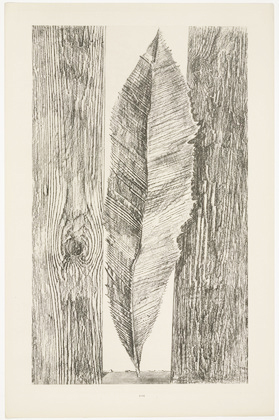
The habit of leaves, Max Ernst.

The habit of leaves, Max Ernst.

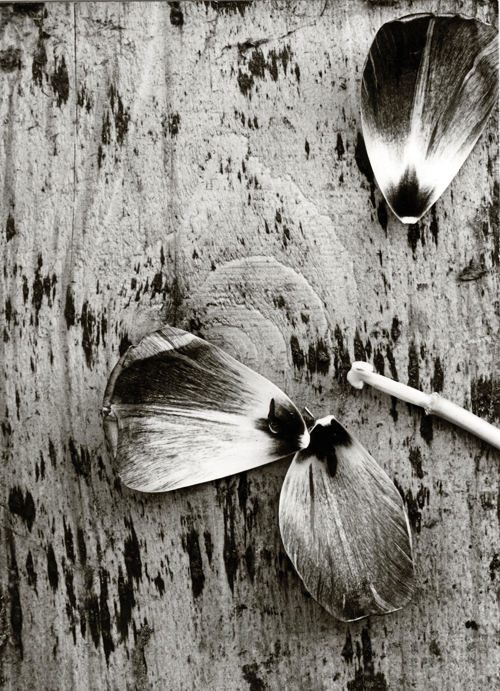
In search for the invisible hand that animates the unseen, I remember coming upon the technique of frottage by Max Ernst. He was intrigued by the reversal of textures achieved when rubbing surfaces with a soft pencil – be it weathered wooden planks, bark, textiles, netting … For Ernst the results evoked superimposed images and visionary associations.

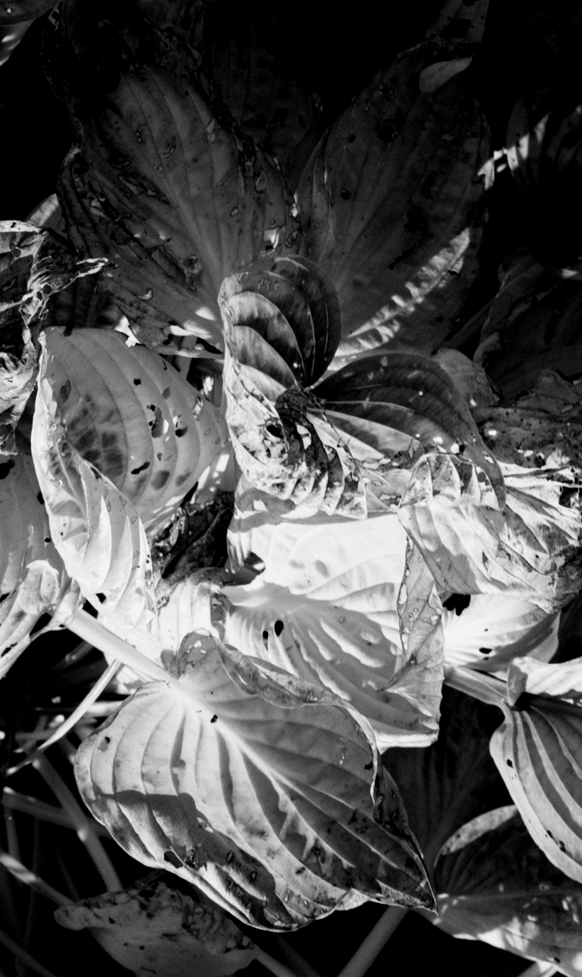
Whirling Hosta

Whirling Hosta

Not only artists find surprises in the textures of surfaces. Who does not occasionally pause before a weathered wall, lichen-covered gravestone, the grain in a wooden plank, a windswept cloud, a reflection in glass or water, or detect resemblances and fresh arrangements in the shape of cliffs or in the veins of plants? Unexpected patterns call for unfurling, inspire a collage, a scientific idea, a poem, a story,  or painting.

Grain

Grain

We rub off impressions from the ambience around us, especially first impressions – scents and sounds, tactile sensations, patterns of light and shadow, textures, colours and shapes, anything that attracts or repels us.

In a psychological sense, we rub off qualities we find in each other – in parents, siblings, friends, strangers and public figures we admire or despise. From what impresses us we extrapolate and find recurring resemblances. As our imagination sparks random associations involving all of our senses, a theme becomes reflected in our heart, as in a mirror, and informs our personal myth.

It’s what my novels are about, which, I hope, will also have a universal appeal.

Among related posts:

https://courseofmirrors.wordpress.com/2012/05/25/pattern-which-connects/

https://courseofmirrors.wordpress.com/2013/10/07/patterns-of-eternity-humbly-opens-your-mind/

Most of the photos on this site are mine. A selection can be found here: http://500px.com/ashen

20 Comments

Filed under Blog

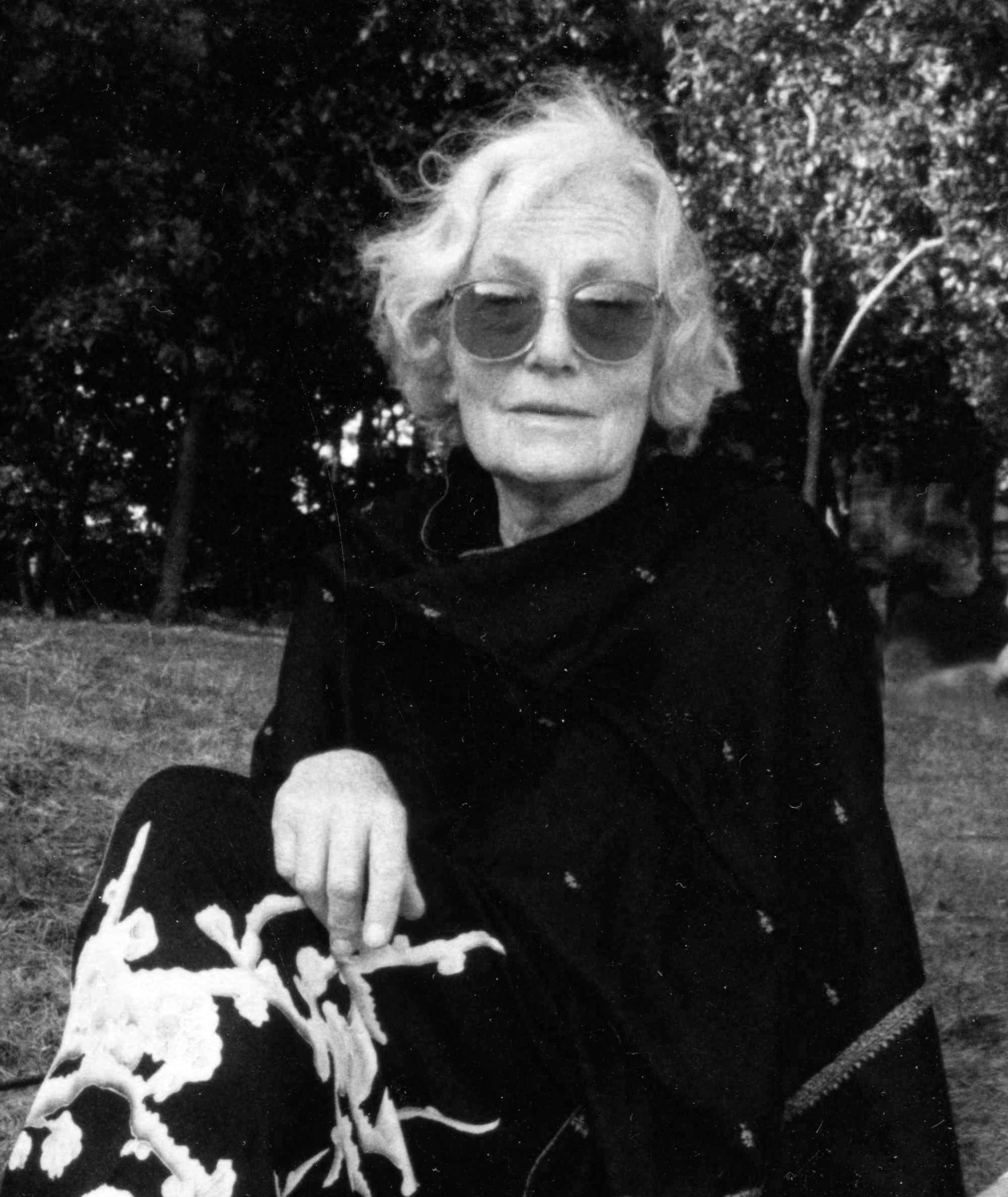
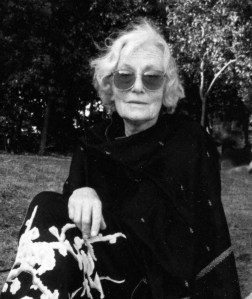
Sitara Brutnell – 1914 – 2004

Sitara Brutnell

Sitara Brutnell


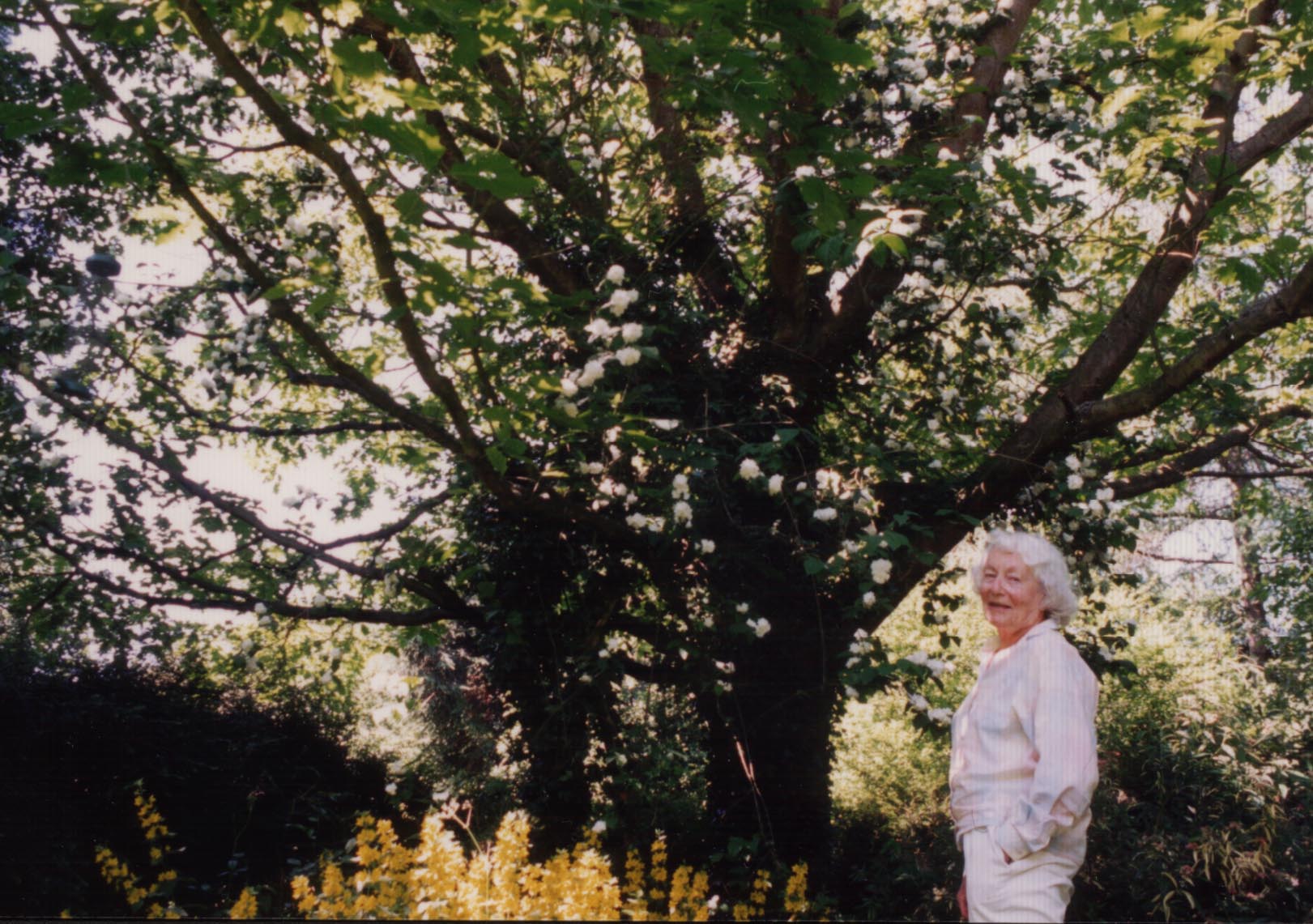
Today’s post is to honour a remarkable woman who died ten years ago, aged nearly 90, having lived her life devoted to the Sufi Message of Love, Harmony and Beauty. Sitara Brutnell was a musician whose brilliant ear for pitch and rhythm extended to the fine-tuning of her personality. By enduring the dissonances life throws at us without dispensing blame, and reading people and situations deeper, she became receptive to the spirit of inner guidance.

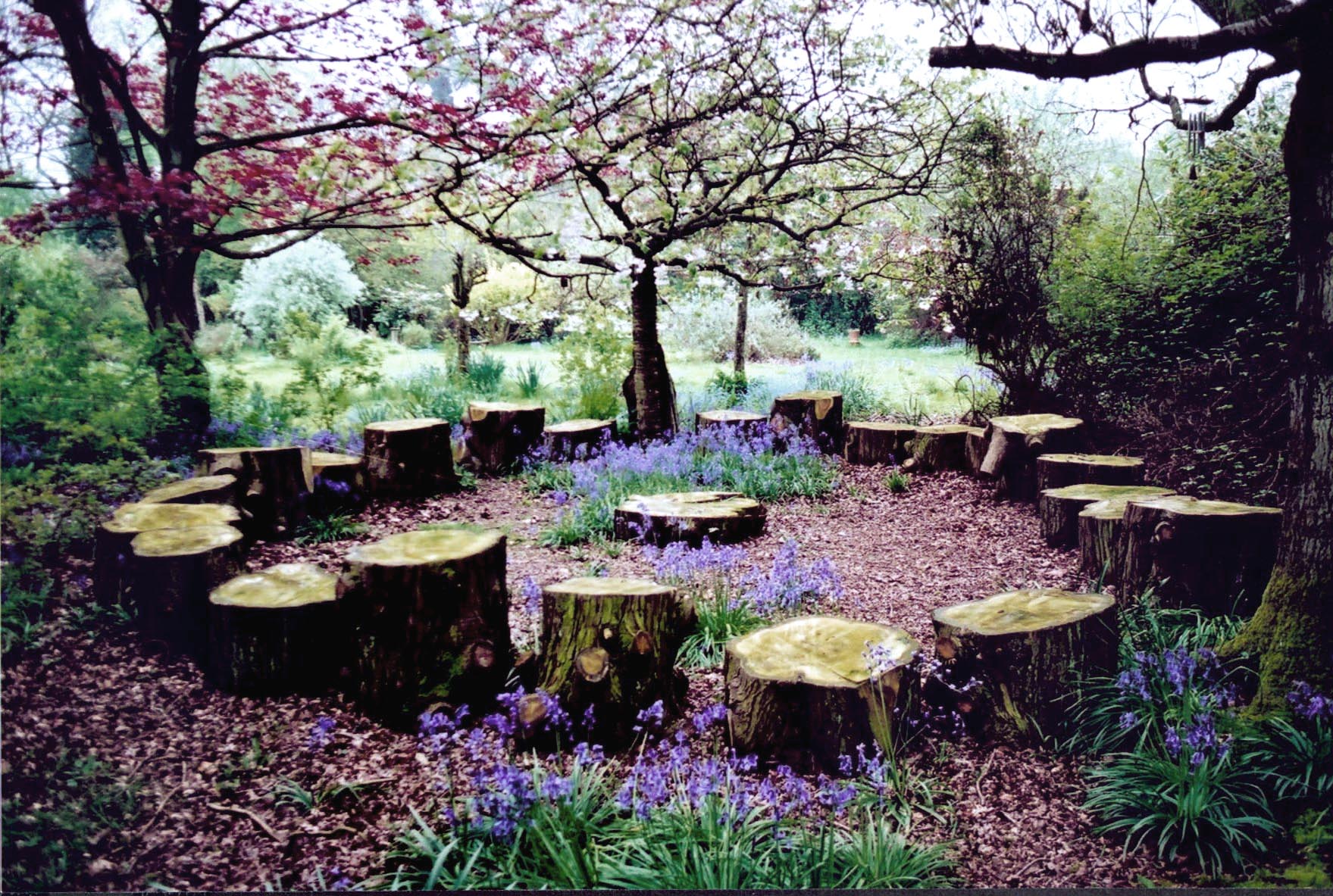
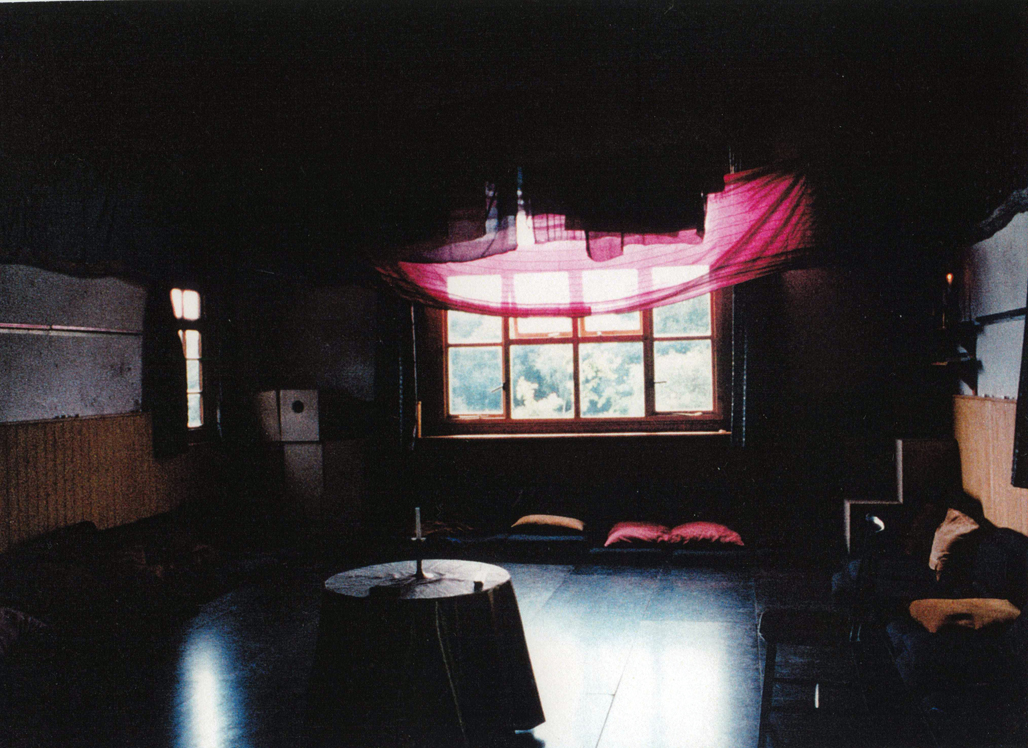
Like her parents before her, she supported the work of the Sufi Movement and continued hosting its leaders after Hazrat Inayat Khan in her home, enjoying many musical soirées. One of Hazrat’s successors was his youngest brother, Musharaff Khan (1895-1967), who handed his role to the 26-year-old Fazal Inayat-Khan. So in 1968 the Sufi Movement was challenged by a dynamic and innovative Pir and custodian, a position Fazal eventually surrendered, giving credence to his own unique teaching approach, calling it The Way of Action, and later Sufi Way. Sitara stood by him for almost three decades, and after his untimely death in 1990, the leadership of Sufi Way fell to her. My Pictures 438 - CopyAknar Circle in Roughwood
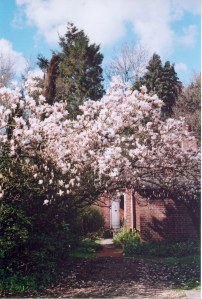
She is remembered as a wonderful musician, and for her kindness, humour, sparkling mind, frequent expressions of gratitude and her warm hospitality.

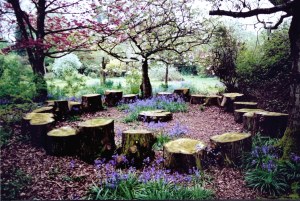
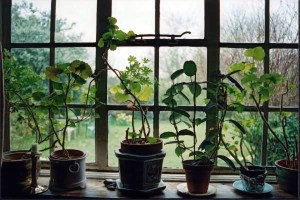
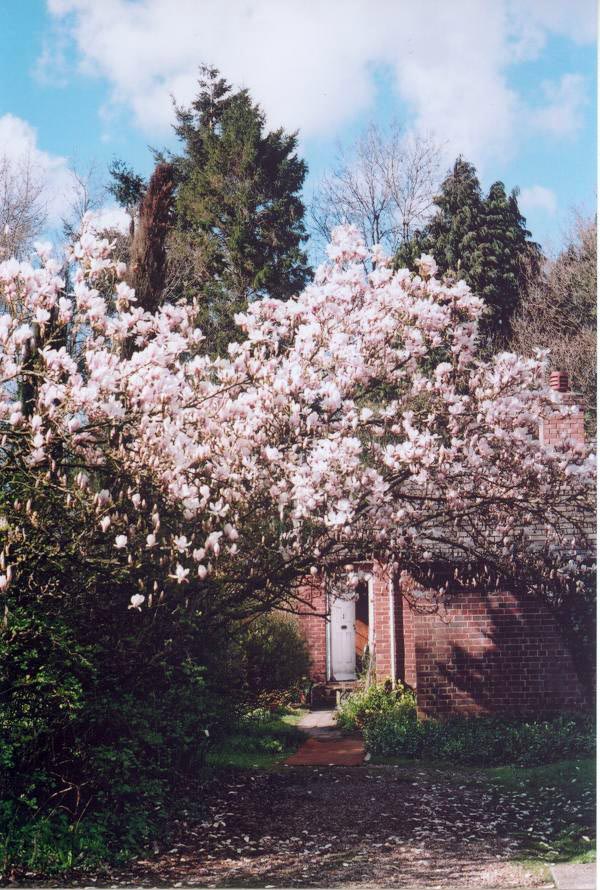
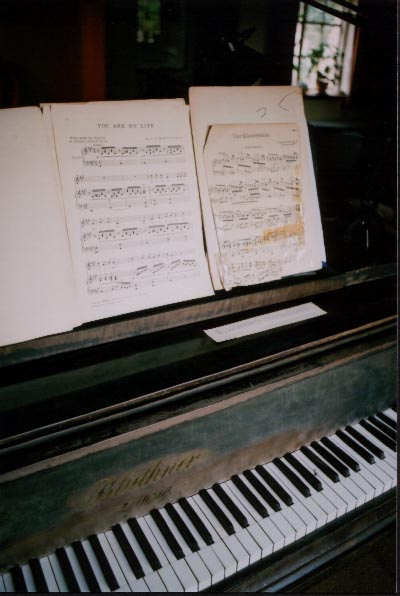
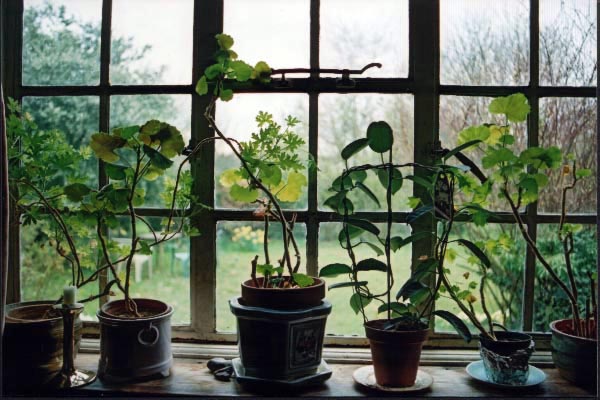
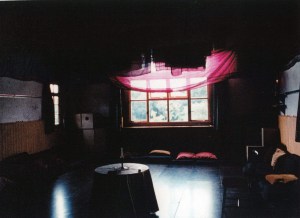
The door to Sitara’s home was always opens to her many friends spanning the globe. There was hardly a time when she did not gracefully entertain guests who treasured Roughwood as a place to relax and be nurtured, like she lovingly nurtured her pot plants, no matter how straggly they lined up on her windowsill. The wild flowers in the secret nooks of her garden looked after themselves. Sheltered by high trees and bounded by fields, this magical place was only a few miles away from Four Winds, Fazal’s residence, and the then official spiritual home of Sufi Way, which was like a buzzing metropolis of the psyche compared to the sanctuary of Roughwood. My Pictures 410 - Copyat Roughwood,window13-04-04
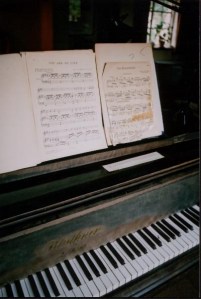
It is tremendously reassuring to come back to rooms where everything has over time claimed its place. Shelves packed with old books, well-worn furniture and carpets, paintings and prints on the walls, items on the mantelpiece, like the tiny carved gazelle, the Japanese ginger jar, red-veined serpentine stones from the Lizard – interspersed with rotating tokens of love – the photograph sent from a family in America, a child’s drawing, a postcard from South Africa … each object holding a story. And stories popped from shells with every question of where and what. We held garden working-parties, chasing away moles, poetry gatherings, celebrated birthdays …
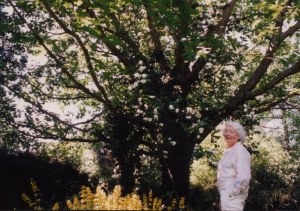
The year roses grew in the tree.

The year roses grew in the tree.

Following Fazal’s death, his partner, Wendy Rose-Neil, a transpersonal therapist, put Four Winds on the map as a venue for London’s workshop facilitators, and Sitara, aged 76, though daunted by the task, embraced her spiritual leadership role with grace. Helped by the local and international community, she continued regular Sufi Way activities, and encouraged Sufi friends and professional therapists among us to run workshops. In this and many other ways Four Winds maintained itself financially for another decade and served a wide community.

This positive development ended abruptly after Sitara’s death. The new Pir, Elias Amidon, sold both Roughwood and Four Winds to raise money to achieve more flexibility for Sufi Way. I am still grieving the loss of the places and the multicultural network that was truly inclusive, beyond the brand of Sufism, which is not to say that the inclusive approach is not continued elsewhere. However, attempts of local people to buy Four Winds from the newly created charity failed. The two spiritual homes in England now only exist in the rich memory of companionships.
Barn at Four Winds

Barn at Four Winds

It was impressive how Sitara embraced the challenges of the next generation, how she joined the freedom of enquiry of the 70s and 80s. Over three decades, people from all walks of life and all corners of the earth gathered yearly for Summer, Winter and Spring schools at Four Winds, which was a vortex  of creativity, with stimulating lectures and discussions, psychological war games and intense experiential meditative and contemplative practices that deepened lives and formed lasting friendships.

Though an unlikely team, Fazal and Sitara complemented each other. While Fazal, with the sincerity, contradiction of doubt and faith, intensity and humour of a Qalandar *, challenged the assumptions of his students and encouraged unlearning, Sitara was the blessing guardian, typed up hundreds of Fazal’s lectures and regaled us with piano recitals on her Grand, songs, esoteric readings, tea-time-treats of Battenberg cake, stories, and the consistency of her welcoming home. What they had in common, apart from disseminating the essence of Hazrat Inayat Khan’s message, was their love for music, keen curiosity in life and the playful deflation of any pretensions to grandiosity.

For one of the famed spontaneous Magic Theatre performances at Four Winds, Sitara offered a poem that gives a flavour of her delightful poise:

Lord thou knowest better than I know myself

that I am growing older and will someday be old.

Keep me from the fatal habit of thinking that I must say something

on every subject and on every occasion.

Release me lord from craving to straighten out everyone’s affairs.

Make me thoughtful not moody, helpful but not bossy.

With my vast store of wisdom it does seem a pity not to use it all …

but thou knowest lord that I want a few friends in the end.

Keep my mind free from the recital of endless details;

give me wings to get to the point;

seal my lips on my aches and pains …

they are increasing

and love of rehearsing them has become sweeter as the years go on.

I dare not ask lord, for grace enough to enjoy the tales of other pains,

but help me to endure them with patience.

Teach me that glorious lesson that, occasionally, I may be mistaken. 

Keep me reasonably sweet lord.

I do not want to be a saint …

some of them are so hard to live with,

but a sour old person is one of the crowning works of the devil.

Give me the ability to see good things in unexpected places

and talents in unexpected people.

And give me oh lord the grace to tell them so.


(The author of this poem is anonymous, but Sitara wrote poems in the same vein)

*    *    *

* A Qalandar is traditionally a wandering dervish, a free spirit with a strong love for humankind. Fazal Inayat-Khan once wrote a breath-taking poem called ‘Qalandar’ at Roughwood. It can be found in this book: Heart of a Sufi – A Prism of Reflections, link: https://courseofmirrors.wordpress.com/2013/03/16/a-rare-book-now-on-line/

The present Sufi Way: http://sufiway.org/ And an article by Fazal Inayat-Khan that sheds light on the various branches that grew from the tree of the Sufi Movement: http://sufiway.org/about-us/our-lineage/12-about/33-western-sufism

If you’re inclined to explore the spiritual message of Hazrat Inayat Khan, you’ll find plenty of links and source material on these and many other sites, all free: https://wahiduddin.net/mv2/   http://www.cheraglibrary.org/

Thank you Sitara, thank you Fazal, and thanks to all the friends in this adventure. You are still enriching my life.

10 Comments

Filed under Blog

… weddings still happen …

Come July, my son, Yeshen, is joining creative forces with Natasha, who magicked this invite for the intimate part of their wedding celebration. I’m allowed to share her delightful animation.

http://vimeo.com/89556579

The venue will be an old pearl-fishing boat in Darwin, where part of Natasha’s family live. I’ve never been to Australia, so I’m looking forward to the trip. Their UK friends, I understand, will be invited to a summer picnic in London.

I’m very happy for them. They’re a wonderful team.  http://www.yeshandtash.com/about/

Tash

Tash

Natasha working


Yesh & Tash

Yesh & Tash

15 Comments

Filed under Blog

… meeting the other …

None but nature could have written a better curriculum for becoming human …


Attend for a moment to you breathing. If you’re aware of heaviness in any part of your body, breathe the colour of water under a blue sky into that part and let the tension drift into the earth with the out-breath.

In your mind’s eye, find yourself in a meadow, abundant with scented wild flowers. Nearby is the outcrop of a mountain and a welcoming dry cave stirs your curiosity. Entering the cave, you find a spacious passage from which comes a luminous glow. All of a sudden you’re walking on air, and – like a feather on a breeze – you’re floating, floating gently downward into velvety twilight. In your heart you know you’re guided towards a special encounter.

A waft of fresh air brushes your skin. You find yourself standing in a soft beam of light from high above at the centre of a dome-shaped cavern. The circular wall of the dome has tunnels that lead in all directions. You must choose one. Be patient.

White Window, St Cathrine's Chapel - more lowresWithin your reach sits a small bronze bell. Lift the bell and give it a slight nudge. As the clear sound of the bell reverberates in your heart, you’re drawn to one particular tunnel and you know this is the one to follow.

Warm air greets you with otherworldly scents, the crystal walls of the passage glimmer. Soon brightness appears ahead, momentarily blinding. You step forward and slowly make out a landscape of rolling hills with the sun reflecting in a silver stream that meanders towards a distant sea. 

Close by, you notice a strong presence under a solitary tree and feel your heart chime in perfect harmony with the presence. A near transparent human form steps out and mirrors your innermost being. Eyes, radiating love and acceptance, completely affirm you. For an instant you are – you are natural mind, pure consciousness.
A soft voice says: Where is the other?

Pondering the question, a shrouded figure moves, from hiding behind your back, boldly into view. It is a repulsive creature and you want to shush it away.

Greetings to your other, the soft voice of your essence says. Then you realise what the apparition represents, everything you reject and prefer to keep hidden from your consciousness, all you find objectionable, embarrassing and unacceptable in others, and in yourself.

Understanding happens. By denying your inferior being you are also ruled by its whims. And realisation comes – of your body’s wisdom, and of knowledge gained from human frailty you were too proud to value. You see with fresh eyes  and extend the very love and acceptance you absorbed from your essence. The other straightens, lightens. There’s a new respect, an affirmation, a softening.

Turn and look again into the deep compassionate eyes of your essence, absorb this capacity for tolerance in your heart, allow the healing.

Then bow to your essence and return the way you came. Give a nod of acknowledgement to your other, so the shrouded figure won’t slink behind, become resentful and trip you up. Let it walk in view, accepted, even with gratitude for its imperfections and its treasures.

*    *    *

Continuing from my last two posts, this is further classic theme for an inner journey, usually adjusted to the context in which it is used. I kept the narrative short and succinct. Even if you don’t enter the journey experientially, alone, or read to by friend, and allow your own images to emerge, the scenario might spark reflections, and drawings or writings for your diary or chapbook.

It’s humbling to recognise our flaws and the blame we assign to others, and yet, no matter how many veils are falling from our eyes, there’ll always be more projections to be owned, more grudges to let go of, more misunderstandings to tolerate, more hurts to absolve, and more to be embodied of what feeds us from dark roots. Our struggles with conflict and contradiction polish the heart, feed our imagination and create our realities. None but nature could have written a better curriculum for becoming human.

http://www.youtube.com/watch?v=9NrAGJEMnHE          Marie Louise von Franz – The Way of the Dream 2.1 – Our Shadow Knows

One does not become enlightened by imagining figures of light, but by making the darkness conscious. – C G Jung, CW 13: Alchemical Studies. P.335

Everyone carries a shadow, and the less it is embodied in the individual’s conscious life, the blacker and denser it is. At all counts, it forms an unconscious snag, thwarting our most well-meant intentions. – C G Jung

If we could read the secret history of our enemies, we should find in each man’s life sorrow and suffering enough to disarm all hostility. – H W Longfellow

9 Comments

Filed under Blog

… delights of peek-a-boo …

In ways we project ourselves into our surroundings, as children we delight in the appearance, vanishing and re-appearance of a loved object or person.

Georgios Jakobides - 1895

Georgios Jakobides – 1895

To observe something reappear is as thrilling as green shoots returning in spring, as inexplicable as birth itself. Hide and seek or peek-a-boo are games said to adjust toddlers to ‘object permanence,’ an illusion we embrace, yet these games are also the prelude to a lifelong quest for the mystery of existence. Children, unless talked down to and belittled, ask deep questions – where do I come from, where did the candle-flame go, where has grandpa gone, how long is time, how come I see things with my eyes closed?  The same questions spurn lifelong passion in scientists.

Growing social, we slip into collective rituals of seeing, feeling, thinking and doing. We obey, ignore or defy rules meant to serve cultural cohesion, rules promising acceptance and success in life. We respond or react according to circumstance and temperament. Some of us have a need to belong, feel safe, protected, others may venture into the unknown, become spiritual warriors on a warpath with obstacles, often rituals, blocking individual potential.

I’m a warrior learning from obstacles, one of which I like to share.

You may recall commands, often subtle and inferred, by early significant persons, communicated via responses, to you, to life, based on generational ideals. These commands worm themselves into the psyche and settle around an inner critic. While well-meaning in aiding conscience and integrity, this critic can also become strident and counter-productive.

In my case – the critic periodically berates me for not keeping my own promises … stay on top of things, complete tasks,  respond to request without delay, call on friends, de-clutter, prepare accounts, fix the warped front-door, only so many roll-ups a day, only two glasses of wine … the tick-off list is … ah well … endless …

Good objectives aside – the more the opinionated critic berates my shortcomings, the more I need to release the tension by transgressing self-imposed rules – otherwise the noise of my inner battle drives away the bird of intuition, the unexpected and the wonder of each day.

I listen, but won’t bow to the critic, obey in fear and cage the bird. In my book, this sums up the making of tyrants.

More and more often I remember to soften the demands. Instead of berating I praise myself for small promises kept, for what has gone well, small steps in overcoming this stealthy ritual that does not benefit my aims. It’s my idiosyncratic strategy: no fighting, no surrendering. Try it – humour the critic into humanness and adjust your rules of engagement with the elegant phenomenon of now.

P1050813 - lowres You may ask – how does my strategy relate to hide and seek and peek-a-poo?

It’s the play with reality by the child in us – the delight in re-discovering being.

*    *    *

This little bird cheered me, it arrived flattened in a Christmas card. Instructions read: Stand me up on my feet.

Blessings to my friends for 2014 – may the bird of intuition frequently visit you.

19 Comments

Filed under Blog

… emitting the real …

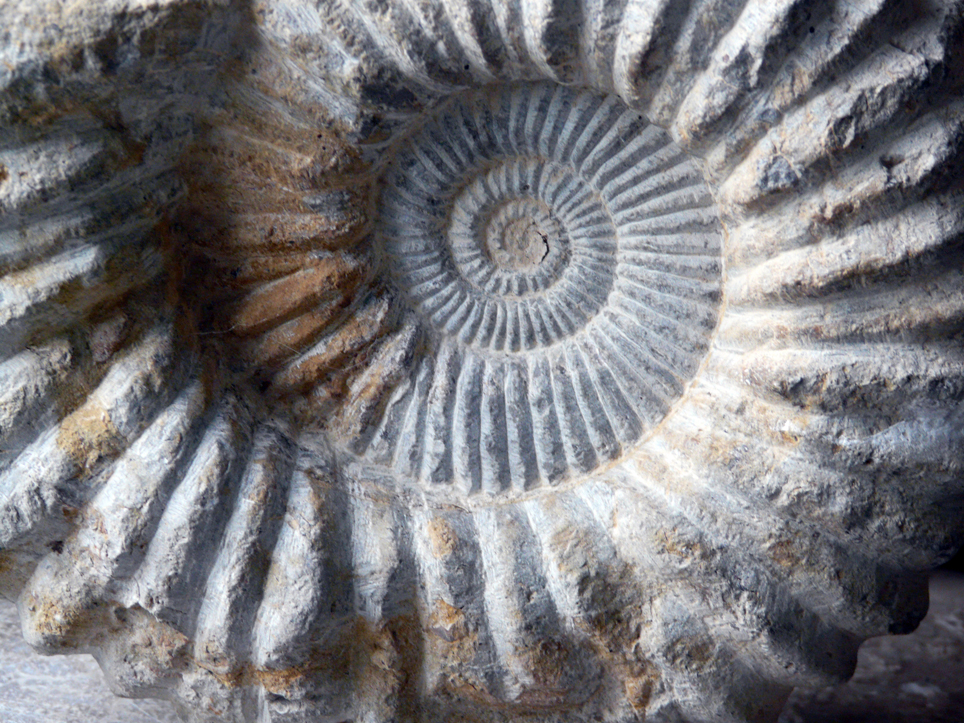
nothing beats the spiral

nothing beats the spiral

In the spaces between

Harmony and chaos

Wisdom voids the mind

To expose veins of

Hidden avoidances

Where – omniabsent –

Omnivalent in our longing

We exist inverted –

Give in receiving

Receive in giving

While surfing across the deep

To simulate worlds

Sift signals

Endure ironies

For evermore becoming

And emitting realities

Fleeing the ground

Of being …

*    *    *

Dear readers, I hope you stick around, while I’m immersed in writing scenes  for my second book, Shapers – the continuation of an epic search for the real.

10 Comments

Filed under Blog