 The morose question of whether to be or not to be has moved on to whether to appear or not to appear. Appearances can deceive according to context. Or as my spiritual friend, Fazal Inayat Khan used to say, ‘Form is a relic of eternal potential.’ Things that have lost their former function have joined the archive of icons, metaphors.
Could the function of our individuality become no more than a statistical entity during our lifetime?
Today’s institutions and corporations share knowledge, advice, wisdom, stipulate laws, or instill fear via alerts. Ultimately, they accumulate information but are not necessarily held accountable for how this information is used. Priests used to claim this power in the name of God, as well as sorcerers and witches, who made it their business to converse with spirits. Many people project power onto an all-knowing agency, though today’s most consequential agency has moved on into the next clan of power holders – those who collect and control data … our data, our location, movements, activities, political leaning, looks, habits, likes and dislikes.
Our existence is being whittled down into digits that tumble about in a sea of algorithms, and wherever they perk up in statistics they could fix our fate, since temporal data can be adjusted to any setting a bureaucracy chooses as being predictive. This, mainly unchecked, development is running into problems, with the recent U.K exam result fiasco only being the latest example. Bless our young people for revolting.
Power of information equals control, for your own good, maybe, depending, of course, on who is in charge. Distorting and withholding knowledge, be it intentionally, through ignorance or through expediency, endangers democracy when used unchallenged as manipulation tools by governments. At worst, it enables profit seekers to accelerate the exploitation of earth’s resources, maintaining poverty around the globe.
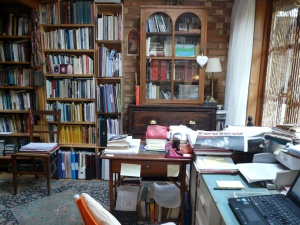 Those involved in research, students, scientist, and writes, know the challenges of filing and stacking information. My own filing mirrors the ad hoc workings of my brain. To find stuff again is a matter of focus, luck and intuition. While occasionally frustrating, I trust my larger self and the collective unconscious. It is my oracular method, circumventing any too strict measurements promoted as our new saviour, algorithms. I value rationality, just not when it discounts spontaneous human creativity, heart felt compassion, and the inspiring moods of nature.
Belonging has never been easier – not belonging has never been more difficult. How does one evade the pressure of countless unfair impositions our systems prescribe via algorithms? In Walt Whitman style one could say … every ‘digit’ belonging to me as good belongs to you … But wait, there is vast space in the One, space between atoms, between digits, between the many of us, where one can belong and be eccentric and separate at the same time.
Where do algorithms lead? How do they influence our values? Yuval Noah Harari in his book Homo Deus, describes ‘dataism’ as a new religion, a potential digital dictatorship that could shape our reality. Who would aspire to such a stagnant future?
I was fascinated and encouraged by a recent discussion between Yuval Noah Harari and Taiwan’s digital minister, Audrey Tang. (click here for the YouTube video coming up on a separate page)
They discuss code, including, at the start, the issue of non-polarized gender, going on to the negatives and positives of human hacking and the democratic fairness that can potentially happen when transparent data sharing and plural viewpoints are allowed.
Audrey Tang says,
‘Technology should be utilised to promote freedom, democracy & human rights.’
In Taiwan, this hugely influential young trans woman is making this happen.
 I’m old and grumpy, a familiar sight. Small chance she wonders where I hang out when not visiting. Today she spotted me – a fluffy ginger ball dozing on a brick wall sheltered by ivy – not my regular spot. I prefer having my daily nap on a bench at the top. From that royal view downhill I keep half an eye on creature traffic, neighbour cats that shamelessly kill fledglings or lame birds, the stray dog or sly fox that slips through the hedge, reckless rodents … but it’s been drizzling all night and my favourite bench is soaking wet this morning.
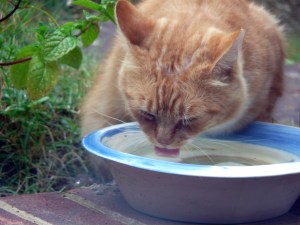 bowl near the house with fresh water, just for me to slurp. In such moments we exchange glances, and she nods. What she doesn’t like is when I get too close to her little stone Buddha. Then she shakes her head or steps from the backdoor to clap her hands. I’ve seen her turn the water hose on cats with bad manners. She should know better, I’m not one of them, I have principles.
 I bet she misses her companion, glossy and black as a moonless sky. She was gentle and tolerant of me, which is why I used to protect her from a nasty tom. Some years ago the woman dug a deep hole for her friend, near the compost heap. Not the most romantic spot to have one’s bones rest, but due ceremony was observed, which must count for love.
 I doubt she cares where I camp at night. Doesn’t know I endure the stoned torpor of Mr X, lost in a dark place. It’s not a home, the vibes upset me. But each morning I vocally rouse X from his hangovers to alert him to my dry meal. This must be my purpose – my insistence on my existence is how he tracks time, like noticing a new day. Alas, the filthy water bowl is only rarely topped, which is why I’m thankful that the woman got the message … I’m always thirsty.
 after his medical studies. There it was – a white little sports car in front of my door in Schwabing (Munich’s student patch during the 1970s.) By then I was working as a freelance photographer and paid a fortune for Taxis to get me and my gear to destinations. ‘This will motivate you to get your driving licence,’ my generous friend said.
 contained little house, which was, much like Dawn French shared, equipped for blizzards, resulted in countless adventures, some of them precarious: Gears failing on steep mountain slopes, flat tires on lone country lanes, pulling windshield wipers with a string from inside the car during heavy snowfall, border guards wanting to arrest me because I wore an army jacket and a Che Guevara cap. Once, on the island of Elba, a companion suggested a shortcut which got us stuck in a vineyard. The farmer who had to pull us out was not pleased. But heck, life was exciting.
 By then I’ll get a good old sturdy Jeep, the kind you can rent on rocky islands.
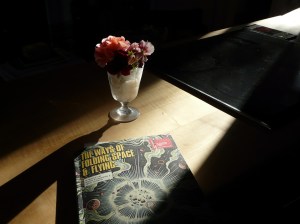 Here I find peace and time to crawl once more out of a family pattern, the kind of constellation one is born into, gets sucked into, and tries one’s best to loosen in order to gain more freedom and clarity.


 Course of Mirrors