Tag Archives: awareness

… Is a parent ever unemployed ? …

Something new – AVAAZ encourages individual campaigns now . I started one. Click the link and read the proposal, and if you like the idea vote for it.

http://www.avaaz.org/en/petition/Put_parents_on_the_payroll/?fHNQuab&pv=0

Yes, it makes sense – put parents on the payroll – tied to the attendance of courses.  Here some more thoughts as to why …

Family structures are changing for a variety of reasons. No use blaming parents and home-makers that are unable to cope. No good romanticising the past. Parents and carers need  support in this time of flux.  New structures are emerging, single parents or carers, for example, seek families of heart and mind. Our policy-makers don’t seem to take note of this phenomenon. Think of independent units around a communal space that would allow socialising and the sharing of skills.

And why not use the psychological knowledge that has been available for decades? Why is this knowledge not disseminated to parents? Corporations require further training from their employees, offer courses that teach people skills, because they realise these skills improve business.

Parenting is important business, without question the most important one.  Years ago, when I was involved with Parent-Link, sharing skills, I had an idea how to create more opportunities for parents and raise their status. You can read about it by clicking on the AVAAZ link above.  And please vote, or come up with your own ideas.

Present social policies often force a mother or father to beg alms from the state, become unemployed. Is a parent ever unemployed?  Children are the future and must concern us all. I meet many parents, who, even with heightened awareness, tenacity, creativity and sacrifice, struggle to stay sane.

Thanks

3 Comments

Filed under Blog

… put parents on the payroll …

Traditional family structures are falling apart for a variety of reasons. No use blaming parents for their inability to cope, or romanticising the past. When we look at the whole picture, we must also acknowledge that the sacred family unit was often a torture chamber of abuse. Affected individuals (predominantly women and children) suffered in silence. The shocking narratives that keep emerging from across all sections of society show ignorance perpetuated over generations about what a child needs to thrive.

On the positive side, there are new forms of families emerging, families of heart and mind. Housing policies seem blind to this new phenomenon. The trend is still to build little boxes rather than independent units around a communal space that would allow socialising and sharing.

On the negative side, why is the psychological knowledge that has been available for decades not disseminated to parents? Corporations offer courses on motivation and people skills to their employees, because they realise these skills improve business.

There were attempts. During the 80’s and 90s, I was involved with Parent Link, a non-profit scheme that offered a playful and empowering set of twelve experiential sessions transmitting people skills. The resulting emotional self-awareness reduced stress and frequently turned lives around. The charity, set up by I. Sokolov and J. Pearson, offered subsidised training to parents who had benefitted from what they learned, and unlearned. Consequently hundreds of parents went on to facilitate more courses, drawing in more parents. Teachers were keen to bring the programme into schools. Sadly, without government support, the brilliant scheme did not survive its popular success.

Since stay-home parents pay no tax, they are considered a drain on government resources, unless they get a job and perk up the employment statistics. The status of parents has been gradually eroded, and, to top it, they are blamed for the ills of society.

Ten years ago I hatched the following idea and was laughed at:

Offer an appropriate part-time wage (taxed) to those who choose to be vocational parents or carers and are willing to learn, since the wage would be tied to basic obligations, like involvement in the community and the attendance of courses to develop relevant skills and knowledge. A reward for the most vital of all contributions to society would shift the status of a parent or carer – lessen social segregation – defuse the destructive acrimonious fights over property and maintenance where relationships break up –  raise self-esteem and build a stronger community spirit through networking and sharing of responsibilities, while still allowing part time work outside the home.

A parent or carer who has financial security will not be perceived as a burden to the state. No more would he/she be diminished by cliché projections and judgements.

It makes also financial sense – some benefits could be scrapped and the funds re-applied to wages, skills training and creative community projects.

And here is why any idea that proposes a shift in the social structure will be regarded as naïve, and not convince politicians:

Our social system thrives on unsustainability. Problems have become a growth industry. In the social sphere it is poverty, unemployment, sickness and criminality that have turned into the most profitable enterprises.

Present social policies are irresponsible, like building a high-rise in an earthquake zone disregarding safety regulations. They are based on blame, the lowest of all public denominators. They are an insult to the intelligence of ordinary people, who, with heightened awareness, tenacity, creativity and sacrifice, struggle to stay sane.

Ashen Venema

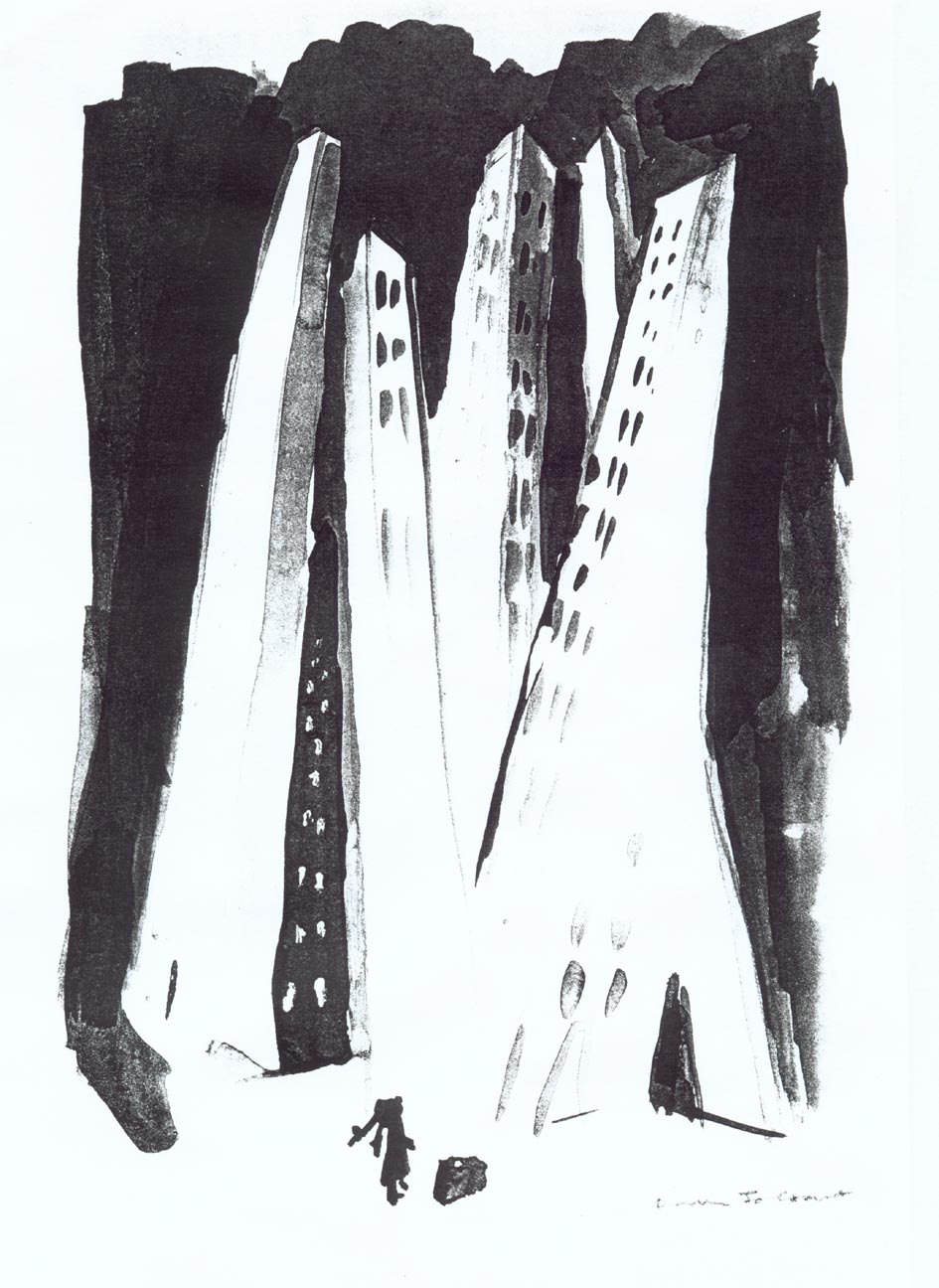
The above illustration is by Daphne Jo Grant, and was  kindly provided for my 1993 poetry collection ‘Gapsy Truth.’

2 Comments

Filed under Blog

… symbolic understanding …

The star that guides us is not meant to be reached concretely, or, as Hazrat Inayat Khan expressed it:

‘The ideal is the means – its breaking is the goal.’

Aged twenty-seven it struck me that I was not my own person, but a clone of my first gods, my parents. I realised I was not special. I was like everyone else, a slave to habits formed in my early environment, which I then unconsciously ritualised. The shocking insight put an end to my pretending I was a foundling (my joke at the time.) For better or worse I had to reconcile myself to my given mould, accept my parents’ imperfections, and my own.

Having reached an impasse re: a series of romantic relationships that bruised my heart, I was disillusioned. My ideal of love had lost its meaning and I yearned for a new horizon.

Fortunately I met a mentor who re-framed conflict for me, because in my flight towards spirituality I had come to avoid conflict like a plague. The trouble with rejecting conflicting thoughts and feelings is that we create taboo boxes in our psyche, boxes where we hide stuff we don’t want to think and feel. The accumulated rejects trip us up and actually energise conflict around us. Childish feelings may pop up to embarrass us where they don’t fit circumstances. Best welcome them, unless you want to fuel the addiction to war.

Driven by unconscious refrains our lives unfold from crisis to impasse to transcendence – like a drama with all its obligatory heroes and villains. Ignoring our inner conflicts and projecting them onto others and the world at large serves a purpose – in that it (hopefully) makes us aware that the way we go about fulfilling our needs is not particularly elegant, and has a price. The price is awareness, which can be painful, but it brings choice. Feelings that ‘have us’ don’t ‘have to’ be acted out, they can be expressed symbolically – one way is through writing things off one’s chest and releasing the outpour to the elements. Tear up and bury your unsavoury confessions, drown them in a river, or burn them. Release all association, free and purify the energy.

What is hidden from consciousness nevertheless affects us deeply.  In an archetypal sense, for example, a person who identifies with the masculine principle (animus) will be drawn to a person who identifies with the feminine principle (anima.) I don’t use the terms man and woman because physical gender does not necessarily equal psychological identification.

Generally, the hidden gender is actualised by the way the opposite principles are experienced through a parent.  Behind the attraction towards opposites is a desire for wholeness, a need to integrate our unrealised nature. This growth happens through relationships.

Plato put it like this …

… the dry desires the moist, the cold the hot, the bitter the sweet, the sharp the blunt, the void the full, the full the void, and of all other things; for the opposite is the food of the opposite, whereas like receives nothing from like …

Plato also emphasised that wholeness does not equal goodness.

As an example: too much goodness in a parent can make a child fearful of negative emotions and constellate a demand for goodness impossible to live up to. If human frailty is lacking in a father or mother, that is, if they are too perfect – or absent – then the expectations father or mother figures are invested with throughout one’s life become inflated, difficult to achieve, and no actual person can satisfy such expectation.

I’m not a practicing Christian, but I appreciate the powerful symbolic significance of the cross. The story of Jesus shows us that in the process of becoming human we are stretched between earth and heaven, matter and spirit, crucified by the dichotomy. Conflict has meaning if we allow it into consciousness. The challenge is to endure opposing forces, identify with neither good nor bad, but instead suffer the deadlock of contradiction, be crucified, because – there are conflicts we cannot resolve.

Yet by accepting what is we invite grace. We ready ourselves to be initiated into a reconciling symbolic experience of transcendence that is personally meaningful to us. The reconciling symbol cannot be grasped. It will emerge from the unconscious in its own time, through an event, or through a dream – if we can be receptive and master humility and the patience.

Symbol, a definition …. Taken from ‘The Creative Imagination in the Sufism of Ibn ‘Arabi’ by Henry Corbin, translated by Ralph Manheim, Bollingen Series XCI, Princeton University

The symbol announces a plane of consciousness distinct from that of rational evidence; it is a ‘cipher’ of a mystery, the only means of expressing something that cannot be apprehended in any other way; a symbol is never ‘explained’ once and for all, but must be deciphered over and over again, just as a musical score is never deciphered once and for all, but calls for ever new execution.

4 Comments

Filed under Blog

the trance of rhythm

I tend to wake with a keyword or an image, nothing new, just reshuffled ideas that emerge, as it were, from the darkroom. Today the keyword was ‘rhythm.’

I hope it makes you wonder.

*    *    *    *

Order unfolds from chaos through rhythm in all dimensions.

Stick your fingers in your ears and hear the blood-river …

Press your fingers on your wrist and feel the rhythm of your pulse …

Hold your hand to your face, and know what travels on the breath returns …


The beat and rhythm of the heart begins within weeks of conception in the womb, and invites the spirit into a trance-dance. Why would spirit otherwise get itself trapped in the constraining form of a body, with limited access to the universal mind, attracting only certain frequencies, all depending on the contents of the available gene bank, the energy of the planet constellations at the time, and the quality of stimulation the environment happens to provide.

Repetition is the trance. We learn by repetition, we relax into its familiar beat, habits of belief, feeling, thought and behaviour. The quickly established repetitive patterns comprise the cards we are dealt to play with.

The deck of cards is universal, and the game has laws, physical laws, psychological laws, spiritual laws, and random laws. When we make an effort to learn the blueprint of our cards and acknowledge the player in us who holds the hand, the game has meaning, whether we win this round or not.

He who cannot see himself within the context of at least 2000 years expanse of history is all his life shackled to days and weeks.

Rilke

… anyone noticed how irrational our rational culture behaves?

1 Comment

Filed under Blog

… on awareness …

Magic or what? According to the Hindus everything is food, including sounds and visual vibrations – all kinds of impressions: stories, architectural proportions, union of forms and colours, harmonics and rhythms, dissonance, conflict and all the ideas with which we come in contact. All this, absorbed mechanically and mostly without awareness throughout the day, has made up our being and continues to do so, unless we wake up to this process and adjust our rituals.

*    *    *    *

Psychological laws: excerpt from ‘The Act of Will’ by Roberto Assagioli M.D.

*    *    *    *

1   Images or mental pictures and ideas tend to produce the physical conditions and the external acts that correspond to them. Every image has in itself a motor element.

2   Attitudes, movements, and actions tend to evoke corresponding images and ideas; these, in turn evoke or intensify corresponding emotions and feelings.

3   Ideas and images tend to awaken emotions and feelings that correspond to them.

4   Emotions and impressions tend to awaken and intensify ideas and images that correspond to or are associated with them.

5   Needs, urges, drives and desires tend to arouse corresponding images, ideas and emotions.

6   Attention, interest, affirmation, and repetitions reinforce the ideas, images and psychological formations on which they are centred.

7  Repetition of actions intensifies the urge to further reiteration and renders their execution easier and better, until they come to be performed unconsciously.

8   All the various functions, and their manifold combinations in complexes and sub-personalities, adopt means of achieving their aims without our awareness, and independently of, and even against, our conscious will.

9   Urges, drives, desires and emotions tend to and demand to be expressed.

10   The psychological energies can find expression: 1. directly, through discharge and catharsis, 2. indirectly, through symbolic action, 3. through a process of transmutation.

*    *    *

After carefully contemplating these laws you will draw your own conclusions.

Here some practical examples:   Having experienced Feldenkreis work, and practices deriving from it  –  after doing a gentle physical exercise and repeating it in my imagination only, with eyes closed, the same physical reactions happen in my body. This  explains why active imagination can affect mind and body at a deep level and change physical symptoms as well as states of mind.

When I hit my toe, elbow or head on an object, I repeat the exact contact and, in my imagination, send the impact back. There remains hardly any pain and the usual swelling is mild or does not occur at all.

Therapeutically, if a tense or hurtful part of the body is listened to and  allowed a voice, the result can be  instantaneous,  much like when you lower yourself at eye-level to a toddler who has a tantrum, and do nothing else but acknowledge the rage, surprise, surprise, the tantrum stops.

What seems like magic, is actually simple and applies both ways: physical activity influences mood and mind,  active imagination influences mood and body.  Many of our modern-day ailments derive from people not being able to listen to their bodies and/or not being able to use their imagination in a constructive way.

Reading and, even more deeply, writing, are indirect symbolic expressions of psychological energy, which explains the incredible power of stories 🙂

9 Comments

Filed under Blog

Dear Shadow

You hold the luminous night in our hearts,

Though your task is belied around the globe,

Lest our false face is revealed by your truth.

All ill and wars we blame on your aberrant ways.

Unjustly, since you play the hidden tune,

The one to waken us between each dawn

And dusk to our timeless deeper knowing.

Yet calling you evil comforts our pride,

Since we can see your dark shape over there,

We need not respond to our self-made pain,

Sleeper, you snuff out candles in the dark,

Yet shrink in shame when light defines your shape.

‘Fake,’ shouts every single child in the land,

Asking us why man has no love for man.

Who wants to know? When I mention your undercover existence, most people pretend not to understand what I’m talking about. I become the troublemaker who transgresses unwritten rules of conduct. Your face appears here and there around me. When I don’t recognise you we clash inside, and you press your talk through me.

You represent the blind spot, the patch of darkness that contradicts conventions and stains ideals. I would confine you to the dusty ground of my sleepy mind. Yet disowned, you lurk behind my back and act through me like a parasite. Please darken my view. I had rather face your unsavoury challenges than act out your strident orders.

Forgetting is an acquired skill, in service to coherence and meaning. I like things to stay the same. I like to be liked, which is fine as long as I stay in the shade of the collective shadow. Society sanctions those who stay in the shade. They are predictable, loyal to the party, pay their taxes and won’t make a fuss. And you, dear shadow, seem safely contained, locked away.

That’s what we have prisons for.

Only when my coherence is threatened do I look over my shoulder.  Only when I step into my deeper truth do I cause a disturbance, and in that light of truth, you, my dear shadow, take shape. Then I have to acknowledge your existence and bring a clear mirror to this luminous dark that is you in me.

Like I remember a day – in a rush to get some copying done, my mind already on the road, the telephone rang. The call was annoying and could not be dealt with in that instance.

I arrived at the copy shop expecting efficiency – it being the kind of day when minutes counted. The woman serving was new, unfamiliar with procedures. She moved slow, pausing, seemingly overwhelmed with the technical complexity of the machine. I asked, ‘How long will it be?’ Wrong question – the woman succumbed to a catatonic state. The task was beyond her. ‘Can’t you get some help?’ I asked. Wrong question – her thoughts knotted.  This moment requires patience, I thought to myself, patience for what seemed an eternity. My truth spat on patience. ‘Forget it! I must be on my way.’ And the sting in the tail, ‘Best look for another job, you obviously don’t like this one.’

Furious, I clutched my papers and left. Back in the street, my behaviour caused me concern. My frustration led back to the telephone call from earlier on – I had shouldered it along. Despite this insight, I did not return to the shop and apologize. Another truth – the woman resisted her work. My inferior ‘I’ had delivered a verdict. So be it.

Truth often jumps free through contradiction – imperfection, disharmony. But where to deposit the accumulated energies that tie our heart? How many places are there for people to safely unclench built up anger and honour their conflict inside? Make that inner war meaningful instead of defending an outworn right? Bless my true friends – one of them advised, ‘Being right does not make you potent – responding does.’ Another friend said, ‘We are not made to agree with each other, we are made to create beauty.’ Ah!

What I deny in me, I meet in others – the fearful, the stubborn, the frivolous, the envious and devious, the demanding, the controlling, the calculating, the needy, the critical, the judgemental, the revengeful and sarcastic, the plain stupid, and not to forget – the perfect, the clever, the bright, the wise, the lucky one born with a golden spoon. The list goes on, endlessly, including all I cannot accept in myself. Yet editing my feelings and thoughts to please the noble ideal is the worst of self-tortures. Ah!

Your formidable opponent, my dear shadow, is material rationalism, and the newest craze, political correctness. You have a sharp eye. You anticipate the madness reaching its summit when people will have neither names nor narratives, when only numbers, facts and statistics will be considered fail-proof to inspections. Efficiency and targets are the vogue, nothing messy to obstruct progress. But please, dear shadow, should your patience ever be strained by my forgetting, don’t act the fanatic anarchist through me. They play foul and unforgiving war-games, lacking all humour. Better you embarrass me in person than pour your outrage into the collective through me.

Remind me to listen to your uncomfortable messages. I’ll acknowledge your discontent. I need you in my life as a filter to catch my smugness. Not all the time! So what do you think? Should I give my ego a break? Its desires are forever unfulfilled – always lacking, always searching for something other, better, craving attention. It has childish wants but needs a little kindness in these difficult times, and gentle persuasion to see beyond its small world.

I’ll remember your purpose, my dear shadow, and I invite you to also remember – the fiery love-affair – waiting in each breath, the warmth leaping from every languid gesture, the sudden spark through the eye of a deepening smile. A smile so old and so young, nothing can contain its meaning. The grasp of a reaching hand so firm and so tender, only by simulating water can we fathom its mystery. And a dawn so expectant, every creature perks its ears with bliss and halts all doings. A love stirring the imagination, where the wind shapes a cloud just so – or the moonlight silhouettes eternal players in trees – the sleeping giant, the grinning troll, the child, whirling, the astonished angel, malleable to our fancy. A love that illuminates seeing, feather-light in its desire to dance just where it finds itself in the universe. A love nothing can resist, yet nothingness enfolds it in its boundless existence …

But let me not be carried away, I respect your teaching, dear shadow. Let me befriend you, even so I mostly don’t agree with you. Let me never forget the sacred purpose of my physical existence in the orbit of the sun. Without you I would only be fluff on the coat of real human beings.

Ashen – 2009

10 Comments

Filed under Blog