After my last post I was reminded of another beetle from the scarab family – Maikäfer – in German. In my village we had a beech alley towering above a grove with a stream at the bottom, where Maikäfer swarmed in May. As kids we collected these hard-shelled creatures in match boxers and engaged them in races by fencing flat parallel rows with stones or twigs. That many beetles did not obey the boundary rules and had to be disqualified was a huge frustration.
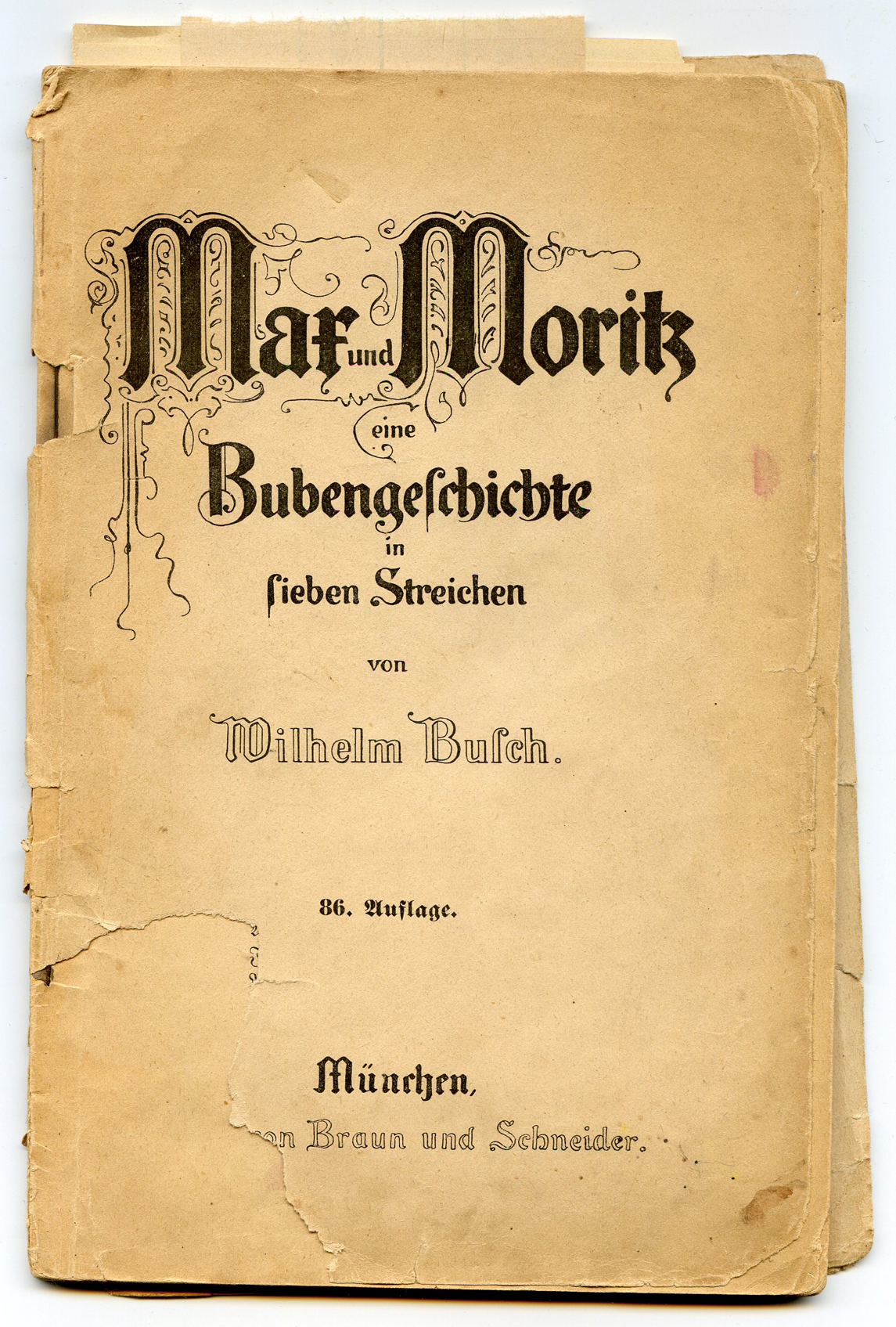 A further memory popped up – a prank featured in Wilhelm Busch’s Max and Moritz– click on the link and check out the fifth trick (prank) with the poetry shown in German and English.
Heinrich Christian Wilhelm Busch (15 April 1832 – 9 January 1908) was a German humourist, poet, illustrator and painter. Some of his illustrated cautionary tales were banned by authorities. The seven pranks of Max und Moritz were called a frivolous and undesirable influence on the moral development of young people,
Busch described himself in autobiographical sketches and letters as sensitive and timid, as someone who “carefully studied apprehension” and who reacted with fascination, compassion and distress when animals were killed.
 I have a 1923 booklet of the Max and Moritz pranks. They may have put me on the path of my own ‘carefully studied apprehension.’
Later I was gifted ‘Das Grosse Wilhelm Busch Hausbuch’ by Ulla, a German friend, a huge book with over six hundred pages of wonderful illustrations of unforgettable characters and comic poetry by the master.
Busch drew on contemproray parochichal and and city life, satirizing Catholicism, Philistinism, strict religious morality and bigotry. His comic texts were colourful and entertaining, using onomatopoeia, neaogolism and other figures of speech, check out his life. See here
His quote,’ Kein Ding sieht so aus wie es ist.’– roughly – nothing is as it seems … rings ever true.


 Course of Mirrors