Tag Archives: symbolic understanding

… here is everywhere …

Nationalism is the pathology of modern developmental history as inevitable as neurosis in the individual.   – Tom Nairn, The Break-Up of Britain

The growth dynamics of nations and those of individuals have striking parallels, especially when it comes to the forming of an identity in relation to the other, and the ongoing struggle to maintain or adjust set habits to changing circumstances. For instance, when religious authority declines, the blame for the ills of a nation can no longer be projected onto the omnipotent godhead. People find themselves challenged to reflect on how they contributed towards the ills and become accountable for their actions.   The psychological development towards spiritual independence and interdependence – for individuals or nation states – is a humbling process in that it confronts us with our failures, imperfections, and the need to learn from our experience and cultivate human qualities.
I’m German-English, my official citizenship is Dutch. Though I live in England, I have felt at home in the Arabian deserts, along the Mediterranean coast, among friends wherever they are. But is there one location from where I look out onto the world, one place that is traditionally called home? To not betray all my loves it would have to be the bridge, in a metaphorical sense. The theme of my first novel starts out with a bridge across opposites. On that bridge my protagonist has an encounter with herself where here becomes everywhere.

I feel like an ancient being torturing language to express the simplicity of experience, digging through layers of false evidence, sifting through sediments of unreliable gossip for grains of truth. Words fall from my pen like dust settling after another hole dug, showing the trifle of an image that needs a night of dreaming to cohere into a sentence, and then more sentences, resonating with a universal narrative, re-arranged in time as if the story is yet to happen.

Germany – Before print was instrumented by Luther’s Reformation, the Latin language represented the voice of divine authority – the father. A lone human hero, Martin Luther (1483-1546), Doctor of Theology, not a prophet, disputed the church’s practice of selling indulgences, which urged him to write his 95 thesis, among them: Why does the pope, whose wealth today is greater than the wealth of the richest Crassus, build the basilica of St. Peter with the money of poor believers rather than with his own money?’ When Luther’s followers printed his 95 theses and displayed them in public places, their controversial contents spread like wildfire. The papal hegemony was rattled. Convinced that salvation was not gained by merit but by the grace of God alone, Luther went into hiding and translated the bible into the most spoken vernacular. Time seemed to call for a voice like his. In some historic records he is accused of hiding under the mantle of the princes rather than siding with the folk, of not grasping the opportunity towards the forming of a German nation. Luther’s theme of grace was limited. When his efforts of converting the Jews failed, his loathsome sentiments incited their persecution. Yet he was seen as encapsulating the struggle of the German people for an identity while living under the shadow of the slain father, the Roman Empire, which compelled the German psyche to emulate its glory.

A.J.P. Taylor writes in The Course of German History: ‘Since Charlemagne founded the Reich in 800, more political energy went into maintaining German states independent of the Reich, or even hostile to it, than into the Reich itself.’ By the fifteenth century, the Holy Roman Empire of the German Nations was divided against itself. Through the intense struggle for wholeness emerged some of the world’s finest philosophers, scientists, writers, musicians and mystics, as well as the most ignorant and corrupted leaders.

Walter Benjamin had a vision of Hope and Despair, inspired by a painting:
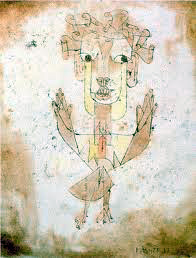
A Klee drawing named “Angelus Novus” shows an angel looking as though he is about to move away from something he is fixedly contemplating.  His eyes are staring, his mouth is open, his wings are spread.  This is how one pictures the angel of history. His face is turned toward the past. Where we perceive a chain of events, he sees one single catastrophe that keeps piling ruin upon ruin and hurls it in front of his feet.  The angel would like to stay, awaken the dead, and make whole what has been smashed.  But a storm is blowing from Paradise; it has got caught in his wings with such violence that the angel can no longer close them.  The storm irresistibly propels him into the future to which his back is turned, while the pile of debris before him grows skyward. This storm is what we call progress.    

                   – Walter Benjamin, Ninth Thesis on the Philosophy of History

The extremes of enlightened spirituality and regressive brutality happen wherever human fallibility seeks to reconcile itself with the divine ideal. A geographically hemmed in Germany was not relaxed about its identity, which was further knocked by the Versailles Peace Treaty. Debates about the effects of the treaty are ongoing. Germany was blamed for the First World War and had vindictive reparations imposed that aided hyperinflation. The crushed self-respect of its people called in a saviour, who tragically sublimated his oppressed childhood with vastly inflated ideals.

Sanity might have prevailed in the darkest hour had Germany given more value to its folk tales. They leave nothing of human nature untold. The secret mysteries of the heart are found in mythical tales all over the world, and while set in local landscapes, their themes are similarly transcending race. These coded treasures are basically the stuff of all yearning for the home or source, a human phenomenon riddled with the tensions of fixation and avoidance.
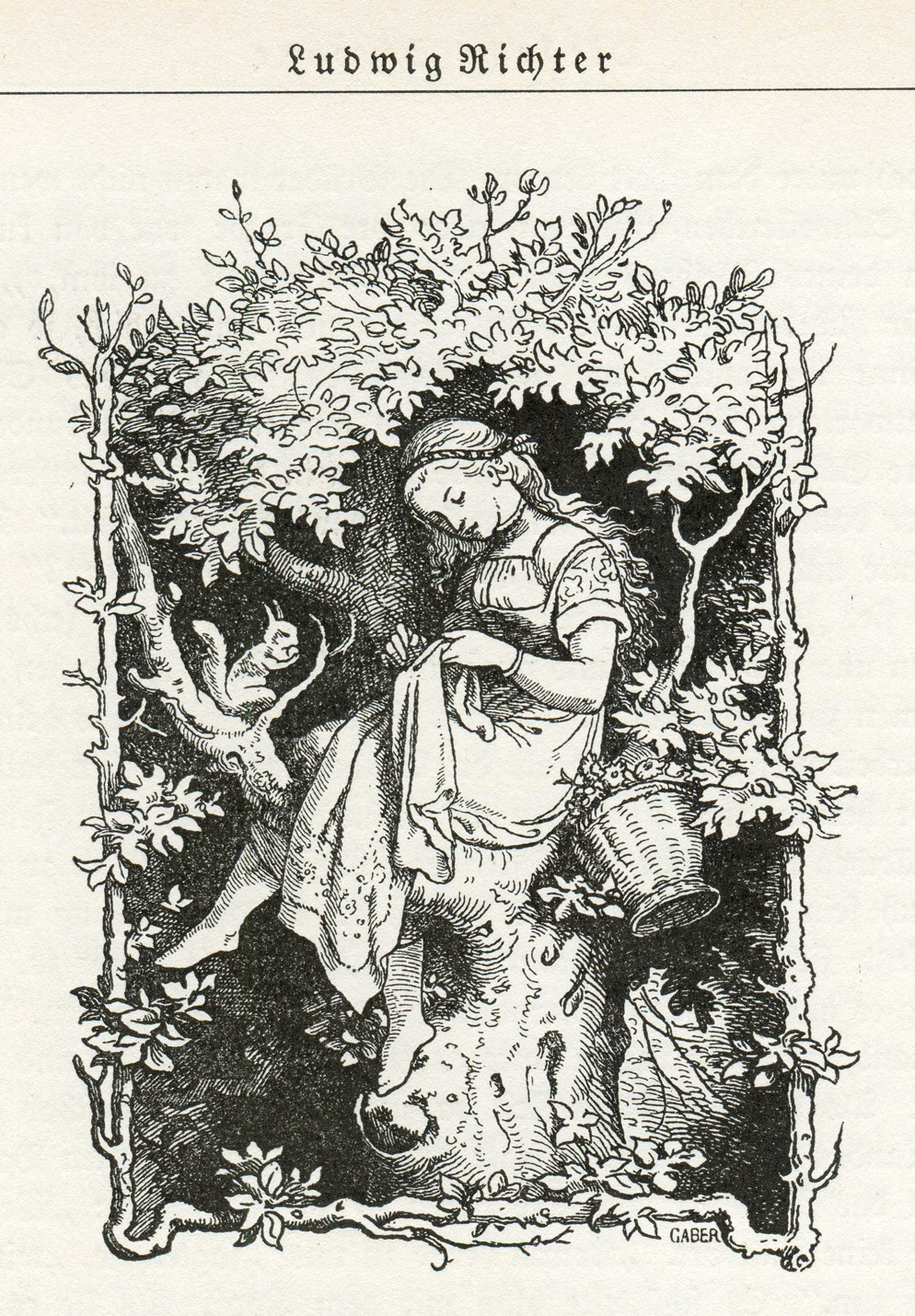
A hint of the tenacity available to the German people can be found in the tales collected by the Brothers Grimm when storytelling was still practised with the potency of embodied memory. Children growing up with the characters, animals and landscapes of these stories are absorbing timeless themes through symbols and metaphors. Censors protested, and still do, that these themes are cruel and unfit for the innocent child.
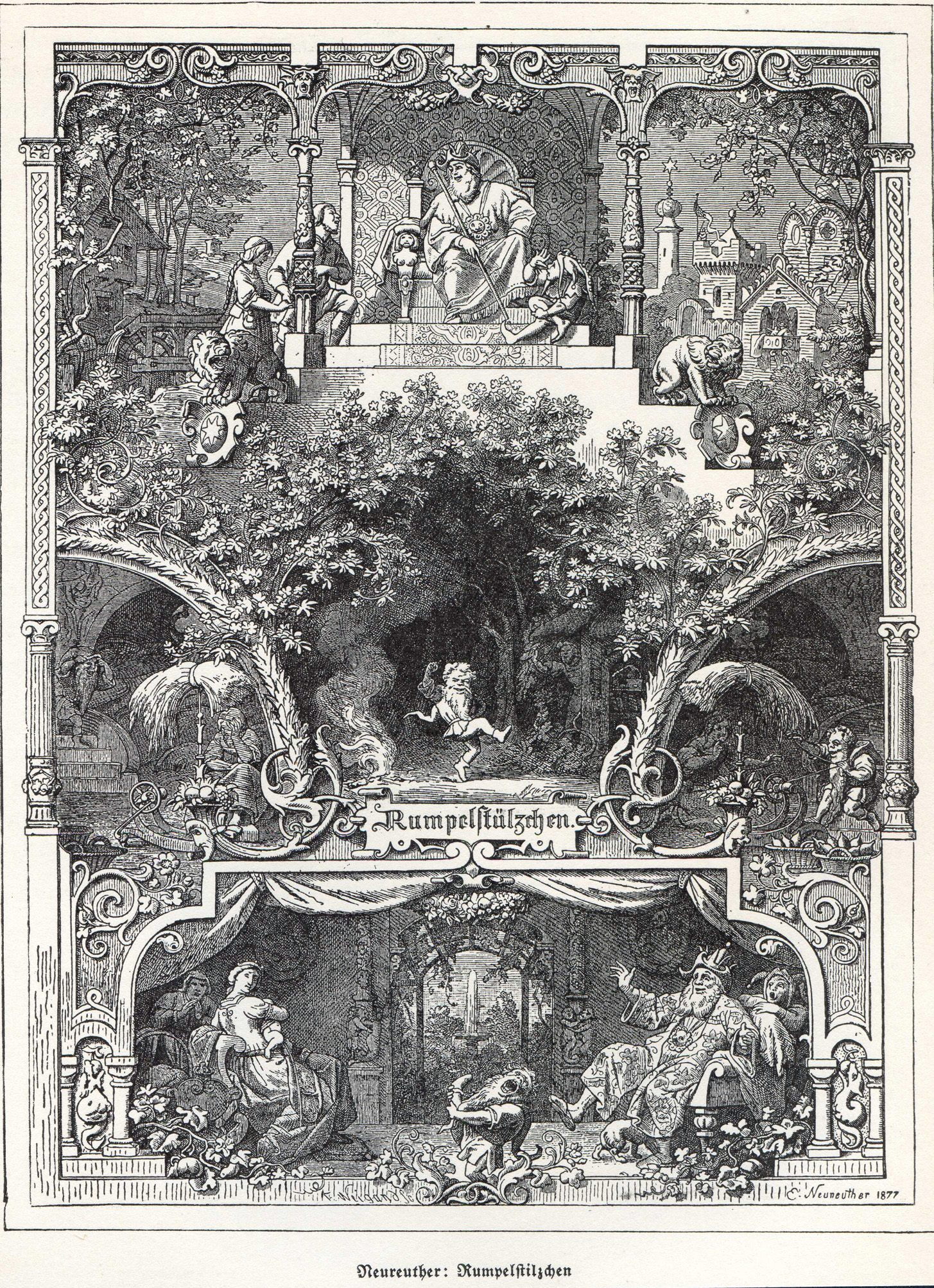
The Grimm brothers comment in the introduction to the second, updated 1819 edition of their collection: ‘The right usage discovers nothing bad is in these tales, but as a beautiful word has it – a testimony in our heart. Children point without fear into the stars while others, as popular belief has it, would insult the angels.’

Was the melancholy that gripped so many German people their nemesis or their salvation? Tales that contain symbols of mythic time need to be deciphered again and again within a temporal context. Yet because the emotive power of symbols defies rationality, the sentiments evoked are always in danger of being abused by myopic national concerns. When a nation loses balance by being overly defended or irrationally unleashed, differences of religion, race or politics are thought to explain the matter – yet we all know there is no pure race.

England, like Germany, struggled through internal conflicts but achieved a sense of unity by conquering the world. Felling forests to build boats which sailed under the banner of the Royal Navy, explorers and missionaries spreading across the waters formed a Colonial Empire that brought great wealth and influence. The Commonwealth still lingers like a halo and gives Britain a sense of sovereign pride. Cultural Imperialism, natural to nations with access to the sea, had created the other at a safe distance rather than at home. Yet spoils of victory, too, come at a cost.

When the flagship of King Henry VIII was lifted from the depth of the Solent Estuary into the twentieth century on 11 Oct 1982, the Mary Rose flared back into view and boosted national confidence, adding a powerful impetus to Mrs Thatcher’s resolution to win back the Falklands. It worked – just. Yet now it seems conflicting images of the past, informed by freed-up information providing more and more varied perspectives, are testing every nation’s conscience.

In the twenty-first century, with migration being a global reality, nations are obliged to open their doors to the other. Given changing policies, foreign individuals are often able to acquire legal membership. Since the Schengen agreement, European borders, apart from Britain’s, can be crossed freely, though the agreement is regularly challenged by exceptional circumstances. http://www.migrationinformation.org/Feature/display.cfm?ID=859 

Migrants – who are we?  If there are tendrils resembling roots, they connect to the deep impressions left by parental figures and childhood landscapes, and to the layers of national symbolic themes, ancient, historic and contemporary. Social and ethnic codes ricochet among children in every school-playground, even between neighbours like Germany and Britain. We use icons to sum each other up. At times they move us to tears, at times to laughter, often they serve humorous self-reflection, but mostly they envelope us in a ritualistic trance:


Bratwurst with Sauerkraut, Fish & Chips, Schubert and Kurt Weil songs, God save the Queen, the first four notes of Beethoven’s 5th symphony, a blinking eye of Shakespeare in a hologram,   Goethe’s Faust, the Thatched Cottage, das Edelweiss, The Royal Jewels, der Adler, Jack and Jill, King Ludwig’s Castles, Stonehenge, Rapunzel, Big Ben, Karl Valentin, Spike Mulligan, Lorelei, or the Mary Rose:

In order to preserve them, we gave the Mary Rose Trust a chemical solution called polyethylene glycol. Once these items (such as wooden bowl and leather shoes) have been soaked in this solution, they undergo a freeze-drying process that will preserve them for posterity … ‘You can be sure of Shell.’     (Shell advertisement  1985)

Patrick Wright in his book ‘On Living in the Old Country,’ recounts the findings of a young journalist, Charles Moore. He was commissioned in 1982, after Lord Scarman’s report on the Brixton disorders, to interview the really oppressed people in the area, defined as the elderly white people of Lambeth. The findings expose a national sentiment which, in essence, could equally apply to other nations and individuals: it remembers the state of grace and laments the fall which is said to occur when ‘the blacks’ and the welfare state arrive:

In the beginning there was order, friendliness, dignity, sharing and mutual respect: ‘Everyone mucked in and was properly neighbourly.’

A betrayal of the idea of paradise – in the absence of divine certainty someone or something other needs to become bad, in order to preserve the good.

Seeking fault with the other is meant to shield paradise. An oversight – truth stagnates in the fenced gardens of eternity. Enduring human vitality flows from change and is born of vulnerability. The trance of blame sucks us into its gravitational slow time. Unawares, we perpetuate the shielding in the collective psyche, leaving it for the next generation to absolve.

Recorded history is like a rope broken in many places and knotted together again and again. In the light of new truths these knots are strained and made brittle until they snap. Tribes, nations and ideas are strung along this rope. But new concepts of time are changing our perceptions; many individuals struggle to free themselves of knotted history. The desire to make things solid is an automatic reaction to the fear of losing the familiar we nurture – people, environments, passions and beliefs we bond with, that are mirroring us and allow us to discover ourselves. The problem is not loss, but the manner in which we deal with loss, as if it is destroying our identity. Inevitably, if not death, someone or something will be the agent of change in our lives.  Something dear is wrenched from us, a way of life is gone, those around us and the rest of the world may care for a moment, but our identity, the sum of all our embodied experiences, is ours to keep or lose. The valid anger in the face of change is not lifted by words of wisdom, only plastered up. The heart has to suffer and soften before the conscious decision of an individual can unplug resentment and embrace the enduring presence that truly connects us within. Only individuals can release blame and lift the veil of ignorance.

Dich im Unendlichen zu finden, must du unterscheiden und dann verbinden.

To find yourself in the infinite, you must first distinguish then combine.

–  Johann Wolfgang von Goethe

A truly global citizenship must be composed of enough individuals brave enough to explore their own psyche, brave enough to think for themselves and realise that our collective identity unfolds beyond the existence of individual transitory lifespans. We know that, given respect, tolerance and stimulation, a child will engage with life creatively and trusts in the future. Applying this insight to how we educate our children nourishes the collective intelligence of humanity.

The German filmmaker Edgar Reitz has with great sensitivity restored a balanced meaning of the German Heimat in his TV series of the same name, spanning from 1919 to the fall of the Berlin Wall. The series follows three ordinary families and comprises 52 hours of film. The yearning to belong, so distorted by the idealism of the Third Reich, is shown in localised context and conveys the human aspects of the war story. The impetus for the creation of this document was an American Holocaust series on TV in 1978. Reitz was horrified that German intellectuals seemed to accept the sentimental spin as treatment for national guilt.

The knots in the rope of time we constructed are brittle with guilt, the burdening guilt of not loving humanity enough to fully take on its pain, the way Christ did. He said, ‘Thy will be done.’ Does such surrender of will, even if taken symbolically, really release us of using our own will to effect change?    The concept of surrender is more subtle than giving up the power to will. I see surrender as an alignment of our conscious will to the dynamic flow of change, the universal will, enabling evolution to happen and work freely through us, so that here is everywhere. In instances when this shift happens inside, we are.

*    *     *

References other than mentioned in the text:

The Angel of History: Walter Benjamin’s Vision of Hope and Despair – by Raymond Barglow, published in ‘Tikkun Magazine,’ November 1998

Recently 500 more tales, collected by a contemporary of the Grimm Brothers, were uncovered:

http://apps.facebook.com/theguardian/books/2012/mar/05/five-hundred-fairytales-discovered-germany

 

5 Comments

Filed under Blog

… smoking elegies – another facet …

Fusion

He was clear-minded and ambitious, with precise plans for his career. We met at Munich’s Domicile, a jazz bar, where an intimate haze of smoke welcomed and embraced you like an accomplice. The cool gaze and pure intent of his grey-freckled eyes took exclusive possession of me. Jazz and smoke fused us. Our cellular resonance defied the gravity of committed brain cells and gave my heart wings. He moved into my flat, warning me upfront that on completion of his apprenticeship at the most prodigious hotel in town he would return to the States to put his culinary management knowledge to the test. He was going to own not just one restaurant, but a chain of them. He convinced on several points.

One: he totally and reliably engaged with what was before him. The moment he stepped through the door after his day at the hotel, the outside world was no more, only us, together. We showered, cooked delicious meals, listened to music and spent  most of our time in bed. The pure intensity of his presence ricocheted like a charge between us and left no room for anything besides. In this rarefied sphere, lovemaking became a cycle of small deaths and resurrections. Some of my friends had angry fits under the porch of my door, knowing full well I was home but inaccessible. My king-sized futon had become a sacred island floating in a vast ocean.

Two: he was a strategist, which, together with point one, makes an unbeatable combination for material success. But most of all, he understood branding, the powerful imprint repetition leaves in the mind. It happened religiously during our celebratory smoke after lovemaking and became a surreal ritual. With his thumbnail he cut a cross into the filter of his cigarettes. The cross was tied to a mantra he kept secret. I thought this was cute and took up the habit, inventing my own mantra.

Two months passed in eternal bliss of now, until the appointed time for his flight back to the States approached. I started hurting bad. He wanted no soppy goodbyes at the airport. He was not going to be tied down. Only when he had made a million by the age of 30, he said, would he focus on having a family. He left no address. For months I continued punching crosses into my cigarette filters to strengthen my ambition, and, inadvertently, remember him. It became an obsession. Only my mantra, unlike his, was not based on a strategy. And the branding thing annoyed me after a while. I favoured the meandering dance of a poetic life.

His clarity left a strong impression. Hopefully he found what he was looking for. I came to perceive my early ambition as metaphor, and owned up to a misspelling. The path my aim prescribed sharpened many skills, but was littered with Freudian slips that lead into emotional woods. And yet, looking back, every re-start, every detour in my life stimulated creativity and inventiveness, crucial unlearning, greater tolerance with myself and others, and a more symbolic understanding of my existence.

The ideal is the means – its breaking is the goal.   Hazrat Inayat Khan


10 Comments

Filed under Blog

… the cast in the shadows …

Perhaps all the dragons of our lives
are princesses who are only waiting to
see us once, beautiful and brave.
Perhaps everything terrible is in
Its deepest being something
that needs our love.                — Rainer Maria Rilke

Last week I volunteered a short session in the context of a variety of monthly events organised by a group of friends under the umbrella of Archventures.

… the cast in the shadows …  …

We have inside us a cast of players for every imaginable scene. Occasionally banned and hidden characters pop up. Excluded from our script, they emerge inadvertently through surprise encounters, act irrational and appear cartoon-like. Unacknowledged, a wild player roams in the unconscious unconnected, until an emotional trigger hits a sensitive node. We are not amused when an unsophisticated trait breaks to the surface with behaviour that will embarrass and shame us, belying our self-image.

We learn as children to shield ourselves from rejection and injustice. Our strategies are endless and contrary …  like being compliant and withholding or defensive and angry. Think of a natural and well-meaning quality persons in your early environment disapproved of in the name of moral perfection. Your trust may have been betrayed, manipulated and taken advantage of. We adjust as best we can. Rules are needed for societies to function.

We spend our life until we’re twenty deciding what parts of ourselves to put in the bag, and we spend the rest of our lives trying to get them out again. – Bly

In relation to our genuine nature, the sacrifices we make in order to belong can be as disproportionate as the sacrifices we make to defy authority. Feelings we edit out of our lives gather a strange luminosity and succumb to an archetypal force beyond our command. Yet a closer look at the rawness and imperfections of disowned players may surprise. They invariably hold a gift, often the very essence of our creativity.

A way to re-own the locked up energy is to honour our battle scars and weaknesses. We don’t have to agree with inner and outer adversaries, only accept their existence in us. This acceptance opens the heart to tolerance, rapport, understanding, empathy – and insight.

‘Our friends show us what we can do – our enemies teach us what we must do.’ – Goethe

We make room for imperfection … 25th Feb 2012

What is uplifting about our monthly Archventures gatherings are the hugs … yup … never underestimate the invigorating power of hugs. What I also appreciate – and this applies to many groups whose core members meet regularly – is that we form a different entity each time, enriched by everyone’s fresh constellation of experience and insight. Newcomers feel welcome and at ease in this irreverent group that does not follow any one creed, ideology or person.

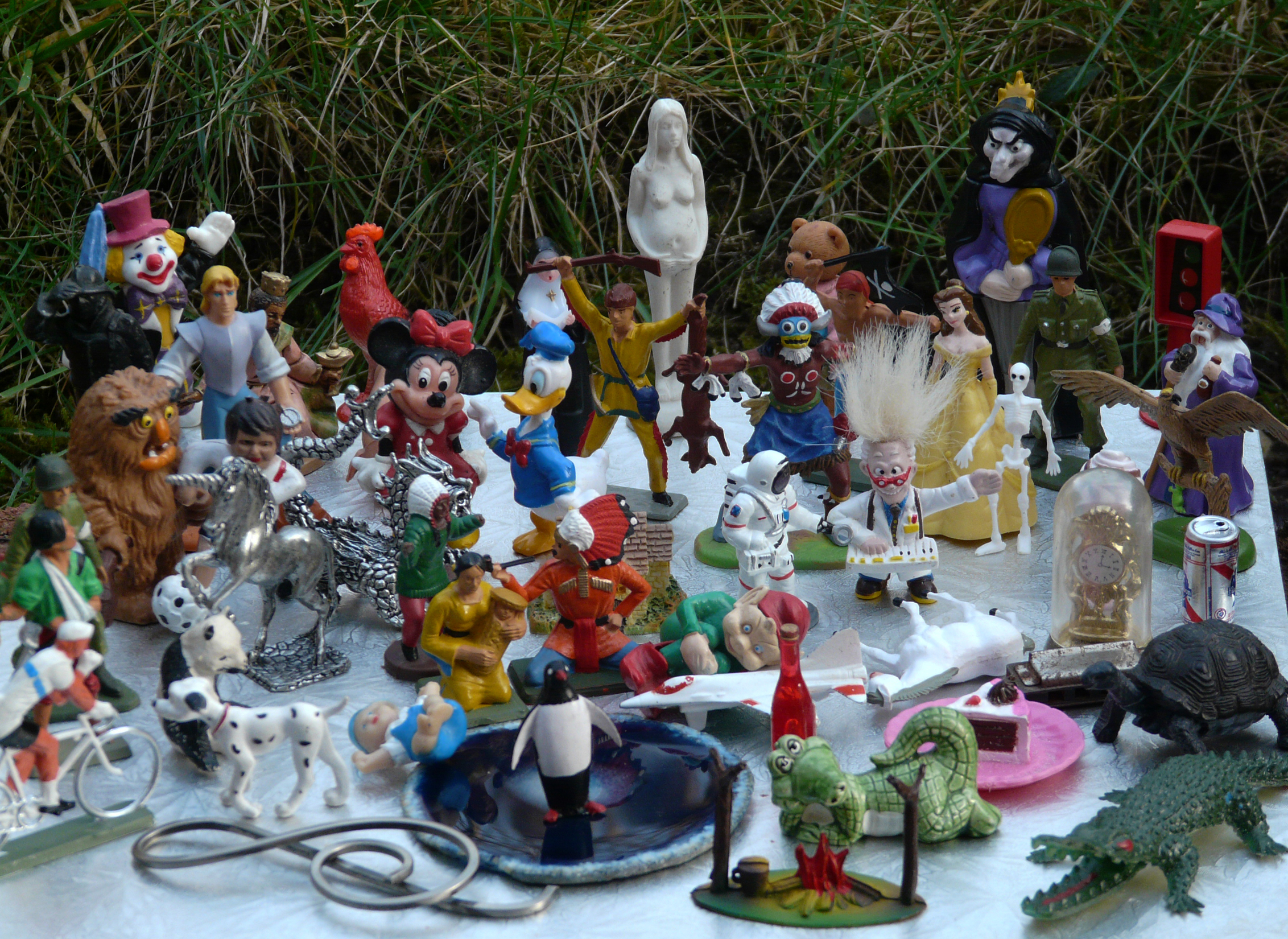
The most powerful player this afternoon was the seven-year-old son of a participant. The boy was fascinated by the boxes of miniature world-objects I had brought along.

He outplayed us all, instantly creating a legion of his world.

The young will be forever potent in their ability to play and invent …

We adults shared unique and moving stories about early misdeeds, raising questions to be explored individually. (The photo is of a  different occasion)

Some shadows we drag along are not of our own making, a dilemma that also applies to families and nations.

‘The best political, social, and spiritual work we can do is to withdraw the projection of our shadow onto others.’  ― C. G. Jung

Understanding the origins of shadow-projections softens the compelling affect they have in defining us, and our reactions to being fitted into a frame. Observing politics, it is obvious that negotiations are not enough to solve longstanding conflicts. It takes the awareness and inner work of individuals to let go of resentment, release the spark of creativity that enables lateral thinking, and the flow of compassion tied up in the entanglement of righteousness.

And there remains the unknowable, luminous black hole, and a sixth sense of something that evades us. What is mysterious, not accessible emotionally or through analysis, drives us on to dig deeper, expand our consciousness, and re-discover the link to our innermost self.

‘We are born at a given moment, in a given place, and like vintage years of wine, we have the qualities of the year and of the season in which we are born.’ ― C. G. Jung

With only three hours’ time available, the session at least inspired us to remember what is in our power to do. There remains the ever impelling potential of greater intensity and more poise between safety and risk on the tightrope of our life.

Our dear friend Rahima outlined the shadow theme as C. G. Jung defined it. If you have not heard of the term ‘shadow’ in this context you might want to investigate: http://en.wikipedia.org/wiki/Shadow_(psychology)

And in relation to the activity of writing – here a dream image in the eye of its beholder  http://www.youtube.com/watch?v=M19S89UcaKQ&feature=related

If we could read the secret history of our enemies, we should find in each man’s life sorrow and suffering enough to disarm all hostility. Henry Wadsworth Longfellow


*    *    *

4 Comments

Filed under Blog

…the revolt against regulations …

Our sanity is at stake if we don’t learn to bridge extremes. Below I paint two contrasting scenarios illustrating, arguably, two types of tendencies within our society. They relate roughly to left and right brain functions.  Each is a simplified, fictional abstraction and ignores the function of the corpus callosum and the complexity of individuals where many overlapping abilities, dichotomies, and all shades of grey and colour apply. Like Yin and Yang, one contains the other. In the two graphic scenarios I make the environment the crucial factor. To complicate matters, imagine being born with a predisposition into an environment that is not supportive of your natural inclination. It’s bound to mess you up for a while.

 First scenario …

Imagine you grow up in a disciplined environment where bedtimes, mealtimes, tasks in the home and considerate attitudes are encouraged, and in cases enforced, not to be digressed. As long as you toe the line you are accepted and feel supported.  Within this ordered structure, you learn to respect yourself and know your place. If this structure appeals to your temperament you will extend your expectations of order towards school life, friendships and work life. In other words, as a well-adjusted member of your community you anticipate similar coherent behaviour from others. You may feel particularly drawn to work for organisations that require a solid structure to function efficiently, the army, police, government, education, science, social services, the NHS or any large corporation. You become part of a sub-culture, a clan your feel protected by and will most likely defend. Natural forces may seem as something to be conquered. The concept of the unconscious and a free-wheeling imagination often fly in the face of rationality and seem alien. If your clan lets you down because its structure is crumbling and needs changing in order to survive, due to technological advances, financial pressured or corruption, you will have a really hard time and may feel betrayed.

What will be your challenge …?

 Second scenario:

Imagine you grow up in an intellectually and emotionally highly stimulating, or a merely disorganised home. You are frequently left to your own devices, have to think for yourself, find your own rhythm and make decisions as to your role in life. You may be lucky to find your field of action or feel lost and, or develop slowly. You certainly will experience adults as fallible beings, not semi gods. You might revolt against imposed structures and the way they inhibit your creative freedom. And if you are driven by innovative ideas you will find obstacles towards their manifestation whenever regulations are involved. You are a risk taker, but you need emotional intelligence and elbows to push through obstructions or linger in obscurity as misunderstood maverick. If you manage to find a voice, a platform and supporters, your influence could have wide-ranging consequences. Yet if you can’t find support for your wild ideas, what will be your challenge …?

The rational, first scenario, dominated our culture for centuries now. But if it hadn’t been for passionate, irrationally motivated innovators we would live in a very different world. You could apply all kinds of other dichotomies, the masculine versus feminine principle, historic versus psychic time, whatever concept you apply, it’s pretty obvious that what is called for is bridging, a facilitated traffic across 250 million or so nerve fibres of the corpus callosum that connects our two brain halves. Culturally integrating our dichotomies into some kind of functional unity seems a vital part of human evolution.

Many know a truth beyond appearances in their hearts, but truth seeks fresh expression. New maps are needed in time to make the expansion of consciousness intelligible, through science, through the arts, through sharing processes and insights, and through collaboration.

How to give expression to the implications of the enormous changes that happened during the last hundred years, the consequences of which are evident in the fragmentation of values around us? How to remain alert to the transformations in store, and find creative ways to birth ‘essence’ into the context of now? It‘s ‘playtime’ again because the rulebook we inherited has lost is meaning.

The collective is still trying to process the metaphor of Einstein’s concept of relativity, which in a psychological sense opened a climate of moral liberty and allowed us to play with perspectives, and which is why moral advice lost much of its authority. And we have hardly understood the symbolic reality of quantum physics, offering new understandings of human consciousness in relation to the universe, a spiritual liberty that a hundred years ago could have only been imagined by a very small minority – probably mystics who always knew …

Light is both particle and wave, and though we can only observe one at a time it is one light .

And now we are swept up by the digital revolution, which makes the linear metaphor and our limited concept of history redundant and transforms our relationship to time and space.

The seeming liberty of democracies is threatening to  traditionalist cultures. Too many regulations in a democracy will cause a lack of co-operation or revolt. We need new maps, different living structures for families, including families of heart and mind, and we must find ways to translate what we think we know anew, fresh, and offer each other guidance in the changing room (the psyche). This happens in as many ways as there are individuals who value psyche as the bridge and gateway connecting the sensible to the spiritual world.

‘What else, when chaos draws all forces inward to shape a single leaf …’ C. Aiken

6 Comments

Filed under Blog

… crazy life …


My birthday coming up -micro/macro scales of the expansive mind, can’t help being born into that matrix. New links abound, one brought back the magnificent … KOYAANISQATSI – CRAZY LIFE

http://video.google.com/videoplay?docid=5539613947839465921

*    patterns of movement that reflect our mind

*    the grand illusion

*    weird and wonderful

In case you haven’t seen this before, prepare yourself for an 80 minutes’ trance.

2 Comments

Filed under Blog

… symbolic understanding …

The star that guides us is not meant to be reached concretely, or, as Hazrat Inayat Khan expressed it:

‘The ideal is the means – its breaking is the goal.’

Aged twenty-seven it struck me that I was not my own person, but a clone of my first gods, my parents. I realised I was not special. I was like everyone else, a slave to habits formed in my early environment, which I then unconsciously ritualised. The shocking insight put an end to my pretending I was a foundling (my joke at the time.) For better or worse I had to reconcile myself to my given mould, accept my parents’ imperfections, and my own.

Having reached an impasse re: a series of romantic relationships that bruised my heart, I was disillusioned. My ideal of love had lost its meaning and I yearned for a new horizon.

Fortunately I met a mentor who re-framed conflict for me, because in my flight towards spirituality I had come to avoid conflict like a plague. The trouble with rejecting conflicting thoughts and feelings is that we create taboo boxes in our psyche, boxes where we hide stuff we don’t want to think and feel. The accumulated rejects trip us up and actually energise conflict around us. Childish feelings may pop up to embarrass us where they don’t fit circumstances. Best welcome them, unless you want to fuel the addiction to war.

Driven by unconscious refrains our lives unfold from crisis to impasse to transcendence – like a drama with all its obligatory heroes and villains. Ignoring our inner conflicts and projecting them onto others and the world at large serves a purpose – in that it (hopefully) makes us aware that the way we go about fulfilling our needs is not particularly elegant, and has a price. The price is awareness, which can be painful, but it brings choice. Feelings that ‘have us’ don’t ‘have to’ be acted out, they can be expressed symbolically – one way is through writing things off one’s chest and releasing the outpour to the elements. Tear up and bury your unsavoury confessions, drown them in a river, or burn them. Release all association, free and purify the energy.

What is hidden from consciousness nevertheless affects us deeply.  In an archetypal sense, for example, a person who identifies with the masculine principle (animus) will be drawn to a person who identifies with the feminine principle (anima.) I don’t use the terms man and woman because physical gender does not necessarily equal psychological identification.

Generally, the hidden gender is actualised by the way the opposite principles are experienced through a parent.  Behind the attraction towards opposites is a desire for wholeness, a need to integrate our unrealised nature. This growth happens through relationships.

Plato put it like this …

… the dry desires the moist, the cold the hot, the bitter the sweet, the sharp the blunt, the void the full, the full the void, and of all other things; for the opposite is the food of the opposite, whereas like receives nothing from like …

Plato also emphasised that wholeness does not equal goodness.

As an example: too much goodness in a parent can make a child fearful of negative emotions and constellate a demand for goodness impossible to live up to. If human frailty is lacking in a father or mother, that is, if they are too perfect – or absent – then the expectations father or mother figures are invested with throughout one’s life become inflated, difficult to achieve, and no actual person can satisfy such expectation.

I’m not a practicing Christian, but I appreciate the powerful symbolic significance of the cross. The story of Jesus shows us that in the process of becoming human we are stretched between earth and heaven, matter and spirit, crucified by the dichotomy. Conflict has meaning if we allow it into consciousness. The challenge is to endure opposing forces, identify with neither good nor bad, but instead suffer the deadlock of contradiction, be crucified, because – there are conflicts we cannot resolve.

Yet by accepting what is we invite grace. We ready ourselves to be initiated into a reconciling symbolic experience of transcendence that is personally meaningful to us. The reconciling symbol cannot be grasped. It will emerge from the unconscious in its own time, through an event, or through a dream – if we can be receptive and master humility and the patience.

Symbol, a definition …. Taken from ‘The Creative Imagination in the Sufism of Ibn ‘Arabi’ by Henry Corbin, translated by Ralph Manheim, Bollingen Series XCI, Princeton University

The symbol announces a plane of consciousness distinct from that of rational evidence; it is a ‘cipher’ of a mystery, the only means of expressing something that cannot be apprehended in any other way; a symbol is never ‘explained’ once and for all, but must be deciphered over and over again, just as a musical score is never deciphered once and for all, but calls for ever new execution.

4 Comments

Filed under Blog

… on awareness …

Magic or what? According to the Hindus everything is food, including sounds and visual vibrations – all kinds of impressions: stories, architectural proportions, union of forms and colours, harmonics and rhythms, dissonance, conflict and all the ideas with which we come in contact. All this, absorbed mechanically and mostly without awareness throughout the day, has made up our being and continues to do so, unless we wake up to this process and adjust our rituals.

*    *    *    *

Psychological laws: excerpt from ‘The Act of Will’ by Roberto Assagioli M.D.

*    *    *    *

1   Images or mental pictures and ideas tend to produce the physical conditions and the external acts that correspond to them. Every image has in itself a motor element.

2   Attitudes, movements, and actions tend to evoke corresponding images and ideas; these, in turn evoke or intensify corresponding emotions and feelings.

3   Ideas and images tend to awaken emotions and feelings that correspond to them.

4   Emotions and impressions tend to awaken and intensify ideas and images that correspond to or are associated with them.

5   Needs, urges, drives and desires tend to arouse corresponding images, ideas and emotions.

6   Attention, interest, affirmation, and repetitions reinforce the ideas, images and psychological formations on which they are centred.

7  Repetition of actions intensifies the urge to further reiteration and renders their execution easier and better, until they come to be performed unconsciously.

8   All the various functions, and their manifold combinations in complexes and sub-personalities, adopt means of achieving their aims without our awareness, and independently of, and even against, our conscious will.

9   Urges, drives, desires and emotions tend to and demand to be expressed.

10   The psychological energies can find expression: 1. directly, through discharge and catharsis, 2. indirectly, through symbolic action, 3. through a process of transmutation.

*    *    *

After carefully contemplating these laws you will draw your own conclusions.

Here some practical examples:   Having experienced Feldenkreis work, and practices deriving from it  –  after doing a gentle physical exercise and repeating it in my imagination only, with eyes closed, the same physical reactions happen in my body. This  explains why active imagination can affect mind and body at a deep level and change physical symptoms as well as states of mind.

When I hit my toe, elbow or head on an object, I repeat the exact contact and, in my imagination, send the impact back. There remains hardly any pain and the usual swelling is mild or does not occur at all.

Therapeutically, if a tense or hurtful part of the body is listened to and  allowed a voice, the result can be  instantaneous,  much like when you lower yourself at eye-level to a toddler who has a tantrum, and do nothing else but acknowledge the rage, surprise, surprise, the tantrum stops.

What seems like magic, is actually simple and applies both ways: physical activity influences mood and mind,  active imagination influences mood and body.  Many of our modern-day ailments derive from people not being able to listen to their bodies and/or not being able to use their imagination in a constructive way.

Reading and, even more deeply, writing, are indirect symbolic expressions of psychological energy, which explains the incredible power of stories 🙂

9 Comments

Filed under Blog

Dear Shadow

You hold the luminous night in our hearts,

Though your task is belied around the globe,

Lest our false face is revealed by your truth.

All ill and wars we blame on your aberrant ways.

Unjustly, since you play the hidden tune,

The one to waken us between each dawn

And dusk to our timeless deeper knowing.

Yet calling you evil comforts our pride,

Since we can see your dark shape over there,

We need not respond to our self-made pain,

Sleeper, you snuff out candles in the dark,

Yet shrink in shame when light defines your shape.

‘Fake,’ shouts every single child in the land,

Asking us why man has no love for man.

Who wants to know? When I mention your undercover existence, most people pretend not to understand what I’m talking about. I become the troublemaker who transgresses unwritten rules of conduct. Your face appears here and there around me. When I don’t recognise you we clash inside, and you press your talk through me.

You represent the blind spot, the patch of darkness that contradicts conventions and stains ideals. I would confine you to the dusty ground of my sleepy mind. Yet disowned, you lurk behind my back and act through me like a parasite. Please darken my view. I had rather face your unsavoury challenges than act out your strident orders.

Forgetting is an acquired skill, in service to coherence and meaning. I like things to stay the same. I like to be liked, which is fine as long as I stay in the shade of the collective shadow. Society sanctions those who stay in the shade. They are predictable, loyal to the party, pay their taxes and won’t make a fuss. And you, dear shadow, seem safely contained, locked away.

That’s what we have prisons for.

Only when my coherence is threatened do I look over my shoulder.  Only when I step into my deeper truth do I cause a disturbance, and in that light of truth, you, my dear shadow, take shape. Then I have to acknowledge your existence and bring a clear mirror to this luminous dark that is you in me.

Like I remember a day – in a rush to get some copying done, my mind already on the road, the telephone rang. The call was annoying and could not be dealt with in that instance.

I arrived at the copy shop expecting efficiency – it being the kind of day when minutes counted. The woman serving was new, unfamiliar with procedures. She moved slow, pausing, seemingly overwhelmed with the technical complexity of the machine. I asked, ‘How long will it be?’ Wrong question – the woman succumbed to a catatonic state. The task was beyond her. ‘Can’t you get some help?’ I asked. Wrong question – her thoughts knotted.  This moment requires patience, I thought to myself, patience for what seemed an eternity. My truth spat on patience. ‘Forget it! I must be on my way.’ And the sting in the tail, ‘Best look for another job, you obviously don’t like this one.’

Furious, I clutched my papers and left. Back in the street, my behaviour caused me concern. My frustration led back to the telephone call from earlier on – I had shouldered it along. Despite this insight, I did not return to the shop and apologize. Another truth – the woman resisted her work. My inferior ‘I’ had delivered a verdict. So be it.

Truth often jumps free through contradiction – imperfection, disharmony. But where to deposit the accumulated energies that tie our heart? How many places are there for people to safely unclench built up anger and honour their conflict inside? Make that inner war meaningful instead of defending an outworn right? Bless my true friends – one of them advised, ‘Being right does not make you potent – responding does.’ Another friend said, ‘We are not made to agree with each other, we are made to create beauty.’ Ah!

What I deny in me, I meet in others – the fearful, the stubborn, the frivolous, the envious and devious, the demanding, the controlling, the calculating, the needy, the critical, the judgemental, the revengeful and sarcastic, the plain stupid, and not to forget – the perfect, the clever, the bright, the wise, the lucky one born with a golden spoon. The list goes on, endlessly, including all I cannot accept in myself. Yet editing my feelings and thoughts to please the noble ideal is the worst of self-tortures. Ah!

Your formidable opponent, my dear shadow, is material rationalism, and the newest craze, political correctness. You have a sharp eye. You anticipate the madness reaching its summit when people will have neither names nor narratives, when only numbers, facts and statistics will be considered fail-proof to inspections. Efficiency and targets are the vogue, nothing messy to obstruct progress. But please, dear shadow, should your patience ever be strained by my forgetting, don’t act the fanatic anarchist through me. They play foul and unforgiving war-games, lacking all humour. Better you embarrass me in person than pour your outrage into the collective through me.

Remind me to listen to your uncomfortable messages. I’ll acknowledge your discontent. I need you in my life as a filter to catch my smugness. Not all the time! So what do you think? Should I give my ego a break? Its desires are forever unfulfilled – always lacking, always searching for something other, better, craving attention. It has childish wants but needs a little kindness in these difficult times, and gentle persuasion to see beyond its small world.

I’ll remember your purpose, my dear shadow, and I invite you to also remember – the fiery love-affair – waiting in each breath, the warmth leaping from every languid gesture, the sudden spark through the eye of a deepening smile. A smile so old and so young, nothing can contain its meaning. The grasp of a reaching hand so firm and so tender, only by simulating water can we fathom its mystery. And a dawn so expectant, every creature perks its ears with bliss and halts all doings. A love stirring the imagination, where the wind shapes a cloud just so – or the moonlight silhouettes eternal players in trees – the sleeping giant, the grinning troll, the child, whirling, the astonished angel, malleable to our fancy. A love that illuminates seeing, feather-light in its desire to dance just where it finds itself in the universe. A love nothing can resist, yet nothingness enfolds it in its boundless existence …

But let me not be carried away, I respect your teaching, dear shadow. Let me befriend you, even so I mostly don’t agree with you. Let me never forget the sacred purpose of my physical existence in the orbit of the sun. Without you I would only be fluff on the coat of real human beings.

Ashen – 2009

10 Comments

Filed under Blog