Ursula Le Guin’s short metafiction, ‘The Ones who Walk Away from Omelas,’ first published in 1973, had its 40th anniversary last year. My first reading, when Google and book review sites were non-existent, left a deep impression. This week’s re-reading, once, twice, three times – the story deserves it – made me curious as to what other readers might have made of it. Obsessing in a web-crawl I came upon predominantly moral interpretations, which I distinctly remember resisting, though these associations are understandable. The way our systems deal with the unadjusted tends to appease the troubled conscience for the rest of us normal citizens.
For me, there were deeper complexities in this brilliant piece of writing. I decided to share my thoughts and tempt those of you who don’t know the story to read it and derive their own insights. I’ll use spoilers, so if you want to read the story first, here is a link: http://genius.com/Ursula-k-le-guin-the-ones-who-walk-away-from-omelas-annotated
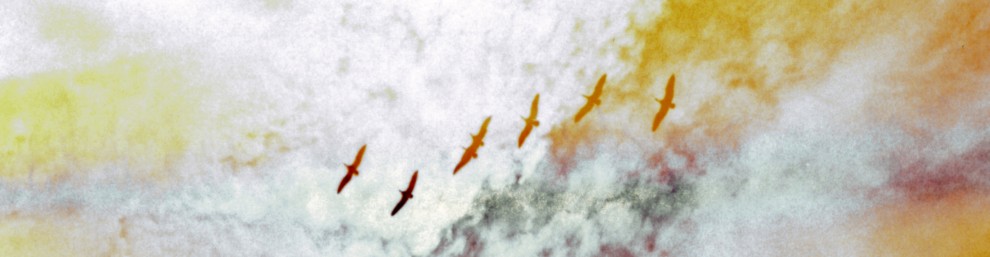
… With a clamor of bells that set the swallows soaring, the Festival of Summer came to the city of Omelas, bright-towered by the sea …

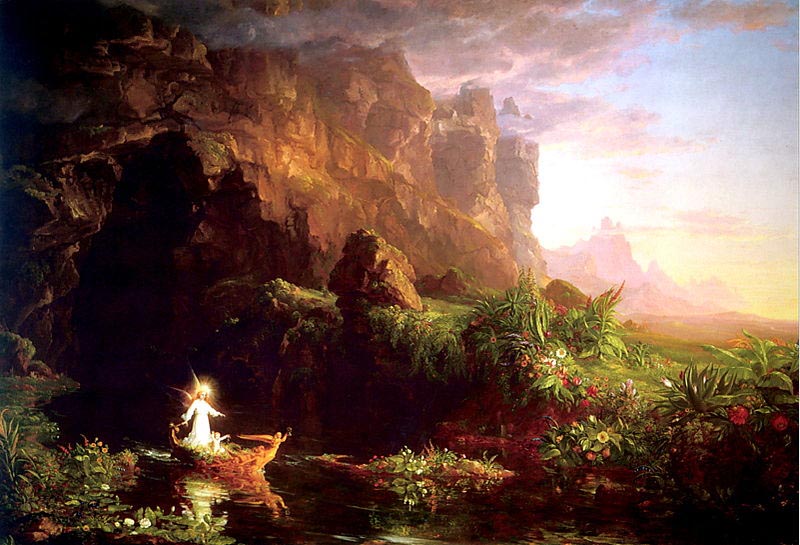
Childhood, Thomas Cole, 1842
We are shown a charming city where order and harmony reign, a city well-protected in a bay, resembling a womb. Reality is suspended. There’s a sense of timelessness. It is a civilised place, decorous, joyful, without hierarchy. No king, no swords, no slaves … no power games. Utopia comes to mind, the idea of eternal life – the eternal innocent child.
No science has yet dispelled the vision of a haven without strive, where everyone is happy. In the wake of traumatising wars and unspeakable atrocities, there are always attempt to re-create places like Omelas, attempts to soften the reality of birth and death, the extremes of joy and pain, nature, the cosmos our life depends on and which we try to fathom. But since our spiritual lore cautions that life is an illusion – an ornament that covers ultimate truth we can’t perceive with our senses, we get anxious when life becomes too comfortable.
The narrating voice, anticipating our scepticism, invites us to fill in the sketches of this perfect democracy. We are told, ‘They were not simple folks, you see, though they were happy.’ After all, Omelas may strike some as goody-goody. Smiles, bells, parades, horses, bleh. ‘If so please add an orgy.’ More delightful pleasures are suggested – celebrating life, with one significant addition, ‘One thing I know there is none of in Omelas is guilt.’
In contrast, the voice notes the bad habit of a different place, where pedants and sophisticates consider happiness as something rather stupid. ‘Only pain is intellectual, only evil interesting … the treason of the artist: a refusal to admit the banality of evil and the terrible boredom of pain.’ The voice insists that the citizens of Omelas were mature, intelligent, passionate people whose lives were not wretched.
The Festival of Summer has begun. ‘Do you believe?’ the narrator asks. ‘Do you accept the festival, the city, the joy? NO? Then let me describe one more thing.’
And there it is, the secret lurking out of sight, a child, kept in the darkness of a tiny cellar room, with only a faint ray of hope based on a dull memory. The child is not driven out of the city, like the traditional scapegoat, but contained below ground; there to absorb everyone’s fear of reality and its cruel justice, embodying, maybe, submerged histories, rather like the depths of the iceberg below water keeps its peak afloat in the light.
… They all know it is there, all the people of Omelas. Some of them have come to see it; others are content merely to know it is there. They all know that it has to be there. Some of them understand why, and some do not, but they all understand that their happiness, the beauty of their city, the tenderness of their friendships, the health of their children, the wisdom of their scholars, the skill of their makers, even the abundance of their harvest and the kindly weathers of their skies, depend wholly on the child’s abominable misery …
Terms are clear, should this child be freed, the beauty would wither and be destroyed. The pragmatic solution seems such: One punished and suffering child is meant to redeem the rest from coming to terms with their inherited sins and traumas.
To leave this comfortable enclave of Omelas means leaving security and loved ones behind. It requires crossing mountains, stepping into the unknown, with no charm against collective guilt.
Omelas’ citizens are free to look at the unacceptable child. While reactions, those of young ones mainly, vary from disgust to outrage, most accept the necessity of this child’s sacrifice, though some fall quiet and leave Omelas in the middle of night, alone.
For me the child is there to serve cohesion, symbolizing a lid on the unconscious, primitive, wild aspects of the psyche. Isn’t dis-ease a loss of order and rhythm? If you judge this pragmatism harshly, consider the purpose of trip-switches in an electricity-wired house. Or, consider how people under social or dictatorial pressure may choose to safeguard the lives of their loved ones at the cost of betraying their knowing heart.
Le Guin does not condone staying or leaving Omelas, she provides no answers. I am one of those who walked away, many times, always at a cost, because I preferred guilt to shame. C G Jung developed the concept of individuation, hoping for it to expand collective consciousness from the inside out, through the individual, sometimes involving a precarious personal journey, going through a process of separating psychologically from parents, state, authority, to become whole. Like in the Zen story where the seeker eventually returns, better able to serve the community. While a single brain does not survive its limited life-span, the collective memory of matter, and each human experience lives on and is transmitted to every new-born life.
Each one of us carries the traumas of our histories, though not everyone has the opportunity to redeem such wounds, contribute new ideas, or explore different states of being. What drives one to walk away from the familiar – is it inner conflict, allegiance to one’s heart, fear to upset the order, the need for a wider perspective, or simply a calling? We bond to the systems we grow up in, in cases we adjust our behaviour in order to emotionally survive, along with the implicit bargain to keep quiet about the shit, our shit, others’ shit, and how we deal with all the shit.
There are those who leave a comfortable place and those who stay. Maybe a balance between conservative forces that protect structures and revolutionary forces that seek change is necessary. Not everyone, for example, can face existential pain and futility without succumbing to psychosis. There is a case for Festivals of Summer, sport, drugs, ecstasy, trance …
Was the power of the imagination born from fear of mortality? Is this why we envisage dystopias or utopias, and, ultimately, scenarios that make us feel in control of our destiny?
What we hide from ourselves and from each other often relates to our most prominent outcast, the neglected inner child, so embarrassing to the adult world. This child in Omelas seems to embody the ongoing ritual of shame for walking from Eden into the dawn of creation, a reality burdened with consciousness, and free will that frequently misses the mark, but, heck, is the very process of becoming human.
My naïve hope is that we can learn to embrace our all too human failures, show patience with our children, stop seeking blame and end scapegoating, yet also acknowledge our individual and collective need for comfortable realities … protecting us … from what?
Here a quote from a former friend and teacher, Fazal Inayat-Khan … taken from a lecture on Reality:
‘For the whole collective of the human mind – outside that self-created reality there is a storm. That storm – that wind – that pressure – that influence and space is for our existence and permanency completely annihilating and destructive … our assignment outward is because of a deep decay … Reality is a veil that is spun with the finest and thinnest and strongest silk. It weighs nothing – it covers a little darker area behind – and yet the moment when you reach out with your hand to draw the veil away it will skin your hand till blood is drawn.’
To fill this emptiness we assign our meaning outward. Call it the human project. Sorry to trouble you, my friends, but the function of reality is worth contemplating, and, in my view, Ursula Le Guin’s story does just that.



 Course of Mirrors